Nobody warns you about the chinchilla hair ring until somebody's male is already in trouble. It is a band of fur that works its way around the shaft of the penis, sits under the foreskin where you cannot see it, and tightens like an elastic band nobody put there on purpose. Left alone it cuts off circulation and can block urine, and a chinchilla that cannot urinate does not have days to spare. I keep two females, Pebble and Juniper, so I have never pulled one off an animal of my own. I am saying that up front, because you should know how much of what follows is my hands and how much is accepted keeper and exotics vet practice that I have read carefully. On this one it is mostly the second thing, and I would rather tell you that than pretend.
What a chinchilla hair ring is
A male chinchilla's penis normally sits retracted inside the prepuce, the sheath of skin in front of the anus. Grooming is where the trouble starts. Loose fur, his own or a female's, gets picked up, wraps around the shaft, and then gets pushed back inside the sheath when everything retracts. Now there is a ring of matted fur sitting in a warm, moist place.
That ring behaves exactly like a tourniquet. Twisted tight and worked down against the base, it can restrict blood flow enough to cause swelling below the ring. Once the tissue is swollen past the ring, the penis often cannot retract at all, which is a condition your vet will call paraphimosis.
The words chinchilla fur ring and chinchilla hair ring mean the same thing, and you will see both in breeder forums and in exotics veterinary texts. Neither is a disease you catch. It is a mechanical accident of anatomy plus a very fine, very dense coat, and that is genuinely good news, because mechanical problems are the kind you can find on purpose before they become a crisis.
Why males get them, and who is most at risk
Females do not get hair rings. There is no penis and no prepuce, so the mechanism does not exist. If you keep only females, as I do, this is one page of the health list you get to skip entirely. If you keep a male, it is on your list permanently, and it does not come off when he gets older or calmer.
Breeding males are the classic case. Mating transfers a lot of loose female fur to exactly the wrong place, which is why breeding males need checking much more often. But it is a mistake to file this away as a breeder-only problem. A single male living alone, with no female in the house, still grooms himself, still sheds, and still gets hair rings.
A neutered male can get one too. Neutering removes the testes, not the penis, so the anatomy that traps fur is unchanged. Owners sometimes assume the risk goes away with the surgery, and it does not. Long-coated animals plausibly have more raw material available, so if you keep a male angora I would check him at least as often as anyone else does, though I have not seen a solid number putting a figure on how much higher that risk really is. Assume it is not lower, and check.
The signs that should send you looking
The frustrating truth is that an early hair ring may have no signs at all. The chinchilla is bright, eating, jumping, and completely normal, because a loose ring is not yet doing anything. By the time behavior changes, the tissue is already unhappy. That asymmetry is the whole argument for routine checking rather than watchful waiting.
When signs do arrive, these are the ones worth acting on:
- Persistent grooming or chewing at the genital area, well beyond the quick tidy-up a male does normally.
- The penis visibly out and staying out, especially if it looks swollen, red, or dry.
- Straining to urinate, or urinating in small dribbles.
- A hunched, tucked posture, restlessness, or a chinchilla who will not settle in his usual spot.
- Going off food, going quiet, or the flat stillness I would call lethargy.
- Fewer or smaller droppings, because a chinchilla in pain stops eating and the gut follows fast.
Straining to urinate is not specific to hair rings. Bladder stones and urinary infections can produce a similar picture. You cannot tell them apart by watching, and you do not need to. Look at the anatomy first, and if there is no ring you have narrowed the problem down and can say so when you phone the vet.
How to check a male safely
Do this when he is already calm and handled, not as the opening move of a wrestling match. Sit on the floor so there is nowhere to fall. Support him against your chest or cradle him on his back in one hand, whichever he tolerates better, and keep the session short. If he panics, stop. A fur slip or a bad struggle is not worth forcing, and a chinchilla who learns that handling ends badly is harder to check next month.
With him steady, apply gentle pressure with your thumb and finger at either side of the base of the prepuce and ease the shaft out. It should come out easily. What you are looking for is bare pink tissue with no fur on it at all. A ring shows up as a distinct band of hair, sometimes pale and obvious, sometimes matted flat and dark and easy to mistake for a crease in the skin. Run your eye all the way round, because a partial wrap on the far side is easy to miss from one angle.
Check for the ring at the base too, not just at the tip. If everything is clean, let him retract naturally and put him down. Check him on a regular schedule and after any contact with a female. I have not seen a rigorous study fixing the right interval, and I would rather say so than invent precision.
Taking a ring off at home
A fresh, loose ring on a shaft that looks otherwise normal is a home job, and it is worth being able to do, because the alternative is leaving it in place until an appointment opens up. Wet the fur with a water-based lubricant, the sort of sterile jelly sold for medical use. That softens the matted fur and lets it slide instead of dragging. Give it a moment to work rather than pulling straight away.
Then work the ring off toward the tip with your fingertips, rolling and easing rather than yanking. Take your time. If it moves, keep going until it is off, then check the skin underneath for a groove or a mark. The penis should retract on its own once the constriction is gone. Repeat the whole check the next day.
What I would not do is reach for scissors. The tissue and the fur look very similar when they are matted together and swollen, and the consequences of a slip there are not repairable at home. Vets do sometimes cut a ring off, under sedation if needed, and that is a completely different procedure from doing it on your kitchen floor with a struggling chinchilla. If the ring will not slide with lubricant and patient fingers, it has stopped being a home job.
When it stops being a home job
Call an exotics vet the same day, not next week, if any of these are true: the ring will not come off with gentle lubricated pressure, the penis is swollen enough that it cannot retract, the tissue looks discolored or damaged, or the chinchilla is straining and producing little or no urine. A urinary blockage is an emergency in an animal this size, and it gets worse with every hour you spend hoping.
Go the same day too if he has stopped eating. A chinchilla in enough pain to refuse hay is already heading toward gut stasis, and that becomes its own emergency on top of the original one. Pain relief and sedation for a proper examination are things a vet has and you do not. I am an experienced keeper, not a vet, and this is exactly the line where saying so matters more than sounding useful.
If you keep a male and have not yet found an exotics vet, do it this week rather than at 9pm on the night you need one. Small mammal competence is not universal, and a practice that mostly sees dogs may not have handled a chinchilla penis before. Ask on the phone, before the emergency, whether they treat chinchillas and who the exotics clinician is.
What prevents hair rings
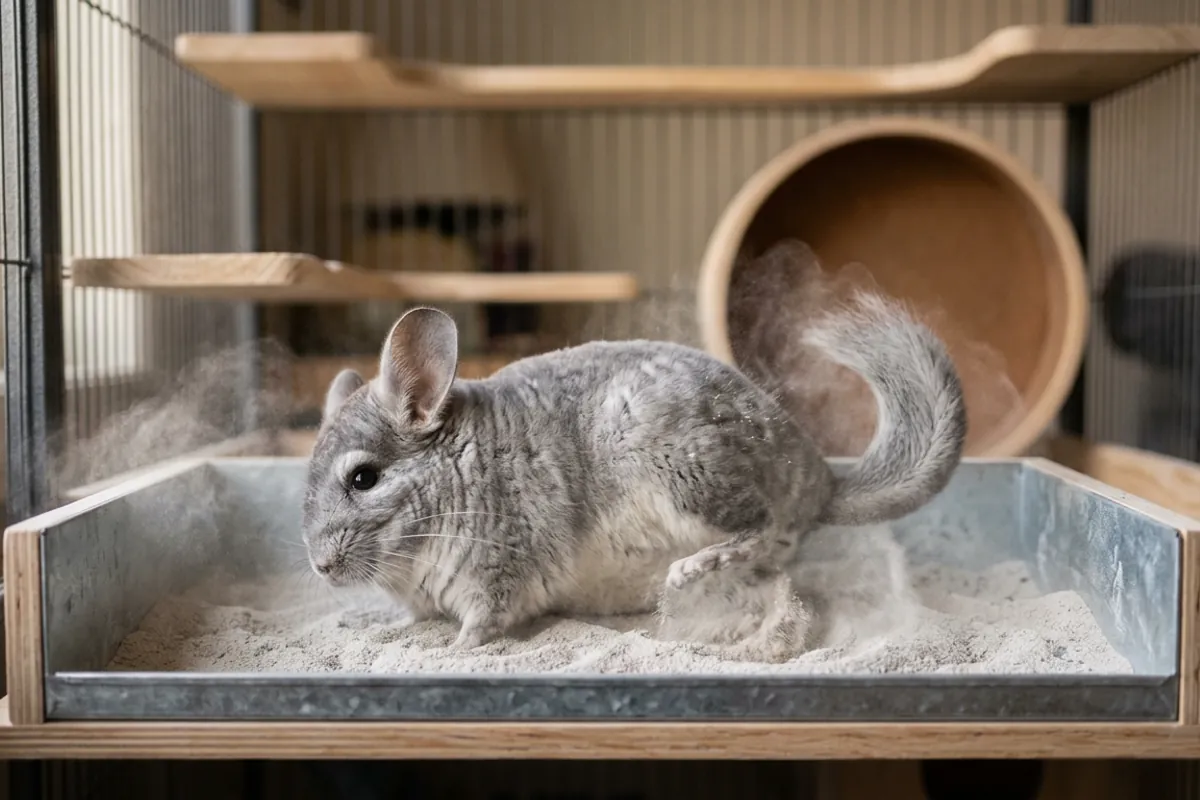
Coat condition is the obvious place to start, though I have not seen anyone measure how much it helps. A chinchilla who bathes properly in fine volcanic pumice dust carries less loose, greasy, clumping fur, and in principle less loose fur means less raw material for a ring.
Lixit Blue Beauty chinchilla dust, 3 lb As an Amazon Associate I earn from qualifying purchases.
Two or three baths a week suits most animals, more in humid weather, and the dust bath page covers the schedule properly. Never water, ever. A wet chinchilla coat holds moisture against the skin and creates exactly the damp, matted conditions you are trying to avoid.
Cage hygiene matters too. Damp bedding, urine-soaked corners, and shelves that never dry out all push fur toward matting. A tall metal and wood cage with solid wooden ledges cleans out easily and dries fast, which is one of several reasons plastic pans and plastic shelves do not belong in a chinchilla setup.
Critter Nation double unit small animal cage As an Amazon Associate I earn from qualifying purchases.
Keep to a real cleaning routine rather than an occasional deep clean.
Separating a breeding pair after mating reduces transfer, and if you are not deliberately breeding, housing an intact male with a female is a decision worth revisiting for reasons well beyond hair rings. None of this replaces checking. Prevention may lower the odds; only looking finds the one that formed anyway.
The check that costs you almost nothing
Juniper's dental disease means I have hands on her nearly every day, watching her jaw, her chin, her weight, whether she is eating hay or just sitting near it. That routine is what would catch a bad week early, instead of after she has dropped weight. A hair ring check works the same way and takes less time. It is not a medical skill. It is a habit, like counting droppings or feeling for a spine that has become too easy to find.
If you keep a male, put it on the same rhythm as something you already do without thinking, the weekly weigh-in or the water bottle change. A ring caught early is a bit of lubricant and a slightly annoyed chinchilla. The same ring found late is an emergency appointment and sedation. That gap is entirely made of whether somebody looked.