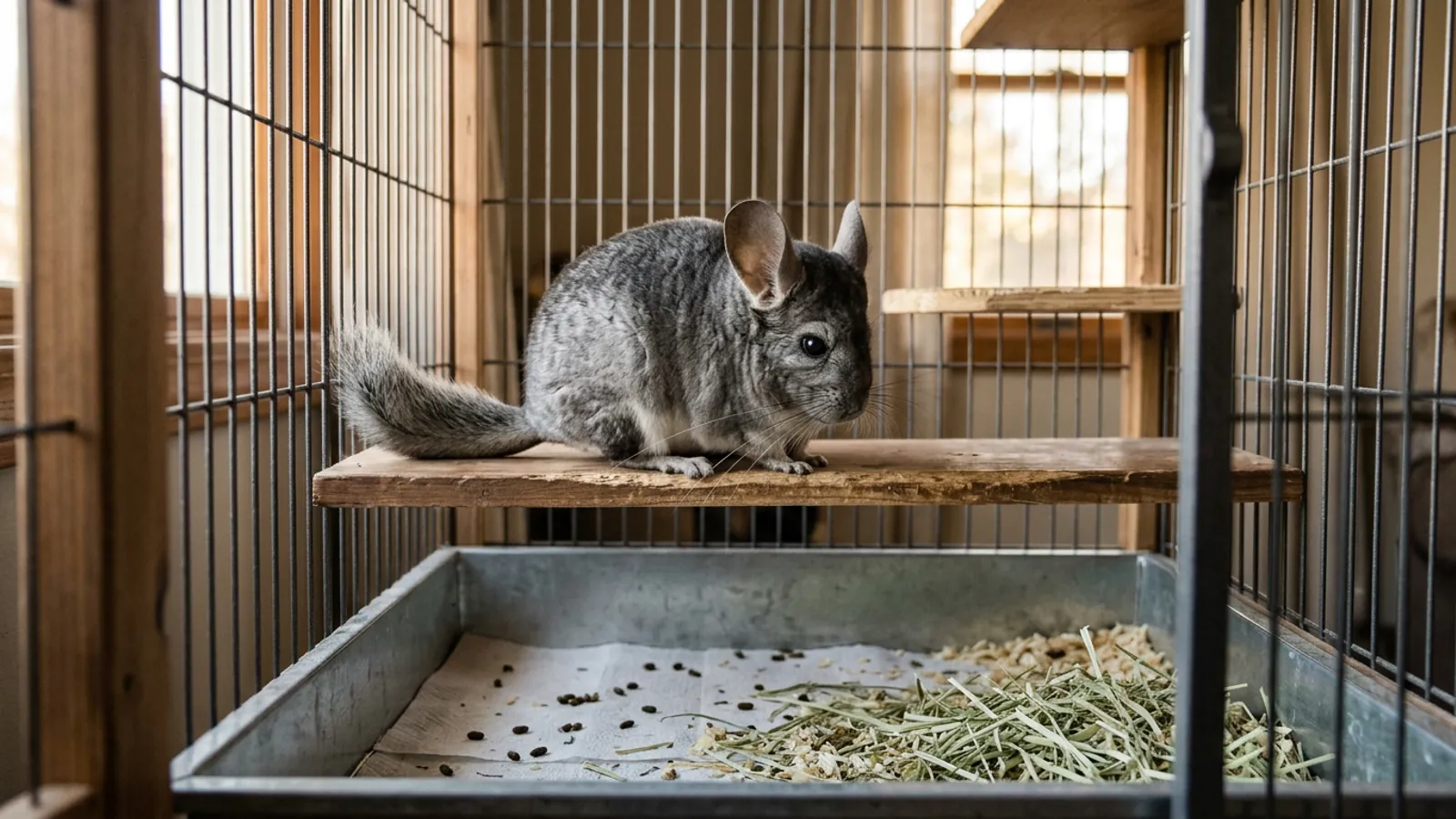
The first thing I look at every morning is not my chinchillas. It is the tray under their cage. Chinchilla poop is the cheapest, fastest health monitor you will ever own, and after about ten years of keeping these animals I trust it more than anything I can judge from across the room. A chinchilla will sit up bright and alert while something is going wrong inside, because prey animals hide illness until they cannot hide it any longer. The droppings do not hide anything. They shrink, they soften, they change smell, they stop, and they usually do it a day or two before the animal starts looking unwell.
It is not a glamorous subject. It is still the most useful daily check I know, so here is what I look for, what the changes mean, and where the line sits between "keep watching this" and "call an exotics vet today."
What healthy chinchilla droppings look like
Healthy chinchilla droppings are small, oval, firm, and boring. Think a grain of rice with rounded ends, uniform from one to the next. Fresh ones have a slight sheen and give very slightly if you squash one between two bits of tissue. Within an hour or two they dry hard. That firmness is the point: a dropping that holds its shape is telling you the gut moved food through at the right speed and pulled the right amount of water back out.
Smell is the other half of the test. Healthy chinchilla poop smells faintly of hay and not much else. If the cage smells sharp and ammonia heavy, that is urine, not droppings, and it means the tray needs emptying more often rather than that anything is wrong with the animal. A genuinely foul, sour smell coming off the droppings themselves is different, and it is worth a vet call.
Quantity matters too. These are small animals that produce an absurd volume of waste. Pebble alone fills a corner of the tray overnight. What you are learning is your own animal's normal output, because "fewer than yesterday" is a signal you can only read if you know what yesterday looked like.
Uniformity is the last thing I check. A tray of identical droppings is a good tray. A tray with a mix of sizes, some tapered, some stuck together in a chain, is a tray asking for attention.
Small chinchilla poop, and what shrinking droppings mean
Small chinchilla poop is the change I take most seriously, and it is the one owners most often talk themselves out of worrying about. When droppings get shorter, thinner, drier, or more tapered at the ends, and especially when there are fewer of them, the cause is almost always the same underlying thing: the chinchilla is eating less than it should.
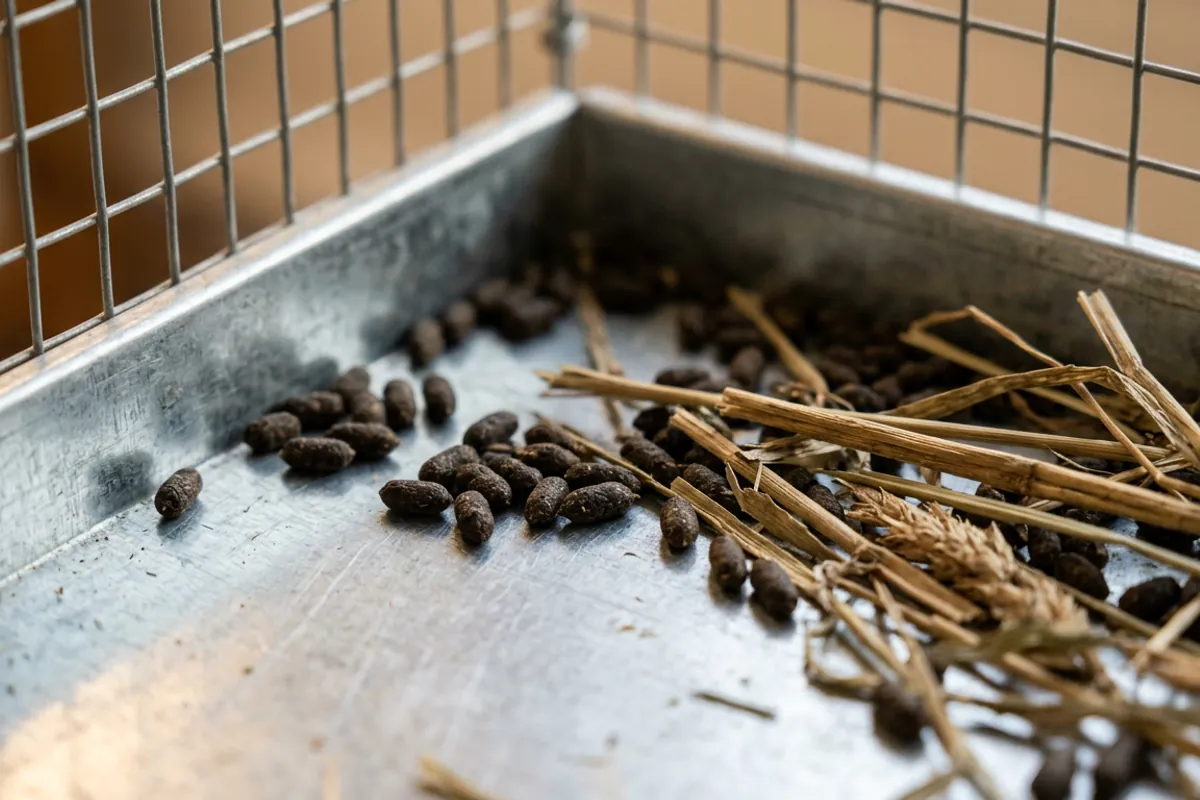
The question then becomes why. In my house, the first suspect is teeth. Juniper came to me as a neglected rescue with dental disease, and I manage it day to day. When her mouth is bothering her, her droppings tell me before her behavior does. She will still approach the hay rack, still look interested, and still leave most of it. Chinchilla teeth grow continuously and are worn down by grinding coarse fiber. When they overgrow or develop sharp points, chewing hurts, hay intake falls, and the droppings shrink within a day or two. If you want the fuller picture, I wrote about the warning signs in chinchilla teeth problems and what healthy looks like in chinchilla teeth.
The second suspect is heat. A chinchilla that is too warm stops eating. The comfortable range is 60 to 70°F (15 to 21°C). Heat beyond 75°F (24°C) puts her at risk, and 80°F (27°C) or higher is an emergency, which humid air makes arrive sooner. I keep a thermometer and hygrometer on the cage itself rather than trusting the hallway thermostat. digital thermometer and humidity gauge with remote probes As an Amazon Associate I earn from qualifying purchases. If small droppings show up on a warm day, check the temperature before you check anything else, and use the heat danger calculator if humidity is in play.
Third is dehydration, which usually means a water bottle that has stopped delivering. Ball bearing bottles fail silently. Press the nozzle yourself every single day.
The fix for the everyday version of this is unglamorous and it works: unlimited grass hay, always available, never allowed to run out. I buy timothy hay in bulk so there is never a gap between bags. Oxbow Western Timothy Hay, 9 lb box As an Amazon Associate I earn from qualifying purchases. Alongside it, real chew variety so the teeth get worn down properly rather than just occupied. Apple wood, in a mix of shapes and thicknesses, does more for Juniper's mouth than any single chew ever has. emours apple wood chew sticks, 40 count As an Amazon Associate I earn from qualifying purchases.
Soft chinchilla poop and where the line sits
Chinchilla soft poop sits in an awkward middle ground, and it is worth being precise about what you are seeing. Soft means a dropping that squashes, smears slightly, or leaves a mark on the tray. It still has a shape. It is not liquid. That is different from diarrhea, and the two get different responses.
Soft chinchilla poop most often comes from something that went into the animal. Too many treats, and I mean more than a single small piece a day. Anything fresh and wet, including greens, vegetables, and fruit, which is why I feed almost none of it. A sudden switch from one pellet brand to another with no transition. Hay that has gone slightly musty in a damp cupboard. A chinchilla gut is built for dry, coarse, high fiber plant material and very little else, and it protests when you hand it sugar or moisture.
When I see soft droppings and the animal is otherwise bright, eating, and behaving normally, I do exactly one thing: I strip the diet back to hay, plain pellets, and water, and I pull every treat out of the cage. No dried fruit, no herbal mixes, no rose hips, nothing. Then I watch for a day or two. Most of the time the droppings firm back up on their own. That is my routine for an animal that is bright and eating; if the chinchilla is new to you, or you are not sure, phone the vet rather than watch. The plain guidance on what is safe is in chinchilla treats, and the short answer is that treats are the most common cause of soft poop I encounter in other people's chinchillas.
What I do not do is guess at medication. Nothing off the shelf, nothing intended for humans, nothing intended for a dog. A chinchilla gut runs on a bacterial population that is easy to wreck and hard to rebuild.
Soft droppings that persist past two days, soft droppings in an animal that is quieter than usual, soft droppings with mucus or blood, or soft droppings with a bad smell all cross the line. That is a vet call, not a wait and see.
When my chinchilla has diarrhea
If you are searching "my chinchilla has diarrhea" at two in the morning, here is the blunt version: true diarrhea in a chinchilla is an emergency, and it needs an exotics vet, not a forum thread.
Real chinchilla diarrhea is liquid or nearly liquid. It stains and mats the fur around the vent and down the back legs. It often comes with a hunched posture, a chinchilla sitting still in a corner, fur that looks rough instead of sleek, and a refusal of food. These are small animals with very little reserve. Fluid loss that a rabbit or a cat would shrug off can flatten a chinchilla in hours.
The causes range widely and you cannot tell them apart by looking. Bacterial infection, parasites such as Giardia, a serious dietary insult, spoiled or moldy food, and gut flora wrecked by certain antibiotics are all on the list. That last one matters: some antibiotics that are perfectly routine in a dog or cat are dangerous in a hindgut fermenter like a chinchilla, which is one of many reasons a general practice vet is not the same thing as an exotics vet. Find yours before you need them, and read how to find a chinchilla vet if you have not done that yet.
What you can safely do while you arrange the appointment: keep the animal at 60 to 70°F (15 to 21°C), keep clean hay and working water in front of it, take a fresh sample of the droppings in a sealed bag or pot for the vet, and note when the last normal dropping appeared. Do not water bathe a soiled chinchilla, ever. A wet chinchilla coat holds water against the skin and invites fungal infection, and it takes an extremely long time to dry. Dust is the only bath these animals get.
Do not withhold water, do not give human anti diarrhea medicine, and do not wait for the morning because the animal "seems okay otherwise."
Why a chinchilla eating poop is normal
Watching a chinchilla eating poop for the first time is unnerving, and I promise you it is fine. Chinchillas are hindgut fermenters. Bacteria in the caecum break down fiber that the small intestine could not extract nutrients from, and the products of that fermentation, including B vitamins and protein, are packaged into a softer type of dropping. The chinchilla eats those directly, usually bending round to take them straight from the vent, most often at night or early in the morning. Running that material through the gut a second time is how it gets the nutrition out.
This behavior is well accepted in chinchillas even though it has been studied far less than in rabbits, where it has a formal name and a large literature. Either way, the practical rule is the same: do not interrupt it, do not scrub the cage in a way that denies them the chance, and do not treat it as a hygiene problem. A chinchilla prevented from doing this loses out nutritionally.
What is not normal is a chinchilla that eats hard, dry, old droppings compulsively, or one that chews and eats bedding, wood shavings, or fabric with real determination. That pattern suggests the diet is missing something or the animal is bored and under stimulated, and it deserves a look at whether hay is unlimited and whether there is enough to chew. Sudden appetite for anything and everything, in a chinchilla that also looks unwell, goes to the vet.
Chinchilla throw poop, and how to keep chinchilla poop inside the cage
People search for chinchilla throw poop because it looks deliberate. It is not. Nobody is aiming at you. What happens is that a chinchilla covers ground fast, kicks hard off ledges, and turns in tight spaces, and dry droppings on a flat surface skitter and fly out between the bars. A dust bath makes it worse, because the flipping and rolling launches whatever is on the floor of the enclosure. Zoomies at eight in the evening will redecorate the surrounding carpet.
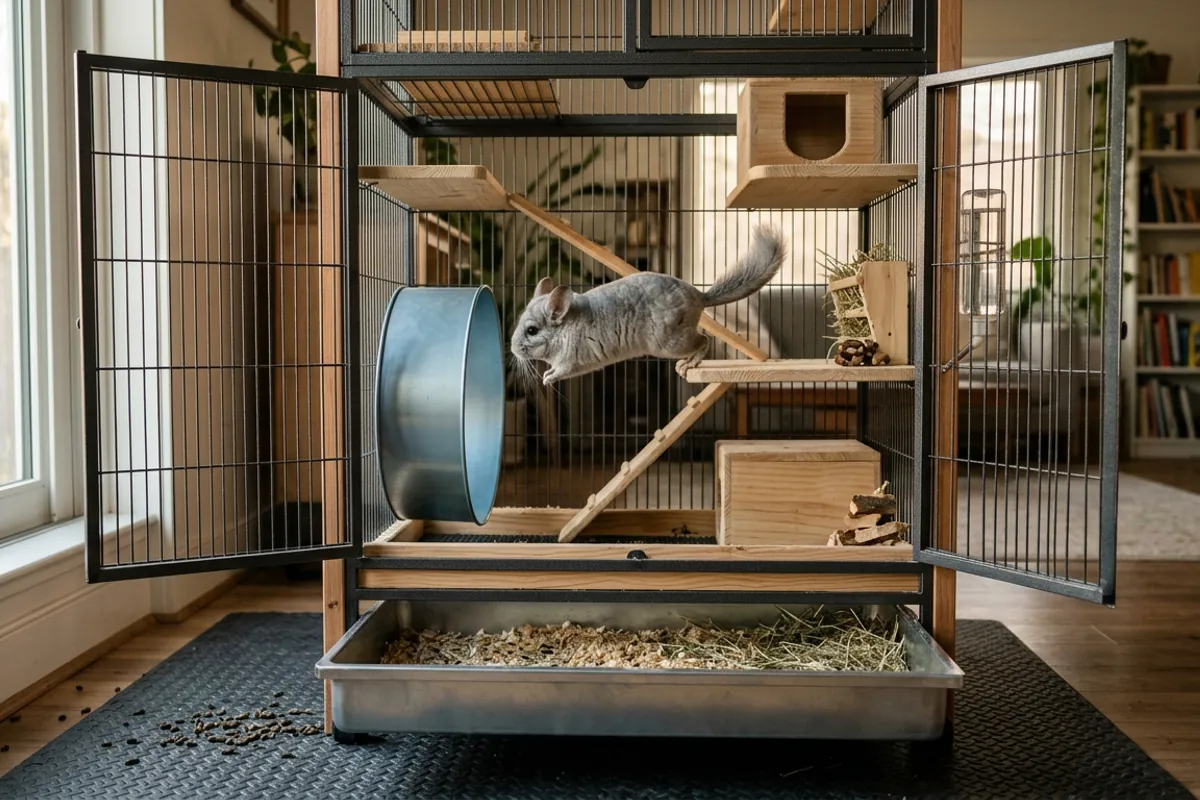
To keep chinchilla poop inside the cage, you are fighting physics, not behavior. What works:
- A cage with a deep metal pan rather than a shallow lip. Height on the tray is the single biggest improvement you can make. A tall metal and wood cage with a proper pull out pan solves most of this by design.
- A guard or skirt around the lower bars, fitted on the outside where the chinchilla cannot reach and chew it. Nothing plastic inside the cage, ever, because a chinchilla will eat it.
- A washable mat or cheap rug under and around the cage. This is not solving the problem, it is making the cleanup a thirty second job.
- Doing the dust bath inside an enclosed bath house rather than an open bowl, which contains the worst of the scatter.
The deep pan is the one that does the heavy lifting, and it is worth buying the cage that has one rather than retrofitting. Critter Nation double unit small animal cage As an Amazon Associate I earn from qualifying purchases.
Litter training deserves an answer. Some chinchillas will reliably urinate in one corner, and a corner pan there saves you real work. Almost none will confine their droppings, because they drop them continuously while moving and there is no instinct to control it. Plan for daily sweeping, not for training. My routine for the rest of it is in how to keep a clean chinchilla cage.
Chinchilla poop as fertilizer
Chinchilla poop fertilizer is one of the few genuine upsides of the volume these animals produce. The droppings are dry, low odor, and made of digested grass fiber, which puts them in the same broad family as rabbit manure that gardeners use freely. Unlike fresh horse or chicken manure, it is not aggressive enough to burn most plants when used sensibly, and it breaks down slowly into the soil.
I will be straight about the limits of what I know here. I keep chinchillas, I am not a soil scientist, and I have never had a batch analyzed, so I will not quote you nutrient percentages I cannot stand behind. What I do is compost it rather than dig it straight in, mostly because what comes out of my tray is never pure droppings. It is droppings plus bedding plus a fine haze of bath dust, and composting evens all of that out.
Three cautions I would not skip. Do not use droppings from an animal that has had diarrhea or a confirmed parasite, particularly not on anything you plan to eat. Do not use droppings from an animal currently on medication. And keep bath dust out of your veg beds in quantity, because it is volcanic pumice powder and does nothing useful for soil structure.
If you have no garden and no compost heap, the droppings go in the general waste and that is the end of it. Nobody needs to feel guilty about this.
My daily check, and when to call the vet
The whole routine takes about fifteen seconds. When I lift the tray, I ask three questions: is the volume roughly what it was yesterday, are the droppings the same size and shape as yesterday, and are they firm rather than soft or slimy. That is it. Everything else in this article is just detail on what a "no" to one of those means.
Call an exotics vet, same day, if any of these are true:
- Your chinchilla has stopped producing droppings, or the tray is close to empty when it should not be. Do not wait out a set number of hours first; there is no published safe window. A gut that has stopped moving is life threatening and it does not improve on its own.
- The droppings are watery, or the fur around the vent is stained or matted.
- There is blood or mucus on or in the droppings.
- Droppings have been small, thin, or tapered for more than a couple of days, especially alongside drooling, wet fur under the chin, or hay dropped half chewed, which together point at teeth.
- The animal is hunched, quiet, not eating, or sitting apart from a cage mate.
I am an experienced keeper and not a vet, and the list above is a list of moments to phone one, not a diagnosis. Everything else I have described, the odd soft dropping after a treat, a chinchilla eating its own droppings, poop launched across your living room floor, is normal life with these animals. Learn what your own chinchilla's tray looks like on a good day and you will catch the bad days early, which is the entire trick.