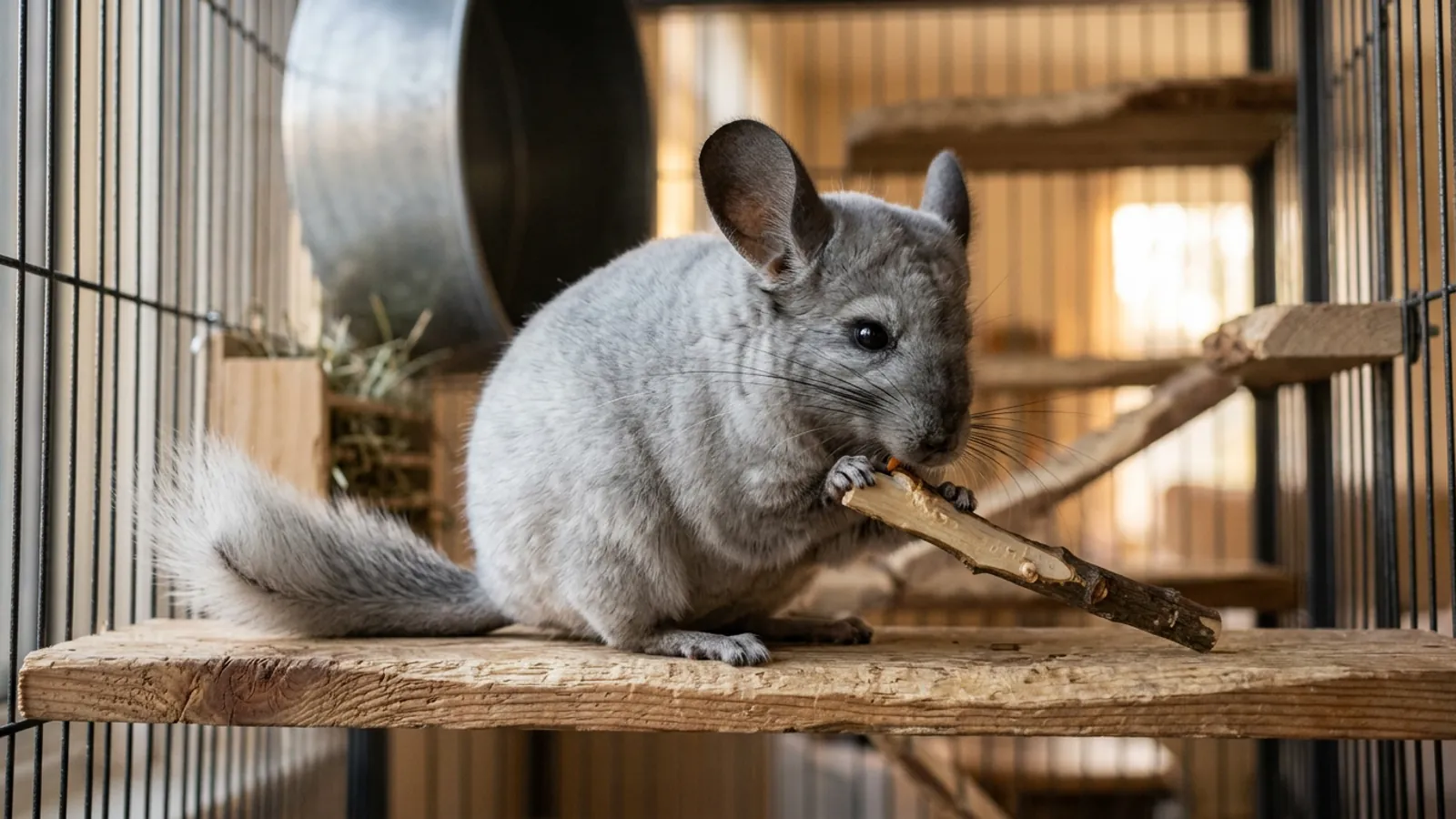
Chinchilla teeth are, quietly, the thing most likely to shorten your animal's life, and the thing almost nobody checks until something has already gone wrong. I have kept chinchillas for about ten years, and one of mine, Juniper, came to me as a neglected rescue with dental disease already set in. Living with her, day to day, has taught me more about what healthy and unhealthy teeth look like than any care sheet ever could. A chinchilla's teeth grow for its entire life, they depend entirely on the right diet to stay in check, and when they go wrong they do it slowly and out of sight. This is the article I wish someone had handed me before Juniper, written owner to owner: what these teeth are, what healthy chinchilla teeth look like, how dental problems start, the warning signs that your chinchilla is sick, and when the only right move is an exotics vet.
Why chinchilla teeth never stop growing
A chinchilla has 20 teeth, and every one of them grows continuously for the animal's whole life. Four are the incisors at the front, the pair up top and the pair below that you can see, and the other 16 are the cheek teeth, the premolars and molars packed along the jaw where you cannot see them at all. These are open-rooted teeth, which is the important part: there is no point at which they finish growing and stop, the way ours do. The incisors alone push out at a fair clip, year in and year out, and the cheek teeth keep growing too.
That design makes complete sense for an animal that evolved to grind through coarse, abrasive plants in the Andes for most of its waking hours. The teeth wear down as fast as they grow because the food fights back. Take the abrasive food away and the growth does not slow down to match. It just keeps going, and the teeth have nowhere to go but sideways, into the tongue and cheeks, and backwards, into the jaw and the tear ducts. Everything else in this article follows from that one fact. The whole job of keeping chinchilla teeth healthy is keeping wear and growth in balance, and hay is how you do it.
What healthy chinchilla teeth look like
One fact surprises most new owners: healthy chinchilla teeth are not white. The incisors on a well-nourished adult are yellow to deep orange, and that color is a sign of health, not neglect. The pigment comes from iron in the enamel, and pale, chalky, white incisors are a warning that something is off, often a dietary problem. So if you look at your chinchilla and its front teeth are a strong orange, that is exactly what you want to see.
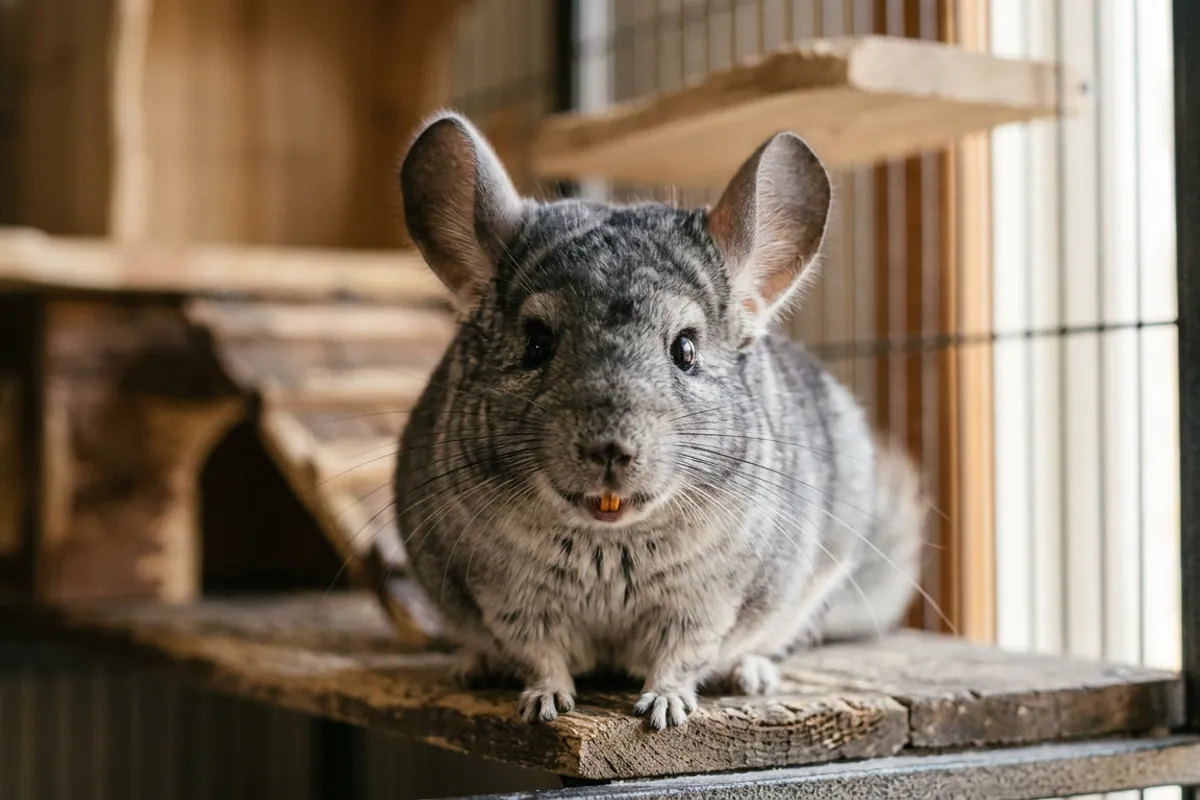
Beyond color, healthy incisors meet evenly and are worn flat across the top, not chipped, not splayed, and not growing at odd angles or curling. The two lower incisors are naturally longer than the top pair, which throws people, but they should still line up cleanly. You can lift the lip gently and take a look at the incisors any time, and I would encourage you to do it often enough that you know your own animal's normal. What you cannot see is the back of the mouth. The cheek teeth do the bulk of the grinding and they are where most serious trouble starts, and there is no way to inspect them properly at home. That blind spot is exactly why the warning signs further down matter so much.
How chinchilla dental problems start
The umbrella term for what goes wrong is malocclusion, which just means the teeth stop meeting and wearing the way they should. It usually runs in one of two directions, and often both at once. The incisors can overgrow, curling long enough to stop the animal closing its mouth or eating. And the cheek teeth can form sharp points, called spurs or spikes, that grow inward and lacerate the tongue and cheeks, or drive the roots down and up into the jawbone and toward the eye sockets.
Two things drive it. The first is diet, and it is the part you control. A chinchilla that does not spend its day grinding coarse hay simply does not wear its teeth down enough, and the growth wins. Feed a diet heavy on soft pellets, treats, and sugary extras instead of hay and you are building a malocclusion over months. The second is genetics, and it is the part you do not control. Some chinchillas are born with jaws or tooth alignment that will drift no matter how perfect the diet is, which is common in poorly bred animals. Juniper is one of those. I did not cause her dental disease and I cannot cure it. What good care does for her is slow it down and keep her comfortable, and that is a real and worthwhile difference. If you want the detail on spotting it early, I wrote a fuller piece on chinchilla teeth problems and malocclusion.
The warning signs your chinchilla is sick
Chinchillas hide illness. It is a prey animal instinct, and it means dental disease is usually well along before it shows. Dental trouble is one of the most common chinchilla health issues that blindsides keepers, partly because chinchilla sickness symptoms from teeth look, at first, like a dozen other things. This is the list I run through, and the one I wish I had known by heart earlier.
- Drooling and a wet chin. Keepers call it "slobbers." Matted, damp fur on the chin, throat, and front paws is one of the most reliable tooth-trouble signs, because a chinchilla that cannot swallow comfortably dribbles. A genuinely wet or drooling chin is never something to wait out.
- Weight loss and eating less hay. A chinchilla with mouth pain often keeps nibbling soft pellets while quietly giving up on hay, so the food bowl looks fine while the animal starves. Weigh weekly on a kitchen scale; the scale catches it before your eyes do.
- Dropping food, sometimes called pseudo-anorexia. The animal goes to the food, picks it up, tries, and drops it. It is hungry, but it hurts to eat.
- Fewer and smaller droppings. Less food in means less out, and the poop is one of the earliest gauges you have.
- Eye discharge or watering. Overgrown roots press on the tear ducts, so weepy eyes can be a dental sign, not an eye infection. Chinchilla eye infection covers why a wet eye is treated as a dental question first.
- Pawing at the mouth, face rubbing, and picking at food more than eating it.
If you are searching "my chinchilla is sick" at 2am and any of these fit, treat it as urgent. Dental problems and other chinchilla diseases share these signs, and none of them are safe to sit on. A chinchilla that has stopped eating entirely is an emergency measured in hours, not days, because the gut has to keep moving to survive.
Teeth chattering and grinding, what it means
Chinchilla teeth chattering is one of the most misread sounds in the hobby, so it earns its own section. The same animal makes a soft, gentle teeth-grinding sound when it is relaxed and content, often while being groomed or dozing, and a harder, louder grinding when it is in pain or badly stressed. The soft version is happy. The loud, deliberate, repetitive grind, sometimes called bruxism, paired with a hunched posture or any of the signs above, is not.
Context is everything. A quiet chatter from a loose, calm chinchilla is fine. The same noise from an animal that is also drooling, sitting puffed up in a corner, and off its hay is telling you something is wrong in its mouth. Chattering can also be a warning to another chinchilla or to you, more of a "back off" than a pain signal, which is why you read it together with posture and appetite rather than on its own. I keep a fuller guide to what chinchilla sounds mean, but for teeth specifically the rule is simple: soft and relaxed is contentment, loud and grinding alongside other symptoms is a vet call.
Hay first, chews second, and why that order matters
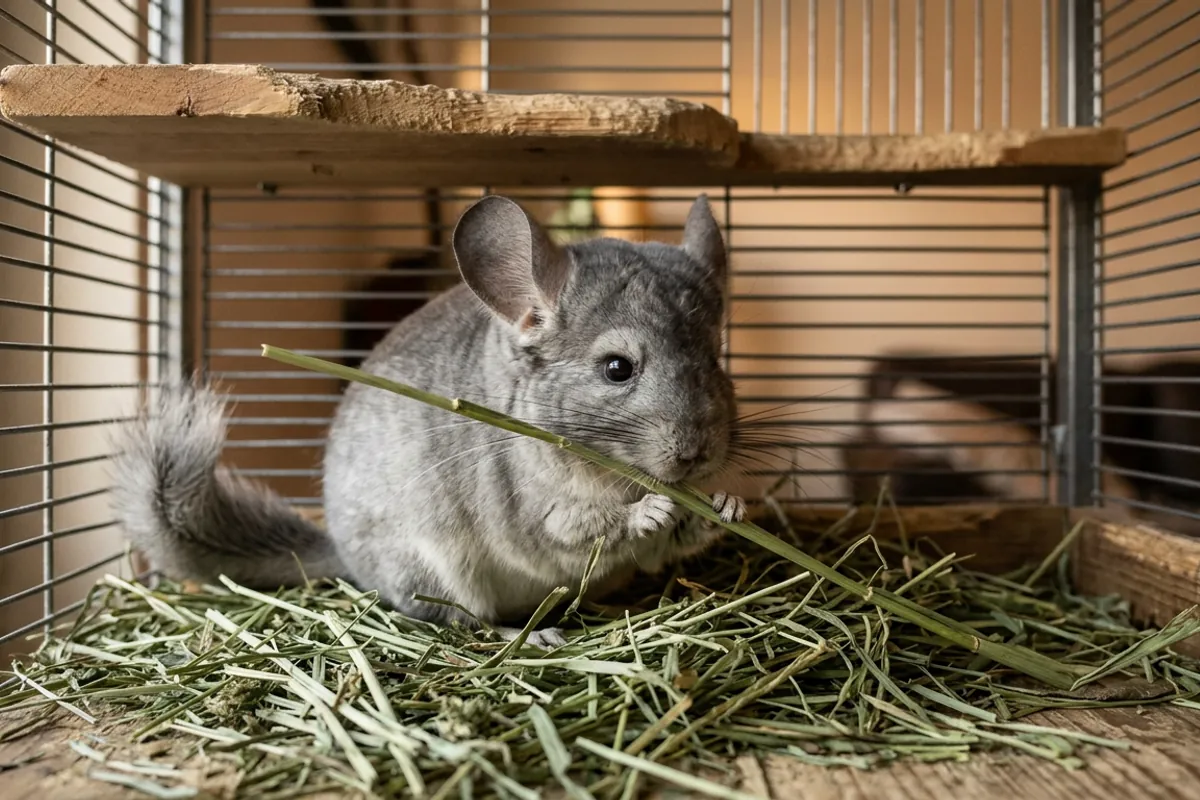
Everything about chinchilla dental care comes down to wearing teeth down as fast as they grow, and there is one tool that does the heavy lifting: grass hay, without limit, all day, every day. This is not a side dish or a supplement. Unlimited timothy or other grass hay is the meal, and the long, sideways grinding motion an animal uses to chew it is the single best thing keeping those cheek teeth level. A chinchilla should always have more hay than it can eat. I go through why in more depth in timothy hay is the whole meal, but the core of it is that hay is not food you add, it is food you build the diet around. Buy it in quantity and keep the rack full; a boxed timothy hay is the easy way to never run out.
Oxbow Western Timothy Hay, 40 oz bag As an Amazon Associate I earn from qualifying purchases.
Pellets come second and in a measured amount, a tablespoon or two a day for an adult, not a full bowl, because a chinchilla that fills up on soft pellets eats less hay and grinds less. Plain grass-based pellets support the diet; they do not replace the hay. And treats, especially anything sugary or fruit-based, are the enemy of a working mouth. I keep them rare and tiny; the plain guide to what is safe as a treat is shorter than most people expect.
After hay comes chews. Safe wood gives the incisors something to work against and gives a bored chinchilla a job. I keep a rotating variety in every cage, because a single chew type gets ignored fast and variety keeps them using it. A mixed apple-wood chew pack is the simplest way to get that spread.
emours apple wood chew sticks, 40 count As an Amazon Associate I earn from qualifying purchases.
Apple, pear, willow, and kiln-dried pine are all safe; avoid anything treated, painted, or from a stone-fruit tree like cherry or plum. Skip plastic chews entirely, they do nothing for the teeth and are a gut hazard if swallowed. This is Juniper's whole life, really: unlimited hay and a spread of chews are the difference between managing her disease and losing her to it. I treat chews as dental care rather than decoration, because that is exactly what they are.
When to see the vet, and what it costs
Here is the plain limit of what you can do at home: nothing you buy fixes an overgrown tooth. I am an experienced keeper, not a vet, and I will say plainly that home care prevents and slows dental disease but does not treat it once it is established. The moment you see the warning signs above, the right move is an exotics vet, specifically one who sees chinchillas or at least small exotics, not a general practice that mostly does cats and dogs.
Expect the vet to sedate or anesthetize your chinchilla for a proper look, because you cannot examine those back teeth or file them on an awake animal. A full workup often includes skull X-rays to see the tooth roots, which is where the real damage hides. If the teeth are overgrown, the vet files or trims them down, and if the roots are affected there is only so much anyone can do. The hard truth is that malocclusion is managed, not cured, so a chinchilla with overgrown teeth usually needs the procedure repeated every few weeks to months for the rest of its life.
On chinchilla teeth trimming cost, I will be straight that it varies too much by region and clinic for me to promise a number, and anyone who quotes you an exact figure online is guessing. What I can tell you is the shape of it: a dental procedure under anesthesia with X-rays is not a cheap visit, it runs well into the hundreds in many places, and because it recurs, the real cost is that figure multiplied out over the animal's life. Budget for it as an ongoing cost, not a one-off. That is one more reason the daily hay-and-chews routine matters so much; it is a lot cheaper, and a lot kinder, than the alternative. If you are weighing whether you can take one on at all, factor lifelong dental care into the decision the way I lay it out in the wider chinchilla teeth and health guide.