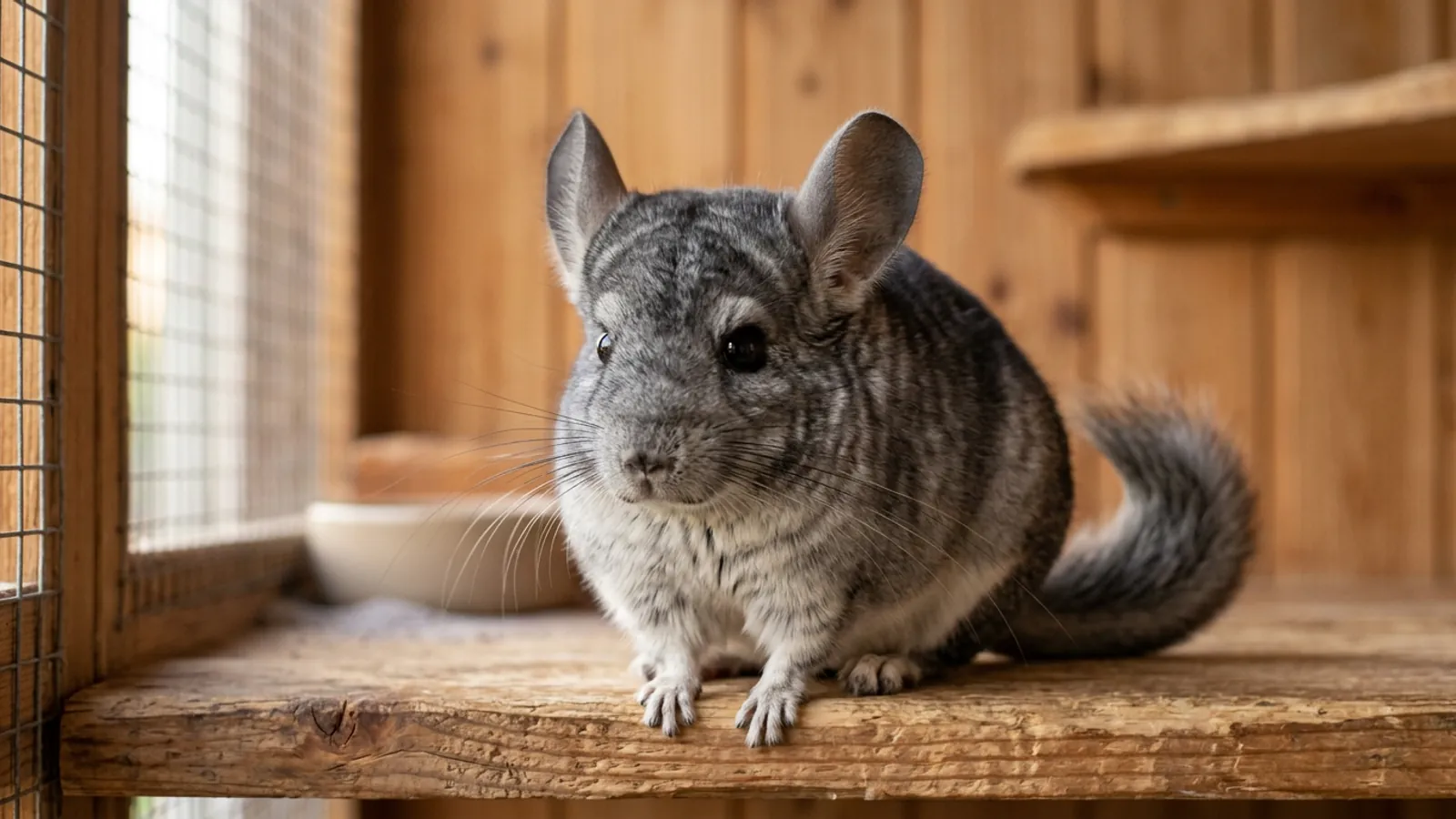
A chinchilla eye infection almost never starts dramatically. It starts with one eye that looks slightly smaller than the other, or a damp track in the fur under the inner corner that you only notice when your chinchilla wakes up in the evening and sits still for once. Chinchillas are prey animals with a lifetime of practice at looking fine, so by the time an eye is crusted shut, whatever caused it has usually been running for days. After about ten years of keeping chinchillas, the most useful thing I can tell you about eyes is this: the eye is very often the symptom and not the illness. Below is what I check, what is safe to do at home, and the point where improvising stops and an exotics vet takes over.
What a chinchilla eye infection looks like
A healthy chinchilla eye is large, round, very dark, wide open, and completely dry. The fur runs right up to the lid margin and stays dry there. There is no normal amount of goop, no morning crust, no "she always waters a bit on that side". Any wetness on a chinchilla's face is worth taking seriously, because their eyes are not supposed to leak.
The signs I look for, in rough order of how early they show up:
- A damp streak or a stained, clumped patch of fur running from the inner corner down the cheek.
- One eye held slightly more closed than the other, or blinking out of sync with the good eye.
- Discharge that is clear and watery, or thicker and white, yellow, or green. Thick colored discharge points harder at infection, but clear tearing is not harmless, it just usually means a different cause.
- Crusts gluing the lids together after a sleep.
- Red or puffy lid margins, or the third eyelid visible across the corner of the eye.
- Face rubbing: pawing at the eye, or dragging the side of the head along a ledge or the bars.
- Any change in the surface of the eye. A healthy cornea reflects light like a wet mirror. A dull spot, a haze, a blue or gray cloud, or a small crater in that reflection is a corneal problem and it is urgent.
- The whole animal looking off: hunched, quiet, hay untouched, droppings smaller or fewer than usual. If you are not sure what normal looks like, what chinchilla poop tells you is the fastest baseline to learn.
Compare both eyes in the same light, and take a phone photo. Asymmetry is information. One eye usually means a local cause or one bad tooth root on that side. Both eyes at once more often means something in the air or a whole-body illness. And an eye held shut is pain. Chinchillas do not squint for fun, and a chinchilla that is also flat and unresponsive is not a wait-and-see case.
Why the eye is usually not the real problem
This is the part I wish someone had told me early, because it changes what you do next.
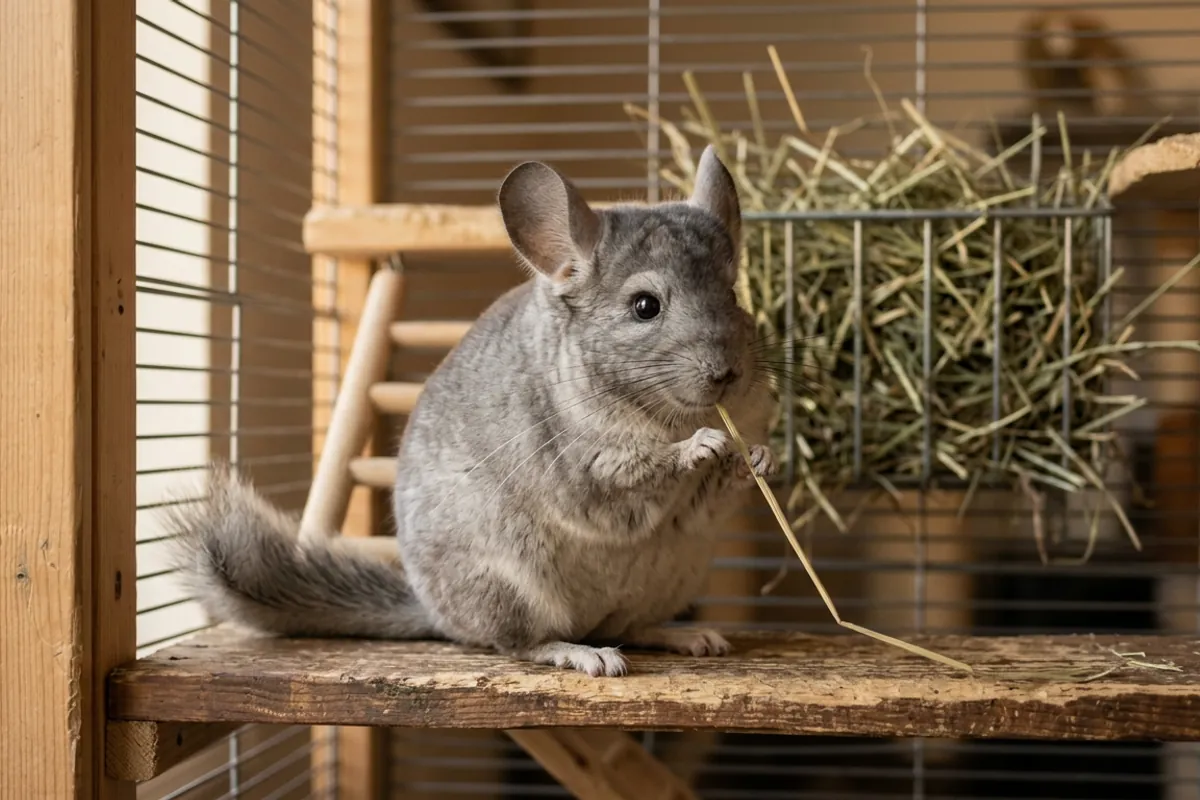
The commonest reason a chinchilla's eye weeps has nothing to do with germs on the eye. It is teeth. All 20 chinchilla teeth grow continuously for life. The incisors alone push out constantly, all year, and the cheek teeth keep growing too, more slowly but just as relentlessly. They only stay the right length because grinding coarse grass hay wears them down at the same speed. When that wear falls behind, the crowns overgrow into the mouth and the roots overgrow the other way, up into the skull. The tear duct runs from the inner corner of the eye down through the skull, past those upper tooth roots, and out into the nose. An elongated root presses on that duct, tears stop draining, and they spill down the face instead. Then the constantly damp fur gets infected, and you are treating an eye infection that started in a molar. Juniper is the reason I look at eyes and teeth as one system rather than two: managing her dental disease day to day has taught me that the face tells you about the mouth long before the mouth is easy to see. If any of this sounds familiar, read chinchilla teeth problems next.
The other causes worth knowing:
- Dust in the eye. Too many baths, baths left in the cage all day, dust that is too deep, or the wrong product entirely. Fine volcanic pumice is what the coat needs; builder's sand and "sand and dust" blends scratch. The dust bath done right covers the schedule.
- A hay poke or other foreign body. A stiff stalk scratches the cornea, and the scratch gets infected. This is why a scratched eye and an infected eye so often arrive together.
- Ammonia from a dirty cage. Urine breaking down under a shelf produces a gas that irritates eyes and airways. This one usually hits both eyes, and the fix is a cleaning routine, not a drop.
- Trauma. A scuffle with a cage mate, a protruding wire end, a screw, a cracked plastic fitting. Cages should be metal and wood with nothing sharp at chinchilla height.
- Respiratory infection. Eye discharge plus sneezing, a wet nose, or audible breathing is a sick animal, not a sore eye. That combination goes to a vet the same day.
I cannot tell these apart by looking, and neither can most vets without tests. That is the point of the exam described further down.
What I do in the first hour
Everything here is safe to do while you are waiting for an appointment. None of it replaces one.
Write down the facts while they are fresh: which eye, when you first saw it, what the discharge looks like, whether the animal is eating. Then weigh your chinchilla and keep weighing daily. Weight is the earliest honest signal you get, and a steady downward trend over a few days is a vet call on its own.
Take the dust bath out of the cage and leave it out. Dust in a sore eye makes everything worse, and a chinchilla with a scratched cornea will still happily roll in it.
Soften any crust with a clean gauze pad dampened with plain sterile saline eyewash, the kind whose only ingredients are salt and water, with no medications and no preservatives. Wipe from the inner corner outward, once, with a fresh pad for each eye. Do not pry the lids apart, do not scrub, and do not pin the animal down to do it. If your chinchilla fights hard, stop. A fur slip and a panicked animal cost more than a tidy face is worth.
Look for a foreign body in good light, from a comfortable distance, without restraining. If you can see something lodged under a lid, that is a vet job, not tweezers at home.
Keep the room cool and calm. The comfortable range is 60 to 70°F (15 to 21°C). Above 75°F (24°C) is risky and 80°F (27°C) or more is an emergency, faster in humid air, and a stressed sick animal has less margin than a well one. If your room is anywhere near that line, deal with the heat first and the eye second.
Finally, book the appointment. My own rule is that a clear, mild weep with a bright, hungry, normal-behaving chinchilla can be watched for 24 hours. Anything else goes in now. And one thing I want to be firm about, because it is where this rule goes wrong: a clear weep that comes back, or that only ever affects one eye, does not get another 24 hours. It gets a dental workup. Tooth roots pressing on the tear duct are the commonest reason a chinchilla's eye runs at all, and a weep that keeps resolving and returning is that story rather than a dust story.
When it is a same day emergency
Stop reading and call an exotics vet if you see any of the following:
- The eye is held fully shut, or the squint is not easing.
- The surface looks cloudy, hazy, blue, dull, or dented. Corneal ulcers can deepen fast and a deep one can perforate.
- Discharge is yellow, green, or bloody.
- The lids or the area around the socket are swollen, or the eye looks pushed forward compared with the other one.
- Both eyes are running and there is sneezing, nasal discharge, or noisy breathing.
- The chinchilla is not eating hay, droppings have gone small or scarce, or it is sitting hunched and quiet.
- The chin, chest, or front paws are damp, which usually means drooling and points straight back at the teeth. A wet chinchilla is never something to shrug at.
A chinchilla that stops eating for half a day has a second emergency stacked on the first, because their gut needs constant fiber moving through it. That is one reason eye pain is not a minor problem in this species: it hurts enough to put them off food.
Find your vet before any of this happens. Not every clinic sees exotics, and the day you need one is the worst possible day to start searching. How to find a chinchilla vet walks through it.
Chinchilla eye infection treatment, and what the vet is doing
Good chinchilla eye infection treatment starts with finding out what you are treating, and there are three things I want to see happen at that appointment.
First, a fluorescein stain. A drop of orange dye goes on the eye and glows green wherever the corneal surface is broken. This is quick, cheap, and it changes the medicine completely, because some drops that are fine on an intact eye are dangerous on an ulcerated one.
Second, a proper look at the teeth. An awake exam with a scope shows the crowns and not much else. Root elongation only shows on skull radiographs or a CT scan, which means sedation. If the tearing is on one side, keeps coming back, or comes with a wet chin, I push for imaging rather than another round of drops.
Third, a plan with a checkpoint. Ask what you should see by day two or three, and what to do if you do not see it.
The medicine that comes home is usually a topical antibiotic, either as drops or as an ointment, sometimes with pain relief. If a systemic antibiotic is needed, it has to be one chosen for a hindgut fermenter. Several common oral antibiotics, including the penicillin family and a few others, can destroy a chinchilla's gut bacteria and kill the animal even while the eye clears. Never give a leftover antibiotic prescribed for a dog, a cat, a person, or a previous illness. I am an experienced keeper, not a vet, and this is exactly the line where that distinction matters.
If the cause turns out to be a tooth, understand what the drops are doing: they are treating the infected surface while the actual problem sits in the skull. Dental work under anesthetic, and an ongoing plan afterwards, is the treatment. I want to be careful with the word cure, because this is not one: the manuals describe elongated cheek teeth as a chronic problem that generally needs repeated visits to stabilize, and Juniper has taught me that at close range. What you are buying is management, and it is worth buying. Eye medicine alone will just get you a quieter month.
Giving chinchilla eye infection drops at home
Chinchilla eye infection drops are easier to get in than most people expect, provided you do it fast and stop making it a wrestling match.
Work at floor level in a small, safe, chinchilla-proofed room, or on a towel on a table with the animal facing away from you. Approaching from the front, with a bottle coming at their face, is what triggers the fight. Come from behind and above. Steady the head with light fingers along the cheekbone, never around the throat or chest, tilt the nose slightly up, ease the lower lid down a fraction, and let the drop fall from about an inch away. The dropper tip must never touch fur or eye, both because it hurts and because it contaminates the bottle.
The whole thing should take ten seconds. If it takes a minute, you are holding too tightly. Let go, give it five minutes, try again. Follow it with something small and boring that they like, such as a single rose hip or a plain hay-based treat, so the routine acquires a happy ending.
Ointment sticks around longer and needs fewer doses, but is harder to place. Drops go in easily and need doing more often. Either is fine, so take whichever your hands manage more calmly. If two different medications are prescribed, leave five minutes between them and put ointment last.
Then the part people get wrong: finish the course. An eye that looks clear on day three is not a cured eye, and stopping early is the most common reason the same infection reappears a fortnight later. Keep dust baths paused until your vet clears them, then restart with fresh dust and a shorter session. And if the eye is worse at 48 hours, more squinting, more discharge, cloudier, phone the clinic rather than hoping the rest of the bottle turns it around.
What I will never put in a chinchilla's eye
- Human redness relief drops. They work by shrinking blood vessels and they hide the exact sign your vet needs to see.
- Anything containing a steroid, unless a vet has stained the eye first and specifically prescribed it. On an ulcerated cornea, steroids can let the tissue melt through. This is the single most dangerous well-meaning mistake in this whole article.
- Leftover drops from another animal, another illness, or another year.
- Contact lens solutions, which contain cleaners and preservatives that are not meant for a damaged eye.
- Tea bags, chamomile, honey, colloidal silver, apple cider vinegar, boric acid, breast milk. None of these are treatments, and the days spent on them are the days an ulcer deepens.
- Water on the animal. Chinchillas never bathe in water. A damp gauze at the lid margin is the whole extent of it.
I will be clear about one gray area. Some experienced keepers flush a dusty eye with sterile saline. I limit myself to wiping crusts, because if the cornea is already scratched I would rather not push fluid across it, and because I cannot see a scratch without dye. If the eye still looks wrong after the crusts are off, that is a vet visit, not a second flush.
Preventing the next one
Most eye infections I have seen in other people's chinchillas trace back to one of four things, and all four are fixable.
Teeth first, because teeth cause the tearing that causes the infection. Unlimited grass hay is not a side dish, it is the whole meal and the only thing that grinds cheek teeth flat, so hay should be available every hour of every day and refreshed constantly. Oxbow Western Timothy Hay, 40 oz bag As an Amazon Associate I earn from qualifying purchases. Back it with a real variety of safe woods to chew, rotated so they stay interesting, because a bored chinchilla stops chewing and a chinchilla that stops chewing grows roots into its tear ducts. emours apple wood chew sticks, 40 count As an Amazon Associate I earn from qualifying purchases. Stick to species you have confirmed are safe, and skip anything treated, stone-fruited, or unidentified. Chinchilla safe wood has the list I use.
Dust next. Two to three baths a week, 10 to 15 minutes each, then the bath house comes straight back out of the cage. An inch or two of fine volcanic pumice dust is plenty, and a house with high sides and a top opening keeps most of it off the face. Lixit Blue Beauty chinchilla dust, 3 lb As an Amazon Associate I earn from qualifying purchases. A bath left in the cage all day is the fastest route to a chronically irritated eye I know.
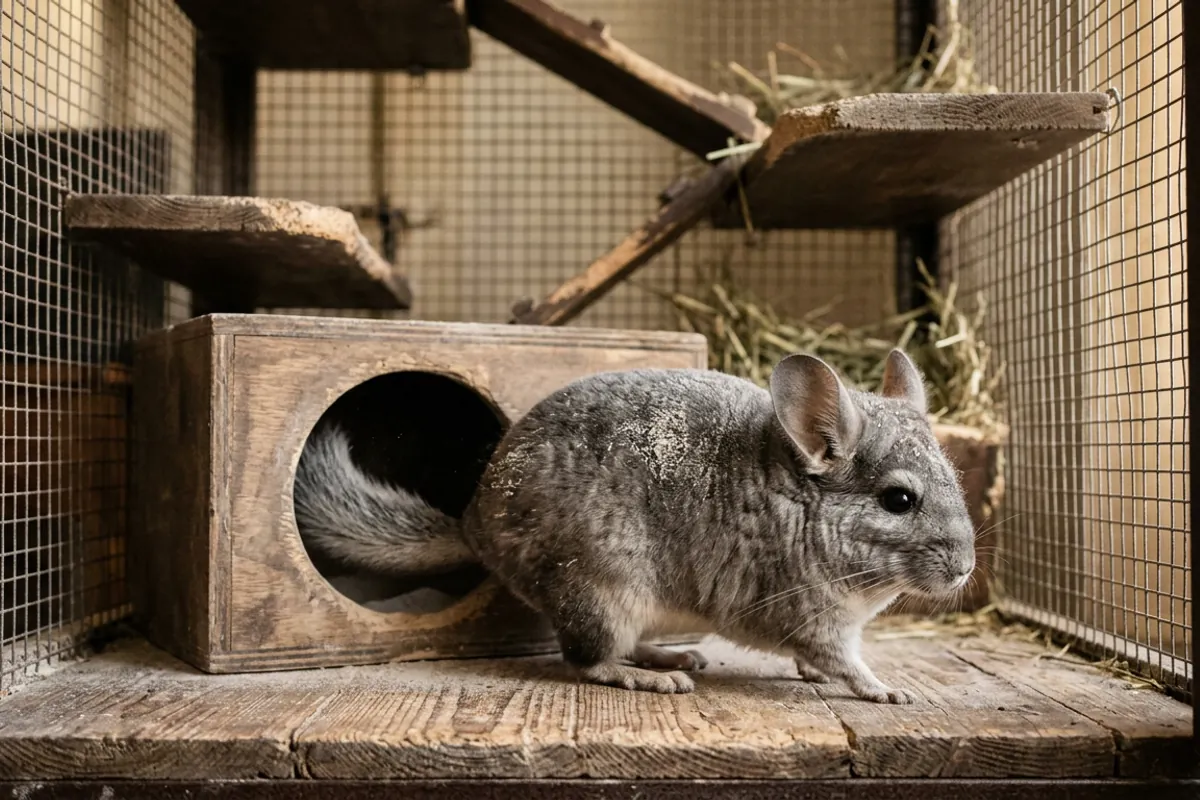
Then the cage itself. Metal and wood, tall, no plastic, no sharp wire ends at head height, and a cleaning routine that never lets urine sit long enough to turn into ammonia. Critter Nation double unit small animal cage As an Amazon Associate I earn from qualifying purchases.
Last, the air. Cool and dry, measured rather than guessed, because a room that feels fine to you can be well past what a chinchilla tolerates. I keep a thermometer and hygrometer at cage height, aim for 60 to 70°F (15 to 21°C) and humidity under about 50 percent, and treat 75°F (24°C) as the line where I intervene. digital thermometer and humidity gauge with remote probes As an Amazon Associate I earn from qualifying purchases. Pebble came out of an overheated attic and had a near miss in her first summer, and that night at the emergency vet is why this is not negotiable: heat is not a comfort issue, and humid heat is worse than the thermometer alone suggests. Chinchilla temperature has the full version.
Add a weekly hands-on check. Look at both eyes in good light, weigh, glance at the droppings, feel whether the chin is dry. Photograph healthy eyes once so you have a reference for the night you are squinting at a slightly damp cheek at midnight, wondering whether you are imagining it. You probably are not. Chinchillas do not weep for no reason, and the sooner you find the reason, the smaller the reason usually is.