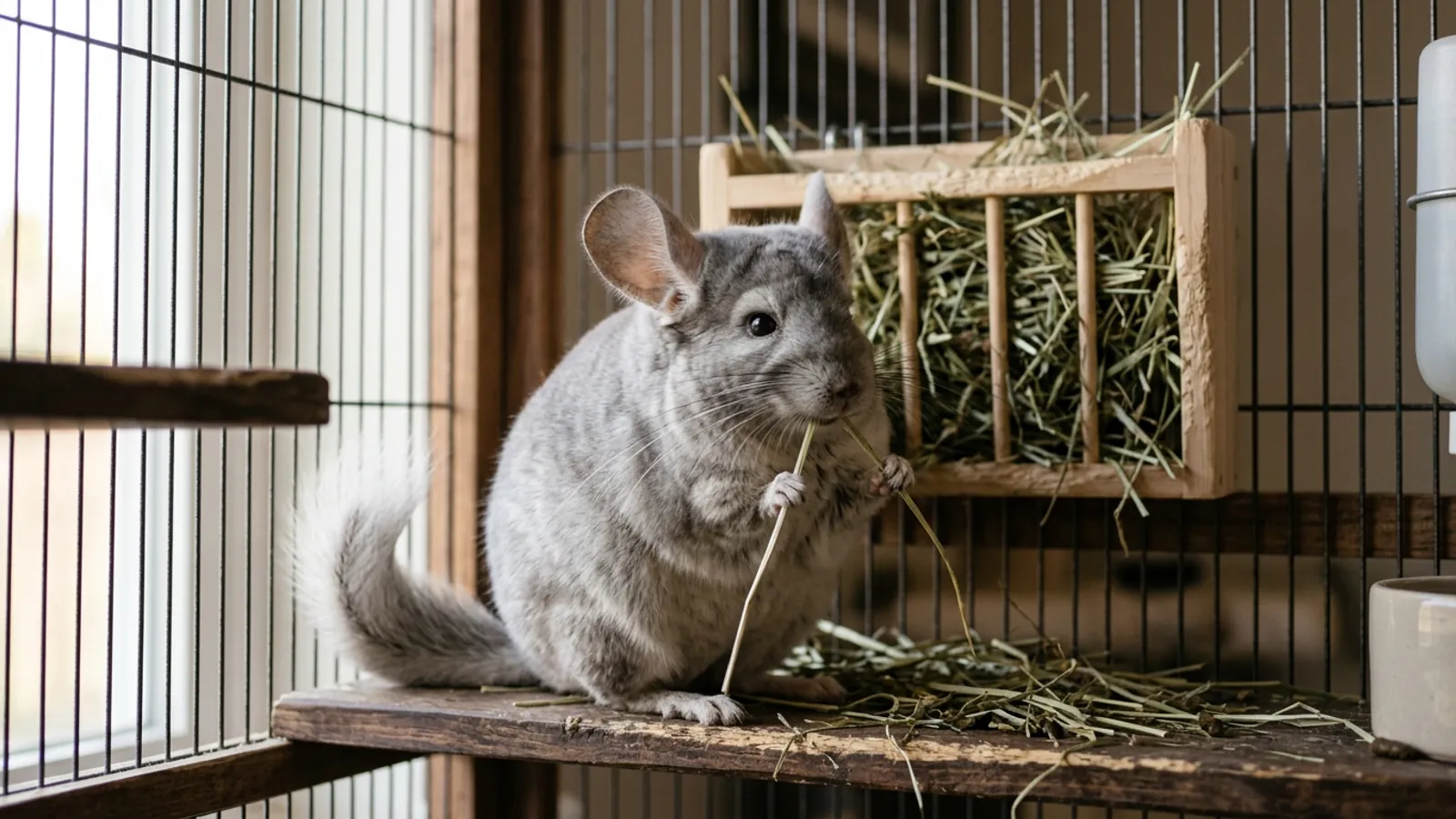
Can chinchillas vomit? No. They cannot, and that one missing ability shapes more of daily chinchilla care than almost anything else about the animal. It is not that a chinchilla is too stoic, too small, or too well mannered to be sick. The reflex is absent, the muscular coordination behind it is absent, and no amount of nausea, bad food, or panic will produce it. I have kept chinchillas for about ten years, and once I understood this properly, a pile of advice that had sounded fussy to me started reading like the bare minimum: hay first, treats tiny, nothing sticky, nothing swallowable, and an exotics vet number saved before the night I needed it.
The short answer, and why it is not a small detail
Chinchillas do not vomit. Neither do rats, mice, or guinea pigs, and neither do rabbits or horses, which are not rodents at all. It is a shared quirk across a group of animals whose guts are built to run in one direction, continuously, on a constant supply of coarse fiber.
Four consequences follow from that, and every one of them is practical:
- Anything a chinchilla swallows is staying swallowed. There is no second chance.
- There is no home first aid for poisoning. You cannot bring it back up, and trying will not help.
- Gas and gut contents move one way only. When they stop moving, pressure builds with nowhere to go.
- A chinchilla that inhales or lodges food has no backup mechanism at all. Chinchilla choking does not resolve itself. It is an airway problem with a very short clock.
So when an owner tells me their chinchilla threw up, my first thought is not what did she eat. It is that something else is going on, and it is usually dental, and it usually needs a vet sooner than they think.
Why the anatomy makes it impossible
Vomiting sounds simple but it is a surprisingly coordinated act. A specific circuit in the brainstem has to fire, the diaphragm and the abdominal wall have to squeeze together in a particular rhythm, and the muscular ring at the top of the stomach has to relax on cue so the contents can pass back up a long tube. Take away any one of those pieces and the whole thing fails.
Chinchillas appear to be missing more than one. The neural wiring that triggers the reflex is either absent or too weak to fire. The junction where the esophagus meets the stomach is organized as a barrier against anything coming back up. The esophagus itself is relatively long, and the stomach is not shaped to funnel contents back into it. The diaphragm is not built to deliver the kind of push that emesis needs.
Which of those is the true block is still argued over by people who study it properly, and I am an experienced keeper, not a vet or a physiologist. What is not argued over is the outcome. In ten years I have never seen a chinchilla vomit, and no reputable source describes it happening.
There is a related point worth knowing: chinchillas also do not burp in any meaningful way. Gas produced in the gut has one exit, and it has to travel the whole length of the animal to get there. That is why a chinchilla with a slow gut goes downhill so fast, and it is the whole reason bloat is an emergency rather than a nuisance.
What owners usually see when they think a chinchilla threw up
Nearly every time someone describes chinchilla vomit to me, the real cause is on this list.
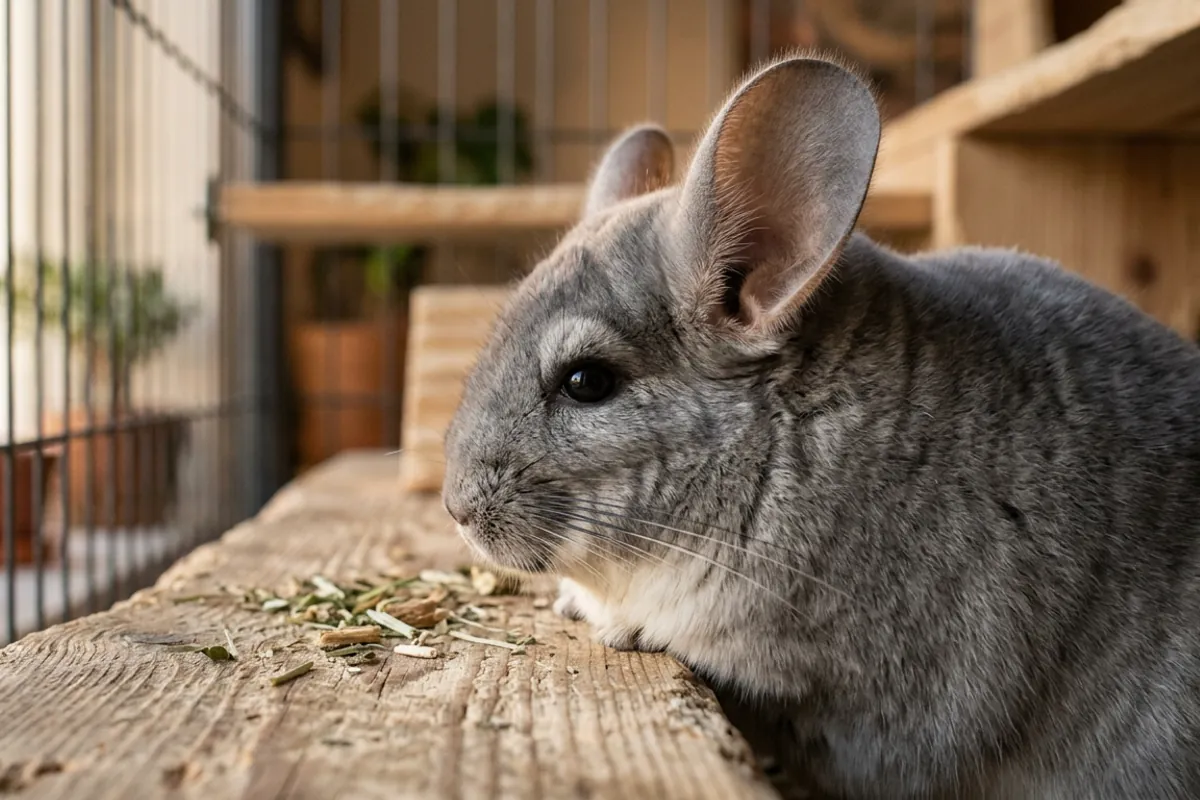
A wet chin and drool. This is the big one, and it is a dental sign until proven otherwise. Overgrown molar spurs cut into the cheek or tongue, chewing becomes painful, saliva runs, and the fur under the jaw stays damp and eventually stains or falls out. Juniper's dental disease is why I check chins as a routine, not as a reaction. A wet chin is one of the clearest early warnings a chinchilla gives you, and it is easy to miss on a gray coat. There is more on what a damp coat versus a damp chin means in Chinchilla wet: a soaked coat, a drooling chin, and what each one means, and the dental side in Chinchilla Teeth Problems: Spotting Malocclusion Before It Turns Serious.
Half chewed food dropped on a ledge. A chinchilla with a sore mouth picks food up, works at it, and lets it fall. What you find looks like something that came back up. It did not. It never went down.
A wet patch of bedding with food debris in it. Usually a dripping water bottle over a food bowl or a hay pile. Worth checking the bottle before you assume anything medical.
Soft or smeared droppings. Gut trouble looks alarming when it is smeared on a ledge, but it comes out the other end. Droppings are the single most useful daily readout you have, and What chinchilla poop tells you before anything else does covers what changes mean.
Cecotropes. Chinchillas produce a soft, nutrient rich dropping that they eat directly, so you rarely see one. If you do find one, it is not vomit.
None of these are trivial, and the first one especially is a reason to book an appointment rather than to relax.
Recognizing chinchilla choking in the moment
Choking in a chinchilla is fast. What you get is behavior that looks wrong.
Signs I would act on immediately:
- Pawing at the mouth, or rubbing the face hard along a ledge or the cage bars.
- A retching or gagging motion with nothing produced. This is the one people describe as vomiting. It is not. It is an animal trying to clear something.
- Sudden drooling, especially if the chin was dry ten minutes ago.
- Open mouth breathing. A chinchilla breathes through its nose. An open mouth is abnormal in any circumstance.
- Visibly labored breathing, with the flanks working hard.
- Weakness or collapse.
The usual culprits are pieces too big to swallow safely: a chunk of dried fruit, a nut, a seed, a broken off shard of a hard treat, a wad of fleece or plastic from something that should not have been in the cage. Sometimes it is bedding fluff. Sometimes it is a pellet swallowed badly.
What to do, and what I would not try
I want to be straight about the limits here, because this is exactly the place where confident internet advice does damage.
What is reasonable at home:
- Stay with the animal and keep the room quiet. Do not chase her around the cage. Panic and pursuit make the breathing worse.
- Get the carrier out and get moving toward an exotics vet at the same time as you are doing anything else. If you live alone, put the carrier by the door permanently. How to choose a chinchilla carrier before the day you need it is worth reading on a calm afternoon rather than a bad night.
What I would not do:
- No blind finger sweeps and no tools down the throat.
- No water, no food, no syringe of anything. A partially blocked airway does not need liquid added.
- No shaking, swinging, or squeezing maneuvers copied from dog first aid. I know they circulate for small pets. The plain position is that they are not well evidenced in chinchillas. I am not going to tell you a technique I cannot stand behind.
If the obstruction is partial and she seems to settle, she still needs seeing. Material left in the airway or the esophagus can cause swelling and complications later. This is the kind of call an exotics vet should make, not you and not me. How to find a chinchilla vet before you need one is the piece I wish more people read in advance, because the search is impossible to do well at eleven at night.
Bloat, poison, and the other things that cannot come back up
Because nothing reverses, two other emergencies get much more dangerous in a chinchilla than they would in a dog or a cat.
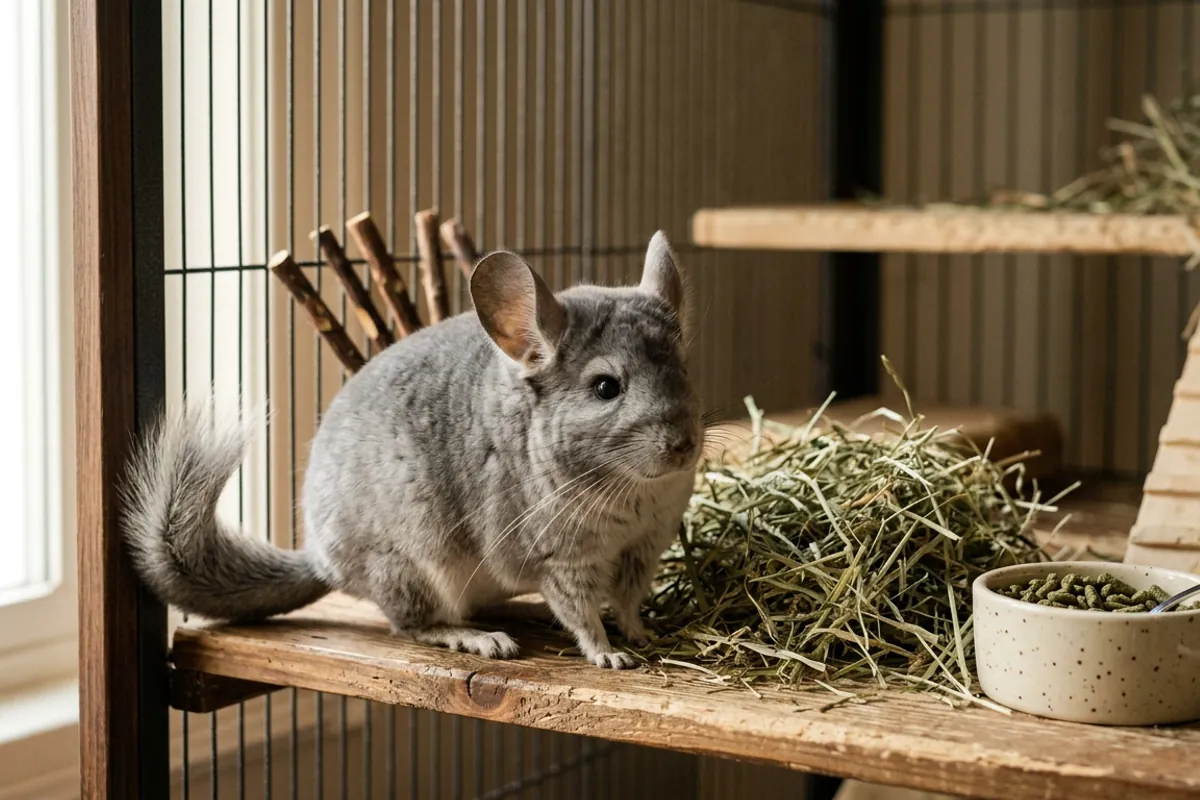
Bloat. Gas builds in a gut that has slowed or stopped, and it cannot be belched or vomited out. The belly goes tight and drum like, the animal hunches, refuses hay, stops moving, and droppings shrink or vanish. This is measured in hours, not days. It follows sudden diet changes, too many pellets or treats, a mouthful of the wrong greens, dental pain that stopped her eating, or plain stress. A chinchilla that has stopped eating and stopped producing droppings needs a vet. What a lethargic chinchilla is telling you, and when to call the vet covers the wider picture.
Heat belongs in this section too, because overheating is one of the things that stops a chinchilla's gut. Pebble joined me from a rehome in an attic with no cooling at all, and her first summer here ran a heatwave close enough that we spent a night at the emergency vet. I do not soften this. Keep the room at 60 to 70°F (15 to 21°C). Above 75°F (24°C) is genuinely risky. At 80°F (27°C) and up you have an emergency on your hands, and humid air makes it arrive faster. A cage thermometer and hygrometer on the cage itself, not across the room, is how you know. digital thermometer and humidity gauge with remote probes As an Amazon Associate I earn from qualifying purchases.
Poison. If your chinchilla chews a houseplant, a cable, treated wood, or painted trim, you cannot empty her stomach and neither can any home remedy. Never give hydrogen peroxide, salt, or anything else you read about for dogs. Call the vet, tell them exactly what and roughly how much, and take the packaging or a piece of the plant with you. The real defense is prevention, and What chinchilla out of cage time should look like is mostly a list of what to remove from the room first.
Feeding and cage choices that lower the risk
Everything above argues for the same boring diet, and the diet is boring because it works.
Unlimited grass hay is the meal, not the side. Timothy is the default and what I buy, and it should be in front of the animal every hour of the day. Long fiber is chewed slowly with a grinding side to side motion, which is exactly the motion that wears molars flat and keeps spurs from forming in the first place. A small box is fine for one chinchilla. Oxbow Western Timothy Hay, 40 oz bag As an Amazon Associate I earn from qualifying purchases. If you keep more than one, buying in bulk costs less per week and means you never run low, which is when people start substituting. Oxbow Western Timothy Hay, 9 lb box As an Amazon Associate I earn from qualifying purchases. More detail lives in why chinchilla hay is the whole meal.
Plain pellets are a measured supplement on top of hay, commonly around 1 to 2 tablespoons a day for an adult. Check what your specific brand recommends and confirm with your vet. Plain means plain: no seeds, no colored bits, no dried corn, no fruit pieces mixed in.
The foods I keep out of the cage entirely
Nuts and seeds, including sunflower seeds. Dried corn. Sticky dried fruit and yogurt drops. Anything from a human plate. Muesli style mixes, which let a chinchilla eat the sweet pieces and leave the fiber. These are choking hazards, sugar loads, and fat loads all at once, and some of them are the exact size and texture to lodge in a small throat. My whole treat allowance is a piece or two of dried rose hip or a pinch of a safe dried herb, a few times a week, no more. My guide to chinchilla treats has the full list.
Chews are dental care, not decoration. A variety of untreated safe woods gives the incisors something to work against and gives a bored chinchilla something to do besides gnaw the cage. emours apple wood chew sticks, 40 count As an Amazon Associate I earn from qualifying purchases.
On equipment, two rules matter here. Keep soft plastic and fabric out. Fleece hammocks shed strands, plastic shelters shed shards, and both get swallowed. And if you run a wheel, it must have a solid running surface, because a wire wheel breaks legs and tails. 15 inch Chin Spin solid surface chinchilla wheel As an Amazon Associate I earn from qualifying purchases. The cage itself should be tall, metal, and fitted with wooden ledges. Why a chinchilla cage has to be metal, and how to fit it out covers the rest.
When to call an exotics vet, and one thing to tell them
Call the same day, not next week, for any of these: drooling or a wet chin, food dropped repeatedly while eating, weight loss, no droppings or noticeably smaller ones, refusing hay while still nibbling pellets, a hard or swollen belly, hunching. Call immediately, out of hours if you have to, for open mouth breathing, a suspected obstruction, collapse, or a chinchilla found in a hot room.
The answer to can chinchillas vomit is a flat no, and I would rather that fact frighten you slightly than reassure you. It means the food bowl is a safety decision, the treat jar is a safety decision, and every scrap of plastic or fleece in the cage is a safety decision. Get those right and the emergency mostly does not arrive. Keep the hay unlimited, keep the treats tiny, keep the room cool, and know where you are driving before you need to drive there.