Chinchilla out of cage time is one of those subjects where the advice splits into two useless halves: people who let a chinchilla roam the whole house unsupervised, and people who never open the door at all. Neither is what I do. After about ten years with Pebble and Juniper, I have landed somewhere specific: a short, deliberately boring, ruthlessly proofed session in one small room, most evenings, at a time that suits the animal rather than me. That is the entire method. What follows is why each piece of it is there, and what happens when you skip one.
What out of cage time is really for
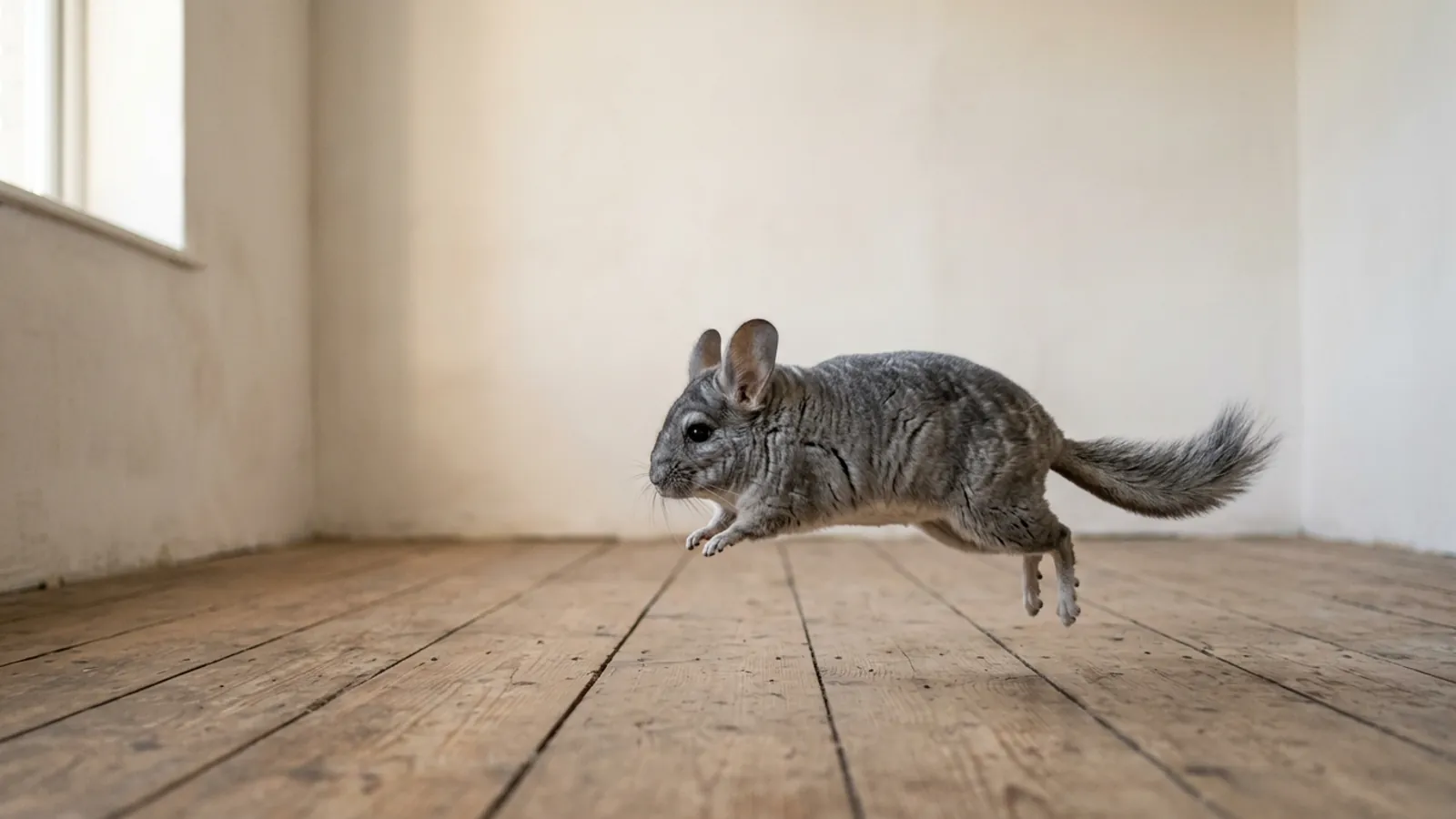
A chinchilla in the wild lives on rock. The terrain is vertical and broken, and the animal moves through it in bursts: a jump, a landing, a scramble, then a long stretch of sitting still and watching. That is the movement pattern the body is built for, and it is why a chinchilla running around a room looks nothing like a hamster on a track. She does not jog. She fires.
Out of cage time exists to give that firing pattern somewhere to happen at full scale. Even a good cage, and mine are as tall as I can get them, caps the length of a run and the height of a single leap. An open floor with a few safe surfaces at different heights lets her string jumps together, change direction at speed, and misjudge a landing occasionally without hitting a bar.
The second reason is behavioral, and it is the one I underrated for years. Chinchillas are curious in a methodical, unglamorous way. Give Pebble a room she has known for years and she will still re-check the same four corners, the same gap behind the door, the same wooden block. That checking is genuine mental work. A chinchilla who never gets any of it tends to redirect the energy into bar chewing, fur chewing, and pestering a cage mate.
What out of cage time is not for is bonding on your schedule. It is tempting to treat the open door as your chance to hold her. Do not. The fastest way to make a chinchilla dread that door is to end every session by grabbing her. Sessions where I sit on the floor, do nothing, and let her decide whether to climb on me have bought more trust than any amount of handling. If she is not tame yet, taming comes first and free roaming comes after.
How long it should last, and at what hour
Thirty to sixty minutes is the range I use, and I have never felt a need to go longer. A chinchilla who has been out for two hours is not getting twice the benefit; she is getting tired, harder to catch, and more likely to start working on something she should not. Most of the real activity happens in the first twenty minutes anyway. After that Pebble usually parks herself on a ledge and watches me, which is pleasant but is not exercise.
Daily is ideal. Every other day is fine. Twice a week is thin but still worth doing, as long as the cage itself is doing its job the rest of the time. Consistency matters more than duration, because chinchillas learn a routine fast and settle better when the door opens at a predictable point in the evening.
The hour is not negotiable in the same way. Chinchillas are crepuscular, most active around dusk and dawn, and they sleep in long broken stretches through the day. Waking a chinchilla at two in the afternoon to make her run around is asking a night shift worker to go jogging at three in the morning. She will do it, badly, and she will resent the interruption. I open the door in the evening, once she is already up and moving on her own. If yours is still asleep, wait. There is no version of this that works better for being forced.
One more thing about timing: if she does not want to come out, let her not come out. An open door with no pressure attached is the point. Some nights Juniper looks at the doorway, decides the hay is more interesting, and stays in. That is a valid answer and I do not overrule it.
Proofing the room before you open the door
This is the part people rush, and it is the part that kills chinchillas. A chinchilla explores with her teeth. Anything she can reach, she will taste, and her incisors go through most household materials without effort.
The cord rule
Electrical cords are the single biggest danger in free roaming. A chinchilla can bite through a live cable faster than you can cross the room. Not tucked behind furniture, not covered with a rug, not "she has never gone over there": unplugged and physically out of the room, or the room does not get used. I treat this as a binary. If I cannot clear every cord, I do not open the cage in that room.
Choosing and clearing the room
Pick the smallest sensible room and strip it. A spare room or a bathroom with the toilet lid down works well. What goes out: houseplants (many are toxic and none are worth the gamble), anything upholstered, anything made of plastic, anything with a gap she can get behind or under. Chinchillas squeeze into spaces that look impossible, and a chinchilla wedged under a wardrobe turns a pleasant evening into an hour of furniture moving.
Assume any wood in the room will be chewed. Skirting boards, chair legs, door frames. I gave up defending mine and instead put out things she is allowed to destroy: untreated apple wood, pine blocks, a couple of chunky chews scattered where she likes to sit. emours apple wood chew sticks, 40 count As an Amazon Associate I earn from qualifying purchases. Giving her a legal target genuinely reduces the illegal chewing, though it does not eliminate it. See chinchilla safe wood for what is safe to leave lying around.
Other pets stay out. A dog that is perfectly gentle with the cat is still a predator to a small prey animal, and even a chase that ends with nobody touched can leave a chinchilla shocked and shedding fur. I cover this properly in keeping a chinchilla and dog under one roof.
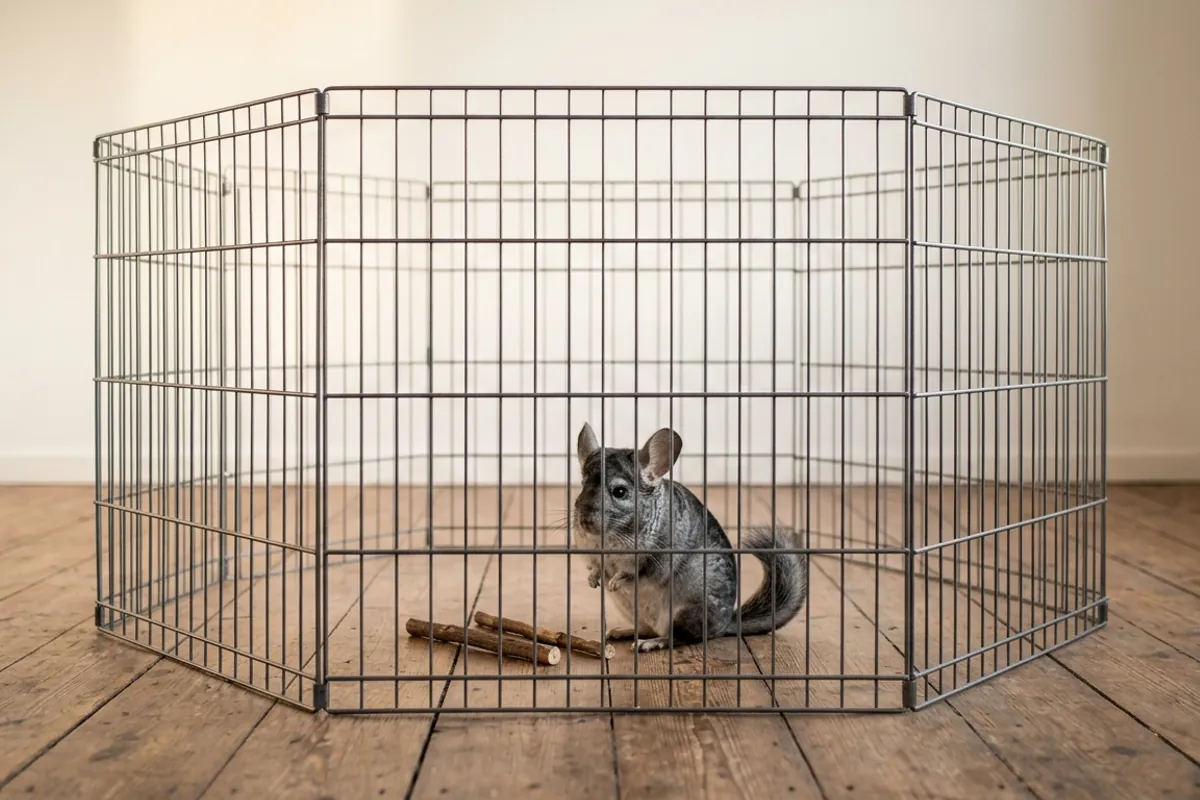
If you cannot proof a whole room, a playpen is the plain compromise. Metal panels, tall enough that she cannot clear them, on a hard floor. It is smaller than a room but infinitely safer than a room with a cable in it.
What chinchilla playtime looks like
The first time you see it, real chinchilla playtime is startling. She will sprint the length of the room, hit the wall, run partway up it, twist off, and land facing the other way. She will popcorn, which is a straight vertical hop with a mid air kick, and she will do it repeatedly for no visible reason. Then she will stop dead and sit motionless for two minutes.
All of that is normal. A chinchilla bouncing off walls at speed is a happy chinchilla, not a panicking one. You can usually tell the difference by the ears and the pauses: a frightened chinchilla runs in one direction, flattens, and hides, and she does not stop to groom herself halfway through. If you want the fuller vocabulary of what she is telling you, I go through it in chinchilla behavior.
Give the room some structure. A couple of sturdy wooden boxes, a low shelf, a plank leaning as a ramp: anything that lets her get off the floor and change levels. Flat open floor is less interesting to her than height is. Keep the surfaces hard and non slip where you can, since sliding on a rug at full speed is how a chinchilla twists something.
Playtime is also the natural slot for a dust bath. I put the bath house out for ten to fifteen minutes near the end, let her roll, and then remove it. Lixit Blue Beauty chinchilla dust, 3 lb As an Amazon Associate I earn from qualifying purchases. Leaving dust available all evening leads to overbathing and dry, irritated skin, and it is easier to control the timing outside the cage than in it. Dust only, never water, always.
What I do during all this is mostly nothing. I sit on the floor with a book. She investigates me, climbs on a knee, leaves again. That is the relationship working.
Getting her back in without a chase
End the session on your terms, before she is exhausted and before you are impatient. Chasing a chinchilla around a room is the worst possible finish: you will not win, and if you do get a hand on her badly you may end up with a mouthful of fur and a bald patch where she let it go on purpose. That release is called fur slip, it is a genuine escape reflex, and it takes months to grow back.
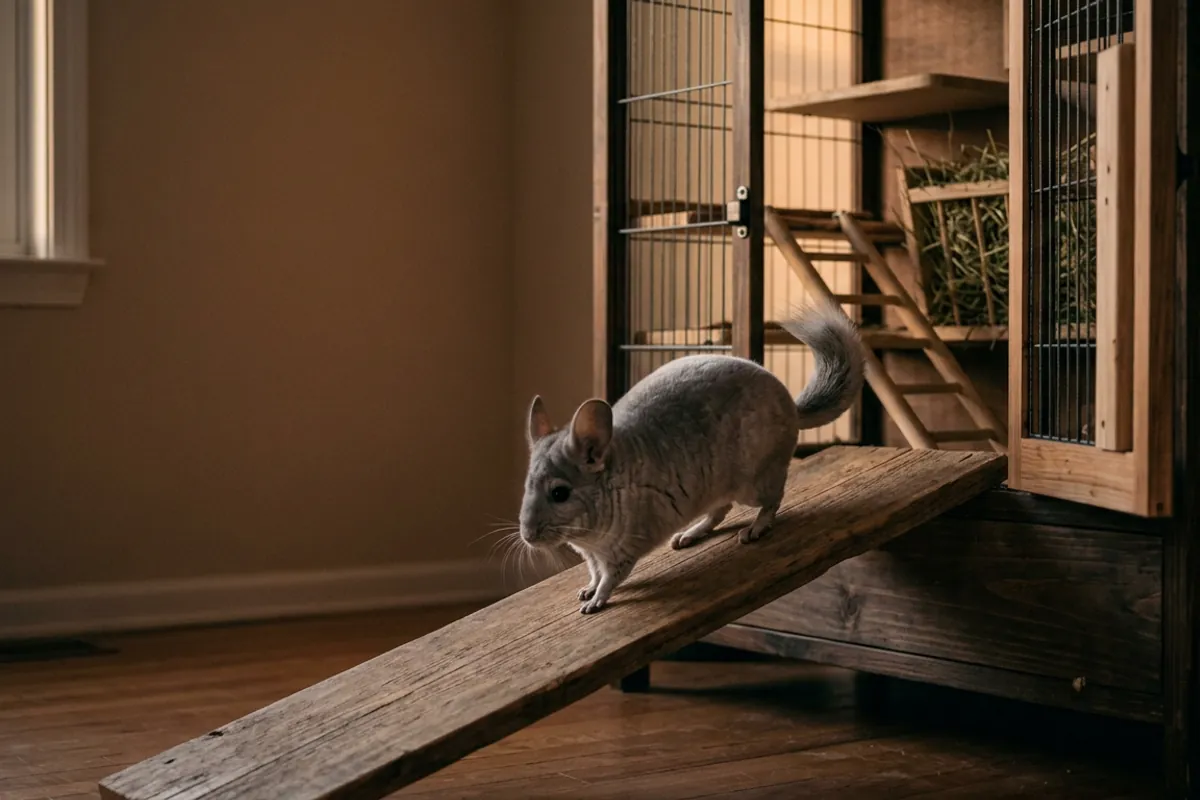
What works instead is making the cage the obvious destination. Put the cage on the floor if it is portable, or lean a wide plank up to the open door so the route in is easy. Then wait. Most chinchillas go home by themselves within a few minutes, especially if the session is a habit and the hay rack has been topped up just before.
If waiting is not working, use a small lure rather than your hands. A single rose hip, or a plain pinch of good hay held at the doorway, is usually enough. Keep treats tiny; the whole point of a lure is that it is a signal, not a meal.
The last resort is a carrier. Teach her that stepping into a carrier is normal and unremarkable, and you have a calm way to move her that does not involve a grab. That skill pays for itself the first time you need an emergency vet trip at eleven at night.
If she is fully out of reach and dug in behind something, dim the lights, sit down out of her eyeline, and go quiet. Chinchillas come out when a room settles far more reliably than when a person is crouched nearby whispering at them. What I do not do is leave the room, and I want to be consistent about that, because it is the same rule as everywhere else on this page: an out of cage chinchilla is never unsupervised. Quiet and still is the thing that works, not absent.
When I skip out of cage time entirely
There are nights when the right call is to leave the door shut.
Heat is the first and hardest rule, and it overrides everything else on this page. Chinchillas are comfortable at 60 to 70°F (15 to 21°C). Above 75°F (24°C) is risky, and 80°F (27°C) and up is an emergency, faster still in humid air, because that dense coat traps heat and they cannot shed it efficiently. Exercise generates heat. Pebble came to me from an overheated attic and had a near miss in her first summer that ended at an emergency vet, and the rule I took away from that night has not moved since: if the room is over 75°F, there is no playtime, no exceptions, no "just ten minutes". Put a thermometer in the room she runs in, not just on the cage, and read it before you open anything. digital thermometer and humidity gauge with remote probes As an Amazon Associate I earn from qualifying purchases. The full picture is in chinchilla heat safety and the heat danger calculator.
I also skip it when a chinchilla is newly home and still settling, usually for the first week or two while she learns the cage is hers. When she is unwell, off her food, sitting hunched, or producing fewer and smaller droppings than usual, the answer is a vet call and rest, not exercise. And when the room cannot be properly cleared that evening, the session simply does not happen. A missed night costs nothing. A cord costs everything.
What the cage still has to do
Here is the misunderstanding I want to kill: out of cage time does not buy you a smaller cage. An hour of running around the room does not offset twenty three hours in a box she cannot stand up and jump in. The cage is where she lives; the room is a supplement.
So the cage has to carry the daily load on its own. Tall, metal, with solid wooden ledges at staggered heights so she can climb rather than just pace. Critter Nation double unit small animal cage As an Amazon Associate I earn from qualifying purchases. A wheel earns its place if, and only if, the running surface is solid and continuous. Wire rungs and cross bars catch feet and legs, and the injuries they cause are ugly, so a solid surface is the only version worth buying. 15 inch Chin Spin solid surface chinchilla wheel As an Amazon Associate I earn from qualifying purchases. I go into sizing and mounting in the chinchilla exercise wheel.
Unlimited grass hay stays in front of her at all times, because it is both the whole meal and the dental system. Juniper came to me neglected, with dental disease I now manage day to day, and watching what happens when teeth do not get worn down properly is why I will not compromise on hay volume or chew variety. Pellets are a measured supplement, not the main event, and treats are close to nothing. Oxbow Western Timothy Hay, 40 oz bag As an Amazon Associate I earn from qualifying purchases.
Get the cage right and out of cage time becomes what it should be: a bonus that keeps her mind busy and her legs strong, rather than a rescue operation for a setup that is too small.
Signs it is working, and signs it is not
Working looks like this: she comes to the door on her own when it opens, moves in confident bursts rather than frantic flat out running, investigates instead of hiding, and goes home without a fight. Bar chewing eases. She sleeps properly afterwards.
Not working looks like a chinchilla who stays pressed in a corner the whole session, who has to be extracted every single time, or who comes back with fur missing. That is fear, not exercise, and the fix is usually a smaller space, a quieter room, or a step back to plain taming work before free roaming resumes.
And if you get to the end of a session and cannot honestly say the room was clear, the temperature was under 75°F, and she went back in calmly, change one of those three things before the next one. Everything good about out of cage time depends on those three, and nothing else about it is complicated.