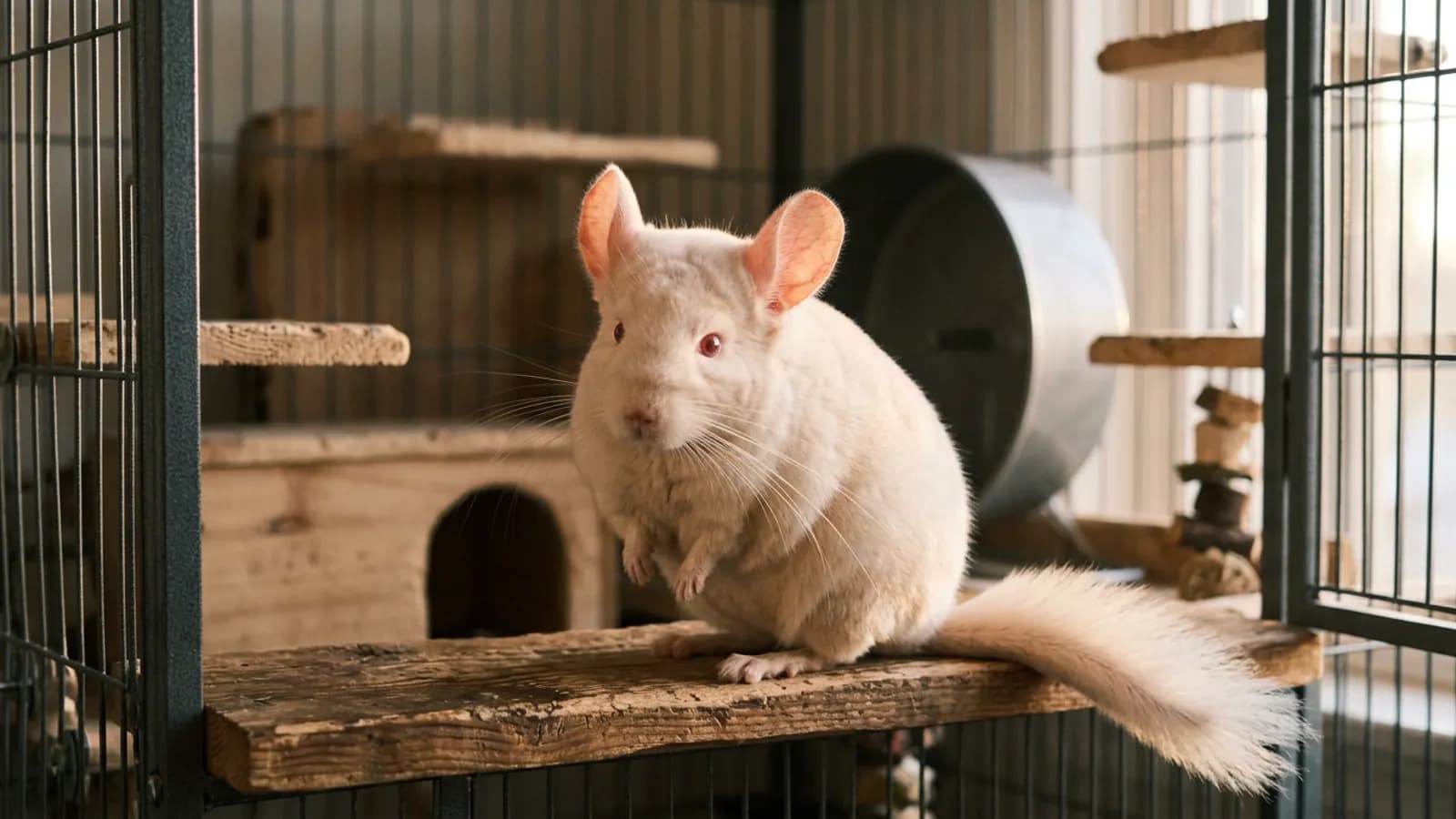
A chinchilla pink white is one of the prettier labels in the hobby, and one of the most misread. People see "pink white" and picture a chinchilla that is actually pink, the way a flamingo is pink or a cartoon is pink. That is not what the name means. A pink white chinchilla is a white animal carrying the beige gene, which lends the coat a warm champagne cast and turns the ears and skin a soft rosy shade. The pink you see is skin and eye colour showing through a pale coat, not pigment painted into the fur. I have kept chinchillas for about ten years, and colour names are where I see new owners get the most confused, so let me walk through exactly what this one is, where the pink comes from, and the part that matters most: what the colour changes about care, which is nothing at all.
What a pink white chinchilla actually is
Every fancy chinchilla starts from the wild-type animal, the dense silver-gray one with the dark slate underfur. Every colour you have ever seen a name for is one or more mutations stacked on top of that base. A pink white is a combination of two of them: the beige gene and the white gene.
Beige is a dominant mutation that warms the whole coat toward a champagne or light tan, lightens the eyes toward ruby or red, and gives the ears a distinctive pink flush. White, in the form most commonly behind these animals, is also a dominant mutation. On its own it lightens and can produce anything from a mostly white coat to the silvered, ticked pattern people call silver or mosaic, depending on how it expresses. Put beige and white together and you get a coat that reads as white or near white but carries beige's warmth through it, with pink ears and eyes that range from dark to red depending on how much beige is in the mix.
So "pink white" is shorthand for a specific recipe: white plus beige. It is not a separate species, not a rare breed, and not a sign of anything unusual about the animal's health. If you want the plain white version without the beige warming, that is a different animal, and I wrote about it separately in what a white chinchilla actually is. The pink white is the white animal with beige stirred in.
Where the pink actually comes from
The word "pink" does the most damage here, so it is worth being precise. A white pink chinchilla is not producing pink pigment. Chinchilla fur pigment runs in the black to brown to yellow range, the same eumelanin and pheomelanin every mammal uses. There is no pink dye in the biology.
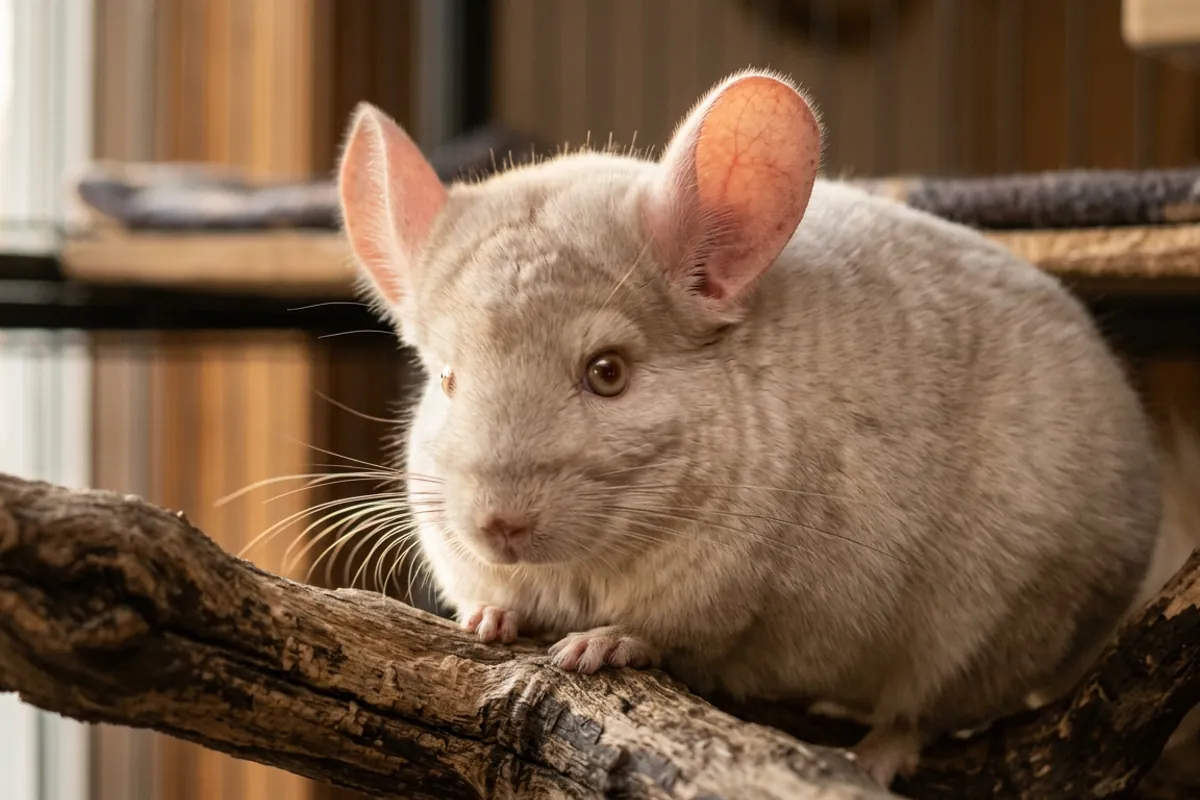
What you are seeing is two things at once. First, the ears. Chinchilla ears are thin and nearly hairless, so the blood supply underneath shows through the skin. In a dark chinchilla the ear skin is grey and you never notice. In a beige or pink white animal the skin carries far less pigment, so the pink of the blood underneath reads clearly, and the ears look rosy. Second, the eyes. Beige lightens eye colour, so a pink white often has red, ruby, or pink-tinged eyes rather than the black eyes of a standard grey. Between the rosy ears and the light eyes, the animal reads as "pink" even though the coat itself is white with a warm champagne veil.
This is the same reason people mislabel these animals as albino. A true albino makes no pigment at all, and I have never met one that actually fit the definition. Almost every "albino" chinchilla for sale is really a white or a pink white, which does make pigment, just far less of it. If that distinction interests you, I went through it in detail in what an albino chinchilla really is. The short version: pink ears and light eyes do not make an albino, they make a beige-carrying white.
Pink white next to the other white and pale colours
It helps to place the pink white alongside its neighbours, because the pet shop names blur together fast. A plain white chinchilla is white without the beige warmth, with grey ears and darker eyes. A black and white chinchilla usually means a white with dark patterning, sometimes sold as silver or as a mosaic. A chinchilla mosaic is a pattern of white and grey rather than a single solid colour, which is why I keep saying mosaic is a pattern and not a colour. Beige on its own gives you a solid champagne animal with the same pink ears but no white lightening.
Then there are the colours people reach for when they want something dramatic: sapphire, violet, and the so-called purple that is really a deep violet. All of those are recessive mutations that behave very differently in breeding from the dominant beige and white behind a pink white. A pink and white chinchilla sits firmly in the dominant, warm, pale corner of the family. None of that changes anything about how the animal lives, but it does change what a breeder can honestly tell you about pairing it, which I will get to.
What the colour never changes
Here is the part I care about most, and the part a colour article usually buries. The colour changes nothing about care. A pink white chinchilla needs exactly what a standard grey needs: a cold room, unlimited hay, endless things to chew, a dust bath, and a cage built for a jumping animal. The pink ears do not make it more delicate. The light eyes do not mean it sees poorly enough to need special handling. It is a chinchilla, and the mutation only touched the coat and eye colour, not the biology underneath.
I say this because colour-marketed animals often come with a price premium and a whisper that they are somehow special or fragile. They are not. If you want the full honest picture of what living with one of these animals actually asks of you, I put it in chinchilla as pets, the honest version. Everything in it applies to a pink white identically.
Heat safety comes first, colour comes nowhere
If you take one thing from this article, take this one, because it is the thing that kills chinchillas. Coat colour has nothing to do with heat tolerance. A pink white overheats at exactly the same temperatures a grey does, and a pale coat gives you no margin whatsoever.
Chinchillas are comfortable at 60 to 70°F (15 to 21°C). Above 75°F (24°C) you are into risky territory, and 80°F (27°C) and up is an emergency, faster in humid air because a chinchilla dumps heat by radiating it from those thin ears and cannot do that when the room is both hot and damp. This is not an abstract number to me. My Pebble came out of an overheated attic, and her first summer brought a heatwave near-miss and a night at the emergency vet. That scare is why I am relentless about temperature, and why the heat guidance on this whole site is really Pebble's story turned into rules.
So keep the room cold, put a thermometer where the animal actually lives rather than trusting the wall, and know your ceiling. A cheap cage thermometer and hygrometer that reads both heat and humidity is the single most useful ten dollars you will spend. digital thermometer and humidity gauge with remote probes As an Amazon Associate I earn from qualifying purchases. A chunk of chilled granite gives the animal a place to dump heat on a warm afternoon, and a cooling stone is safe, chewable, and passive. Kaytee Chinchilla Chiller granite stone As an Amazon Associate I earn from qualifying purchases. Neither of those is a substitute for a cold room, though. If you cannot hold the room under 75°F (24°C) reliably, that is the problem to solve before anything else. I keep a heat danger calculator on the site for exactly this, and the heat stroke warning signs are worth learning cold before you ever need them.
Teeth and hay, the same for every colour
The other thing the colour never changes is the mouth. Chinchilla teeth grow continuously for the animal's whole life, and they only stay the right length if the animal grinds them down all day on the right food. That means unlimited grass hay first, always, with plain pellets as a small measured supplement and nothing sugary as a regular treat.
I am uncompromising about this because of Juniper. She came to me a neglected rescue with dental disease I now manage day to day, and I have watched up close what happens when teeth do not get worn down. It is not a cosmetic problem. Overgrown roots press into the jaw and eyes, the animal stops eating, and by the time you see drooling or weight loss you are already deep into a veterinary problem. A pink white with untreated dental disease suffers exactly as much as any grey would.
So the hay is not optional and it is not a snack. It is the whole foundation of the diet, available every hour of every day. I buy timothy in bulk so I never run short and never ration it. Oxbow Western Timothy Hay, 9 lb box As an Amazon Associate I earn from qualifying purchases. A hay box keeps it off the cage floor and out of the soiled bedding, which cuts waste and keeps the animal eating from the clean middle rather than the trampled edges. Oxbow Western Timothy Hay, 40 oz bag As an Amazon Associate I earn from qualifying purchases. Alongside the hay, give real chewing variety, because a single wooden block gets boring and a bored chinchilla stops chewing. A variety pack of safe woods keeps it interesting and keeps the molars working. emours apple wood chew sticks, 40 count As an Amazon Associate I earn from qualifying purchases. If any of your animals ever drools, drops weight, paws at its mouth, or leaves hay uneaten, that is a vet visit, not a wait-and-see. Dental disease is one of the clearest lines where an exotics vet is the right call, every time. I laid out what to watch for in chinchilla teeth problems.
The dust bath and keeping a pale coat clean
People do worry that a white or pink white coat shows dirt more, and honestly, it does a little. A grey coat hides a grubby patch that a white coat announces. The answer is not to bathe the animal more cleverly, it is to bathe it the way every chinchilla should be bathed: in dust, never in water.
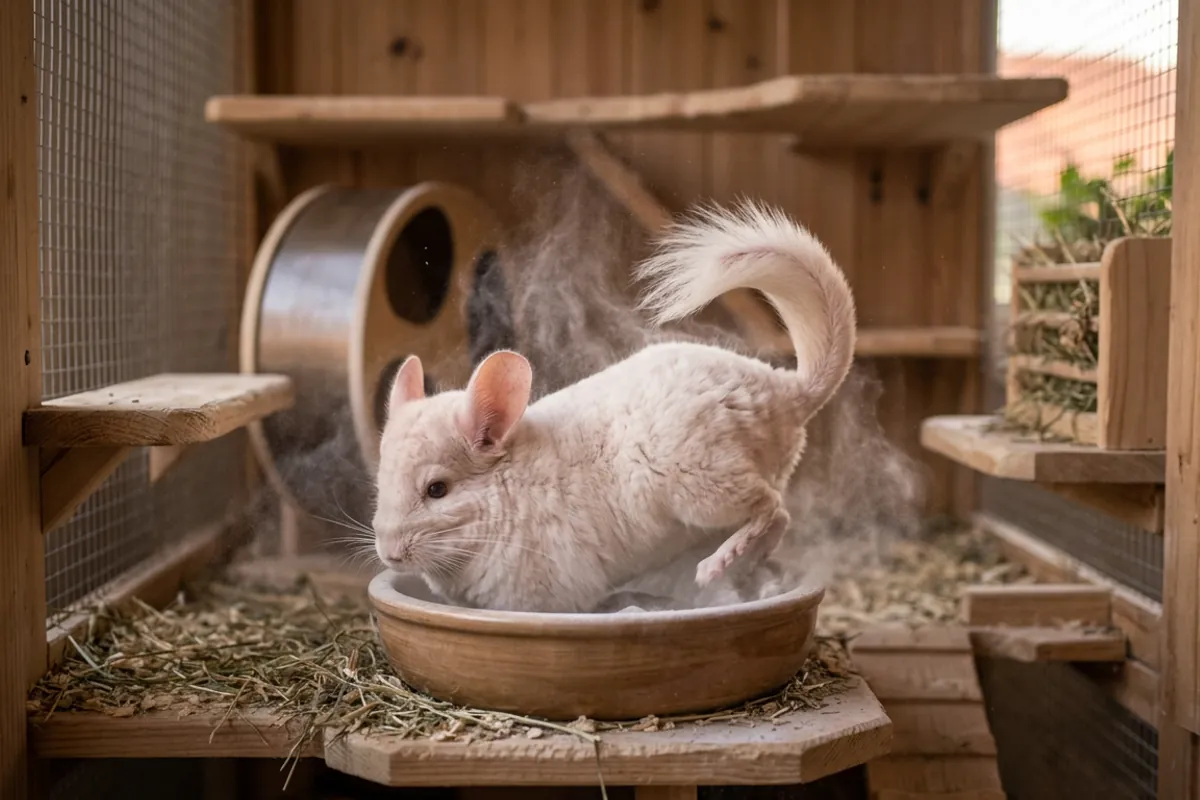
Chinchillas clean themselves by rolling in fine volcanic dust that works through the dense coat and pulls out oil and grime. Water is genuinely dangerous for them, because that coat is so dense it does not dry properly, traps damp against the skin, and invites fungal infection. A wet chinchilla is a problem, not a bath, and I explained why in chinchilla wet. The correct bath is a dust bath, and a proper chinchilla dust is fine pumice-based powder, not sand and not craft dust. Lixit Blue Beauty chinchilla dust, 3 lb As an Amazon Associate I earn from qualifying purchases. Offer the bath a couple of times a week rather than leaving it in the cage, because too-frequent bathing dries the skin. On a pink white the dust does the same job it does on a grey, it just shows results you would not notice on a darker animal. If you want the full method, from dust choice to schedule, I put it in the chinchilla dust bath done right.
Buying a pink white without getting burned
Colour sells, and pink white sells especially well because the name sounds exotic and the animals photograph beautifully. That is exactly why I want you cautious. A pink white should not cost dramatically more than a standard grey from an honest breeder, and a big premium is usually a sign that you are paying for the label rather than the animal. Judge the chinchilla, not the colour: clear eyes, a clean dry bottom, steady weight, a body that feels solid rather than bony through the fur, and an animal that moves well.
Ask about the breeding, too, because the genetics behind a pink white matter here. The white gene is widely thought not to be viable in a double dose, which is why careful breeders avoid pairing two white-gene animals together. I would treat a breeder who cannot speak to that, or who cannot tell you the parents' colours, as a reason to walk away. This is the same judgement I apply to any colour animal, and I laid the whole buying process out in how to buy a chinchilla without regretting it later.
Whatever colour you bring home, set the space up before the animal arrives. That means a tall cage in metal and wood with wooden ledges and no plastic, because a chinchilla chews everything and plastic passes through the gut in fragments that can block it. Critter Nation double unit small animal cage As an Amazon Associate I earn from qualifying purchases. It means a solid-surface wheel rather than a wire one, because a wire rung catches a foot or a tail and breaks it. 15 inch Chin Spin solid surface chinchilla wheel As an Amazon Associate I earn from qualifying purchases. A pink white in a proper setup, in a cold room, with unlimited hay and dust, lives the same long healthy life any well-kept chinchilla does. The colour was only ever the coat. Everything that keeps the animal alive sits underneath it, identical for every chinchilla in the family.