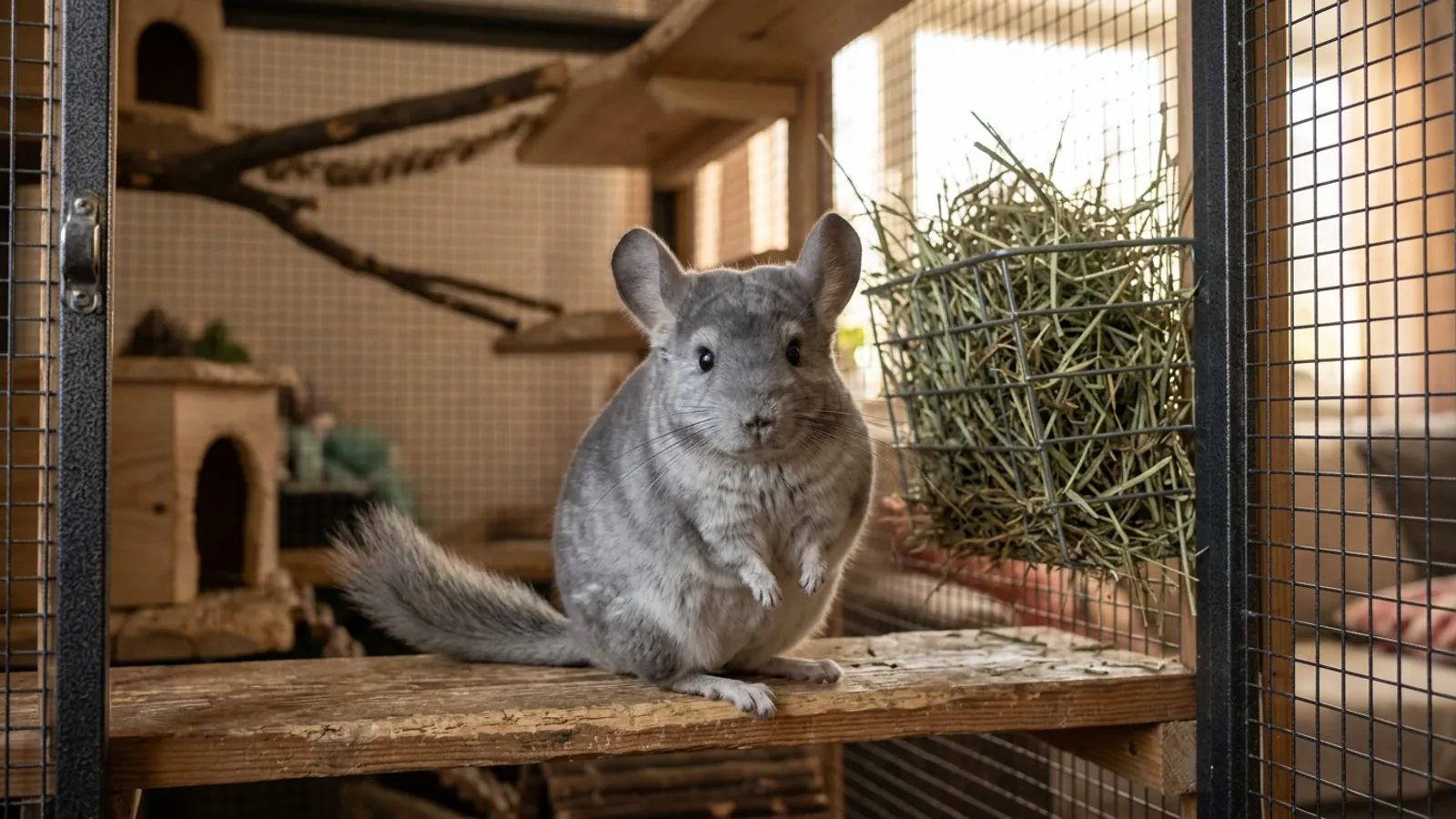
The pet chinchilla lifespan is measured in decades, not years, and after ten years of keeping them I have written it out below with the numbers exactly as they stand, the story behind why I am so uncompromising about heat and teeth, and the plain deal you are signing up for.
===
The chinchilla lifespan pet owners should plan for is longer than almost anyone guesses. A well kept chinchilla lives 15 to 20 years, and a handful reach further still. I have kept chinchillas for about ten years, and the two who share my home now, Pebble and Juniper, are living proof that this is not a short commitment you take on lightly. When you bring one home, you are not signing up for the couple of years a hamster gives you. You are looking at a stretch of your life closer to what a dog asks, sometimes longer, and the number you get depends far more on your care than on luck.
What a pet chinchilla lifespan really looks like
The plain range is wide. Most sources, and my own experience with other keepers, put a pet chinchilla lifespan at 10 to 20 years, with 15 or more being realistic when the animal is kept well. That spread is not vagueness for its own sake; it reflects how much husbandry moves the needle. A chinchilla kept in a hot room, fed the wrong food, or crammed into a cage that lets it hurt itself will land at the bottom of that range or below it. One kept cool, fed hay first, and given room to move can hit the top and keep going.
By "well kept" I mean a short list of things I will come back to through this article: a cool room, unlimited grass hay, plenty to chew, a safe cage, and no water baths. None of it is exotic. It is just done every day, for years.
There are outliers on the record books. The oldest chinchilla on record reportedly lived to 29 years, which tells you the ceiling of the species is genuinely high. I would not treat that as a target, because it is a record for a reason, but it does frame the point: these are long lived animals, and if yours dies at three or four, something went wrong that was almost certainly preventable. If you want the fuller breakdown of the numbers, I have written it out in how long chinchillas really live and chinchilla life expectancy.
Why chinchillas outlive other small pets
People come to chinchillas expecting rodent math. A hamster is a two year pet. A rat, for all its charm, is usually gone in three. A guinea pig, closer to a chinchilla in family, runs five to seven. So a rodent that can pass fifteen feels like a trick.
It is not a trick, it is biology. Chinchillas belong to a group of South American rodents that mature slowly, breed slowly, and live long by rodent standards. A female carries a litter for around 111 days, which is enormous for an animal this size, and the young are born fully furred with their eyes open, ready to move. That slow, heavily invested reproduction goes hand in hand with a long life; animals that pour that much into few offspring tend to be built to last. When you keep a chinchilla, you are keeping an animal whose whole biology runs on a longer clock than the small furry pets it sits next to on the shelf. That is exactly why I push people to understand what a chinchilla really is before they buy one, because the care rules all fall out of that biology.
The wild number versus the home number
Here is the part that surprises even people who know chinchillas live long: the wild number is shorter than the home number, not longer. In their native range, thousands of meters up in the Andes, chinchillas live perhaps 8 to 10 years. Predators, brutal cold at altitude, scarce food, and disease all take their cut. A home, done right, removes almost every one of those threats, which is why a protected pet can roughly double what a wild one gets.
That should reframe how you think about your job. You are not fighting your chinchilla's nature to keep it alive a long time; you are removing the dangers that would have killed it in the wild and then not adding new ones of your own. The trouble is that domestic life brings its own hazards the Andes never had: overheated living rooms, sugary treats, plastic to chew and swallow, wire wheels that catch a leg. Get those out of the way and the long life is largely the default rather than something you have to fight for. If the wild side interests you, I go deeper in what a chinchilla in the wild is really like.
Heat is the fastest way to cut the number short
If I could make every new owner remember one thing, it would be this: heat kills chinchillas faster than anything else on this list, and it does it quietly. A chinchilla's coat is so dense that it holds heat superbly, which is wonderful high in the mountains and lethal in a warm apartment. They cannot pant effectively and they do not sweat. Once they overheat, they go down fast, and there is not much warning.
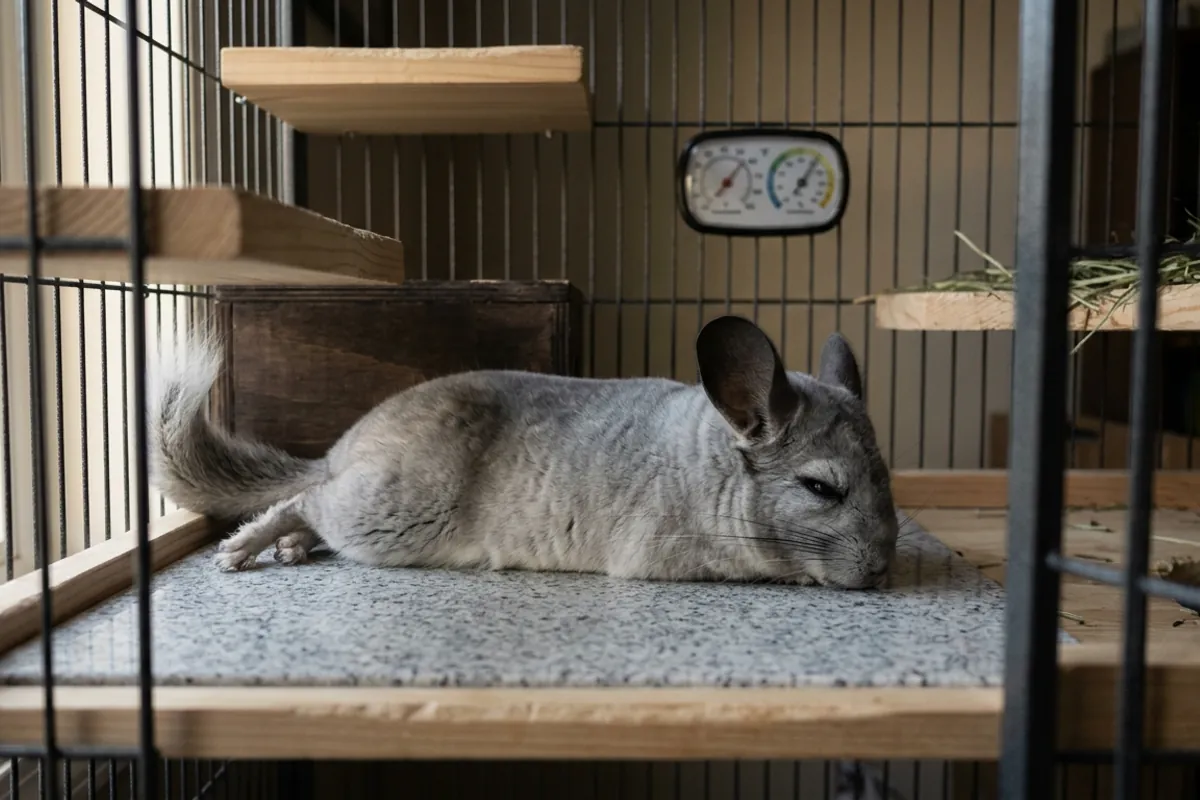
I learned this the hard way with Pebble. I adopted her out of an overheated attic, and her first summer with me brought a heatwave that nearly took her. One night at the emergency vet rearranged my priorities permanently. Everything I believe about temperature comes from that scare, and this is not negotiable.
The numbers are not negotiable. A chinchilla is comfortable at 60 to 70°F (15 to 21°C). Above 75°F (24°C) you are into risky territory, and 80°F (27°C) and up is an emergency, sooner if the air is humid, because humidity strips away what little cooling they can manage. I keep a combined thermometer and hygrometer on the cage so I am reading the actual air the animal breathes, not guessing from how the room feels to me. digital thermometer and humidity gauge with remote probes As an Amazon Associate I earn from qualifying purchases. A cool granite or marble slab in the cage gives a chinchilla somewhere to dump heat on a warm day. Kaytee Chinchilla Chiller granite stone As an Amazon Associate I earn from qualifying purchases. Neither of those replaces air conditioning when the room climbs; they buy margin, they do not perform miracles, and I plan every summer around keeping the whole room cool rather than hoping an accessory covers for me.
Know what heat stroke looks like before you ever need to: red ears, lying flat and stretched out, drooling, labored breathing. If you see it, cool the animal and get to an exotics vet. I have written the signs out in detail in chinchilla heat stroke warning signs, the temperature rules in chinchilla temperature, and there is a heat danger calculator if you want to check your own room against the risk. A single heat death shaves a decade or more off a life that should have run long.
Teeth and hay decide the slow years
Heat is the fast killer. Teeth are the slow one, and they steal just as many years if you let them. A chinchilla's teeth never stop growing, all of them, for its whole life. In the wild, chewing tough, abrasive plants wears them down at the same rate they grow. At home, if the diet does not do that grinding work, the teeth overgrow, the roots go wrong, and you get malocclusion: a painful, progressive dental disease that makes eating agony and can end a life years early.
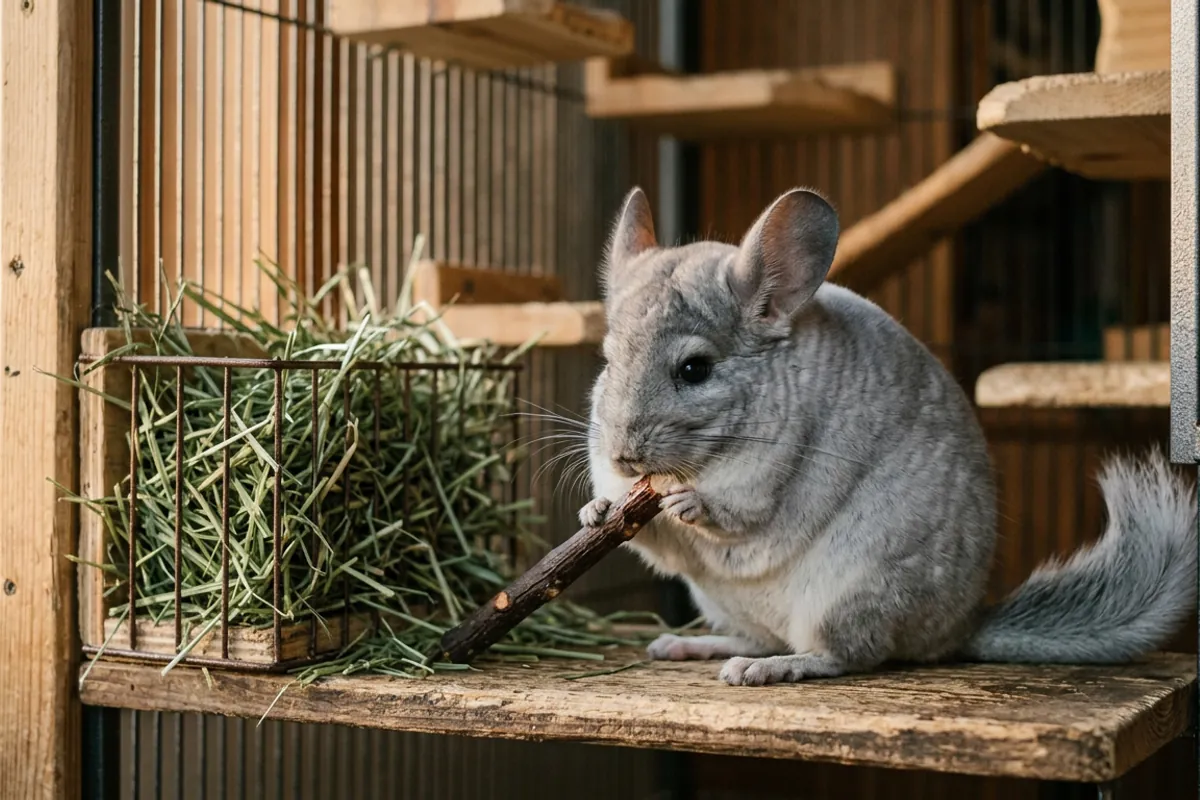
My Juniper came to me as a neglected rescue, and I manage her dental disease every single day. Watching up close what poor teeth do to an animal is why I am uncompromising about two things. First, unlimited grass hay, always available, because chewing hay is the wear that keeps teeth in check. Second, a real variety of safe wood chews, so the jaw works and the teeth stay ground down instead of drifting out of line. Apple wood is a staple in my cages for exactly this reason. emours apple wood chew sticks, 40 count As an Amazon Associate I earn from qualifying purchases.
Learn what healthy teeth look like so you can catch trouble early: they should be yellow to orange, not white, and the lower pair should meet the upper cleanly. The warning signs are drooling, dropping food, weight loss, pawing at the mouth, and a sudden preference for softer food over hay. Malocclusion is a vet job, not a home fix, and the vet has to be one who sees exotics; a cat and dog clinic is not equipped for a chinchilla's mouth. I walk through the whole picture in chinchilla teeth and the disease specifically in chinchilla teeth problems. Caught early, a lot of dental trouble is manageable for years. Ignored, it is one of the surest ways to lose an animal well before its time.
Feeding for a long life
Diet is where the long life is either built or thrown away, and it is simpler than the pet aisle wants you to believe. Grass hay is the whole meal, not a side dish. Timothy hay should be in front of your chinchilla at all times, unlimited, because it does double duty: it wears the teeth and it keeps the gut moving, and a chinchilla's gut is not forgiving when it stalls. I buy it in quantity so I never run dry and never have to ration it. Oxbow Western Timothy Hay, 9 lb box As an Amazon Associate I earn from qualifying purchases.
Pellets come second, and they are a measured supplement, not the main course. A plain, chinchilla specific pellet in a modest daily amount rounds out what hay does not cover, and that is it for the staples. Fresh water in a bottle, checked daily, is the other constant. Treats are where good intentions do the damage: dried fruit, nuts, seeds, yoghurt drops, anything sugary or fatty works against a long life and can wreck the gut. I keep treats rare and boring by pet shop standards, mostly a plain rose hip now and then.
Two more rules that are really about not shortening the life. Chinchillas never bathe in water; a wet coat cannot dry properly down to the skin and invites fungus and worse. They bathe in fine dust instead, and a dust bath a few times a week keeps the coat healthy. Lixit Blue Beauty chinchilla dust, 3 lb As an Amazon Associate I earn from qualifying purchases. And the cage itself has to let the animal live without hurting itself: tall, metal and wood, no plastic to chew and swallow, with a solid running surface if you add a wheel rather than wire that can snap a leg. 15 inch Chin Spin solid surface chinchilla wheel As an Amazon Associate I earn from qualifying purchases. I have the diet laid out fully in chinchilla diet, food, and hay and what to feed a chinchilla.
What the years ask of you
A 15 to 20 year animal is a very different decision than a two year one, and I would rather you sit with that before you buy than regret it in year three. Fifteen years crosses moves, relationships, jobs, and money. It means a real vet fund, because an exotics vet is not cheap and a chinchilla that lives long will eventually need one for teeth or age. It means finding that vet before there is an emergency, not at ten at night with a struggling animal. And it means someone keeping the room cool every summer for the animal's whole life, not just the summer you brought it home.
The back end of that lifespan changes too. An old chinchilla slows down, may lose weight, may need softer food, warmer footing, and closer watching. That is not failure, it is age, and it deserves the same care the young years got. I have written about that stage in what an old chinchilla really is.
None of this is meant to scare you off. I have had about ten years of the best small animal company I can imagine, and I expect a good many more. But the long chinchilla lifespan that makes them such rewarding pets is also the whole responsibility, not a bonus tacked on the end. Keep them cool, feed them hay first, give the teeth something to grind, skip the plastic and the wire, and the years mostly take care of themselves. Do the opposite and the number collapses. That is the plain deal, owner to owner.