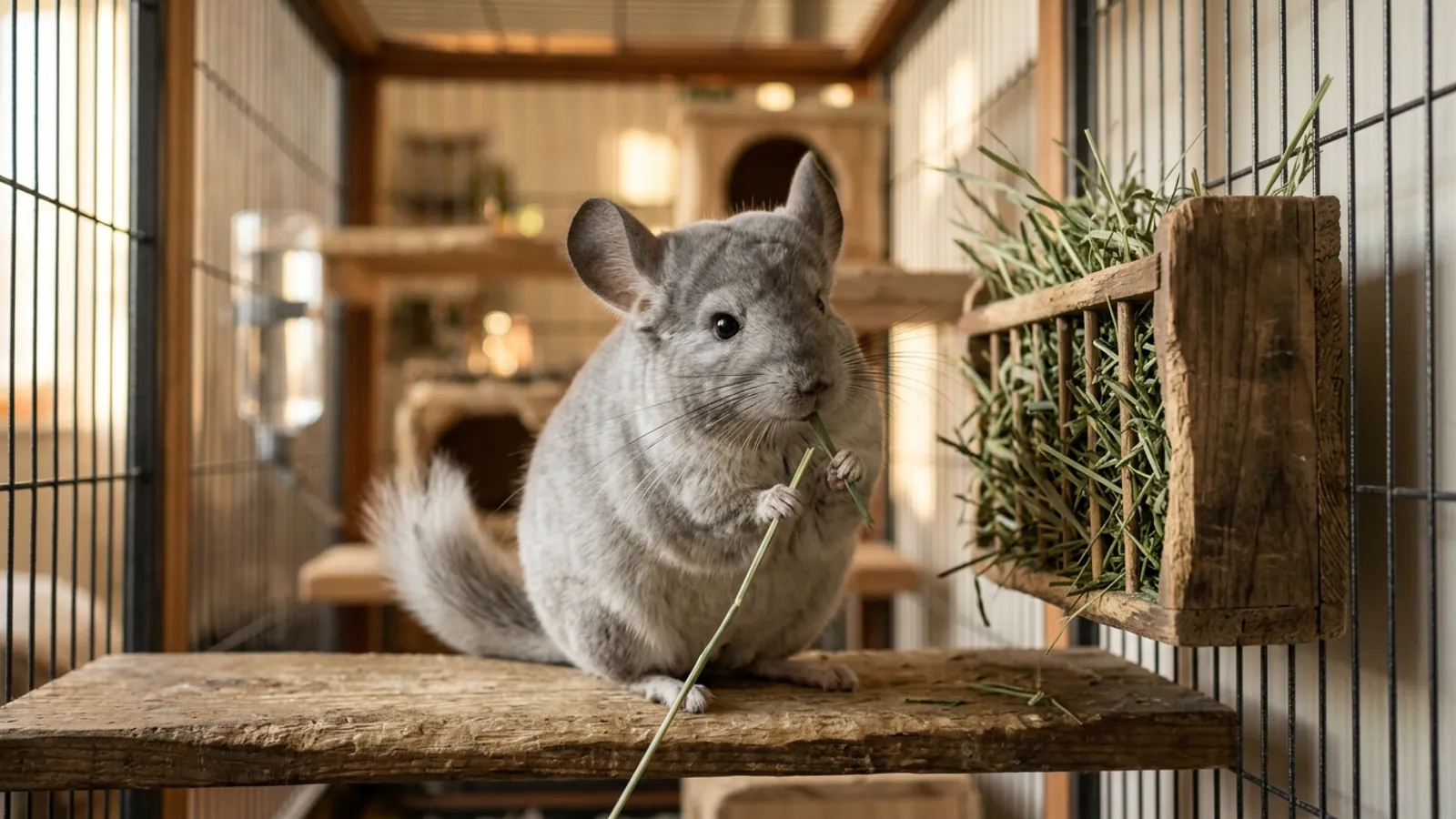
If you want the quick answer on what to feed a chinchilla, here it is: unlimited grass hay, a small measured amount of plain pellets, fresh water, and very little else. That is not me being lazy with the answer. A chinchilla's gut is built to process a steady stream of coarse fiber, and the closer you stay to that, the fewer problems you will ever have. Most of the feeding mistakes I see, and I made a couple myself in the early years, come from adding things a chinchilla was never designed to eat. So I am going to walk through the whole menu: what belongs on it, what to keep down to a crumb, and what I keep out of the cage entirely.
Hay is the whole meal, not a side dish
When people ask what should I feed my chinchilla, they usually expect the answer to be a bag of something colorful from the pet store. It is not. It is hay, and it should be in front of your chinchilla every hour of every day. Grass hay, timothy most commonly, is the foundation of the entire diet. It is not bedding, and it is not a snack between meals. It is the meal.
Two things make hay non negotiable. The first is fiber. A chinchilla's digestive system needs coarse material moving through it constantly to keep working, and long stem hay is the only thing that supplies that in the volume required. The second is teeth. A chinchilla's teeth grow continuously for its whole life, and the sideways grinding motion of chewing hay is what wears them down to the right length. My rescue Juniper came to me with dental disease, and I manage the fallout of teeth gone wrong every single day. Watching that up close is exactly why I will never soften the hay rule for anyone. Unlimited hay is not generosity, it is preventive dentistry.
Timothy is the sensible default for a healthy adult, but other grass hays work too, and rotating them keeps things interesting: orchard grass, meadow hay, oat hay. What I do not use as an everyday hay is alfalfa. Alfalfa is a legume rather than a grass, and it runs much higher in calcium and protein than an adult chinchilla needs. It has a place for a growing kit or a pregnant female, but as a daily staple for a healthy adult it is simply too rich.
Buy hay you can judge with your own senses. Good hay is green, smells sweet and faintly like a summer field, and is not brown, damp, or so dusty it makes you cough. I keep it in a rack or feeder rather than loose on the cage floor, where it gets soiled and wasted, though a generous pile to burrow into is fine as long as you refresh it often. I keep a boxed timothy by the cage for the daily feeder. Oxbow Western Timothy Hay, 40 oz bag As an Amazon Associate I earn from qualifying purchases. The rest I buy in bulk, which is cheaper per pound and means a bag never runs low and I am never tempted to stretch old hay. Oxbow Western Timothy Hay, 9 lb box As an Amazon Associate I earn from qualifying purchases. If you want the deeper version of why hay carries the whole diet, I laid it out in the piece on chinchilla hay and on timothy hay for chinchillas.
Pellets are a measured supplement, not the main course
Pellets are where the phrase chinchilla feed usually points, and they do matter, but they are the supporting act, never the lead. A good plain pellet fills the small nutritional gaps that hay alone can leave, and that is the entire job it has. The common mistake is treating pellets as the meal and hay as the garnish, which has it exactly backwards.
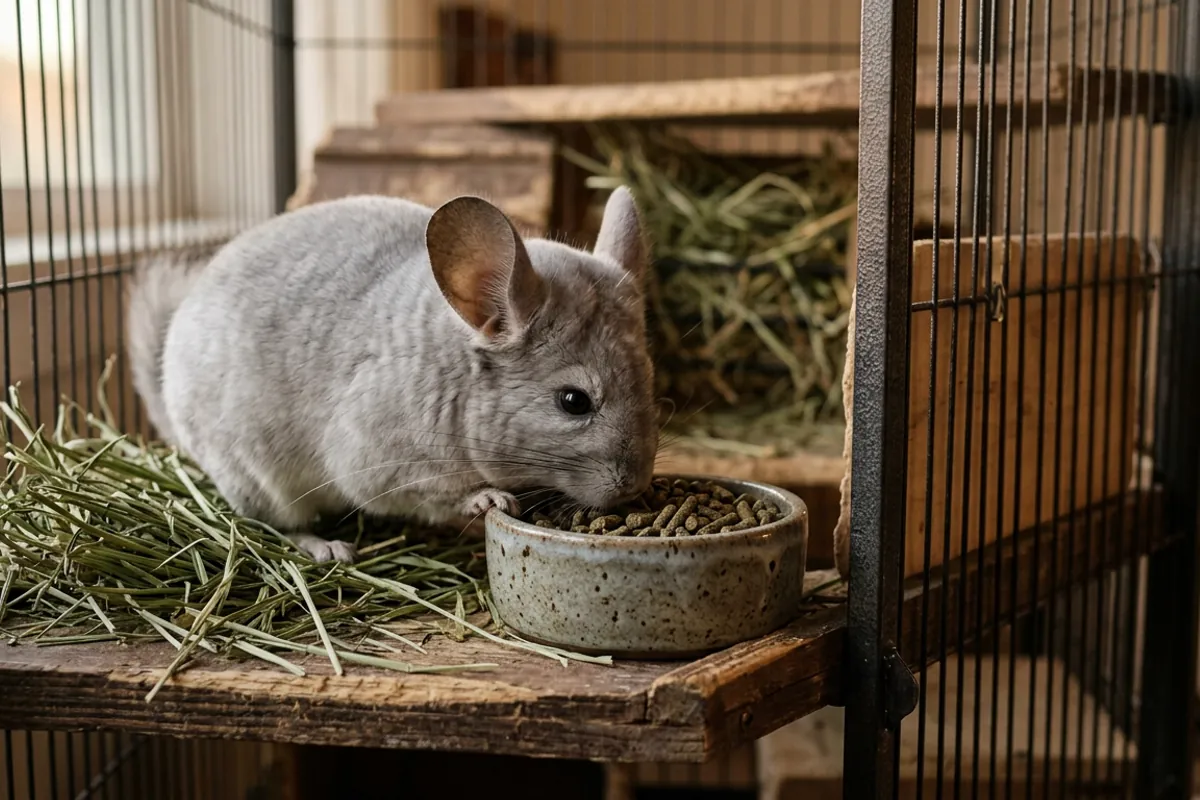
Feed a measured amount, not a full bowl kept topped up. For a healthy adult, roughly one to two tablespoons of pellets a day is the range most keepers and pellet makers settle on. I measure it out rather than eyeballing, because a chinchilla that fills up on pellets eats less hay, and eating less hay is bad for both the gut and the teeth.
Buy the plainest pellet you can find. You want a uniform single kind pellet, ideally timothy based, with nothing added. Skip anything sold as a muesli or a mix, those colorful bags with dried fruit, seeds, corn, and puffed pieces. Chinchillas are selective feeders: given a mix, they pick out the sweet fatty bits and leave the fibrous ones, so you end up feeding a junk diet by their choice rather than yours. Serve the pellets in a small heavy ceramic bowl that cannot be tipped or chewed apart, not a plastic cup, which a chinchilla will happily destroy and swallow pieces of. For brand specifics and portioning, I go into it on chinchilla pellets and Oxbow chinchilla pellets.
What can you safely feed beyond hay and pellets
This is the part everyone wants to know: what can you feed a chinchilla as a treat. Very little, very rarely, and always in a piece smaller than you think is worth bothering with. A chinchilla's digestive system is delicate and was never built for sugar, fat, or moisture, so the treats I use are dry, plain, and tiny.
The short safe list I stick to is close to the whole list: a couple of plain rolled oats, a single dried rosehip, or a small pinch of a plain dried herb such as dandelion leaf or nettle. A treat should be about the size of a raisin, offered once or twice a week at most, never daily. It is a bonding tool and a training reward, not nutrition, and nothing on that list is doing your chinchilla a nutritional favor, so keep the portions honest and small.
What I steer people away from, even though it gets recommended around the internet, is fresh fruit and vegetables. The water and sugar in them do not agree with a chinchilla gut, and a soft slice of banana or a piece of carrot is an easy way to bring on loose stool or something worse. For the full sorted list of yes and no, I keep it current on chinchilla treats and on what can a chinchilla eat.
The foods I never put in the cage
Just as important as what can I feed my chinchilla is the list of what I never do. These are not maybes or personal preferences. They cause real harm.
Nuts and seeds are far too high in fat, and a fatty diet damages a chinchilla's liver over time. Fresh fruit and vegetables carry too much water and sugar and can trigger bloat and diarrhea, which in an animal this small turns dangerous quickly. Dried fruit is no better, it is just concentrated sugar. Muesli style mixes cause the selective feeding problem I described above. Anything meant for people, chocolate, crackers, cereal, dairy, is off the table completely, because chinchillas cannot handle fat, sugar, or lactose. And grass you cut yourself is a firm no, because fresh wet grass is not dried hay and can ferment in the gut.
The through line is simple. If it is moist, sugary, fatty, or processed, it does not go in the cage. A chinchilla evolved on sparse dry mountain vegetation, and its gut never got the update for a richer diet. When in doubt, leave it out and offer more hay instead. For the reasoning behind that, what do chinchillas eat in the wild lays out why the wild diet still rules the food bowl at home.
Chews keep the teeth in check
Food is not the only thing a chinchilla puts in its mouth, and chewing is part of feeding when the teeth never stop growing. Hay does the bulk of the wear, but safe wood to gnaw on gives the teeth extra work and keeps a bored chinchilla busy instead of chewing at the cage bars.
Safe woods include apple, pear, and other untreated fruit and hardwoods, along with plain kiln dried pine that has been prepared for pets. I keep a rotation of apple wood chew sticks in the cage at all times. emours apple wood chew sticks, 40 count As an Amazon Associate I earn from qualifying purchases. What I keep well out is anything treated, painted, or scented, with cedar and fresh green softwoods among the worst, because their oils are not safe to chew. Lava ledges fixed to the cage bars give another hard surface to wear teeth on, and I use a couple of those alongside the wood. This is dental care, not cage decoration, and it was Juniper who taught me to take it that seriously. There is more on the how and why in chinchilla chew toys and on lava ledges for chinchillas.
Water belongs on the menu too
Water gets left out of feeding advice, and it should not be. Fresh clean water needs to be available at all times, and I give it through a sipper bottle rather than an open dish, because a dish gets fouled with droppings, hay, and dust within hours. Check it daily, top it up, and wash the bottle properly on a schedule so the spout does not clog or grow a film inside.
The one thing a chinchilla must never do is bathe in that water. They clean their dense fur in fine volcanic dust, never water, and a soaked coat is a genuine health problem because it cannot dry out properly against the skin. So the bottle is strictly for drinking, and dust is for bathing. If that split is new to you, chinchilla dust covers the bathing side, and for a bottle that does not leak or clog I wrote up chinchilla water bottle.
How much, how often, and when to worry
Put together, a day of feeding is boring by design, and that is the point: hay available every hour, one to two tablespoons of plain pellets, fresh water, safe wood to chew, and a tiny treat only now and then. I feed the pellets at a consistent time each day so I can see at a glance whether the last lot got eaten, which is one of the earliest signs that something is off.
Change food slowly. If you switch hay brands or pellet types, mix the new into the old over a week or two rather than swapping overnight, because an abrupt change upsets a sensitive gut. The same goes for a chinchilla you have just brought home: keep it on whatever it was already eating for a while, then transition gently once it has settled.
Now the part that matters most, and it is not really about the food going in but the output coming out. Healthy chinchilla droppings are plentiful, firm, and dry. If the droppings turn small, scarce, or stop, if your chinchilla goes off its food, drools, paws at its mouth, or drops weight, those are not diet tweaks to solve at home. A chinchilla that stops eating can go downhill fast, and both dental disease and gut stasis need an exotics vet, not a new bag of pellets. I am an experienced keeper and not a vet, and I will always tell you to make that call rather than wait and see.
One feeding note tied to heat, because it nearly cost me Pebble in her first summer. A chinchilla that suddenly stops eating on a warm day may be overheating rather than sick in the gut. Chinchillas are comfortable at 60 to 70°F (15 to 21°C); above 75°F (24°C) it gets risky, and 80°F (27°C) and up is an emergency, faster in humid air. If yours is off its food and the room feels warm, check the temperature before you blame the diet. The chinchilla temperature guide and the heat danger calculator will tell you where you stand.
Get the hay right and keep everything else small and plain, and feeding a chinchilla stops being complicated. It is one of the very few pets where the cheapest, simplest option, a big pile of good grass hay, is also exactly the right one.