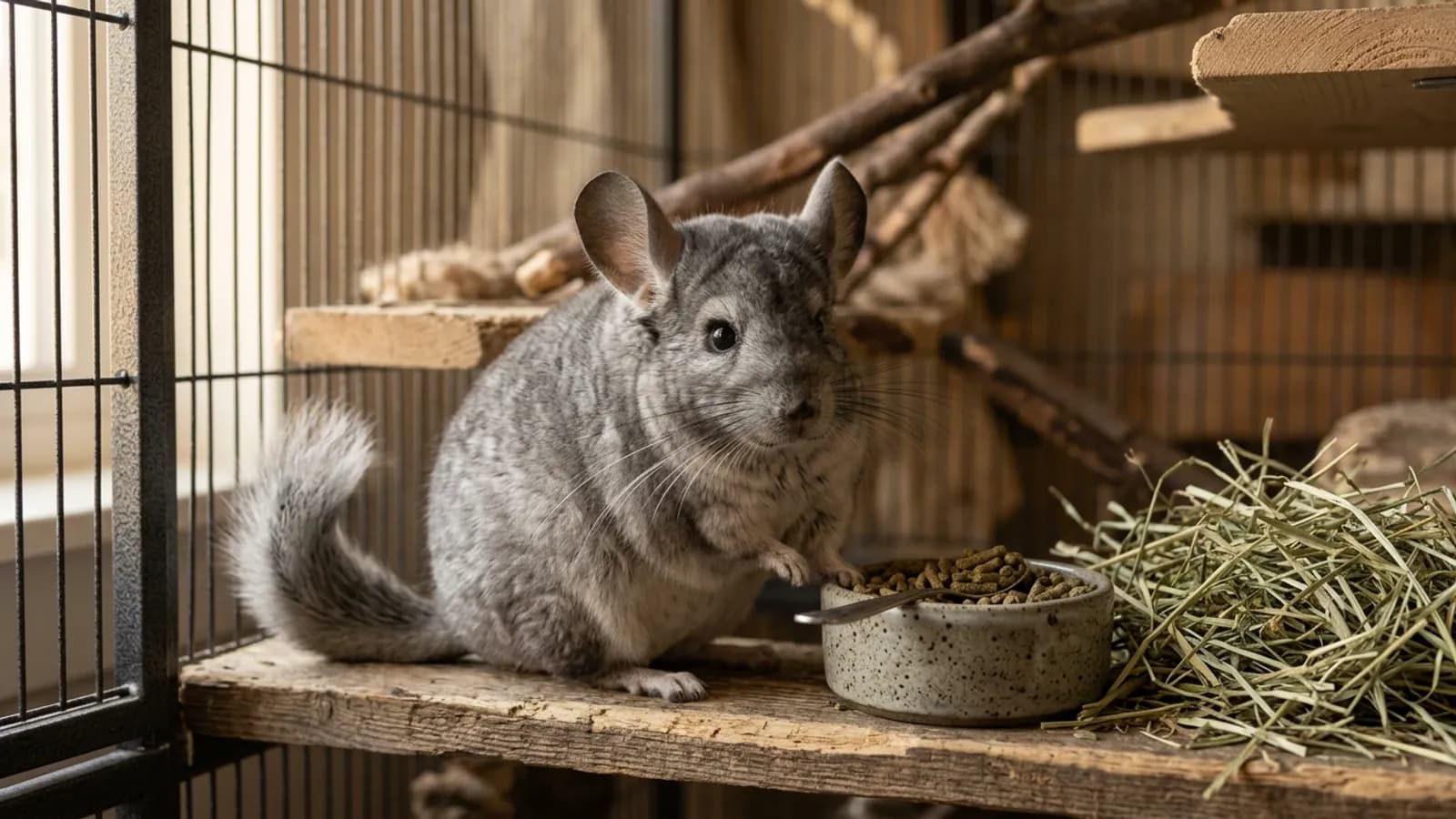
Where oxbow chinchilla pellets actually fit
If you have landed on oxbow chinchilla pellets, you have almost certainly read that they are one of the better plain pellets on the shelf, and that part is true. But before I say a word about the bag, I want to be blunt about the thing the marketing never leads with: pellets are the supplement, not the meal. The meal is hay, unlimited, all day, every day. Grass hay is what wears down a chinchilla's constantly growing teeth and keeps the gut moving, and no pellet, Oxbow or otherwise, does that job. I keep two chinchillas, Pebble and Juniper, and I have kept chinchillas for about ten years now. Juniper came to me as a neglected rescue with dental disease, and watching her manage day to day is the reason I will not let anyone treat pellets as the main event. So yes, Oxbow pellets are a good choice. They are also a small one, and I mean that literally.
That framing matters because a lot of the questions I get come from people who bought a good pellet and then let the hay slide, thinking the pellet had it covered. It does not. Think of oxbow pellets for chinchilla feeding as a measured vitamin and fiber top-up sitting on top of a hay-first diet, and everything else in this article will make sense.
Why the plain pellet beats the colorful mix
The single most useful thing about Oxbow's chinchilla pellet is what it is not. It is a uniform, single-formula pellet. Every piece is the same. There are no dried corn kernels, no banana chips, no seeds, no little colored bits. That sounds boring, and boring is exactly the point.
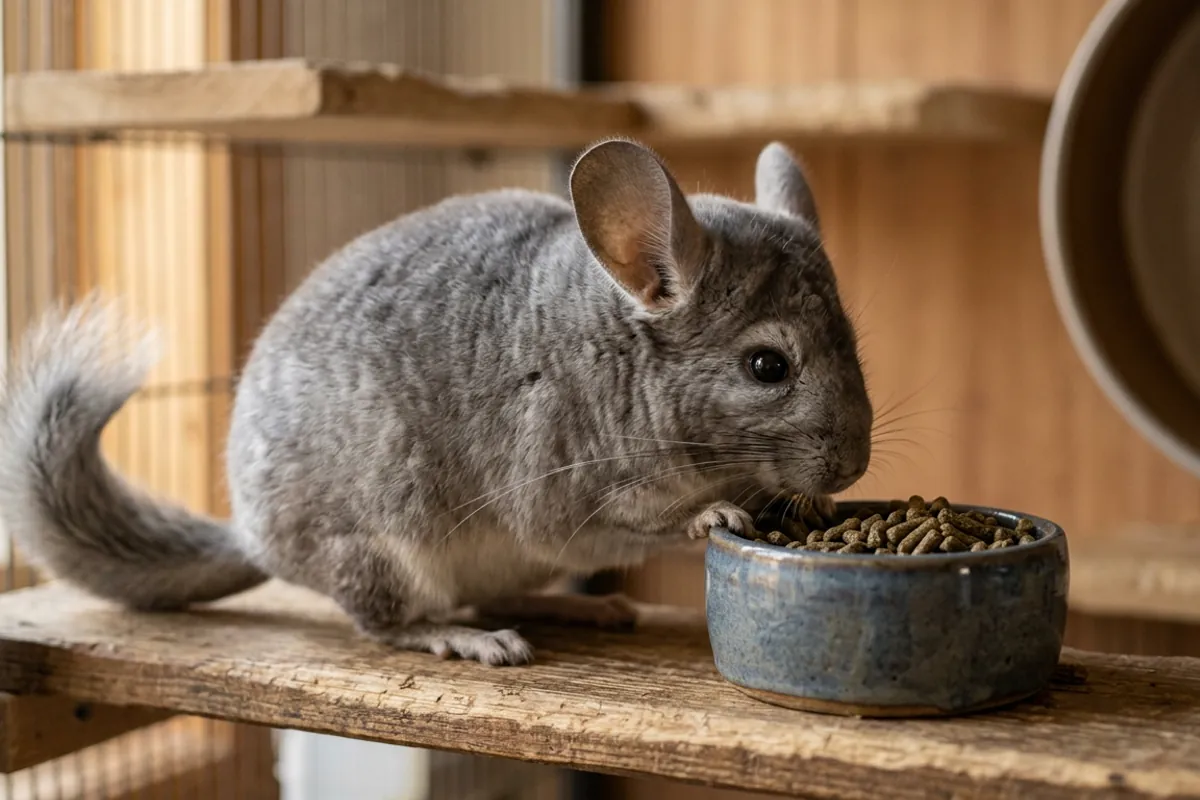
Chinchillas are selective feeders. Give one a mix with different-looking pieces and it will pick out the sweet, fatty, or starchy bits and leave the plain fiber pellet behind. This is called selective feeding, and it turns a "balanced" bag into an unbalanced diet inside a week, because the animal is eating dessert and skipping the vegetables. A uniform pellet removes the choice. There is nothing to pick out, so whatever nutrition is in the formula is the nutrition your chinchilla actually gets.
If you are staring at a wall of products with rabbit and guinea pig on the label too, stick to the one that says chinchilla and shows one plain pellet through the window of the bag. Anything with a rainbow in it goes back on the shelf. I go into the general case for plain pellets in Chinchilla pellets, the honest version of what to buy and how much, and Oxbow is one of the brands that clears that bar.
What is actually in the Oxbow bag
Oxbow's chinchilla pellet is built on timothy hay rather than alfalfa, and that is the detail worth knowing. Alfalfa is a legume, higher in calcium and protein, and it suits growing babies or a pregnant female but is more than a healthy adult needs long term. A timothy-based pellet lines up better with what an adult chinchilla should be eating, which is the same grass hay you should be piling into the cage anyway.
I am not going to quote you a precise protein or fiber percentage, because manufacturers reformulate and the number on your bag is the one that counts, not one I half-remember. Read the guaranteed analysis and the ingredient list on the actual bag in front of you. What you want to see near the top is timothy or grass hay, and what you do not want to see is a pile of added sugars, molasses, seeds, or fruit. Oxbow's plain chinchilla formula generally reads clean on that front, which is why it gets recommended. But the honest move is always to read your own bag rather than trust a brand halo.
One more point people miss. There is more than one Oxbow product a chinchilla could plausibly eat, and the names shift over time. The one you want is the plain, uniform, timothy-based chinchilla pellet. If you want the fuller breakdown of that specific line, I wrote it up in Oxbow Essentials chinchilla food, and where pellets really fit.
How much to feed, and why the amount is small
Here is the number that surprises people: a healthy adult chinchilla needs only about one to two tablespoons of pellets a day. That is it. Not a full bowl, not free-fed, not topped up whenever it looks low. One to two tablespoons, measured, once a day.
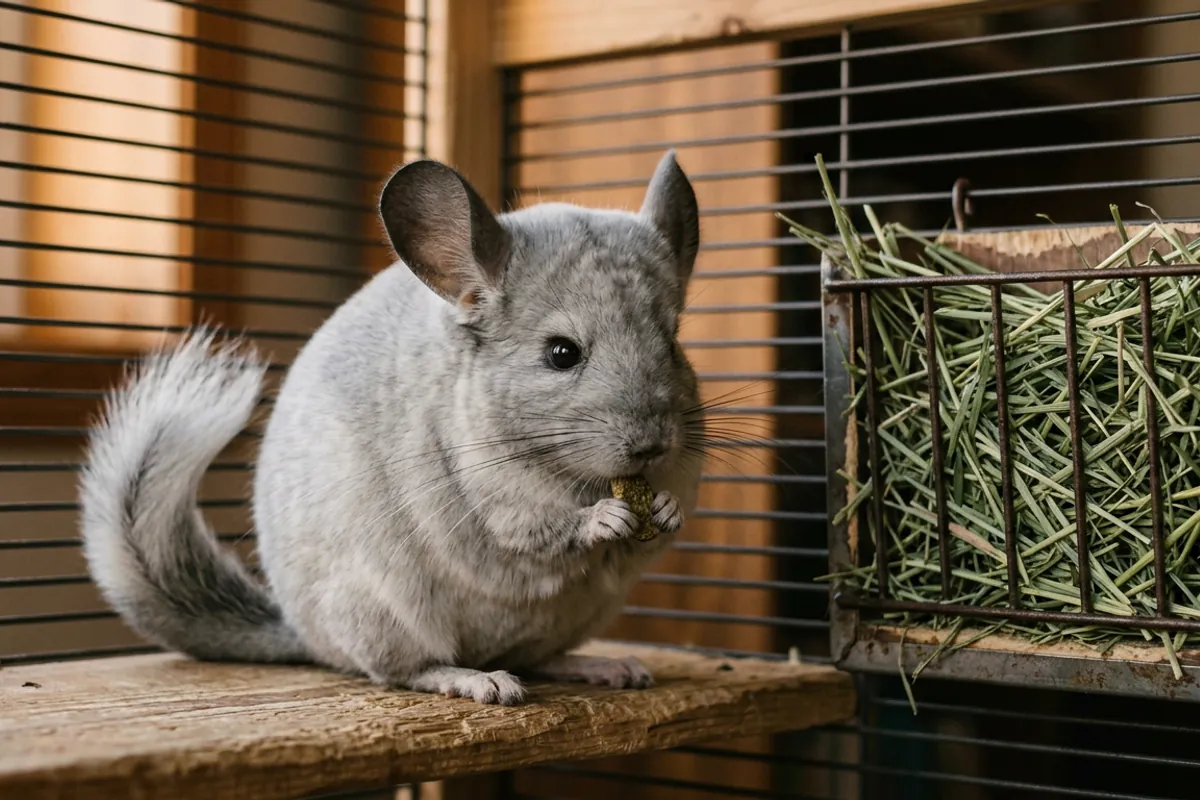
The reason is the same reason pellets are a supplement in the first place. Pellets are calorie-dense and easy to eat compared to hay. If you leave a big bowl out, a chinchilla will happily fill up on pellets and then eat less hay, which is exactly backward. Less hay means less chewing, and less chewing means teeth that do not wear down evenly. With Juniper's dental disease I watch this like a hawk, because the margin for error on her teeth is small. Measured pellets, unlimited hay, in that order.
I feed pellets in a small heavy ceramic dish that cannot be tipped, not a clip-on plastic cup, and I do it at roughly the same time each day so I notice fast if a chinchilla goes off its food. A chinchilla that suddenly ignores its pellets, or stops eating altogether, is telling you something, and appetite loss in a chinchilla is not a wait-and-see problem. That is an exotics vet call, because a gut that stops moving can turn serious quickly. Growing kits, pregnant, or nursing females have higher needs and are the exception to the small-amount rule, but for the average adult, small is correct.
Switching to Oxbow without upsetting the gut
If your chinchilla is currently on a different pellet, do not just swap the bag. A chinchilla's digestive system is sensitive to sudden diet changes, and an abrupt switch can bring on soft stool or a gut slowdown. Both are things you want to avoid on purpose.
Transition over about seven to ten days. Start by mixing roughly a quarter new pellet with three quarters old, hold that for a couple of days, then move to half and half, then three quarters new, then all new. Watch the droppings the whole time. Chinchilla droppings should stay firm, dry, and oval. If they go soft or shrink in number, slow the transition down and hold at the last ratio that was fine. If soft stool does not settle or the droppings stop coming, that is a vet conversation, not a reason to push through.
Throughout the switch, the hay stays unlimited and unchanged. Hay is the constant that keeps the gut steady while the pellet underneath it changes. If your chinchilla is already a reluctant hay eater, sort that out before you fiddle with pellets at all, because a pellet transition on top of a shaky hay habit is asking for trouble.
Storage, freshness, and the date on the bag
A good pellet you have stored badly is not a good pellet anymore. Pellets lose vitamins over time, and the fat in them can go stale, so freshness is part of the value you are paying for.
Check the best-by or milled date when you buy, and do not buy a bag that is close to its date just because it is discounted. Once it is open, keep it in an airtight container somewhere cool and dark, not in a warm cupboard and not in direct sun. Warmth speeds up the loss of nutrients and the fat going off. I keep pellets sealed and I buy a bag size I will actually get through in a couple of months rather than a giant sack that will be tired before it is empty. If you have one chinchilla eating a tablespoon or two a day, the smaller bag is almost always the smarter buy even though the big one looks cheaper per pound.
Give the pellets a sniff now and then. Fresh pellets smell grassy. If a bag smells musty, sour, or off, or if you see any sign of moisture or mold, throw it out. That is not a place to save money.
Where pellets stop and the rest of the diet begins
I keep circling back to hay because it is the whole foundation, and pellets only make sense sitting on top of it. Your chinchilla should have unlimited grass hay available at all times, meaning fresh hay in the cage that never fully runs out. Timothy is the standard grass hay for adults, and a good box of it is the single most important food you will buy.
Oxbow Western Timothy Hay, 40 oz bag As an Amazon Associate I earn from qualifying purchases. Timothy hay in a box keeps a clean, dust-controlled supply within reach, and if you have more than one chinchilla or want to bring the per-pound cost down, buying it in bulk makes sense as long as you can store it somewhere dry and airy so it does not get musty.
Oxbow Western Timothy Hay, 9 lb box As an Amazon Associate I earn from qualifying purchases.
Alongside hay and a measured pellet, a chinchilla needs things to chew that are not food. Constantly growing teeth need constant wear, and safe wood chews give the jaw something to work on between meals. I rotate a few shapes so Juniper does not get bored of any one of them, because a chew she ignores does her teeth no good.
emours apple wood chew sticks, 40 count As an Amazon Associate I earn from qualifying purchases. Apple wood is a safe favorite here. I go deeper on why chews are dental care rather than decoration in Chinchilla chew toys, and why they are dental care, not decoration.
Treats are the last and smallest slice. A tiny piece of plain dried rose hip or a single dried herb now and then is fine. What is not fine is the sugary, fatty, fruit-heavy stuff sold as chinchilla treats, including raisins and yogurt drops, which are far too rich and are a genuine source of digestive trouble. If you want the safe list spelled out, I keep one in Chinchilla treats, the honest version of what is safe and a fuller diet rundown in What can a chinchilla eat, and what should you never feed it.
A quick word on where diet meets heat and health
Diet does not sit in isolation, and two things quietly decide whether a good pellet even matters. The first is water. A chinchilla needs constant access to clean, fresh water, and a bottle is the practical way to give it without the water getting fouled. I cover the choice in The honest guide to a chinchilla water bottle.
The second is temperature, and this is where I stop being gentle. Chinchillas are built for a cool, dry climate and they cannot shed heat the way we do. The comfortable range is about 60 to 70°F, which is 15 to 21°C. Above 75°F, roughly 24°C, you are into risky territory, and 80°F, about 27°C, and up is an emergency, faster still if the air is humid. Pebble came to me from an overheated attic and had a heatwave near-miss her first summer that ended in a night at the emergency vet, and that scare is why I will never soften a heat warning to sound friendlier. A perfectly fed chinchilla in a hot room is still a chinchilla in danger. If you are anywhere near the edge, the chinchilla heat danger calculator and the chinchilla heat safety guidance are the places to start, and a warm-day emergency plan matters more than any bag of pellets on the shelf.
So, is Oxbow's chinchilla pellet a good buy? Yes, when it is the plain timothy-based one, fed by the tablespoon, kept fresh, and sitting on top of unlimited hay and plenty of safe chews. Buy the pellet for what it is, a measured supplement that fills small gaps, and put your real attention on the hay. That is the diet that kept my two going, and it is the honest version I would give any owner across the fence.