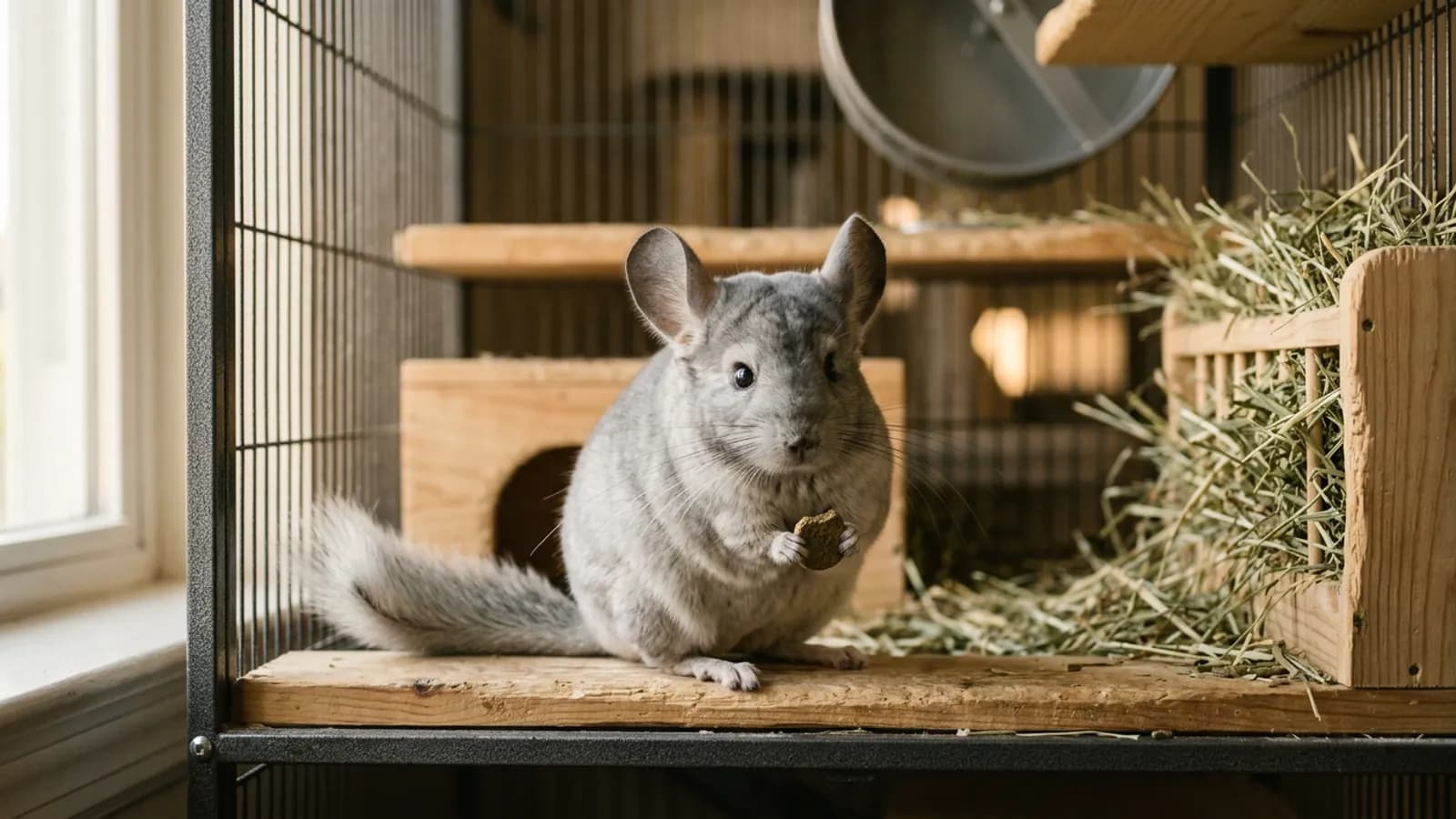
If you have spent any time on chinchilla forums, you have watched Oxbow Essentials chinchilla food get recommended more than almost any other pellet on the market, and for once the crowd is mostly right. It is a plain, uniform, timothy based pellet with no seeds, no dried fruit, and no colorful bits, and that plainness is exactly what a chinchilla needs. But a good pellet is only ever the supporting act. Hay is the food that keeps a chinchilla alive and its teeth in its head, and I have learned that up close. So this is the honest owner's version: what Oxbow Essentials actually is, how it fits into a real diet, how much to feed, and the few things about the bag itself that nobody warns you about until you are staring at fifteen extra pounds of pellets you cannot use fast enough.
What Oxbow Essentials chinchilla food actually is
Oxbow Essentials chinchilla food is a fortified, timothy hay based pellet made specifically for chinchillas. If the name confuses you, that is because Oxbow rebranded its old "Chinchilla Deluxe" line under the Essentials label, so when you see people searching for oxbow essentials chinchilla deluxe chinchilla food, they are chasing the same product under two names. The bag you want today says Essentials, and the pellet inside is the plain brown uniform kind, every piece identical.
That uniformity matters more than it looks. A lot of pet store "chinchilla" mixes come loaded with seeds, corn, dried banana, and rainbow bits, and a chinchilla will do exactly what you or I would do at a buffet: pick out the sweet junk and leave the boring healthy part. That is called selective feeding, and it wrecks the balance of the diet on purpose. A uniform pellet removes the choice. Every mouthful is the same, so your chinchilla cannot cherry pick.
What Essentials gives you is a stable, consistent base of fiber and the vitamins and minerals a chinchilla needs in the amounts it needs them, built on timothy grass rather than alfalfa. The adult formula is timothy based, which suits grown chinchillas better than the higher calcium alfalfa formulas aimed at growing kits. If you want the wider picture on how pellets in general are made and what to look for, I wrote a full breakdown of chinchilla pellets that goes deeper than I can here.
Why hay comes first and pellets come second
I need to be blunt about this because getting it backwards is the single most common feeding mistake I see. Pellets are the supplement. Hay is the food. Not the other way around.
A chinchilla's teeth grow continuously for its whole life, and the only thing that keeps them worn down to a safe length is hours of side to side grinding on long strand grass hay. Pellets are chewed, but they are chewed quickly and they do not deliver the sustained grinding that hay does. Juniper, one of my two, came to me as a neglected rescue with dental disease, and I manage her teeth every single day. Watching what happens when teeth do not get worn down properly is what made me uncompromising about this: unlimited grass hay, always available, is not a nice extra. It is the load bearing wall of the whole diet.
So the structure is simple. Grass hay, timothy or another grass hay, in unlimited amounts, in front of your chinchilla around the clock. Then a small measured portion of Oxbow Essentials on top of that. If your chinchilla is filling up on pellets and ignoring hay, you are feeding too many pellets, full stop. I keep a hay rack packed at all times and buy hay in quantity so I never run short, either the boxed kind for convenience timothy hay or in bulk when I want to save money.
Oxbow Western Timothy Hay, 40 oz bag As an Amazon Associate I earn from qualifying purchases.
For a household with more than one chinchilla, buying bulk is the cheaper path and means you are never rationing the one thing that should never be rationed.
Oxbow Western Timothy Hay, 9 lb box As an Amazon Associate I earn from qualifying purchases.
The full logic of the hay first, pellets second, treats last hierarchy is laid out in the chinchilla diet, food, and hay guide if you want the reasoning end to end.
Reading the bag: what a good pellet has and does not
Here is what I actually check on a bag of chinchilla pellets, and Oxbow Essentials passes on all of it.
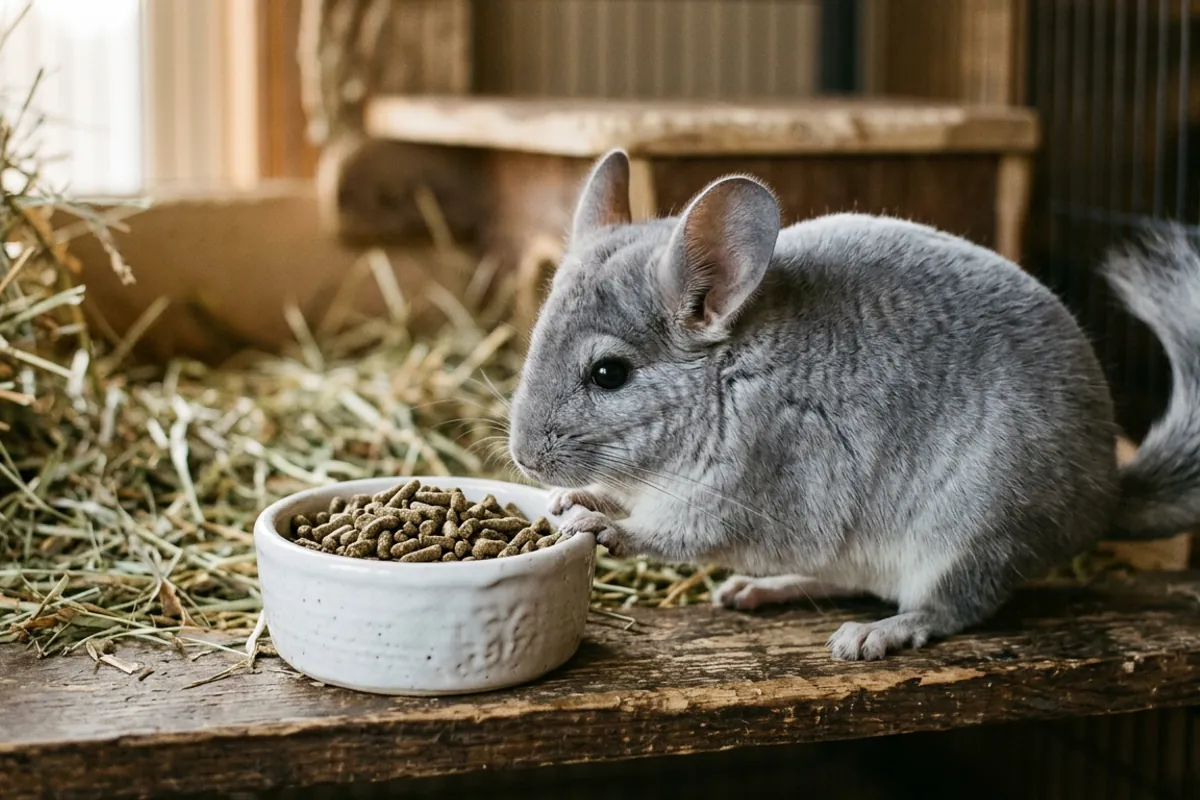
First, it is a plain uniform pellet. No seeds, no dried fruit chunks, no nuts, no colored pieces. If a bag has any of that, put it back on the shelf no matter what the front label promises. Those mixes exist to look appealing to the human buying them, not to keep a chinchilla healthy.
Second, it is grass based rather than alfalfa based for adults. Alfalfa is a legume, higher in calcium and protein, and it has its place for young growing kits or pregnant and nursing females, but a healthy adult chinchilla does better on a timothy grass base. Essentials adult formula is built on timothy.
Third, the fiber is high and the sugar and fat are low. High fiber is the entire point of a chinchilla pellet. Anything sweet or fatty is working against a gut that is built for dry, fibrous grass.
Fourth, and this one gets missed, look at the date on the bag. Fortified pellets carry added vitamins, and vitamins degrade over time. A pellet that has been sitting in a warehouse or on a shelf for a year is not the same food it was when it was milled, even if it looks identical. Buy from somewhere with reasonable turnover, and check for a best by or milled date before you commit to a large bag.
What you will not find in Essentials, and should be glad you will not, is anything designed to tempt. There is no honey coating, no yogurt drop, no dyed kibble. It is deliberately boring. Boring is the goal.
How much to feed, and how to measure it
The standard, widely agreed guidance for an adult chinchilla is roughly 1 to 2 tablespoons of pellets per day. Not a bowl kept perpetually full. A measured amount.
I measure with an actual tablespoon rather than eyeballing a scoop, because "a handful" drifts upward over weeks without you noticing, and a chinchilla that is grazing pellets all day is a chinchilla that is eating less hay. The exact amount inside that 1 to 2 tablespoon range depends on the individual: age, weight, activity, whether it is a growing youngster or a settled adult. A very active young chinchilla may sit at the higher end; an older, calmer, or slightly heavy one at the lower end.
The tell that you have it right is simple. Your chinchilla should be eating plenty of hay and finishing its daily pellets without much left over, and it should hold a steady, healthy weight. If pellets are piling up uneaten, cut back. If your chinchilla is ignoring hay and waiting for pellets, you are almost certainly giving too many. Weight is worth watching over time; a kitchen scale and a monthly weigh in tells you far more than a glance ever will.
One more measuring note. Resist the urge to top the bowl up every time it looks low during the day. Give the day's ration once, and let hay be the food that is always there. The bowl going empty by evening is not a chinchilla going hungry. It is a chinchilla eating hay, which is the whole idea.
The 25 lb bag question: bulk, freshness, and storage
Oxbow Essentials comes in several sizes, and people often ask whether the oxbow essentials chinchilla food 25 lbs bag is the smart buy. The honest answer is: it depends entirely on how many chinchillas you have and how you store it.
Do the arithmetic first. One adult chinchilla eating 1 to 2 tablespoons a day gets through pellets slowly. A tablespoon of pellets weighs only a fraction of an ounce, so a single chinchilla will take many months, often the better part of a year or more, to work through 25 pounds. And here is the problem I flagged earlier: fortified pellets lose vitamin potency over time. A bag that outlasts its own freshness is not a bargain, it is a slow downgrade. By the time you reach the bottom of a huge bag bought for one animal, the food is not delivering what it did on day one.
So the 25 lb bag makes sense if you keep several chinchillas, or a rescue, or you are splitting it with another owner, and you can get through it within a reasonable window. For one or two chinchillas, a smaller bag you finish while it is fresh is the better call even though the price per pound looks worse.
However much you buy, store it properly. Pellets want cool, dry, and dark, in an airtight container, away from heat. Heat and light and air are what strip the vitamins and turn fat rancid. I keep mine sealed in an airtight tub in a cool cupboard, never in a warm room and never in the original bag left open. If you are buying in bulk to save money, spend some of that saving on decent storage or you will lose the freshness you were trying to protect.
Switching to Oxbow Essentials without wrecking a gut
If you are moving your chinchilla onto Essentials from another pellet, do it slowly. A chinchilla's digestive system is a delicate, fiber tuned machine, and an abrupt food change can cause soft stool, bloating, or a gut slowdown, which in a chinchilla is genuinely serious.
The safe way is a gradual transition over one to two weeks. Start by mixing a small portion of the new pellet in with the old, then shift the ratio a little further toward the new food every few days, until you are fully on Essentials. Through the whole switch, keep hay unlimited and unchanged, because hay is the constant that keeps the gut moving while everything else adjusts.
Watch the droppings during a transition. Healthy chinchilla droppings are firm, dry, and plentiful. If they turn soft, small, misshapen, or scarce, slow the switch down and give the gut time to catch up. If your chinchilla stops eating, stops passing droppings, or sits hunched and unwilling to move, that is not a wait and see situation. That is an exotics vet, promptly. Gut stasis moves fast, and I would rather you called too early than too late. I am an experienced keeper, not a vet, and the line between husbandry and medicine is one I will send you across every time your chinchilla crosses it.
Where pellets fit in the whole diet
Step back and the picture is clean. Unlimited grass hay is the foundation and the thing that never runs out. A measured 1 to 2 tablespoons of a plain pellet like Oxbow Essentials sits on top of that as the balanced supplement. Fresh clean water is always available. And treats, if you give them at all, are tiny, rare, and simple.
Notice what is not on that list: sugary snacks, dried fruit, seeds, nuts, and yogurt drops, all of which do real harm despite being sold cheerfully in pet aisles. I keep chinchilla treats to a plain dried herb or a small piece of plain rose hip now and then, nothing sweet, nothing fatty. The rule of thumb I live by is that if a treat would be at home in a candy aisle, it does not belong in a chinchilla.
The other half of dental health is not food at all, it is chewing. Alongside unlimited hay, a real variety of safe wood chews gives the teeth the grinding work they are built for and keeps a bored chinchilla busy. Juniper is the reason I never skimp here: a rotating set of plain untreated apple wood and other safe woods earns its keep every day.
emours apple wood chew sticks, 40 count As an Amazon Associate I earn from qualifying purchases.
If you want to go deeper on the dental side of all this, the chinchilla teeth and health guide and my piece on chinchilla chew toys cover why chewing is care and not decoration.
So yes, buy the Oxbow Essentials. It is one of the genuinely good products in a category full of junk, and choosing it means you have got the pellet decision right. Just remember that getting the pellet right is the easy part. The animal in front of you lives on hay, wears its teeth down on hay and wood, and only ever nibbles the pellets as a measured extra. Get the hierarchy right and the pellet almost takes care of itself.