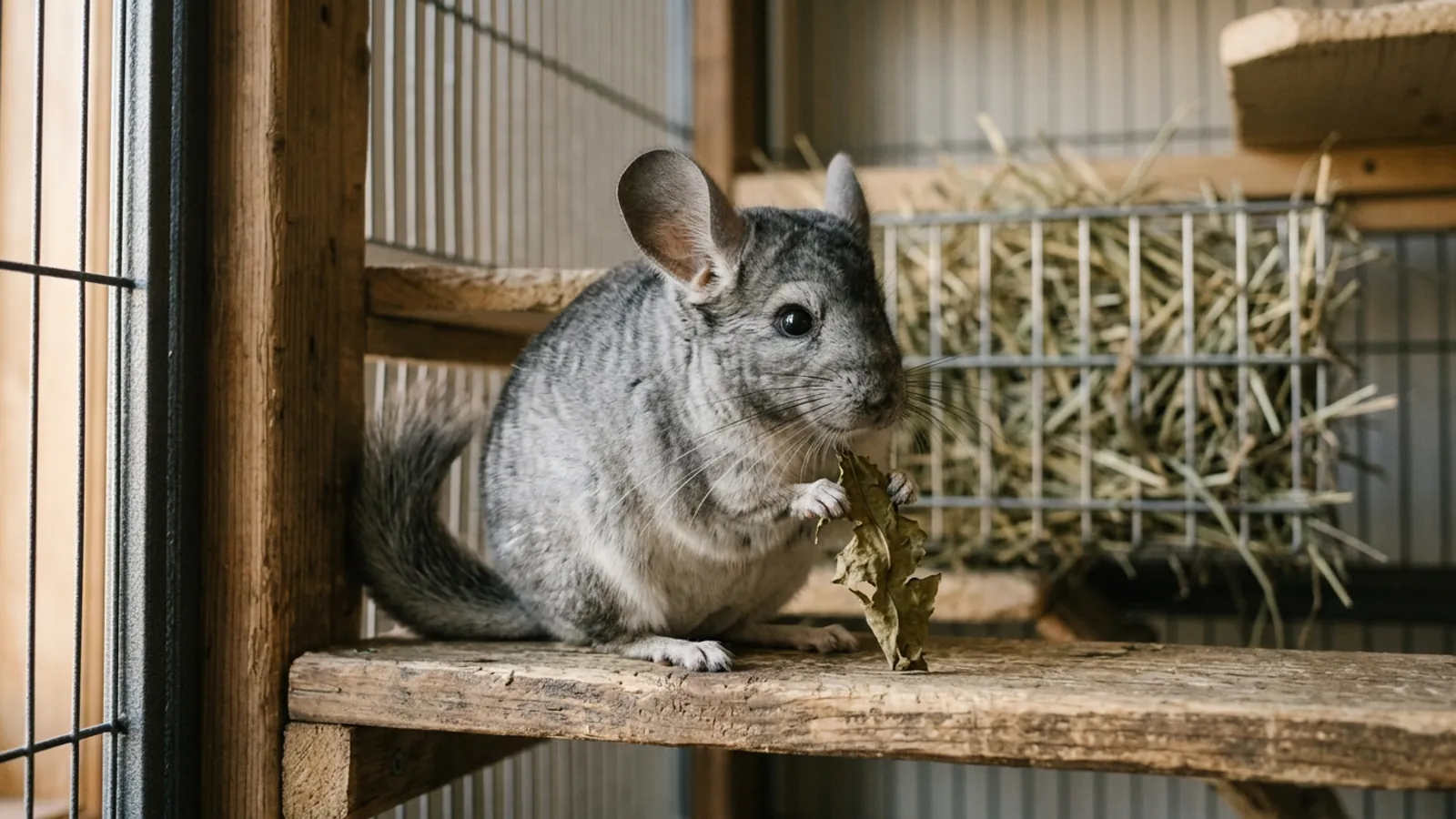
Every few weeks somebody asks me for a list of chinchilla safe herbs, and I am happy to hand one over, but I always attach the same warning to it first. Herbs are a rounding error in a chinchilla's diet. They are not a food group, they are not medicine, and they do not replace a single strand of hay. What they are is a small, dry, low-sugar way to give your chinchilla something interesting to work on without wrecking a gut that evolved on sparse mountain scrub. I have fed them for about ten years, to Pebble and to Juniper, and in that time my useful list has stayed short and fairly boring. That is a good sign. Here is what I keep in the house, what I keep out of it, and how genuinely little of it goes in the cage.
What a safe herb means here
When I say herb, I mean the dried leaf, flower or stem of a soft, non-woody plant, offered as an occasional token rather than as food. That is narrower than what the word means in a kitchen. It does not include seeds, it does not include nuts, it does not include anything soaked in oil or coated in anything, and it absolutely does not include essential oils, tinctures or extracts.
"Safe" is a smaller word than it looks, too. Nothing on my list is safe in unlimited quantity: safe here means a token amount, occasionally, dried, and it stops meaning anything the moment a herb becomes a daily handful. So read any list of chinchilla herbs, including mine, as "safe as an occasional token" rather than "safe.". The amount is doing most of the work in that sentence, and I want to be clear that nobody has established what that amount is for a chinchilla, so I am describing a direction rather than handing you a measure.
The other half of the definition is dryness. A chinchilla's digestive system is built for dry, fibrous, low-energy vegetation, which is exactly what it gets in the wild. Fresh greens bring water and sugars, and here the sources split: the veterinary manual's owner pages permit a little fresh vegetable daily, while one of the UK charities allows none at all and ties the moisture straight to loose droppings. I sit at the dry end of that range, and the first thing I see when I get it wrong is smaller, softer droppings. Everything I feed is bone dry. If a leaf is not crisp enough to crumble between my fingers, it does not go in the cage.
The chinchilla safe herbs I keep in the house
There is no official, regulated list of herbs for chinchillas. I want to be straight about that, because plenty of sites present their list as though a veterinary body signed it, and the long lists you will find, twenty items with a tidy safe or unsafe beside each, are mostly copied across from rabbit and guinea pig pages.
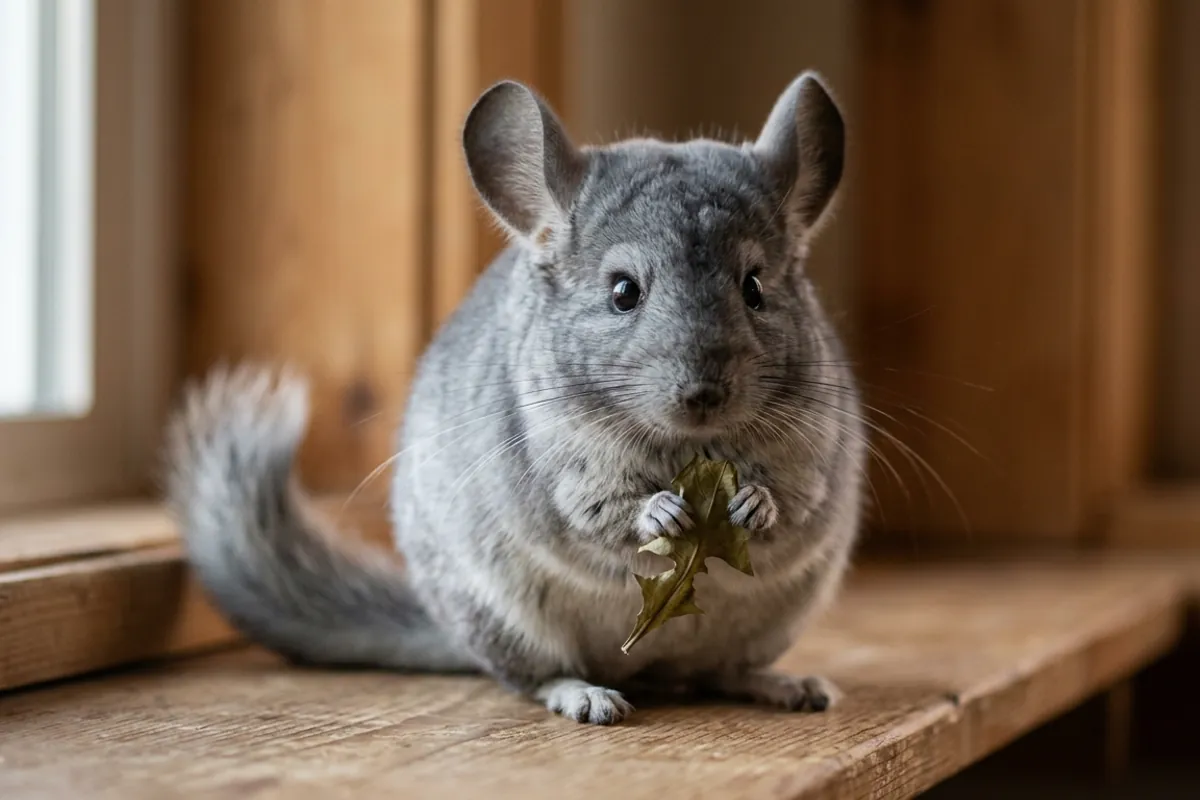
So I went looking for which herbs a veterinary or welfare source names for chinchillas, by name, for this species. The answer is four.
- Dandelion leaf, dried. Named on a UK veterinary charity's own list of suitable chinchilla treats, and the one with a real caveat, which gets its own section below.
- Nettle leaf, dried. Same list. The sting is gone once it is properly dried. Feed it as leaf, not as a powder.
- Chamomile flowers, the small daisy-like heads. Same list.
- Plantain leaf. Named by a second charity, alongside a general permission for assorted dried herbs. This is Plantago, the flat rosette weed with ribbed leaves, not the cooking banana.
That is the published set, and I am going to stop there rather than pad it out. Rose petals, hibiscus, calendula, raspberry leaf, echinacea, lemon balm, peppermint, blackberry and strawberry leaf are all sold as chinchilla forage and all appear on somebody's safe list; not one of them has a chinchilla source behind it that I could find. That does not make them poison, and I am not telling you a keeper who feeds rose petals is harming an animal. It means nobody has checked, and I am not going to launder the trade's stock list into veterinary guidance by printing it here with my name on it. If a mix you buy contains them, that is a decision you are making on the supplier's word rather than on evidence, and you should know that is what you are doing.
Dandelion for chinchillas, the one everybody asks about
Dandelion is the herb people ask about by name, so it deserves a straight answer. Dried dandelion leaf is a good forage for chinchillas. It is fibrous, it is low in sugar, and both of mine will drop everything for it. The chinchilla dandelion question is not really "is it safe", it is "how often".
Here is the caveat, and it is a caveat rather than a verdict, because the two best sources I can point at disagree. A major UK veterinary charity lists dried dandelion among the treats it considers suitable for chinchillas. The veterinary manual most vets reach for tells owners to avoid high calcium greens and names dandelion greens specifically, on the grounds of bladder stones. Both are real, current and easy to find. They are not quite head on, and I should say so: the charity is talking about a dried leaf offered as a treat, the manual about fresh dandelion greens fed as a vegetable portion, which is a different form in a different amount. But they point opposite ways on the same plant, and anyone who tells you the question is settled has only read one of them.
What stops me taking the calcium story at face value is that the same manual, in its professional section, says something that cuts against the mechanism: chinchillas hold a stable calcium content in their urine even when dietary calcium goes up, unlike rabbits and guinea pigs, and it goes on to call it questionable whether cutting dietary calcium prevents stones recurring in this species at all. So the rabbit reasoning that gets copied onto chinchillas may simply not transfer. I am not qualified to settle that, and I am not going to pretend the internet has.
What I do is hedge, because hedging is cheap here. Dandelion is an occasional offering rather than a fixture, and it is never the daily default. I am deliberately not giving you a count or a schedule for it: there is no established figure to give, and inventing one would dress a guess up as guidance. If it turns out the calcium worry does not apply to this species, I have lost nothing, because the animal was never short of forage. If it does apply, I am nowhere near the level anyone is worried about.
Dandelion root is a different thing again. It is woodier, it is often sold chopped, and it shows up in herbal blends aimed at rabbits. I feed the leaf and leave the root alone, because I do not know enough about it to feed it confidently.
If your chinchilla has ever had urinary trouble, blood in the urine, straining, or a vet-diagnosed stone, ask your exotics vet before you make dandelion for chinchillas a routine in your house. That is a case where the general advice stops being good enough.
Finally, sourcing. I buy dried dandelion rather than picking it. Garden and verge dandelions collect herbicide, lawn feed, road grit, exhaust and dog urine, and none of that washes off in a way I would trust for an animal that weighs well under a kilogram. I am deliberately not going to give you a safe-picking procedure, because no chinchilla source addresses wild picking at all and a tidy list of precautions would imply someone has checked that they are enough. Nobody has.
What never goes in, no matter who recommended it
One caveat before the list. There is no chinchilla-specific toxic-plant reference anywhere; the big poison-control database covers dogs, cats and horses and says so itself. So this is general plant toxicology plus what a hindgut fermenter cannot digest, not a list anyone has tested on this species, and the rule at the bottom of it is doing more work than any single entry: if you cannot name a plant with certainty, it is not food.
- The allium family: garlic, onion, chives, leeks. Toxic to a lot of mammals and pointless here.
- Rhubarb leaves, anywhere near the cage.
- Nightshade foliage: tomato, potato and pepper leaves and stems.
- Ornamental garden plants generally. Foxglove, yew, oleander, ivy, aloe and lily are all common in gardens and all bad news. If you cannot name a plant with certainty, it is not food.
- Avocado, in any part.
- Fresh grass clippings, wet greens, and anything wilting. Moisture plus fermentation is how you get a chinchilla with soft droppings and a bad night.
- Clover and alfalfa as a bulk feed. These are legumes, not grasses, and they carry far more protein and calcium than a grass hay. Alfalfa has a narrow place in growth or recovery under vet direction, but it is not a herb and it is not a daily hay.
- Herb blends padded with seeds, sunflower, flax or dried corn. Fat and starch a chinchilla does not need.
- Human tea bags, flavored teas, and anything with "natural flavoring" on the label.
- Essential oils, diffusers and scented sprays anywhere in the room. A chinchilla's respiratory tract is small and sensitive, and irritants show up as sneezing or worse.
- Anything musty, dusty in the wrong way, discolored, or stored damp. Mold is not a risk worth taking for a treat.
How much, how often, and how to add a new one
The amount is smaller than most people expect, and I cannot give you a real one. No veterinary source states a quantity of herbs for chinchillas, so every figure in circulation, including the teaspoon a day you will see quoted as a ceiling, is somebody's habit rather than a finding, and repeating one here would make it look settled. What is well established is the direction: hay is unlimited and is the diet, pellets are measured, and everything else is a token small enough that it could not plausibly displace either. If you find yourself measuring it, you have already gone past the point I would stop at.
Introduce one new herb at a time and then leave it alone for about a week before adding another. If something disagrees with your chinchilla, you want to know which something it was. While you are testing, watch the droppings. Size, shape and firmness tell you more about a chinchilla's gut than anything else you can see from outside the cage, and what the droppings look like is the first place a diet problem shows up. Smaller, softer, fewer, or misshapen means stop the herb and go back to hay only.
A few rules I hold to without exception. No herbs for a chinchilla that is off its food, unwell, or recovering from anything: hay and water until a vet says otherwise. No herbs as a bribe during taming, where plain hay works just as well. And variety across the month, not variety in one bowl. Handing over five herbs at once is how you end up with no idea what caused the problem.
Where herbs sit next to hay, pellets and wood
This is the part I care about most, because it is where herbs get people into trouble.
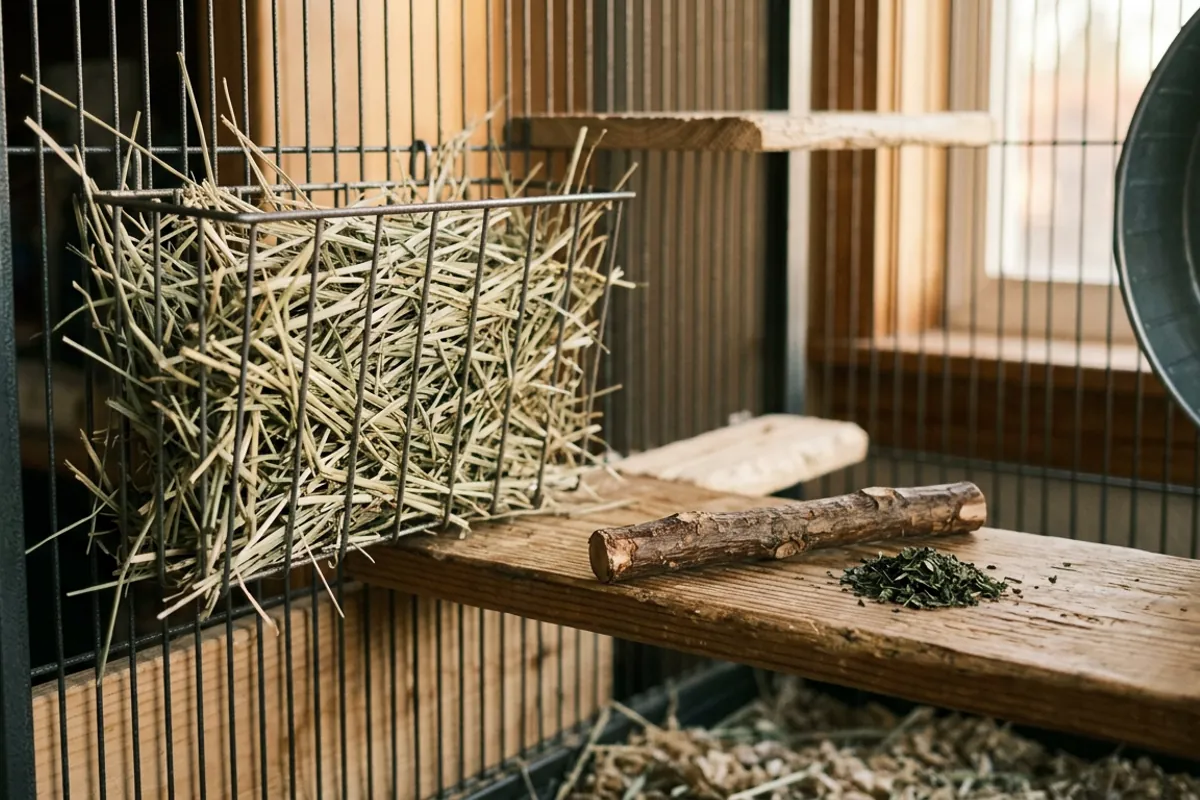
Unlimited grass hay is the meal. Timothy, orchard or meadow hay, available every hour of every day, in quantity, refreshed constantly. A chinchilla should eat roughly its own body size in hay every day and should always have more in front of it than it can finish. I buy timothy in a box for convenience and in bulk when the price is right.
Oxbow Western Timothy Hay, 40 oz bag As an Amazon Associate I earn from qualifying purchases.
Oxbow Western Timothy Hay, 9 lb box As an Amazon Associate I earn from qualifying purchases.
Plain pellets are a measured supplement on top of that, not a second meal. Pellets should be single-formula and boring, with no seeds, no dried fruit and no colored bits.
Herbs come after both, and they do one job hay already does better. The part keepers underestimate: a chinchilla's teeth grow continuously and are worn down by grinding coarse fiber. Dried herbs are soft. A chamomile flower does essentially nothing for a molar. Juniper came to me as a neglected rescue with dental disease, and I manage it every day, so I am blunt about this: nothing in a herb bag wears teeth. Hay does that, and hard wood chews do the rest.
emours apple wood chew sticks, 40 count As an Amazon Associate I earn from qualifying purchases.
If you want to give your chinchilla something to do, a fresh chew and a full hay rack beat a herb every time. Herbs are for enrichment and for the pleasure of watching a chinchilla sit up on its haunches with a leaf in both front paws. That is a real reason to feed them. It is just not a nutritional one. The rest of how the bowl fits together is in the chinchilla diet guide.
Buying and storing them so they stay worth feeding
Buy from suppliers who sell forage for small herbivores. The label test is simple: one ingredient, nothing added. No sugar, no oil, no preservative, no "flavoring", no yoghurt drops mixed in. If the bag is a rainbow, put it back.
Organic is not a magic word, but pesticide residue matters more for a 500 gram animal than it does for you, so it is worth paying for where it is cheap to do so. Buy small quantities. Fed as an occasional token, a modest bag of dried leaf lasts a very long time, and herbs fade in potency and appeal long before you would finish an oversized sack.
Store them airtight, dark, dry and at room temperature, away from the stove and away from any window that gets sun. That is easy in a chinchilla house anyway, because the room is already held at 60 to 70°F (15 to 21°C). Check by smell before every feed. Dried herbs should smell green and faintly sweet. Musty, sour, flat or dusty in a fine gray way means the bag goes in the bin, not in the cage. I do not try to rescue a questionable bag by picking through it. It costs very little to replace and a great deal more than that to treat a gut problem.
When herbs are the wrong tool entirely
Herbs are food, and only food. They are not treatment, and the internet is full of people implying otherwise.
Chamomile will not clear an eye infection. Echinacea will not fix a respiratory infection, and a chinchilla that is sneezing repeatedly, breathing noisily, or has discharge from nose or eyes needs an exotics vet, not a herb blend. Drooling, dropped food, weight loss and a sudden preference for soft food point at teeth, and teeth need a vet with a proper oral exam under sedation, not a change of forage. A chinchilla that has gone quiet and still is an emergency, not a candidate for an appetite-stimulating treat. If you have not already found an exotics vet, find one now rather than on the night you need one.
And herbs do nothing at all about the risk that scares me most. Pebble came out of an overheated attic, and her first summer here brought a heatwave near-miss and a night at the emergency vet, which is why this is not negotiable: above 75°F (24°C) a chinchilla is at risk, and 80°F (27°C) and up is an emergency, faster in humid air. No leaf, flower or "cooling herb" changes that number. A thermometer, a cool room and air conditioning do.
digital thermometer and humidity gauge with remote probes As an Amazon Associate I earn from qualifying purchases.
Keep herbs in the box they belong in. A little dried dandelion, chamomile or nettle, handed over now and then to an animal whose real meal is unlimited hay. Done that way they cost nothing, risk nothing, and give you a small daily moment with your chinchilla. Done as a diet, they are a slow way to cause a problem you will pay a vet to fix.