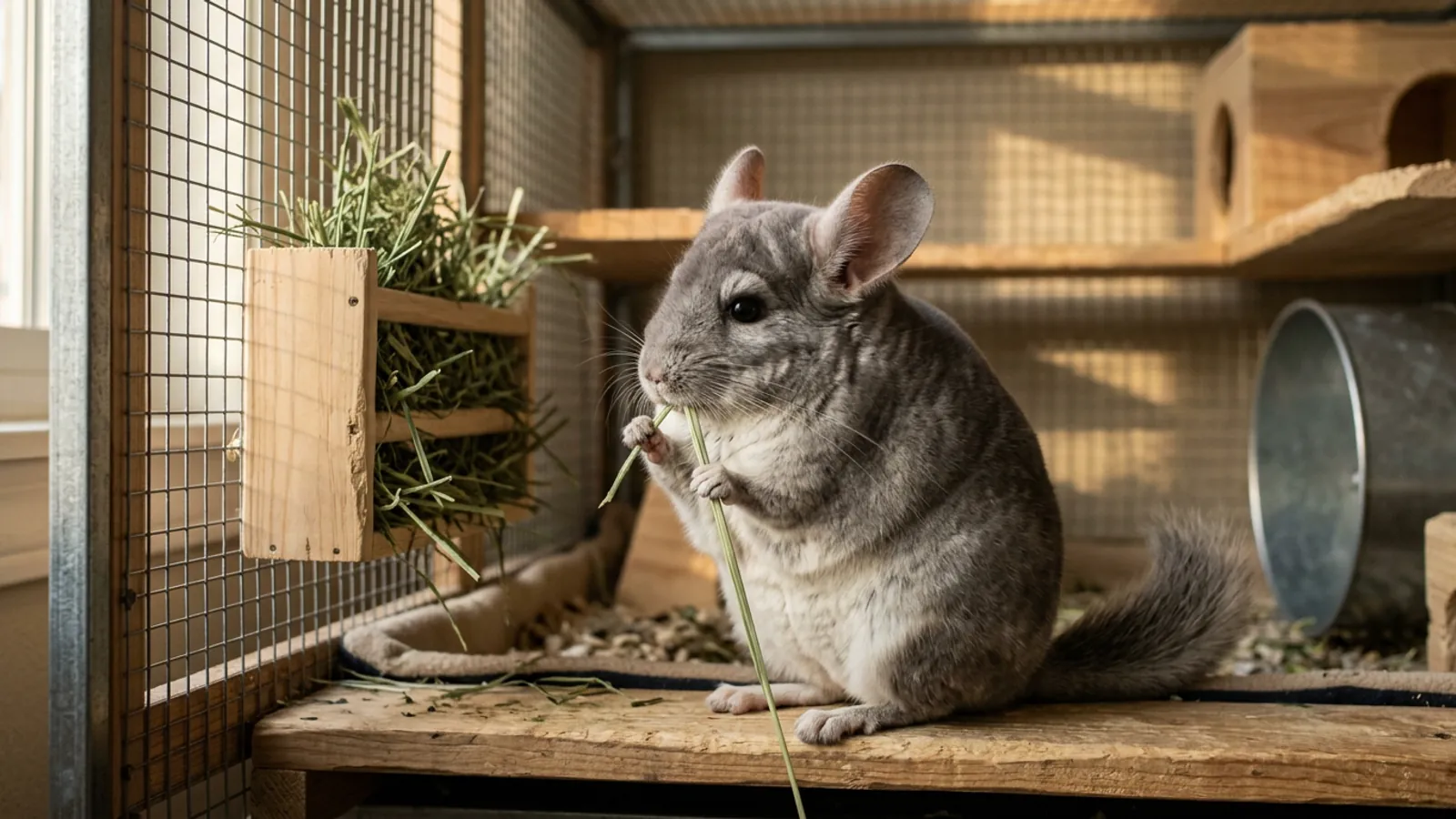
If you get one thing right about feeding a chinchilla, make it the hay. Chinchilla hay is not a garnish or a bit of enrichment tossed in beside the real food. It is the real food, the bulk of what your animal eats every single day, and the one item most new owners underestimate when they build their setup. I have kept chinchillas for about ten years, and the longer I do it the more everything else in the diet shrinks next to a constant, generous pile of good grass hay. Pellets, treats, the occasional dried herb, they are all footnotes. The hay is the book.
Why hay is the whole meal, not a side dish
Chinchillas come from the dry, high slopes of the Andes, where the food is tough, low, fibrous grass and not much else. Their entire digestive system is built around a steady stream of that fiber. They are hindgut fermenters, which is a technical way of saying the back part of the gut depends on a near-constant supply of coarse plant material to keep moving. When that supply is generous, the gut hums along. When the hay runs out for a day, or an owner treats it as optional, the gut can slow down, and a slow or stalled chinchilla gut is a real emergency, not a minor tummy ache.
So the first rule is boring and not up for debate: hay is in front of your chinchilla all the time, unlimited, topped up every day. Not a handful at breakfast. Not "when the bowl looks empty." Always. If you want the fuller picture of how the whole diet fits together, I laid it out in chinchilla food, but the headline never changes. Hay first, everything else measured.
There is a second reason hay sits at the center of everything, and her name is Juniper.
How hay keeps the teeth from destroying your chinchilla
Juniper is one of my two girls, a neglected rescue who came to me with dental disease I now manage day to day. She is the reason I am uncompromising about hay, because I have watched, up close, what happens when teeth do not get worn down.
A chinchilla's teeth never stop growing. All of them, the front incisors and the back cheek teeth, are open-rooted and grow continuously for the whole of the animal's life. In the wild, all that grinding on abrasive grass wears the teeth down at roughly the same rate they grow, so the length stays in balance. Take the grass away and the balance breaks. The teeth keep growing with nowhere to go. That is malocclusion, and it is one of the most common and most painful things that goes wrong with pet chinchillas.
Here is the part people miss: it is the chewing motion that matters, not just the swallowing. Hay makes a chinchilla grind side to side, jaw sweeping across jaw, for long stretches every day. Pellets get crushed in a few quick bites and do almost none of that work. So a chinchilla living on pellets with a token bit of hay can be overweight and still be grinding its teeth into a slow crisis. If you want to know what healthy looks like and when to worry, I wrote chinchilla teeth and the harder chinchilla teeth problems piece. But the prevention is almost entirely in the hay rack.
Chews help too, and they earn their place, but they support the hay, they do not replace it. A rotation of untreated apple, willow, and other safe woods gives the incisors something to work on between meals. A simple variety pack keeps it interesting.
emours apple wood chew sticks, 40 count As an Amazon Associate I earn from qualifying purchases.
If a chinchilla suddenly stops eating hay, or drools, or drops weight, that is not a food preference. That is a vet visit, specifically an exotics vet, and it is one of the few times I tell people not to wait and watch.
What counts as good hay, and which kind to buy
For an adult chinchilla, the staple is a grass hay, and timothy is the one I reach for first. It is widely available, the fiber content is right, and the protein and calcium are moderate rather than rich, which is exactly what an adult needs. I gave timothy its own full write-up in timothy hay for chinchillas because it deserves it, but the gist is that timothy is the meal.
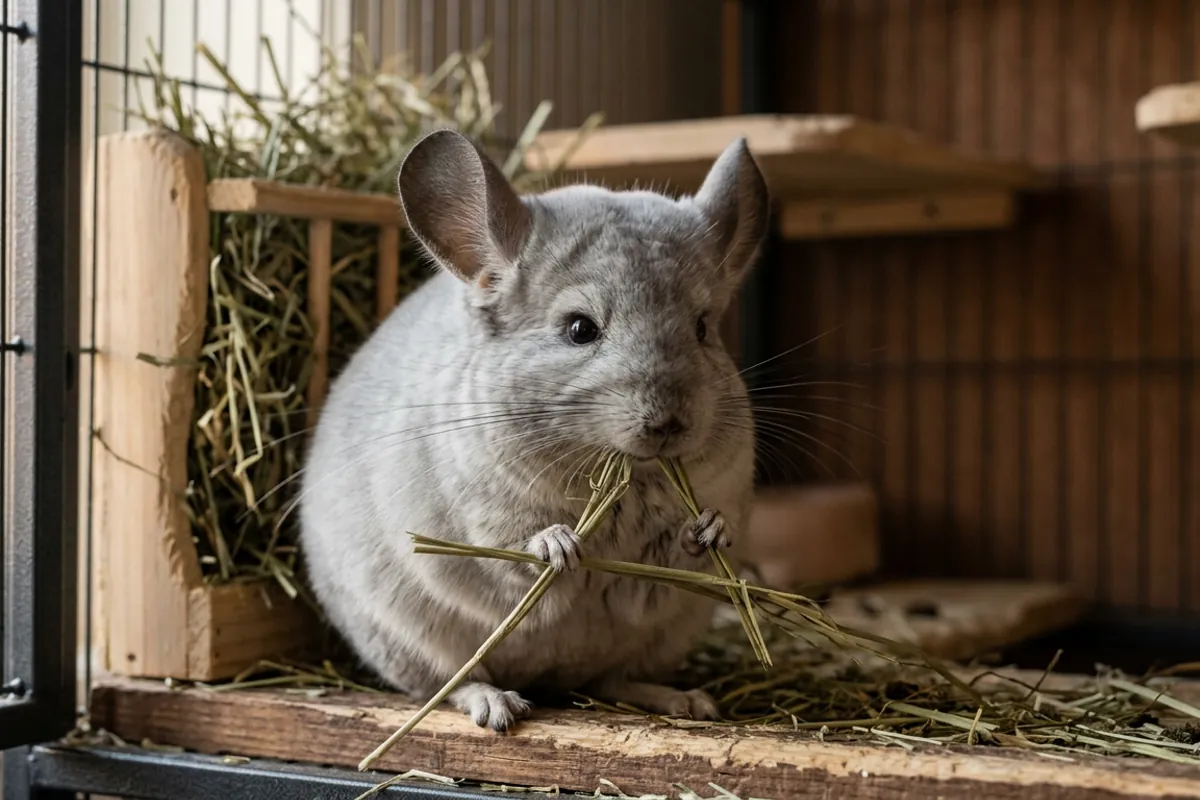
Other grass hays are fine, and variety is genuinely good. Orchard grass, meadow hay, oat hay, and brome all work as grass hays and can be mixed in or rotated. Some chinchillas are pickier than others, and having a second grass hay on hand is useful for the fussy eater or the animal recovering its appetite. The rule is that the everyday hay is a grass hay, whichever grass it happens to be.
The one hay to be careful with
Alfalfa is the exception that trips people up. Alfalfa is a legume, not a grass, and it is much higher in calcium and protein and richer overall. For a growing baby, a pregnant female, or a nursing mother, that richness is appropriate and even helpful. For a healthy adult, feeding alfalfa as the daily hay is too much of a good thing over time and is linked to calcium-related problems like bladder stones. So I treat alfalfa as a special-case food, not the staple. If you have a young hay chinchilla still growing, alfalfa has a role; once they are grown, grass hay takes over as the base.
Anything sold as a "hay treat" that is mostly fruit, seeds, or bright colored bits is not hay in the sense that matters. Read what a package contains, not what the front of the bag says.
How much hay, and how to offer it
The amount is simple: unlimited. There is no measured daily ration of hay the way there is with pellets. A chinchilla should always have more hay available than it can eat, so that it is never rationing itself and never sitting with an empty rack overnight. If your chinchilla routinely finishes every strand, you are not offering enough.
How you present it matters more than owners expect. Chinchillas are wasteful eaters by design. They pull hay out, pick through it, nibble the best bits, and discard the rest onto the cage floor, where it gets soiled and stops being food. That is normal foraging behavior, not fussiness, and it means you should offer plenty and expect some waste. A hay rack, a hay ball, or a section of the cage kept as a hay pile all work. I like keeping hay up off the floor so it stays cleaner, but I also scatter a little for foraging, because a chinchilla working for its food is a happier animal.
Refresh it daily. Even hay that has not been eaten gets flattened, dusty, and mixed with droppings after a day in a cage, and a chinchilla will turn its nose up at stale hay long before you would think to throw it out. Old hay in the rack is one of the quiet reasons a chinchilla eats less than it should. Pull the leftovers, put fresh in, every day. It is a thirty second job that protects the most important part of the diet.
Judging quality, and buying hay so you always have good stock
Good hay you can recognize with your hands and your nose. It should be green, not yellow or brown, though a little sun-faded outer color on an otherwise green bale is fine. It should smell sweet and grassy, like a summer field, never musty, sour, or like a damp basement. It should feel dry and springy, not damp or slimy, and it should not be so fine that it collapses into powder when you grab a handful. Green, sweet, dry, leafy. That is what you are buying.
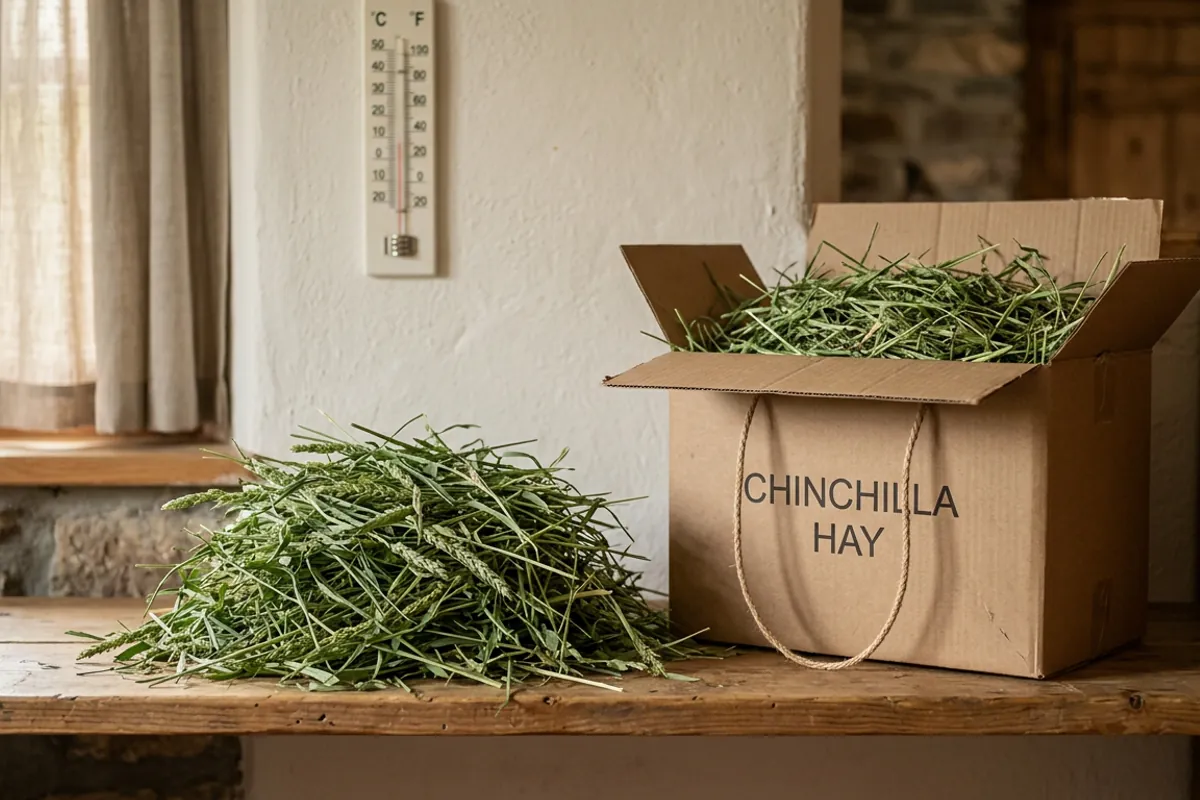
The two things to reject outright are mold and damp. Moldy hay can make a chinchilla seriously ill, and once a bale has been wet, mold is a risk even if you cannot see it yet. If a bag smells off or feels the least bit damp, it goes in the bin, not the cage. Cost is never worth that gamble.
How you buy it depends on how many animals you have and how fast you go through it. For one or two chinchillas, a boxed timothy hay keeps things simple and the packaging protects freshness.
Oxbow Western Timothy Hay, 40 oz bag As an Amazon Associate I earn from qualifying purchases.
If you have several animals, or you have found a hay yours love and want to stop reordering constantly, buying in bulk is cheaper per pound and means you never run dry.
Oxbow Western Timothy Hay, 9 lb box As an Amazon Associate I earn from qualifying purchases.
Bulk only pays off if you store it right. Hay needs to breathe, so keep it somewhere cool, dry, and airtight-adjacent rather than sealed into a plastic tub that traps moisture. A breathable bag or a bin with some airflow in a dry room works. Do not store it anywhere warm and humid, because heat and damp are what turn a good bale into a moldy one. And that is worth a word on its own, because heat is the thing I never stop talking about.
Hay, storage, and the heat rule that is not negotiable
My other girl, Pebble, came out of an overheated attic, and her first summer brought a heatwave and a night at the emergency vet. That scare is why I am relentless about temperature, and it touches hay too. The room your chinchilla lives in, and the room you store hay in, both need to stay cool. Chinchillas are comfortable at 60 to 70°F (15 to 21°C). Above 75°F (24°C) starts to get risky, and 80°F (27°C) and up is an emergency, faster in humid air. That range keeps the animal alive, and the low humidity end of it also keeps your hay from spoiling.
So the same cool, dry room serves both jobs. If you want the full version of why the number matters and how to hold it, chinchilla temperature covers it, and I keep a thermometer and hygrometer where I can see it at a glance.
digital thermometer and humidity gauge with remote probes As an Amazon Associate I earn from qualifying purchases.
I am an experienced keeper, not a vet, and I will say plainly that the heat guidance here is about prevention. If a chinchilla is already overheating, that is a medical emergency and time is against you.
When hay causes trouble, and how to read it
Most hay problems come down to one of three things.
The first is dust. All hay carries some fine particles, and a very dusty batch can irritate a chinchilla's airways, especially in a small cage with poor airflow. If you notice a lot of visible dust when you shake a handful, that is not great hay. You cannot and should not wash it, since wet hay molds, but you can choose a cleaner, leafier batch next time and give a dusty bag a gentle shake outside before it goes in. Persistent sneezing, wheezing, or discharge is not a hay-dust problem to manage at home, it is a vet call.
The second is the picky eater. A chinchilla that suddenly rejects hay it used to eat is telling you something. Sometimes it is stale hay or a bad batch, and swapping to fresh, or offering a second grass hay, fixes it in a day. But refusing hay is also one of the first signs of dental pain, because eating hay hurts when the teeth are overgrown. So I always rule out the hay itself first, and if fresh hay does not bring the appetite back quickly, I stop guessing and see an exotics vet.
The third is simply not eating enough, which usually traces back to how the hay is offered. Empty racks overnight, stale leftovers never cleared, or a single small clump in a corner all lead to a chinchilla eating less hay than it needs. The fix is almost always more hay, fresher, in a spot the animal likes.
Where pellets and treats fit around the hay
Once the hay is right, everything else is easy, because everything else is small. Plain, uniform grass-based pellets are a useful supplement, a measured way to fill nutritional gaps, and the usual guide is a tablespoon or two a day for an adult, not a bowl kept topped up. Buy plain pellets, not the muesli-style mixes with seeds, dried fruit, and colored pieces, because a chinchilla will pick out the sugary bits and leave the boring healthy ones. I go into amounts and brands in chinchilla pellets.
Treats are smaller still. A little dried herb or a tiny piece of plain dried rose hip now and then is plenty, and most of what is marketed for chinchillas is too sugary or too fatty to belong in the cage. No fresh fruit, no nuts, no seeds, no yogurt drops. Chinchilla treats and what can a chinchilla eat go through the safe short list and the long list of things to never feed.
Keep the proportions in your head and you will not go wrong. If hay is the whole plate, pellets are a spoonful on the side and treats are a crumb. Get the hay right, keep it unlimited and fresh, store it cool and dry, and you have handled the single most important thing about keeping a chinchilla healthy. For the wider routine around it, chinchilla care ties the rest together, but it all rests on the hay rack staying full.