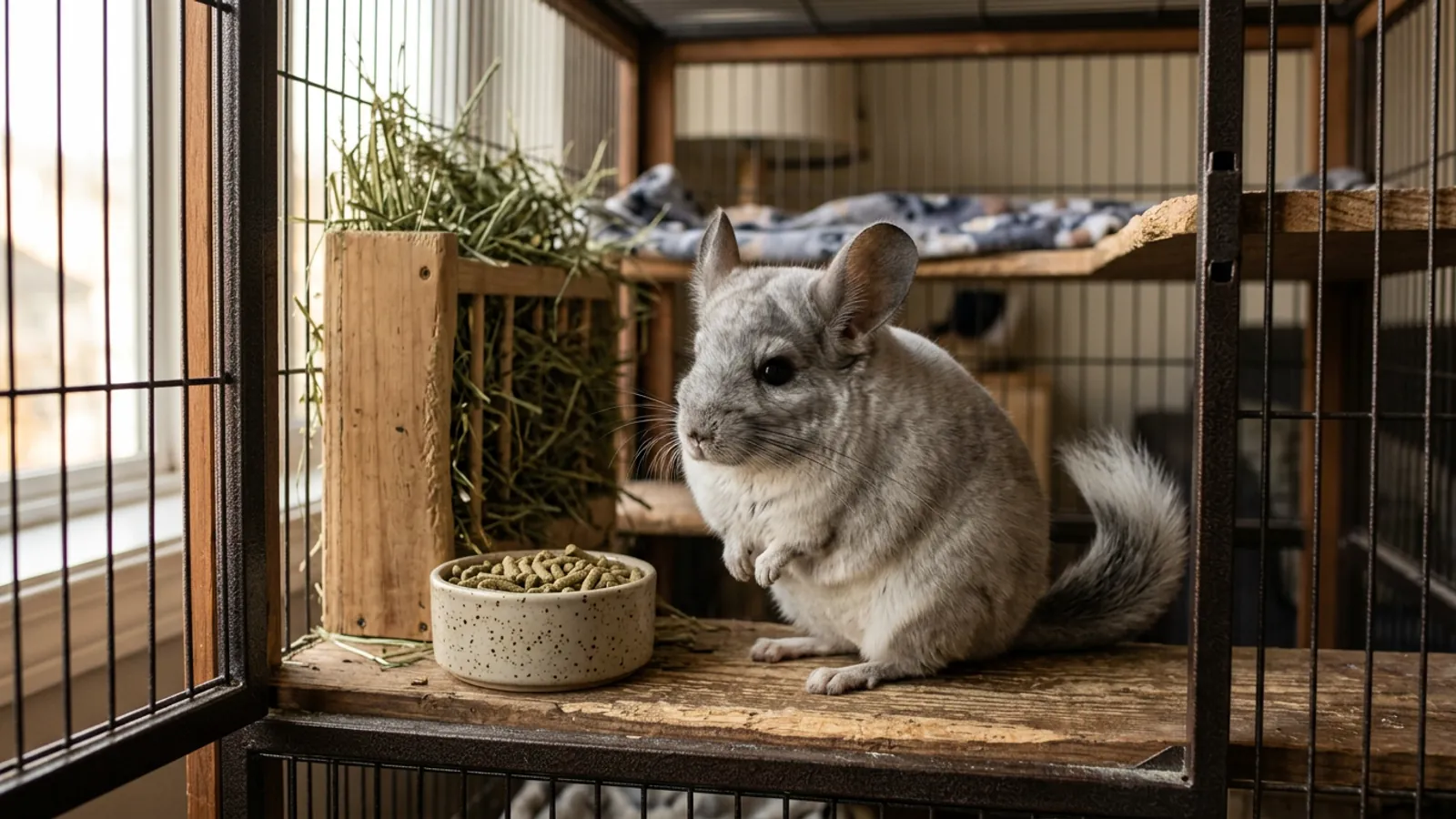
If you have spent any time in chinchilla groups, you have seen oxbow chinchilla food recommended more than almost any other brand, and for once the crowd is mostly right. It is a plain, timothy-based pellet made by a company that has taken small herbivores seriously for a long time, and a version of it has been in my cabinet for most of the ten years I have kept chinchillas. But I want to be blunt from the first line, because this is exactly where most new owners go wrong: the pellets are the smaller half of the meal, not the meal itself. Pebble and Juniper live on grass hay, and Oxbow is the measured extra that fills in the gaps. Get that order right and the brand barely matters. Get it wrong and no pellet on any shelf will fix it.
Hay comes first, and Oxbow is the second thing in the bowl
A chinchilla's gut and teeth are both built around one job: grinding through coarse, dry grass for most of the day. Their molars grow continuously through their whole life, and the only thing that keeps those teeth at a safe length is the slow, side-to-side chewing that hay demands. Pellets do not do that job. They are chewed a couple of times and swallowed. So the foundation of the diet is unlimited grass hay, in the rack and the bowl at all times, and I mean unlimited in the literal sense, never running out.
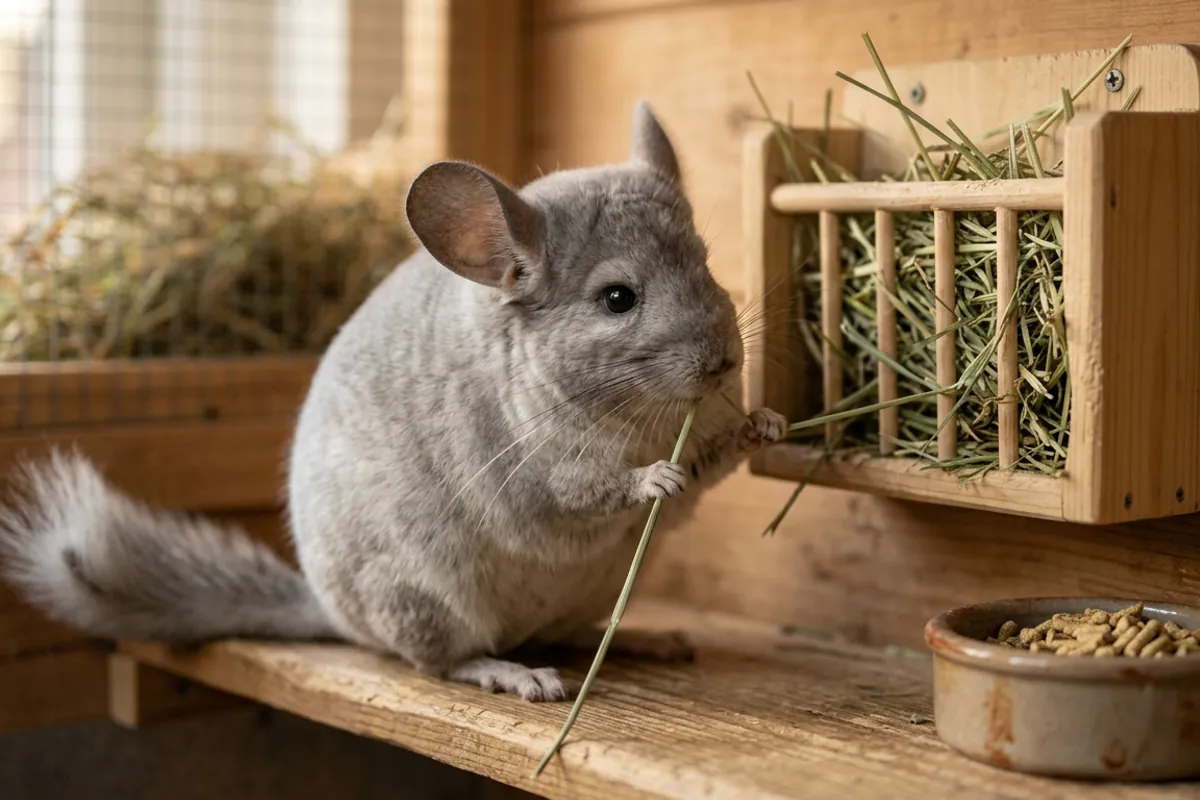
I keep a box of good timothy hay on hand so the rack is never empty. Oxbow Western Timothy Hay, 40 oz bag As an Amazon Associate I earn from qualifying purchases. If you go through a lot of it, that same hay in bulk works out cheaper per pound. Oxbow Western Timothy Hay, 9 lb box As an Amazon Associate I earn from qualifying purchases.
Juniper is why I am strict about this. She came to me as a rescue with dental disease, and I watch every day what happens when teeth do not get worn down properly. Hay and hard chews are her dental care, not decoration, so I keep a rotation of safe apple wood chews going for exactly that reason. emours apple wood chew sticks, 40 count As an Amazon Associate I earn from qualifying purchases.
Only once hay and chews are sorted does Oxbow come into it, as a measured supplement of a tablespoon or two a day. If you want the longer version of how the whole diet fits together, I wrote it up in the chinchilla diet and in chinchilla hay.
What is in Oxbow chinchilla food
Open the bag and every pellet looks the same: a firm, greenish-brown cylinder, roughly uniform in size. That uniformity is the whole point. Oxbow chinchilla food is built on timothy hay as its first ingredient, ground and pressed with added vitamins and minerals and a stabilized form of vitamin C, so each bite carries the same balanced nutrition. Because the pellets are identical, a chinchilla cannot pick and choose. That matters more than it sounds.
The foods you want to avoid are the colorful mixes, sometimes sold as muesli, that pack seeds, corn, dried fruit, and little dyed shapes into one bag. They look generous and they are a trap. A chinchilla will sort through the bowl, eat the sugary high-fat bits, and leave the fibrous, balanced part behind. That is called selective feeding, and it hands you a fat animal on a deficient diet. Oxbow's plain, uniform pellet is the fix: nothing to sort, nothing to leave. If you have read my piece on chinchilla pellets you have seen me hammer this point, and it is the single most important thing about any pellet brand, Oxbow included.
One more thing that is easy to miss: chinchillas do not need the extras that get marketed at them. No dried fruit baked in, no nuts, no seeds. A plain, timothy-based pellet and a rack of hay is the boring, correct answer, and boring is what keeps a chinchilla alive to fifteen or twenty.
Oxbow Essentials versus Oxbow Garden Select
Oxbow sells its chinchilla food in two lines, and new owners get stuck choosing between them. The classic is Oxbow Essentials Chinchilla Food, the uniform tan-green pellet most keepers mean when they say they feed Oxbow. The newer line is oxbow garden select chinchilla food, which the company markets as made with hand-selected garden ingredients, non-GMO, and without added wheat. The oxbow garden select chinchilla pellet looks a little different, with some visible botanical flecks, but underneath it is the same idea: a fortified, timothy-based pellet meant as a measured supplement.
The difference between the two is smaller than the packaging suggests. I have fed Essentials for most of a decade and it has served both girls well. Garden Select is a perfectly good pellet too, usually a bit pricier. What matters far more than which of the two you pick is that you pick one and stay with it. Chinchilla guts do not like change, and swapping back and forth between the lines for no reason is asking for soft stool.
If you want my longer take on each, I broke them down in Oxbow Essentials chinchilla food and in Oxbow chinchilla pellets. The upshot: either Oxbow line is a sound choice, so buy whichever is fresh and available and move on. The energy you might spend agonizing over the two is better spent making sure the hay never runs out.
How much to feed, and how to switch without a stomach upset
Here is the part people always want a number for. A common, widely used guideline is 1 to 2 tablespoons of pellets per adult chinchilla per day. I want to be clear that this is a range, not a law: the right amount shifts a little with the individual animal, its age, and how much hay it is eating. What does not shift is that the hay stays unlimited and the pellets stay measured. If your chinchilla is filling up on pellets and ignoring hay, you are feeding too many pellets.
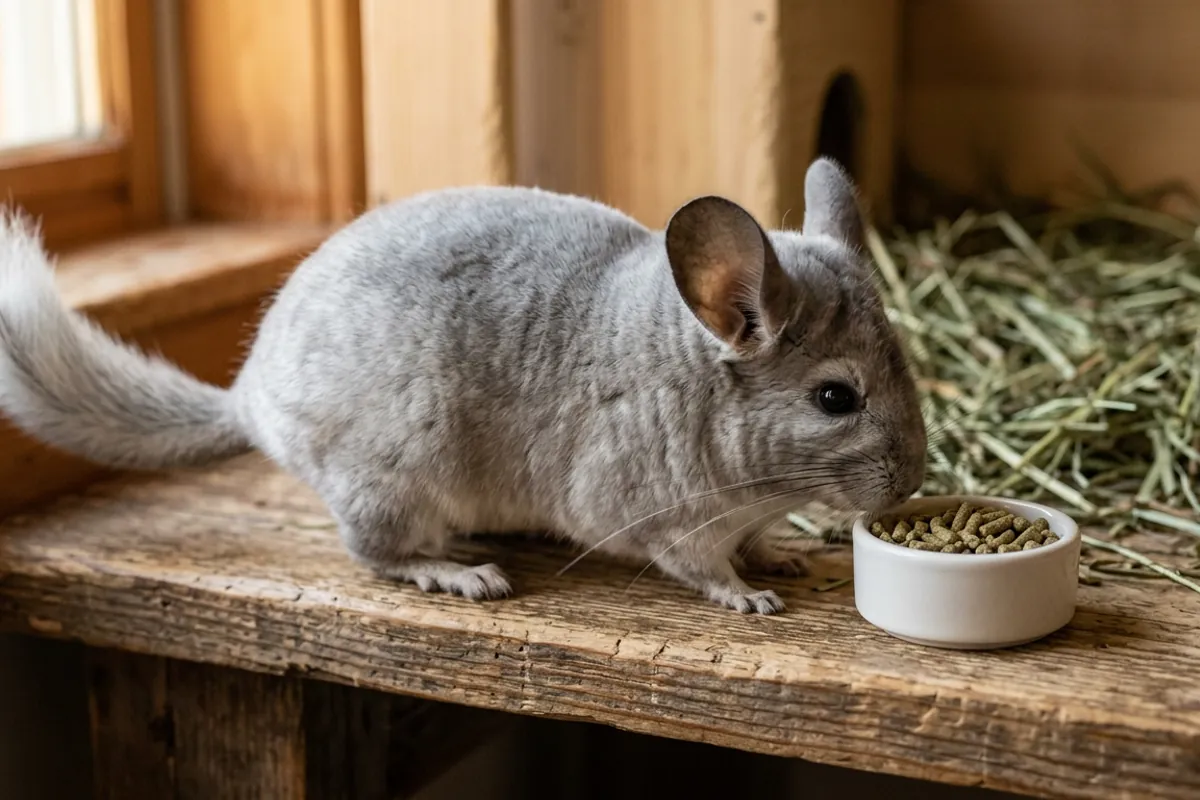
Portion once a day, in a small ceramic dish rather than scattered, so you can see whether it is getting eaten. A bowl that is always full is a bowl you are not paying attention to.
Switching foods is where careless owners cause real harm. A chinchilla's digestive system is sensitive, and a sudden change of pellet can trigger soft stool or worse. Whenever you move from another brand to Oxbow, or between the two Oxbow lines, do it slowly over a week or two. Start with mostly the old pellet and a little of the new, then shift the ratio a bit every couple of days until you are fully across. If you see soft droppings along the way, slow down. Rushing a food change to save a few days is never worth the stomach upset it can cause.
What size bag to buy, from the small one to the 10 lb and 25 lb
Oxbow chinchilla food comes in several sizes, and the biggest bag is not the bargain it looks like. You will see a small bag, a 10 lb bag, and a 25 lb bag, and the price per pound drops as the bag grows. The catch is freshness. A single chinchilla eats a tablespoon or two a day, which is a tiny amount of food. A 25 lb bag would take one or two chins the better part of forever to finish, and the pellets do not stay good that long.
Fortified pellets lose nutritional value as they age, and vitamin C in particular degrades over months, which is the whole reason it is added in the first place. Old pellets can also go stale or turn rancid, and a musty or oily smell means the bag goes in the bin, not the bowl. So buy the size you will realistically use within a couple of months. For most single-chinchilla and two-chinchilla homes, the small bag or the 10 lb bag is the right call, and the 25 lb bag only makes sense for a rescue or a breeder moving through it quickly.
Storage helps but does not work miracles. Keep the bag sealed, somewhere cool and dark, away from heat and damp. You do not need to stockpile for availability either. Oxbow chinchilla food at PetSmart, Petco, and most pet retailers is easy to find, so there is no reason to buy a year's supply that will be stale before you reach the bottom.
Oxbow Critical Care is not everyday food
There is one Oxbow product that gets confused with regular food and absolutely must not be treated as it, and that is Oxbow Critical Care. The oxbow critical care chinchilla product is a powdered, timothy-based recovery food that you mix with water and syringe-feed to an animal that has stopped eating on its own. It is a medical support food, not a daily supplement, and not a treat.
Why does this matter so much? Because a chinchilla that stops eating is a genuine emergency. Their gut has to keep moving constantly, and when it stalls, a condition often called gut stasis, the animal can go downhill frighteningly fast. Critical Care exists to keep calories and fiber going into an animal that will not eat while the underlying problem, often a dental one, gets treated. That treatment is a job for an exotics vet, not for a bag of powder alone.
I keep a sealed packet of Critical Care in the house the way I keep a first aid kit, hoping never to open it. But if one of my girls stopped eating or pooping, the syringe would buy time on the way to the clinic, it would not be the fix. If your chinchilla stops eating, stops passing droppings, or drools, get to an exotics vet the same day. I wrote more about finding one before you need one in how to find a chinchilla vet, and about the dental problems that most often cause this in chinchilla teeth.
Where the accessory pack and cages fit, and where they do not
Oxbow makes more than pellets, and it is worth being clear about where the rest of the lineup belongs. The company also sells hay, hard chews, and treat bundles, and you will run into the oxbow chinchilla accessory pack, which is essentially a variety pack of chews and small treats. As chews, some of those are fine, and safe wood to gnaw on is real dental care. But an accessory pack is not a food group, and the treats inside it stay occasional and tiny, the way all chinchilla treats should.
Where I want to head off confusion is housing. People search for an oxbow chinchilla cage as if the brand that makes the food also makes the cage you should trust, and that is not how I would choose an enclosure. A chinchilla cage is its own decision and its own budget, and the rules do not bend for any brand: tall, made of metal and wood, with wooden ledges and no plastic anywhere the animal can reach. Plastic gets chewed and swallowed, and it can kill. A solid metal and wood cage with proper ledges is what I would put a chinchilla in. Critter Nation double unit small animal cage As an Amazon Associate I earn from qualifying purchases.
If you are working out housing, I put the whole argument in how to pick the best chinchilla cage and in why a chinchilla cage has to be metal. Get the hay right, keep Oxbow to a measured scoop, buy the cage on its own merits, and the food side of chinchilla keeping is genuinely close to solved.