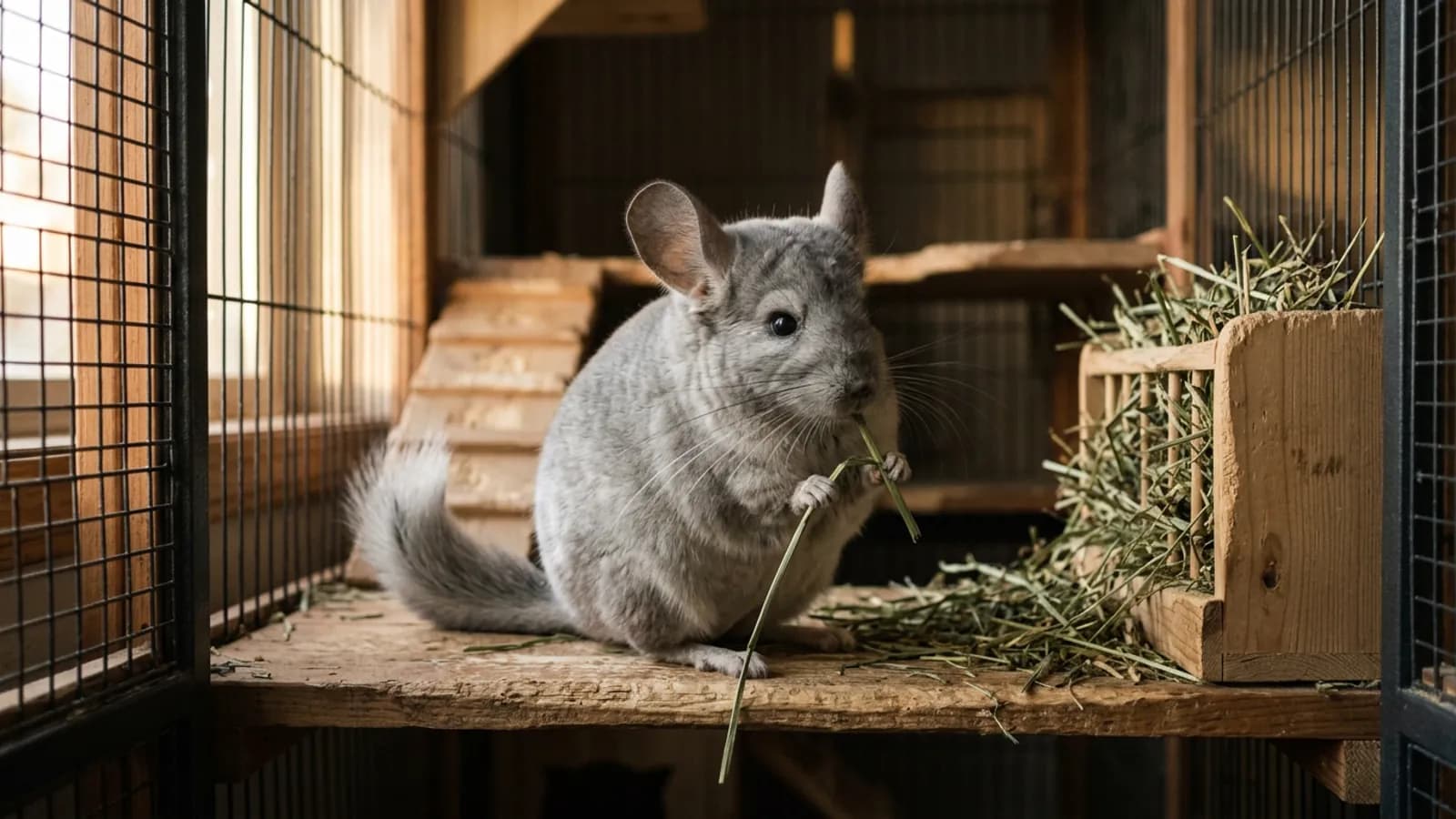
When people ask me what the best chinchilla food is, they are usually waiting for me to name a bag. I get it. The pet store shelf is full of colourful sacks with a chinchilla on the front, and it feels like the right answer has to be one of them. It is not. The honest version, after about ten years of keeping these animals, is that chinchilla food is mostly hay, all day, every day, with a small measured amount of plain pellets on top and very little else. Get that ratio right and most of the trouble I see, from soft droppings to overgrown teeth to a chinchilla that suddenly refuses dinner, never starts. Get it wrong and you spend the animal's short life chasing the damage.
Chinchilla food starts with hay, not a bag
If you take one thing from this page, take this: the overwhelming majority of what a chinchilla eats should be grass hay, and it should be in front of them at all times, never rationed. Timothy hay is the standard for good reason. It is a grass hay, high in fibre and low in the rich protein and calcium that a legume hay like alfalfa carries, and that fibre is what keeps the gut moving and the teeth worn down.
I am uncompromising about this because of Juniper. She came to me as a neglected rescue with dental disease, and I manage the fallout of that every single day. A chinchilla's teeth never stop growing, and the only thing that files them back down is the long, grinding, side to side chew of coarse hay. Pellets do not do it. Treats do not do it. Hay does. When I watch Juniper work through a pile of stalky timothy, I am watching dental care happen in real time, and I have written about what goes wrong when it does not in Chinchilla Teeth Problems: Spotting Malocclusion Before It Turns Serious.
Buy hay that still smells like a summer field and is green rather than brown, with long strands instead of dust at the bottom of the bag. I keep a fresh box in easy reach and refill it before it ever runs low. A simple boxed timothy hay is the everyday staple here. Oxbow Western Timothy Hay, 40 oz bag As an Amazon Associate I earn from qualifying purchases.
There is one exception worth knowing. Alfalfa is a legume hay, higher in calcium and protein, and it has a place for growing kits, for a pregnant or nursing female, and sometimes for an underweight or very old chinchilla. It is not the everyday hay for a healthy adult, though, and feeding it as the staple is a common mistake. For a normal adult, grass hay is the meal and alfalfa is a rare extra at most.
Chewing is not only hay, either. Plain untreated wood gives the teeth something harder to work on between meals, and a rotating set of apple wood pieces keeps a bored chinchilla busy without a scrap of sugar. emours apple wood chew sticks, 40 count As an Amazon Associate I earn from qualifying purchases.
If you want the full case on why chews are dental care rather than decoration, it is in Chinchilla chew toys, and why they are dental care, not decoration. For the whole hay argument, I wrote it out in Timothy hay for chinchillas is the whole meal, not a side dish, and the wider picture lives on the Chinchilla diet, food, and hay page.
Where pellets actually belong
Pellets are the supplement, not the meal. Their job is to backfill the vitamins and minerals that hay alone can miss, and that is all. A healthy adult chinchilla needs only about one to two tablespoons of plain pellets a day. That is a small amount, and it is meant to be. If your chinchilla is filling up on pellets and leaving the hay, the ratio has flipped, and the teeth and gut will pay for it.
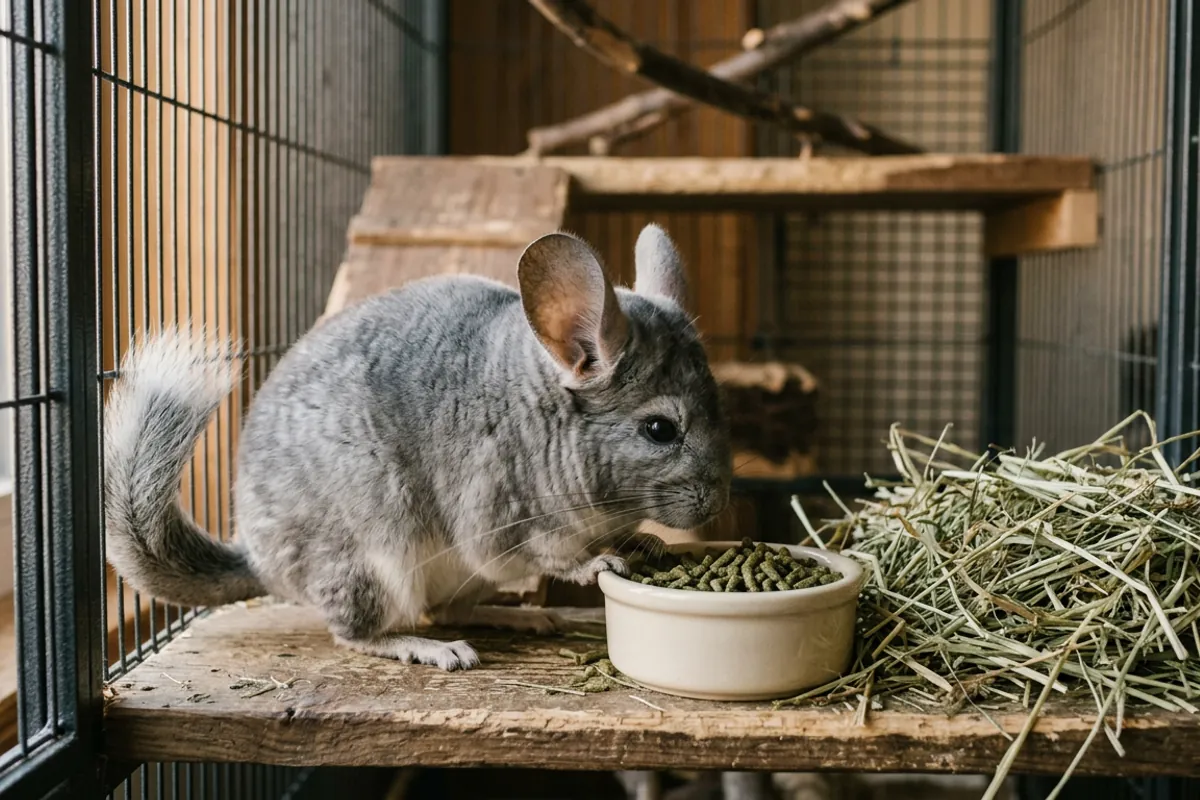
What you want is a plain, uniform, grass based pellet where every single piece looks the same. That uniformity matters more than most people realise. The moment a bag contains different shapes and colours, seeds, dried corn, or bright bits of fruit, you have a muesli style mix, and a chinchilla will do exactly what you would do at a buffet: eat the sweet, fatty pieces and leave the healthy pellet behind. That is called selective feeding, and it hands you an unbalanced diet and a fat, hay refusing chinchilla.
Pellets also go stale. They slowly lose vitamins and pick up moisture, so I buy them in bags small enough to finish inside a couple of months and store them somewhere cool and dry, sealed against damp. A giant sack that goes soft and musty before you reach the bottom is false economy. When you read "chinchilla food pellets" or "chinchilla pellet food" on a label, turn the bag over and look at the actual pieces, because sameness is the whole point. I go deeper on brands, amounts, and storage in Chinchilla pellets, the honest version of what to buy and how much.
The brands, read honestly
People want me to rank the brands, so here is how I actually judge them, and it is the same test every time: is it a plain uniform pellet, or a mix dressed up as one.
Mazuri chinchilla food is a pelleted feed you will see a lot of breeders using, and it fits the plain pellet rule well. Science Selective chinchilla food is another plain, uniform pellet that plenty of keepers, myself included, have had good years on. Oxbow is the one I reach for most, and I have written specifically about where it sits in the diet in Oxbow Essentials chinchilla food, and where pellets really fit and Oxbow chinchilla pellets, and where they really fit in the diet.
Kaytee is where you have to read carefully. The company makes a plain pellet, but it also sells colourful chinchilla mixes with seeds and treat pieces baked in, and those are exactly the selective feeding trap I just described. Charlie chinchilla food is a name UK owners search for a lot; whatever the brand, run it through the same test, look at the pieces, and only buy it if it is a uniform pellet. Watch out too for the "gourmet" and treat blend versions of otherwise fine brands, because a good name on the front does not save a bag full of coloured bits.
So the best chinchilla food is not a single winner. It is any plain, single formula pellet from a maker that has been around long enough to be consistent, fed in a measured amount next to unlimited hay. A good chinchilla food is boring by design. Boring is what keeps them alive.
Buying it near you without the mix traps
When you search for chinchilla food near me you will mostly turn up the big chains, and yes, you can feed a chinchilla well from them if you shop carefully. Petco chinchilla food and chinchilla food from PetSmart both include plain pellets and bags of timothy hay on the same shelves as the muesli mixes and the sugary treats. The store is not going to steer you to the plain option, so you have to do it yourself: skip anything with visible seeds, fruit, or coloured bits, and read the piece, not the picture on the front.
The one thing the big stores are not always great for is hay freshness, because a bag that has sat on a shelf for months goes pale and stalky and loses the smell that makes a chinchilla want to eat it. This is where buying hay in bulk earns its keep, both on price and on freshness, if you have somewhere cool and dry to store it. I keep a large sack for the day to day and refill the small box from it. Oxbow Western Timothy Hay, 9 lb box As an Amazon Associate I earn from qualifying purchases.
Store hay somewhere with airflow, never sealed in plastic while it is even slightly damp, or it will mould, and mouldy hay is not a small problem. A cardboard box or a paper sack in a dry cupboard beats an airtight bin for anything but the short term.
Treats, and the favorite food trap
Ask what a chinchilla's favorite food is and the honest answer is the stuff that is worst for them. Raisins, dried banana, yogurt drops, nuts, seeds, a corner of a cracker: they will beg for all of it, and their gut is not built for any of it. Chinchillas evolved on sparse, dry, high fibre plants. Sugar and fat hit them hard, and a diet with too much of either leads to soft stool, bloat, and a chinchilla that will not touch hay because it is holding out for the sweet thing.
I am not saying never give a treat. I am saying keep it tiny, keep it rare, and keep it plain. A single small piece of a plain dried herb or a plain rose hip, now and then, is plenty, and that is the whole allowance rather than a daily habit. A raisin a day is not love, it is a slow diet problem, and I have watched how quickly a chinchilla learns to hold out for it and snub the hay. I go through the safe list and the hard nos in Chinchilla treats, the honest version of what is safe, and the wider question of what belongs in the bowl at all in What can a chinchilla eat, and what should you never feed it.
Switching foods without wrecking the gut
Whatever you feed, do not swap it overnight. A chinchilla's gut runs on a stable population of microbes, and a sudden change in pellet or hay can throw that balance and cause the kind of GI upset that turns serious fast. When I change a brand or open a noticeably different batch, I mix a little of the new in with the old and shift the proportion over a week or two, watching the droppings the whole time. Slower is always safer than faster here.
Droppings are your daily readout. They should be firm, dry, and plentiful. If they go soft, shrink, or stop, something is wrong, and if a chinchilla stops eating or its droppings dwindle to almost nothing, that is not a wait and see situation. A gut that stalls, sometimes with bloating, is an emergency, and it is a call to an exotics vet, not a problem to sleep on. Stress from a house move, a new cage, or a hot room can knock a chinchilla off its food too, so look at the whole picture and not only the bowl. I am an experienced keeper, not a vet, and that line is one I never blur.
Water, and the things I never feed
Food is only half of the bowl. Chinchillas need clean fresh water available at all times, and the practical way to give it is a bottle rather than an open dish that fills with dust and droppings. I cover the choice in The honest guide to a chinchilla water bottle. One thing that is never on the menu is a water bath: chinchillas clean themselves in fine dust, never in water, and a soaked coat is a real problem, not a treat.
The list of things I never feed is short and firm. No fresh fruit or vegetables in any real quantity, because the moisture and sugar do not suit them. No nuts or seeds. No dairy, no bread, no human snacks, and nothing sugary or fatty however much they beg. Hay, a measured plain pellet, clean water, and a rare plain treat is the entire diet, and it really is enough.
One last thing worth saying, because it catches people out. If a chinchilla that normally eats well suddenly goes off its food, do not only think about the food. Heat is the first thing I check, because a chinchilla is in real danger once the room climbs above 75°F (24°C), and 80°F (27°C) and up is an emergency, faster in humid air. The comfortable range is 60 to 70°F (15 to 21°C). That fixation is Pebble's doing; her first summer brought a heatwave near miss and a night at the emergency vet, and it made me watch temperature as closely as I watch the food bowl. A chinchilla that has stopped eating in a warm room may be telling you about the Chinchilla temperature, not the menu. When in doubt, cool the room, and if it does not turn around quickly, call your exotics vet.