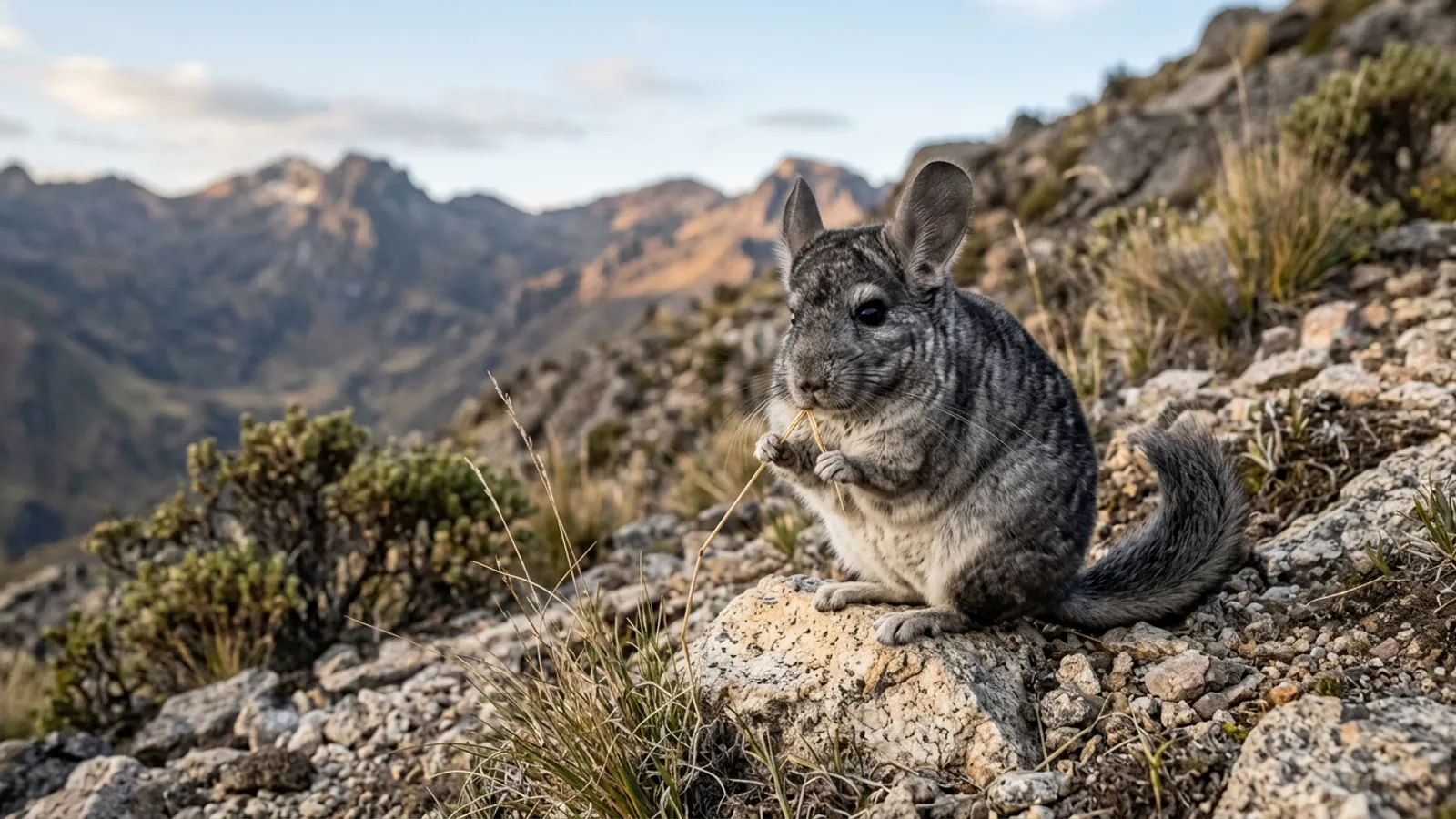
If you want to feed a chinchilla well at home, the most useful question you can ask is what do chinchillas eat in the wild. The answer is not exotic, and that is exactly the point. Wild chinchillas live on tough, dry, low-sugar plants that most animals would walk straight past, and their whole body is built around that thin, spare diet. When I set up food for Pebble and Juniper, I am really just copying the mountainside they came from as closely as a bowl and a hay rack allow. Get the wild picture right and the home diet almost writes itself. Get it wrong, and you end up with a fat, gassy, or dental-diseased chinchilla, no matter how much you love it.
Where a wild chinchilla lives
Chinchillas come from the Andes of South America, the high, dry mountain country of Chile and the ranges around it. This is not lush ground. It is rocky, wind-scoured, and cold, with thin air and sparse plant cover clinging between the stones. What a chinchilla in the wild is really like, and what it still dictates at home goes deeper on the habitat, but the gist matters for food: nothing about that landscape is generous. Plants grow slowly, they grow tough, and there are long stretches of the year with very little green at all.
That scarcity shaped the animal from the inside out. A chinchilla is a small body with a huge appetite for fiber and almost no tolerance for rich, wet, sugary food, because rich, wet, sugary food never existed where it evolved. Nearly every feeding mistake people make comes from forgetting this and treating a chinchilla like a hamster with a seed dish or a rabbit with a sweet tooth. It is neither, and the mountain is the reason.
What do chinchillas eat in the wild, plant by plant
Out on the slopes, a wild chinchilla is a grazer and a nibbler that takes whatever the season offers. The bulk of the diet is grasses and the dry, fibrous herbs and small leafy plants that grow low to the ground. On top of that they take seeds, the pods and fruits of hardy shrubs, bits of bark and twig, roots they can dig to, and the occasional succulent or cactus pad where moisture is otherwise scarce.
No single plant is the meal. The wild diet is a moving mix that shifts with the season, a little heavier on green grass after what small rain comes, and heavier on dried stems, seeds, and woody scraps through the long dry stretches. What holds steady is the character of the food rather than the exact species: fibrous, dry, low in fat, low in sugar, and eaten in small amounts across the whole day instead of in a couple of big sittings. A chinchilla forages, sits up on its haunches, holds a stem in its front paws, and works through it. Then it moves to the next thing and does it again.
If you have ever wondered why your chinchilla seems to eat all day and never really stops, this is your answer. It is doing at home exactly what its body was built to do on the mountainside, and that near-constant grazing is normal and healthy, not greed.
Why it is all tough, dry, and low in sugar
A chinchilla is a hindgut fermenter. The real work of digestion happens in a long gut that needs a steady, bulky stream of fiber moving through it to keep working. Fiber is not filler for these animals. It is the fuel and the traffic that keeps the whole system in motion. Starve the gut of fiber, or flood it with the sugar and fat it never met in the wild, and things go wrong fast: soft droppings, painful gas, bloat, and a gut that slows or stops moving altogether.
That is the single most important thing the wild diet teaches. The plants on that mountainside are nutrient-poor by nature, so the chinchilla evolved to process a large volume of low-value forage rather than a little rich food. A grape, a slice of banana, a handful of sunflower seeds, a yogurt drop: none of that reads as a treat to a chinchilla's gut. It reads as a shock the system was never asked to handle. I go into the safe and unsafe lists in What can a chinchilla eat, and what should you never feed it, but the underlying principle comes straight from the wild: dry and fibrous is normal, rich and sweet is dangerous.
The teeth are the whole reason the diet stays fibrous
Here is the part I care about most, because I live with it every day through Juniper. A chinchilla's teeth never stop growing. All twenty of them keep erupting throughout the animal's whole life, and the only thing that keeps them at the right length is grinding tough, abrasive plant material for hours a day. In the wild that grinding is automatic. The food itself is coarse enough that eating and tooth-wear are the same single act.
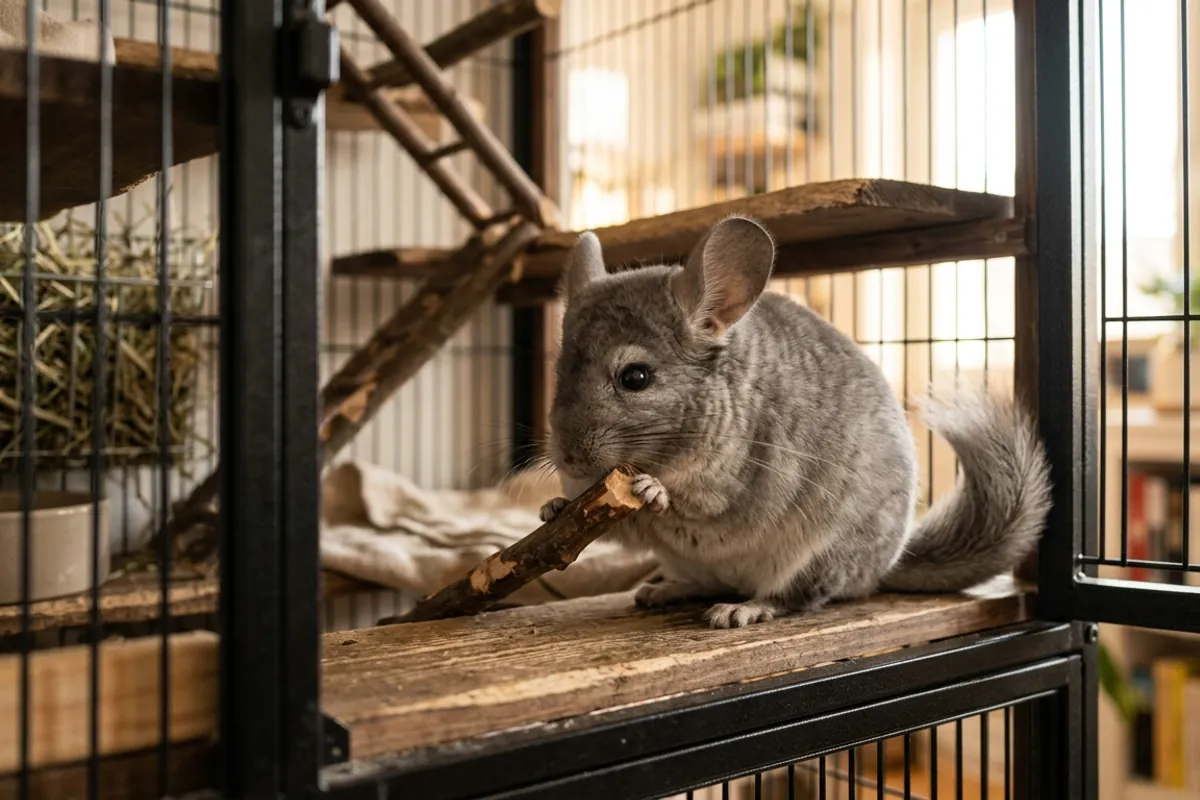
Take the coarse food away and the teeth keep growing with nothing to wear them down. They overgrow, the roots press where they should not, and you get the slow, miserable disease keepers call malocclusion. Juniper came to me already neglected, and I manage her worn and uneven bite day to day. It is the reason I am uncompromising about unlimited hay and a real variety of chews. Soft food is not a kindness to a chinchilla. It is a slow sentence for the teeth. Chinchilla teeth, from what healthy looks like to when to see a vet walks through what to watch for, and if you see drooling, dropped food, weight loss, or a chinchilla that clearly wants to eat but cannot, that is a vet visit, not a home fix. An exotics vet is the right call, every single time that line is crossed.
The home stand-in for wild twigs and bark is a rotation of safe wood chews, plain and untreated, in shapes and hardnesses that make the animal work for it. Apple wood is a favorite here, and a variety pack keeps Juniper interested instead of ignoring one boring block in the corner. emours apple wood chew sticks, 40 count As an Amazon Associate I earn from qualifying purchases.
How much water a wild chinchilla drinks
People are often surprised that standing water barely features in the wild picture. On that dry ground there simply is not much of it. A wild chinchilla gets most of its moisture from the plants it eats and from morning dew, and the low-moisture forage it lives on means it does not need to drink the way a thirstier animal would.
That is a fact about the wild, though, not a rule for your cage. At home you always give fresh, clean water, every day, no exceptions, because the dry pellets and dry hay you feed carry far less moisture than a living plant and a coat of dew. The wild lesson here is a subtle one: the chinchilla is a low-water animal that handles dryness very well, which is another reason wet, watery foods like lettuce and juicy fruit sit so badly in its gut. the plain guide to a chinchilla water bottle covers how I set water up so it stays clean and gets used, because a dirty or dripping bottle is its own problem.
Turning the wild diet into a food bowl at home
Now the practical part. You cannot buy Andean scrub, and you should not try to. What you can do is copy its character, and grass hay does that almost perfectly. Unlimited grass hay is the whole meal for a chinchilla, not a side dish. It is dry, it is fibrous, it grinds the teeth down, it keeps the gut moving, and a chinchilla can graze it all day the way it would graze a mountain slope. Timothy hay is the standard I keep in front of Pebble and Juniper at all times, so much of it that they always have more than they can possibly eat. Oxbow Western Timothy Hay, 40 oz bag As an Amazon Associate I earn from qualifying purchases.
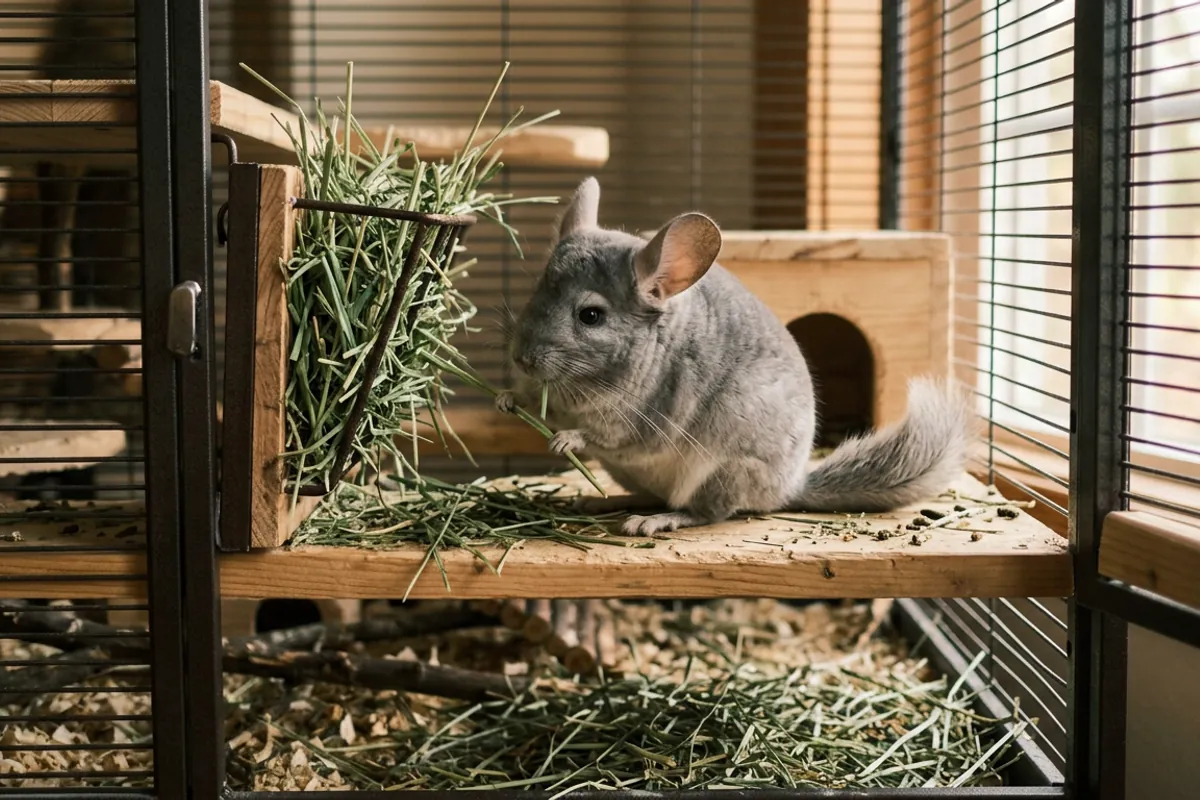
If you keep more than one chinchilla, or you just want to stop reordering every week, buying hay in bulk works out cheaper and means you never run dry, as long as you store it somewhere cool and airy so it stays green and does not turn dusty or moldy. Oxbow Western Timothy Hay, 9 lb box As an Amazon Associate I earn from qualifying purchases.
Pellets come second, and a distant second. A small measured amount of plain, grass-based pellets each day covers the odd nutrient a hay-only diet can run short on, and that is all they are there for. They are a supplement, not the meal. The mistake I see constantly is a bowl kept permanently full of pellets with hay treated as an afterthought, which is exactly backward from everything the wild diet tells you. Which chinchilla pellets to buy and how much to feed and why chinchilla hay is the whole meal lay out the amounts, and the whole hay-first case sits in Chinchilla diet, food, and hay. Get those two things right, hay always available and pellets carefully measured, and you have rebuilt the wild diet inside a cage.
What the wild diet tells you never to feed
The wild picture is also the cleanest guide there is to what to keep out of the cage. Nothing on that mountainside is sweet, wet, or fatty in any real quantity, so nothing sweet, wet, or fatty belongs in a chinchilla's daily diet. That rules out fresh fruit and most vegetables as anything more than a rare, tiny nibble, and it rules out nuts, seeds in any real amount, and anything from the human snack shelf entirely.
Commercial mixes with dried fruit, colored pieces, and seeds are the worst offenders, because they look wholesome and are the opposite. A chinchilla will pick out the sweet, fatty bits and leave the plain fibrous ones, which is the exact reverse of what its gut and teeth need most. If you want to hand over something extra, a small piece of plain dried herb or a single plain oat is far closer to the wild than any of that, and even then, only now and then. I keep the plain safe list in my guide to chinchilla treats. The rule I hold to is simple: if a wild chinchilla could never have found it on that slope, my two do not get it as a matter of routine.
The cold came with the food, and it still matters
One last thing the wild teaches, because it very nearly cost me Pebble. The same mountains that give chinchillas their tough, dry diet are cold. That thin high air runs cold, and the chinchilla answers it with the densest fur of almost any land animal. That coat is superb at holding heat in and terrible at letting it out, which is why a chinchilla that shrugs off cold with ease can die in ordinary summer warmth.
The comfortable range is 60 to 70°F (15 to 21°C). Above 75°F (24°C) starts to get risky, and 80°F (27°C) and up is an emergency, faster still if the air is humid. Pebble came to me out of an overheated attic and gave me one heatwave near-miss and a night at the emergency vet in her first summer, and that scare is the whole reason I am relentless about this. Feeding a chinchilla like the wild is only half the job. Keeping it as cool as its mountains is the other half. A simple thermometer and hygrometer clipped to the cage takes the guesswork straight out of it. digital thermometer and humidity gauge with remote probes As an Amazon Associate I earn from qualifying purchases.
If the room climbs, act on it before it becomes a crisis. Chinchilla temperature is the number that keeps yours alive and Chinchilla heat safety cover the how, and the warning signs of a chinchilla already in trouble are in Chinchilla Heat Stroke: Warning Signs Every Owner Should Know. The wild built a cold-weather animal that eats dry grass all day long. Honor both halves of that, the food and the cold, and you have a chinchilla that can thrive far from the mountains it came from.