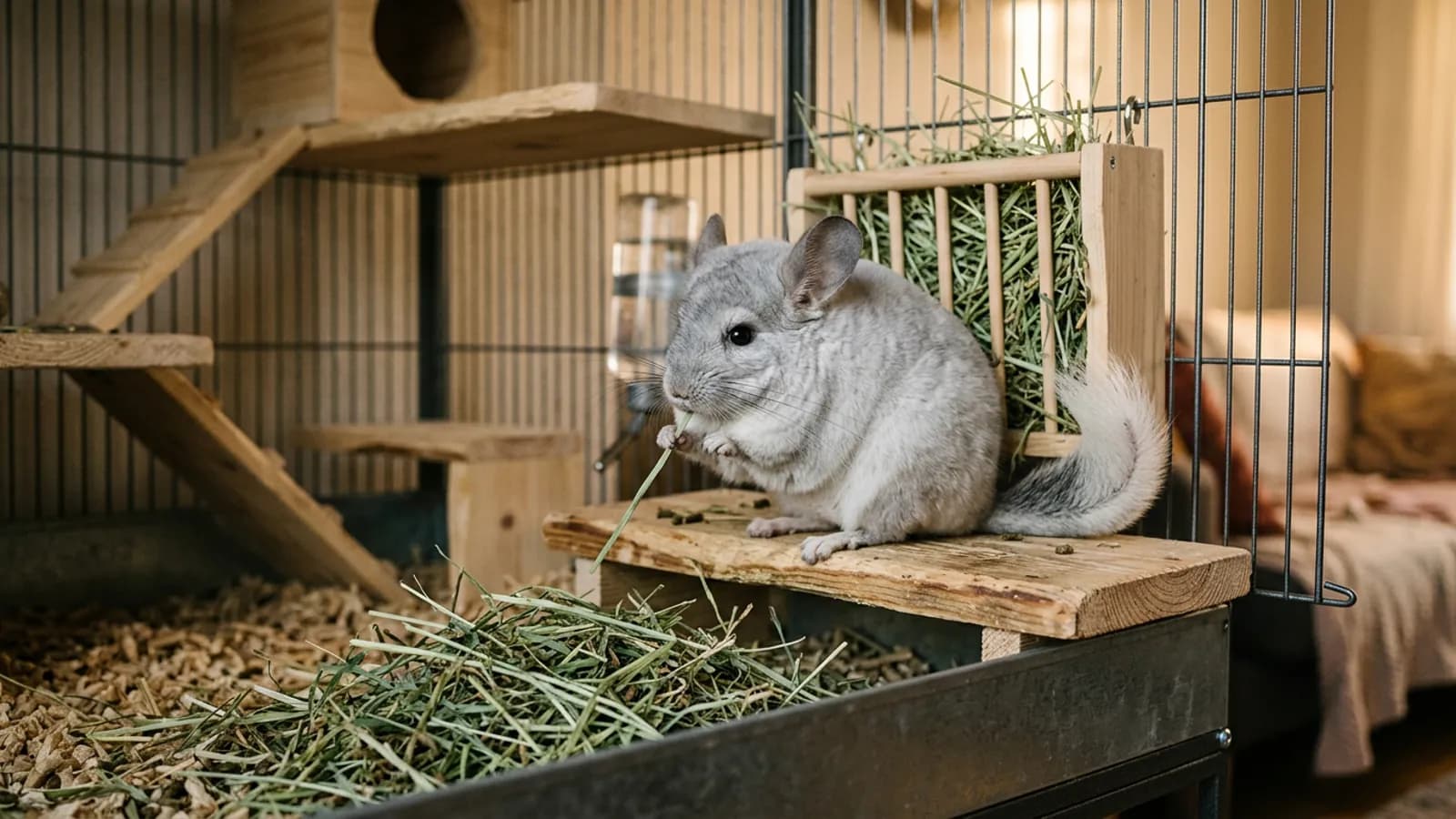
Timothy hay for chinchillas is not the garnish on the plate, it is the plate. A chinchilla's whole body is built to grind coarse, dry grass for most of its waking hours, and the pellets people fixate on are the small measured extra, not the meal itself. I learned exactly how much this matters through Juniper, a rescue who arrived with dental disease already underway. Watching, up close, what happens when a chinchilla's teeth stop getting worn down turned me into someone who is genuinely uncompromising about hay. None of it is complicated, but almost all of it is easy to get subtly wrong, and the animal pays for the mistake slowly. So this is the hay article I wish someone had handed me on day one: what timothy is, why it is the best hay for most chinchillas, where alfalfa and orchard grass fit, and how to get a stubborn animal to actually eat it.
Why grass hay is the entire point
A chinchilla's teeth never stop growing. They keep erupting for the animal's whole life, and the only thing that keeps them at a workable length is the animal chewing coarse, abrasive fiber for hours a day. Grass hay is that fiber. Pull the hay and the teeth keep growing while nothing wears them down, and the result is overgrowth, spurs that cut into the cheek and tongue, and eventually a chinchilla that wants to eat but cannot. That is malocclusion, and it is the single most common serious problem I watch keepers walk into, almost always after months of a diet that was too soft and too rich. Juniper is why I will not stop saying it.
The gut runs on the same fiber. Chinchillas have long, sensitive digestive tracts that need a steady stream of roughage to keep moving, and their hindgut ferments that fiber into much of what they live on. Feed too little of it and things slow down or stall, which is genuinely dangerous and moves fast. Unlimited grass hay keeps the teeth worn and the gut moving at the same time, which is why it makes up the large majority of a healthy chinchilla's daily intake and why everything else on the plate is a supplement to it, not a rival. In practice that means a fresh pile at least the size of the chinchilla itself in front of the animal at all times, topped up so it never runs empty. There is no such thing as too much grass hay: a chinchilla self-regulates on roughage in a way it never will on pellets or treats, so the rack stays full and you stop worrying about portioning it. If you take one thing from this whole site, let it be that hay is not optional and it is never rationed. For how the rest of the diet fits around the hay, I keep a fuller breakdown on the chinchilla diet page.
What makes timothy the default hay
Timothy is a grass hay, and grass hay is what a chinchilla evolved to eat. It is high in fiber, modest in protein, and modest in calcium, which is exactly the profile you want in something an adult chinchilla eats around the clock. That last point matters more than it sounds: grass hays hold calcium at a level a chinchilla can handle every day, where the legume hays do not. This is the main reason timothy is my answer when someone asks for the best chinchilla hay. It is not the only good grass hay, but it is the one that is easy to find, easy to judge by eye, and hard to get badly wrong.
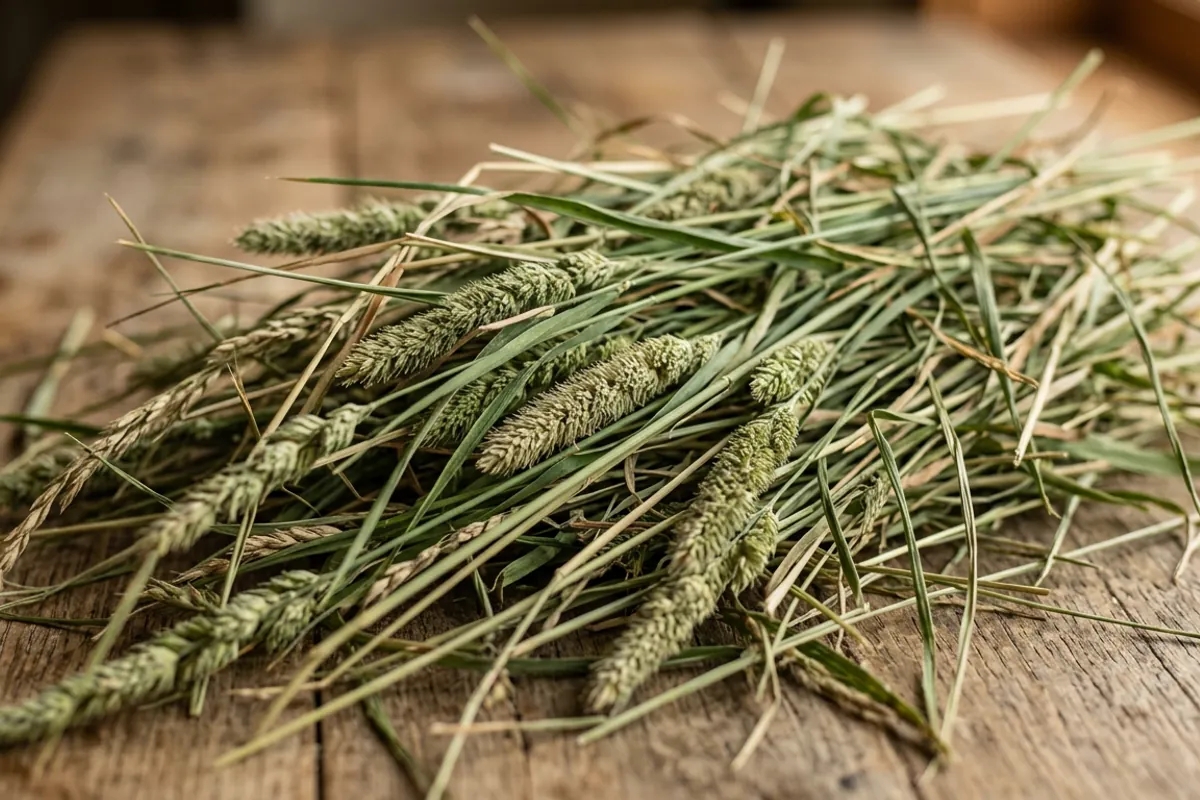
Timothy is cut more than once a season, and the cutting changes the texture. First cutting is stemmy and coarse with more seed heads, which is great for tooth wear though some chinchillas find it too rough. Second cutting is the balance most keepers reach for: a mix of stem and leaf, green, with enough coarseness to work the teeth and enough softness to tempt a picky eater. Third cutting is soft and leafy and low on stem, which the fussy ones love but which does less for the teeth. I keep second cutting as the everyday hay and use a softer cutting only to win over a chinchilla who is refusing. You can also judge timothy by its dust: a good bag has some natural leaf shatter, but a bag that puffs a cloud of fine powder when you open it is either old or handled hard, and that dust irritates the sensitive respiratory tract chinchillas are known for. There is no single perfect cutting, and anyone selling you one as the only correct choice is overselling.
Alfalfa is a tool, not a daily hay
Here is where a lot of new owners go wrong, usually with the best intentions. Alfalfa is not a grass, it is a legume, and alfalfa hay for chinchillas runs much higher in calcium, protein, and calories than timothy. Fed as the daily base to a healthy adult, that extra calcium is a real concern, because chinchillas are prone to urinary and bladder stones and a constant high-calcium load is one of the things that pushes them toward it. So chinchilla alfalfa hay is not a straight upgrade over timothy, and it is not the everyday hay, no matter how enthusiastically a pet store bags it up as one. Read the bag, too, because plenty of chinchilla-branded hays are actually alfalfa or an alfalfa blend sold to owners who assume any hay in a chinchilla aisle is the right one.
That does not make alfalfa the enemy. It has real, specific uses. Growing kits, a pregnant or nursing female, and an underweight or recovering chinchilla can genuinely benefit from the extra protein and calories, and a vet may point you toward it in exactly those cases. I also use a small pinch of alfalfa the way I use a treat, to get a hay-refusing rescue interested in eating from a rack at all, and then I taper it back out. The rule I hold to is simple: for a healthy adult, alfalfa hay chinchilla feeding is occasional and purposeful, and grass hay is the base. If your chinchilla is in one of those special cases, that is a conversation to have with an exotics vet rather than a guess you make at the pet store shelf.
Orchard grass and the other grass hays
Timothy is the default, but it is not the only grass hay worth feeding, and rotating grass hays is a good habit rather than a compromise. Orchard grass hay for chinchillas is the one I reach for most often after timothy. It is a soft, sweet-smelling grass hay with a nutrition profile close to timothy's, and I have used it more than once to turn around a chinchilla who had decided timothy was beneath them. Because it is softer it can be an easier sell to a fussy eater while still keeping the fiber high, which is the whole trick. I keep two grass hays on hand at once and let a fussy chinchilla pick, which usually gets more fiber into them over a week than a single hay ever did.
Other grass hays like meadow and oat hay are fine to mix in as well, so long as the base of the diet stays a grass hay and not a legume. Variety keeps a picky chinchilla from getting bored of a single texture, and a bored eater is one that eats less hay than it should. One honest caveat before you commit to a big box: orchard grass is a common trigger for people with hay allergies, more so than timothy for some of us, so if you are the one filling the rack every day and you start sneezing, that is worth knowing early. The goal never changes, whichever grass you land on, which is coarse fiber in front of the animal at all times.
Buying hay that is actually worth feeding
Hay is food, and stale hay is the reason a lot of chinchillas quietly stop eating what they should. The best timothy hay for chinchillas is not defined by the brand on the front so much as by what is inside the bag. Good hay is green, not yellow or brown. It smells sweet and grassy, faintly like a barn in a good way, never musty or sour. It should feel dry but not so brittle it shatters to dust in your hand, and it should be mostly long strands, not a bag of crumbs and powder settled at the bottom. Judge it with your eyes and your nose before you judge it by the label.
For most keepers a boxed timothy from a reputable brand is the easy, reliable place to start, and it is what I would hand a first-time owner.
Oxbow Western Timothy Hay, 40 oz bag As an Amazon Associate I earn from qualifying purchases.
If you keep more than one chinchilla, or you simply do not want to reorder every couple of weeks, buying in bulk works out cheaper per pound and means the rack is never empty, which is the entire point of having it.
Oxbow Western Timothy Hay, 9 lb box As an Amazon Associate I earn from qualifying purchases.
Whichever size you buy, storage is what protects it. Keep hay somewhere cool, dry, and airy, out of direct sun and off a damp floor, in something that breathes rather than a sealed plastic tub that traps moisture and grows mold. A paper bag or a cardboard box in a dry cupboard beats an airtight bin every time. Do not over-buy on a sale, tempting as it is: a giant box that outlasts its freshness just becomes a box of hay your chinchilla rejects, and rejected hay is money you spent to teach the animal that the rack is not worth checking. Buy an amount you will actually get through in a couple of months, because even good hay fades with age.
Getting a chinchilla to actually eat it
A chinchilla eating hay steadily through the day is the clearest sign the whole diet is working, and a chinchilla ignoring the rack is a problem to solve, not to wait out. The first fix is almost always freshness: dump the old hay and offer a fresh handful, because they will refuse hay that has gone stale or dusty even when it looks fine to us. The second is presentation. Most chinchillas eat more when the hay is held at chest height than when it is dropped on the cage floor, where it gets soiled and trampled and stops being appetizing within a day. Some chinchillas also eat better at dusk and into the night, when they are naturally most active, so a fresh top-up in the evening often disappears faster than the same handful offered at noon.
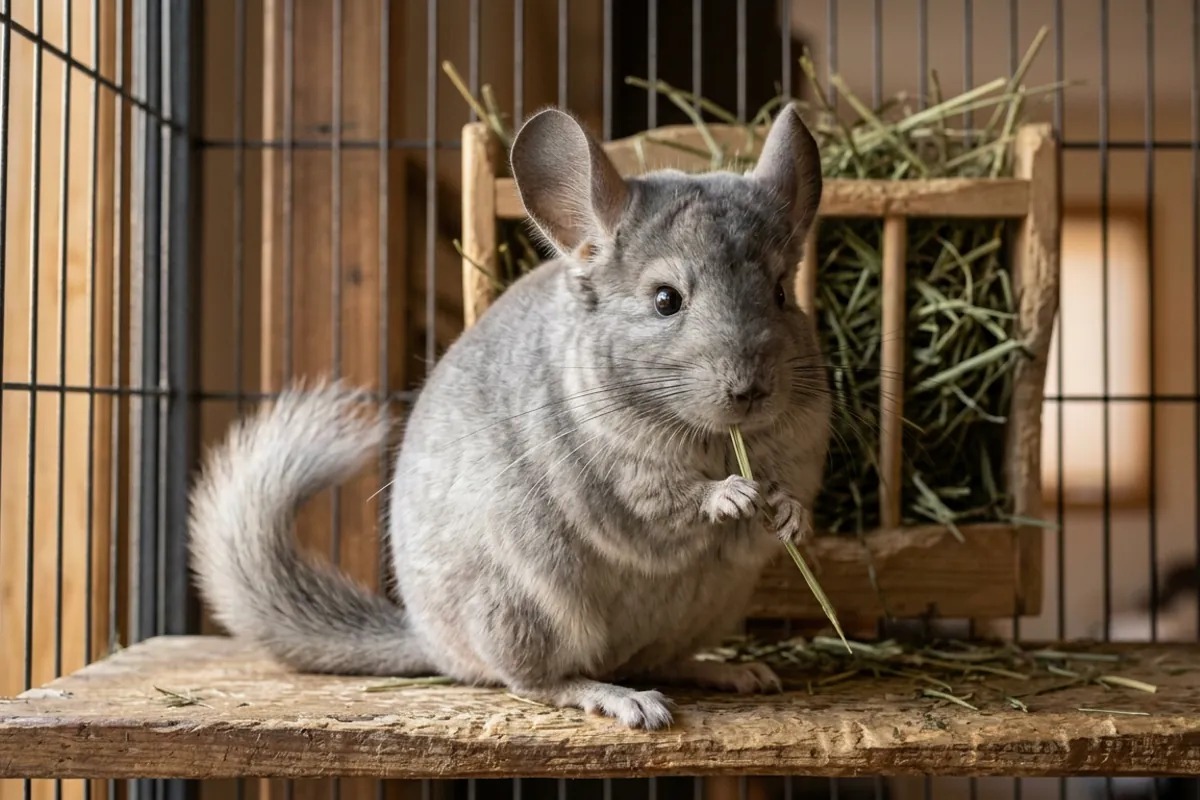
A chinchilla hay rack made of metal or wood does that job far better than a ball or a plastic clip. Skip anything with a wire mesh a leg can slip through, and skip the plastic hay balls entirely, because a chinchilla will chew plastic and plastic has no place anywhere in the cage. A rack mounted to the bars and filled fresh daily keeps the hay clean and keeps the animal coming back to it through the day. If you are still fitting out the enclosure, the cage itself has to be all metal and wood for the same reason the rack does, and I go through why in full on why a chinchilla cage has to be metal.
If a chinchilla that used to eat hay suddenly stops, do not write that off as pickiness. A sudden drop in hay eating, drooling, weight loss, or pawing at the mouth points straight at the teeth, and that is an exotics vet visit, not a hay you can switch your way out of. Juniper taught me that the mouth hides trouble until it is well along, so I weigh the fussy ones on a kitchen scale and I treat a real appetite change as the warning it is.
Hay cubes, pellets, and the complete food trap
Two products muddy this more than they should. The first is chinchilla hay cubes, compressed blocks of timothy or alfalfa. They are fine as an extra, they store neatly and some chinchillas enjoy gnawing them, but a cube is denser and shorter than a strand of loose hay and it does not work the teeth or fill the gut in quite the same way. They also make a decent way to travel with hay, since a cube will not scatter through a carrier the way loose hay does on a car trip to the vet. Treat cubes as a supplement to loose hay, never a stand-in for it, and check whether the cube is timothy or alfalfa before you make it a daily habit.
The second is the bigger trap. Products like Kaytee Timothy Complete chinchilla food are pelleted diets built on timothy, and the word complete does a lot of misleading work on that label. A timothy-based pellet is a perfectly fine plain pellet, and a measured amount of plain pellet is a normal part of the diet, but no pellet replaces loose hay. A pellet does not wear the teeth the way long strands do, and a chinchilla left to fill up on pellets will eat less hay and grind its teeth less, which is the exact road to dental trouble. So I read complete as complete pellet, not complete diet, and I keep the pellet measured rather than poured in without limit. I go deeper on where pellets belong on the chinchilla pellets page.
The wearing job that hay does inside the mouth also wants backup from real chewing between meals. A rotation of safe wood chews, apple and other untreated hardwoods, gives the teeth more surface to work against and keeps a restless chinchilla busy on wood instead of on the cage bars.
emours apple wood chew sticks, 40 count As an Amazon Associate I earn from qualifying purchases.
None of it replaces the hay, though. Hay is the base, chews are the backup, pellets are the measured extra, and everything sweeter is a treat. Get the hay right and you have handled the two things most likely to hurt a chinchilla, the teeth and the gut, before they ever start. Get it wrong and no amount of good gear buys the animal its way back.