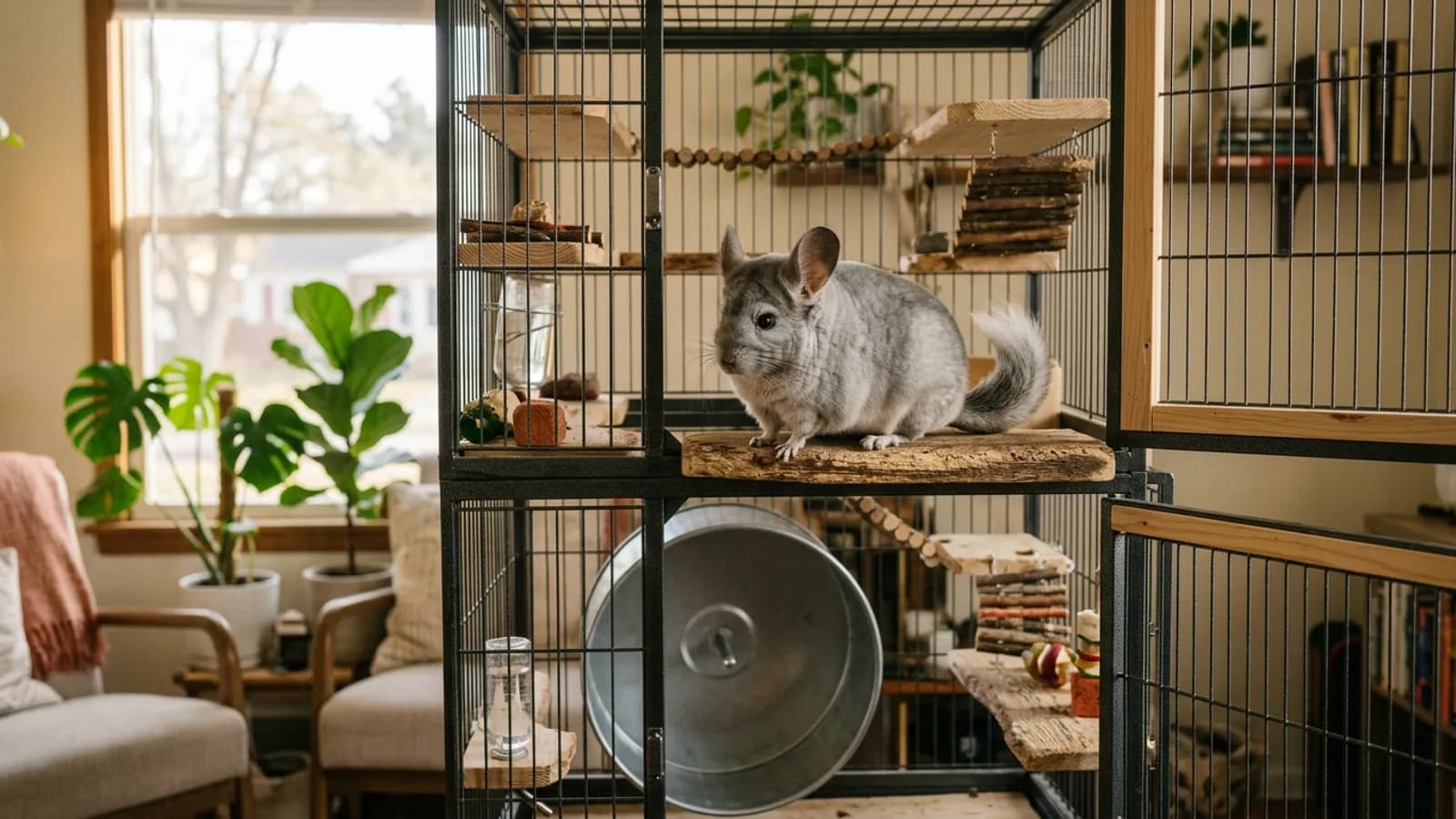
Search "chinchilla cage metal" and you will find a mix of good advice and a surprising amount of junk sold to people who love their animals. The short version, after about ten years of keeping these animals, is this: the frame of a chinchilla home has to be metal, and there is no reasonable substitute. A chinchilla is a rodent built to grind wood, wire, plastic, and your good intentions into shavings. The cage is the one piece of gear standing between that instinct and an animal loose in your walls or bleeding from a swallowed shard of plastic. So I want to walk through what "metal" actually buys you, where wood still earns a place, and how to read the listings without paying for the wrong thing twice.
Why metal is the frame and everything else fails
Chinchilla teeth grow for the animal's whole life, around a couple of inches a year, and they never stop. That single fact drives almost every rule on this site, including this one. Give a chinchilla a plastic-coated cage, a plastic base, or plastic shelves, and it will test them. Not maybe. It will find a corner, work it with its incisors, and start swallowing pieces. Plastic does not pass safely; it can lump up in the gut and turn into an emergency surgery, if you are lucky enough to catch it in time.
Wire and metal, by contrast, they cannot eat. A powder-coated steel cage takes the chewing and shrugs. That is the whole argument for a metal chinchilla cage in one sentence: it is the only common cage material a chinchilla cannot destroy or ingest. Everything else on the market is a compromise you will regret. I have watched Juniper, one of my two, work a wooden ledge down to a nub in a few weeks, and wood is supposed to be chewed. Now picture that same energy aimed at a plastic tray your animal is standing on all day.
There is a second reason, less obvious. Metal is easy to clean and it does not hold odor. Chinchilla urine is concentrated, and a porous surface soaks it up and stinks within days. Steel wipes down. When you are cleaning a cage every week for fifteen or twenty years, that difference adds up to a lot of your life.
What an all metal chinchilla cage really means
"All metal" gets used loosely, so let me be precise about what you want and what you do not. You want the structure, the bars, the frame, and ideally the base pan, to be metal. What you do not want is the animal standing on bare wire mesh all day, and you do not want a cage with zero wood in it either. A truly all metal chinchilla cage, in the literal sense of nothing but wire, is not the goal. The goal is a metal frame with the right surfaces inside it.
Here is the distinction that trips people up. The cage skeleton should be metal because it takes the abuse. But the ledges, the shelves, the perches, those should be kiln-dried untreated wood, because standing and resting on wire causes sore hocks, sometimes called bumblefoot, and because chinchillas need to chew and wood is what they are meant to chew. So the honest recommendation is a metal-framed cage fitted out with wooden ledges you can replace as they get gnawed down. A cage that arrives with a couple of solid wood shelves already fitted is the format I keep coming back to.
Critter Nation double unit small animal cage As an Amazon Associate I earn from qualifying purchases.
If the wire floor is the only surface, you have more work to do: you cover the wire with wood or fleece so the feet are protected, and you accept that you are retrofitting. None of this is exotic. It is just knowing that "metal cage" and "metal floor the animal lives on" are two different claims, and only the first one is a requirement.
Bar spacing, coatings, and the floor question
Metal is necessary but not sufficient. The details decide whether a metal cage is safe or a trap.
Bar spacing comes first. You want horizontal or vertical bars spaced no more than about 1 inch, and closer, roughly half an inch to three-quarters, for a young or small chinchilla that can squeeze through gaps you would swear were too small. A kit can escape a cage rated for a rat. If the listing does not state the bar spacing, treat that as a reason to walk away, not a detail to guess at.
Coating matters next. Powder-coated steel is the standard, and it is fine, as long as the coating is intact. When a chinchilla chews through to bare metal, keep an eye on it; galvanized coatings can shed zinc, and a determined chewer working the same spot is worth watching. This is one reason I like a frame the animal has less reason to gnaw, with plenty of proper wood chews inside to redirect the teeth. Give them a real variety of chews and they leave the bars alone.
emours apple wood chew sticks, 40 count As an Amazon Associate I earn from qualifying purchases.
Then the floor. A solid or near-solid floor under the animal is kinder to feet than open wire. Many good metal cages ship with a wire floor over a pull-out pan; the fix is to lay down wooden panels or fleece so your chinchilla is not standing on grid all day. The pull-out metal pan itself is a feature, not a flaw, it makes cleaning fast, as long as the animal is not living directly on wire. For the full walkthrough of getting a cage kitted out, I wrote a longer piece on how to build a chinchilla cage setup that keeps the animal healthy, and a companion on setting up a chinchilla cage the right way, once.
One more: height beats floor space for these animals. Chinchillas are vertical climbers and jumpers. A tall metal cage with several wooden levels gives them the movement they need far better than a wide, shallow one. If you are choosing between two metal cages, take the taller one with more levels almost every time.
Metal, heat, and why the material cuts both ways
This is where I get blunt, because it is the part that kills animals. Metal conducts heat. That works for you and against you depending on the room.
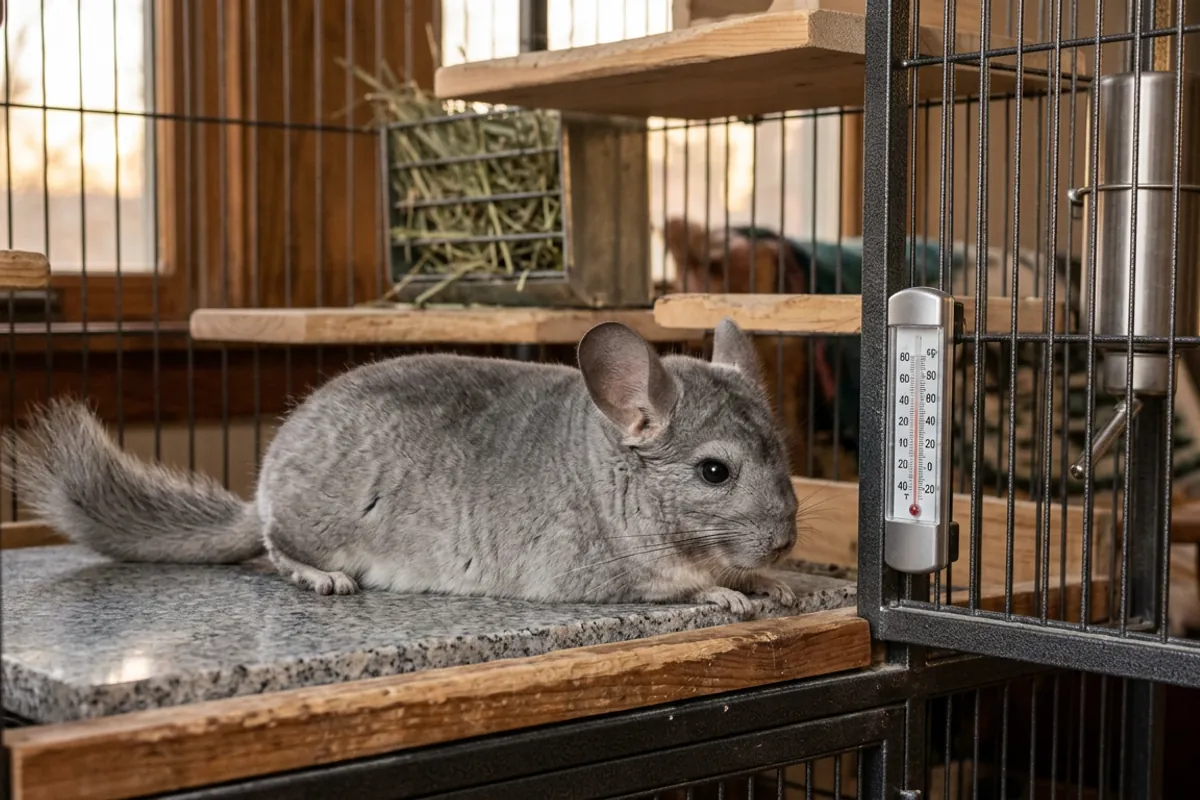
Pebble came to me out of an overheated attic, a rehome, and her first summer with me brought a heatwave and a night at the emergency vet that I am not interested in repeating with any animal. So I am relentless about temperature, and a metal cage is part of that math. Chinchillas are comfortable at 60 to 70°F (15 to 21°C). Above 75°F (24°C) you are into risky territory, and at 80°F (27°C) and up you are in an emergency, faster still when the air is humid, because a chinchilla's dense coat traps heat and they cannot shed it by sweating. The dense fur that makes them beautiful is exactly what makes them fragile in warmth.
Where does metal come in? A metal cage in a hot room does not insulate the animal from the heat the way you might hope; the bars are the room temperature. But metal also lets you add real cooling. A chilled granite or ceramic slab set on a metal shelf gives a chinchilla a genuine cool surface to sprawl on, and metal transfers that coolness rather than fighting it.
Kaytee Chinchilla Chiller granite stone As an Amazon Associate I earn from qualifying purchases.
None of that replaces controlling the room. It supplements it. The non-negotiable is a thermometer on or beside the cage so you know the actual number, not the number your thermostat claims two rooms away.
digital thermometer and humidity gauge with remote probes As an Amazon Associate I earn from qualifying purchases.
If you take one thing from this section: buy the metal cage, then obsess over the room temperature independently. I keep a fuller version of this in chinchilla temperature is the number that keeps yours alive, the chinchilla heat safety hub, and a heat danger calculator that turns the numbers into a plain warning.
The metal Aventura and other huge cage listings
If you have shopped at all, you have seen the listing that reads something like "metal aventura huge metal rat ferret chinchilla cage." These oversized multi-species metal cages show up constantly, and they are worth understanding rather than dismissing.
The good news: a big metal frame built for ferrets or rats is often genuinely useful for a chinchilla, because it is tall, it is steel, and it has the vertical space these animals want. The frame is usually the right idea. The catch is everything that comes bolted inside it. Ferret and rat cages ship with plastic shelves, plastic ramps, plastic tubes, and plastic pans, because those species do not eat their furniture the way a chinchilla does. So the huge metal rat ferret chinchilla cage is frequently a great skeleton wrapped around a set of parts you have to remove.
My approach with any of these is simple. Buy it for the frame and the bar spacing, then strip out every plastic shelf and ramp and replace them with wooden ledges. Check that the door latches survive a determined animal, because a chinchilla is stronger and cleverer than the ferret the latch was designed for. And measure the bar spacing before anything else; a cage built for a full-grown ferret can have gaps a young chinchilla walks straight through. Treated as a frame to be finished, these big listings can be a smart buy. Treated as ready to use out of the box, they are a plastic problem you paid extra for. I go deeper on picking between formats in how to pick the best chinchilla cage without buying the wrong one twice and on the Critter Nation cage, which is the metal cage most keepers land on.
Metal litter boxes and litter pans
The same logic that governs the cage governs the accessories, and litter is where people forget it. A chinchilla litter box in metal exists for exactly the reason the metal cage does: the animal will chew a plastic corner box, swallow the pieces, and hurt itself. A metal litter pan for a chinchilla removes that risk entirely.
Now, honesty. Not every chinchilla uses a litter box, and plenty never take to one at all. Chinchillas are not as tidy as rabbits about a single corner, and you should not buy a corner box expecting toilet training to just happen. But many will settle on one spot to urinate, and if yours does, a metal litter pan in that corner makes cleanup far easier and keeps the mess off the wooden ledges. Fill it with a safe paper-based or kiln-dried pine litter, never cedar, whose oils are a respiratory irritant, and never clumping cat litter, which is dangerous if eaten.
If you cannot find a purpose-made metal chinchilla litter box, a small stainless steel pan of the kind sold for other pets works, provided the edges are smooth and the animal cannot tip it. The point is the material, metal not plastic, and the placement, in whichever corner your particular chinchilla has already chosen. Do not force the location; watch where the animal goes and put the pan there.
What I would actually put in the cart
Pulling it together, here is the setup I would build around a metal cage, in order of what matters.
Start with a tall metal-framed cage with bar spacing no wider than about 1 inch, close-spaced or temporarily lined for a young animal, and with a pull-out metal base pan for cleaning. Fit it with kiln-dried untreated wooden ledges rather than living on wire, and plan to replace those ledges as they get chewed, that is them doing their job. Add a solid-surface running wheel, never a wire-runged one, because wire wheels catch feet and break legs.
15 inch Chin Spin solid surface chinchilla wheel As an Amazon Associate I earn from qualifying purchases.
Put unlimited grass hay in front of them at all times; hay is the whole base of the diet and the main thing that keeps those endlessly growing teeth worn down, with plain measured pellets as a supplement, not the main event.
Oxbow Western Timothy Hay, 40 oz bag As an Amazon Associate I earn from qualifying purchases.
Give them a spread of safe wood chews so the cage bars stay boring by comparison, keep a cool stone and a thermometer in play so a hot afternoon never becomes an emergency, and add a metal litter pan in whichever corner your chinchilla has claimed. A dust bath a few times a week keeps the coat right, and that dust is fine volcanic pumice, never water, because a wet chinchilla coat does not dry properly and invites fungus and worse.
Lixit Blue Beauty chinchilla dust, 3 lb As an Amazon Associate I earn from qualifying purchases.
That is the honest list. The metal cage is the foundation the rest sits on, and it is the one piece you should not cheap out on, because it is the piece the animal spends every hour of its long life inside. Buy the steel frame, finish it with wood, control the room, and you have given your chinchilla the one thing a plastic cage never can: a home it cannot turn into a hazard.