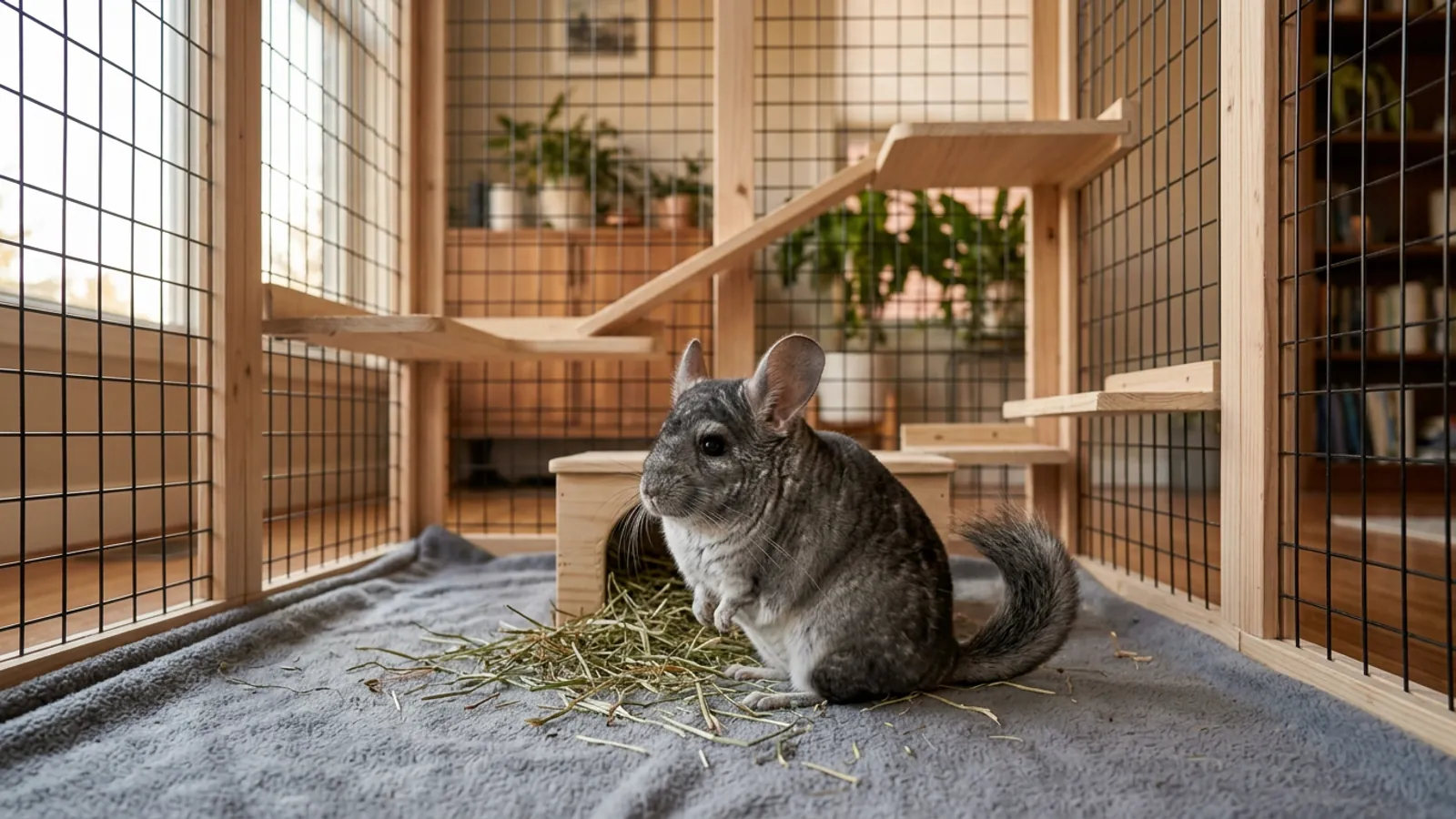
A chinchilla playpen is the enclosure you set up outside the cage so your chinchilla gets real floor space for the half hour or so of movement it needs each day. I want to be straight about what it is and what it is not. It is not a replacement for a big cage, and it is not somewhere you can leave an animal alone. It is a contained, chinchilla-proofed corner of a room where a fast, jumpy, chew-everything rodent can run without wrecking your baseboards or disappearing under the sofa. Done right, it makes out-of-cage time calmer for both of you. Done lazily, it is a box a chinchilla clears in a single jump.
Why a playpen earns its place
Chinchillas are built to move. In the wild they cover rocky ground in short, fast bursts, and even the biggest cage you can reasonably fit in a room does not give them a flat stretch to sprint across. The cage is where they live; the pen is where they get to open up. I run Pebble and Juniper in a pen most evenings, and the difference in how they settle afterward is plain to see.
How much time? I aim for at least thirty minutes of pen time a day, more when I can, split across one or two sessions. It does not have to be long, it has to be regular. A chinchilla that only comes out once a week gets that pent-up, frantic energy that ends in a bad jump or a hard landing. Little and often keeps them fit and keeps the sessions calm.
The alternative most people reach for is letting the chinchilla loose in a whole room. I did that early on and regretted it. A free room is impossible to fully chinchilla-proof, and a chinchilla will find the one cable, the one gap behind a bookshelf, the one thing you forgot. A pen shrinks the problem to a space you can watch and control. It is the difference between supervising a defined area and chasing an animal around the furniture.
If the cage itself is too small, a playpen does not fix that. Fix the cage first, because exercise time is meant to sit on top of a proper home, not paper over a bad one. If you are still sorting the cage, start with why a big chinchilla cage is the baseline.
What a chinchilla playpen has to survive
Two forces destroy a flimsy pen: jumping and chewing.
Start with the jump. A healthy adult chinchilla can clear two to three feet from a standstill, and higher off anything it can push against. Any panel shorter than that is a suggestion, not a barrier. This is the single most common mistake I see with a chinchilla indoor playpen bought off the shelf. The small-animal pens sold for rabbits and guinea pigs are often knee-high, and a chinchilla treats those like a warm-up hurdle.
Then the chewing. Juniper taught me to take this seriously. She is a rescue with dental disease I manage day to day, and I watch, up close, what her teeth do to anything in reach. A chinchilla tests every surface with its teeth, and the wrong material is both a wrecked pen and a real health risk. Plastic panels are the worst offender: they get gnawed, the pieces get swallowed, and that can cause a gut blockage. What you want for the barrier itself is bare metal, and any wood in contact with the animal should be a safe, untreated chew wood, never painted or glued board.
There is a third thing that catches people out: gaps. A chinchilla can squeeze through a surprisingly small space, and a pen with wide bars is an open door. Keep the spacing to about one inch (2.5 cm) or less, tighter for a young chinchilla, and check the corners and the joins where two panels meet, because that is usually where the gap hides.
So the plain shortlist of a pen that lasts: tall metal panels, close bar spacing, no plastic within reach, no painted or treated wood, and a floor you can wipe down or cover.
Height, and why a playpen with top matters
I keep coming back to height because it is where people get burned. A chinchilla playpen with top is not a luxury. For a lot of setups it is the only version that holds the animal.
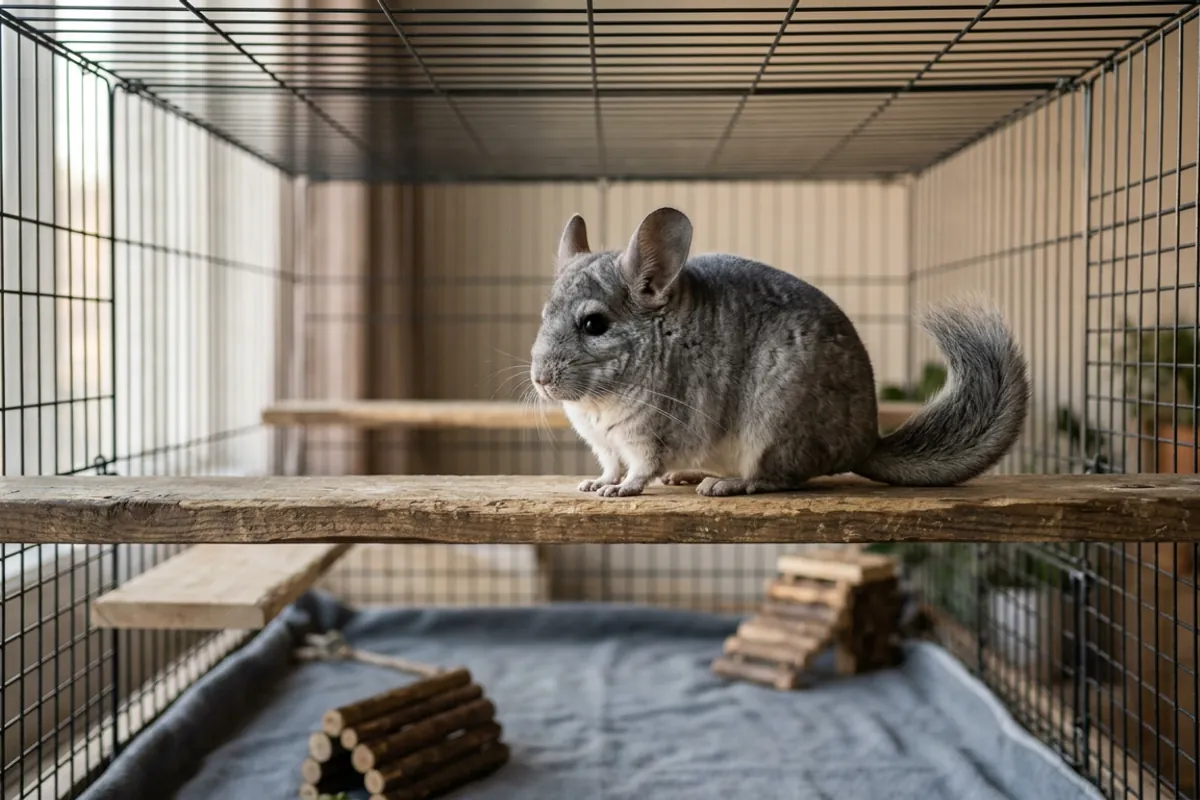
Here is the reasoning. If your panels are a solid four feet or taller and there is nothing inside for the chinchilla to launch off, an open-top pen can work. But the moment you add a ledge, a house, a wheel, or a dust bath, you have handed the animal a launch pad, and the effective wall height drops. A chinchilla will happily hop onto a house and then straight out over the top. A top closes that gap.
The other reason for a top is what is above the pen rather than inside it. If you share the house with a cat or a dog, a top is the line between supervised play and a paw reaching in. Even with me sitting right there, I would not run an open pen in a home with a predator that can get to it. If that is your situation, read keeping a chinchilla and dog under one roof safely before you set anything up.
Building a homemade playpen
A chinchilla playpen homemade version is genuinely one of the better routes, because you can build for height and safe materials in a way the shop versions rarely manage.
The frame most keepers land on is metal storage-cube grids, cable-tied or clipped into panels. They are cheap, they are bare metal, and you can stack them two grids high to reach the height a chinchilla needs. That is the backbone of most any DIY chinchilla playpen you will see keepers share. A few things I would insist on:
- Use the metal grids, and keep any plastic connectors out of reach, or swap them for cable ties trimmed flush so there is no plastic edge to gnaw.
- Make it tall. Two grids high, or grids plus a top panel, is the target. One grid high is a rabbit pen.
- Add a top if anything inside doubles as a launch pad, or if other pets share the house.
- Put something washable underneath. A chinchilla will pee and drop poop as it goes; a wipeable mat or a fleece liner you can throw in the wash saves your floor.
Footprint matters too. Bigger is better, but even a pen of a few square feet beats a cramped cage floor, and you can fold most grid pens flat to store them between sessions. Given the choice, I would rather have a tall, smaller pen than a wide, low one, for all the jumping reasons above.
What I would not cut corners on is the top and the height. A gorgeous pen a chinchilla clears in one jump is not a pen. I would also skip anything sold with a solid plastic base as a "playpen floor," because the chinchilla will chew the edge. Bare floor with a washable cover beats molded plastic every time.
Chinchilla-proofing the space inside and around it
A pen contains the chinchilla, but it does not make everything inside it safe, and it does not stop a determined animal reaching things through the bars. If you would rather give the run of a whole stripped room instead, chinchilla out of cage time covers that version of it.
Inside the pen: nothing plastic, nothing painted, nothing treated. The floor covering should be fleece or a wipeable mat, not a foam play mat, because foam gets chewed and swallowed. If you add furniture for enrichment, keep it to safe chew wood and metal.
Around the pen is the part people forget. A chinchilla at the bars can grab and chew whatever sits within reach outside it. Move cables, curtains, and furniture legs out of range, and do not set the pen against a wall with a chewable baseboard right at bar level. I walk the perimeter at chinchilla height before every session, because the one thing you leave is the one thing they find.
And keep the pen well away from windows and heat sources, which brings me to the thing I am least willing to bend on.
Heat, timing, and supervision
This is Pebble's rule, and it is not negotiable. Pebble came to me from an overheated attic, and her first summer brought a heatwave near-miss and a night at the emergency vet. Everything I do around temperature traces back to that night.
A playpen often ends up in a living room, which is frequently warmer and sunnier than the room the cage lives in. The comfortable range for a chinchilla is 60 to 70°F (15 to 21°C). Above 75°F (24°C) is dangerous ground, and 80°F (27°C) and above is an emergency, quicker again in damp air. Exercise generates body heat on top of the room temperature, so a pen session on a warm day stacks the odds against the animal.
The rules I hold to are simple. Do not run playpen time during the hottest part of a summer day; move it to the cool of the morning or the late evening. Keep a thermometer where the pen is, not only by the cage. digital thermometer and humidity gauge with remote probes As an Amazon Associate I earn from qualifying purchases. If the room is above the comfortable range, skip the session, because a missed run is nothing next to heatstroke. When I am not sure whether conditions are safe, I check the chinchilla heat danger calculator before I open the pen.
On supervision, there is no gray area: never leave a chinchilla in a playpen alone. Not for a phone call, not to answer the door. A pen is a supervised-play tool, and the whole point is that you are there, ready to catch the jump, the chew, or the sudden dash. If you cannot watch, the chinchilla goes back in the cage.
What goes in the pen
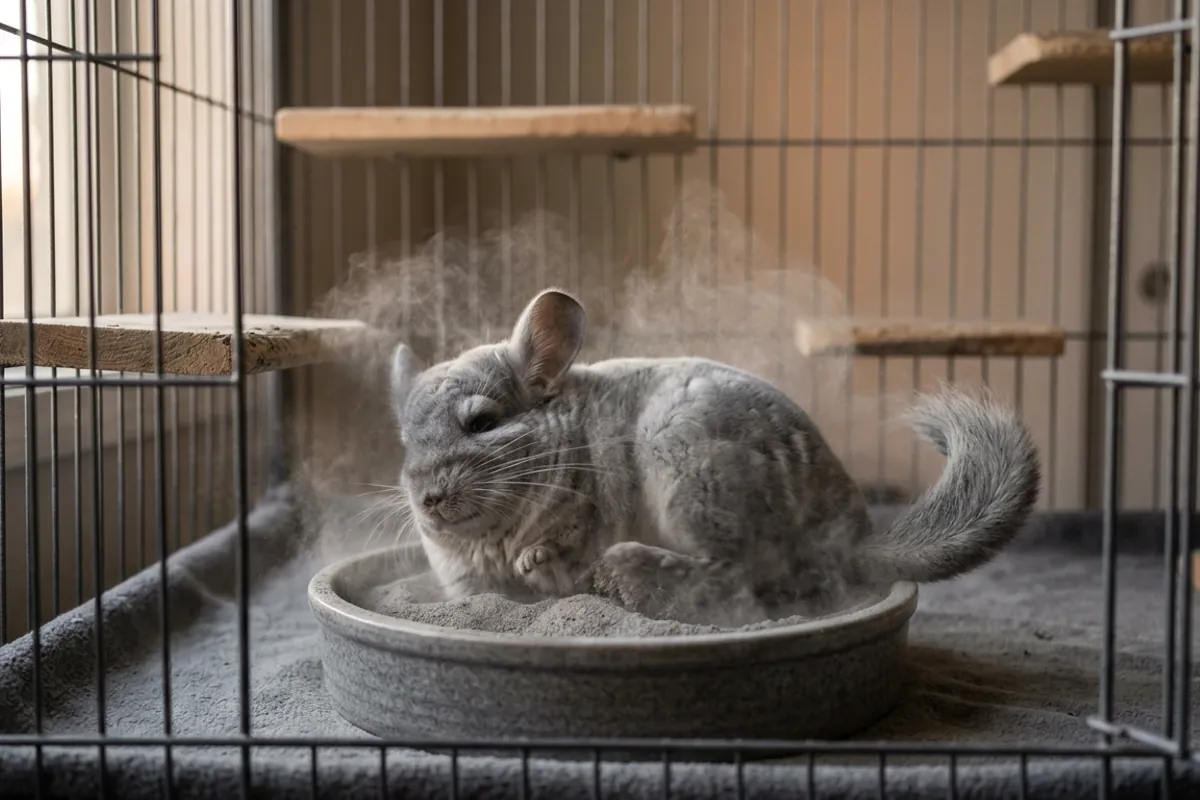
Keep it simple and safe. A dust bath is a natural fit for pen time, because the space lets them really roll. Use proper fine volcanic dust in a heavy dish or a deep container. Lixit Blue Beauty chinchilla dust, 3 lb As an Amazon Associate I earn from qualifying purchases. Chinchillas never bathe in water; the bath is always dust. Give them ten to fifteen minutes, then take it out, or they will just sit in it. If you are new to this, the chinchilla dust bath done right walks through the powder and the schedule.
Chews earn their place, because pen time is a good moment to offer variety. Juniper's teeth are exactly why I always keep safe apple wood and other untreated chew wood around. emours apple wood chew sticks, 40 count As an Amazon Associate I earn from qualifying purchases. Set a few pieces out so the pen is enrichment and not just an empty box.
A wheel can go in the pen if you have the room, and it has to be a solid running surface, never wire or mesh, which catches feet and tails. 15 inch Chin Spin solid surface chinchilla wheel As an Amazon Associate I earn from qualifying purchases. Remember that a wheel is also a launch pad, so if it is in the pen, a top matters more.
And hay. There is no reason pen time cannot include a pile of grass hay to graze on. Unlimited grass hay is the whole meal for a chinchilla, and a handful in the pen keeps them busy while they explore. Oxbow Western Timothy Hay, 40 oz bag As an Amazon Associate I earn from qualifying purchases. What I keep out is everything plastic, any fabric they can shred and swallow, and any treat beyond a tiny safe amount. The pen is for movement, not snacks. Set it up tall, watch the heat, stay in the room, and it becomes the best half hour of your chinchilla's day rather than the one you spend chasing an escapee.