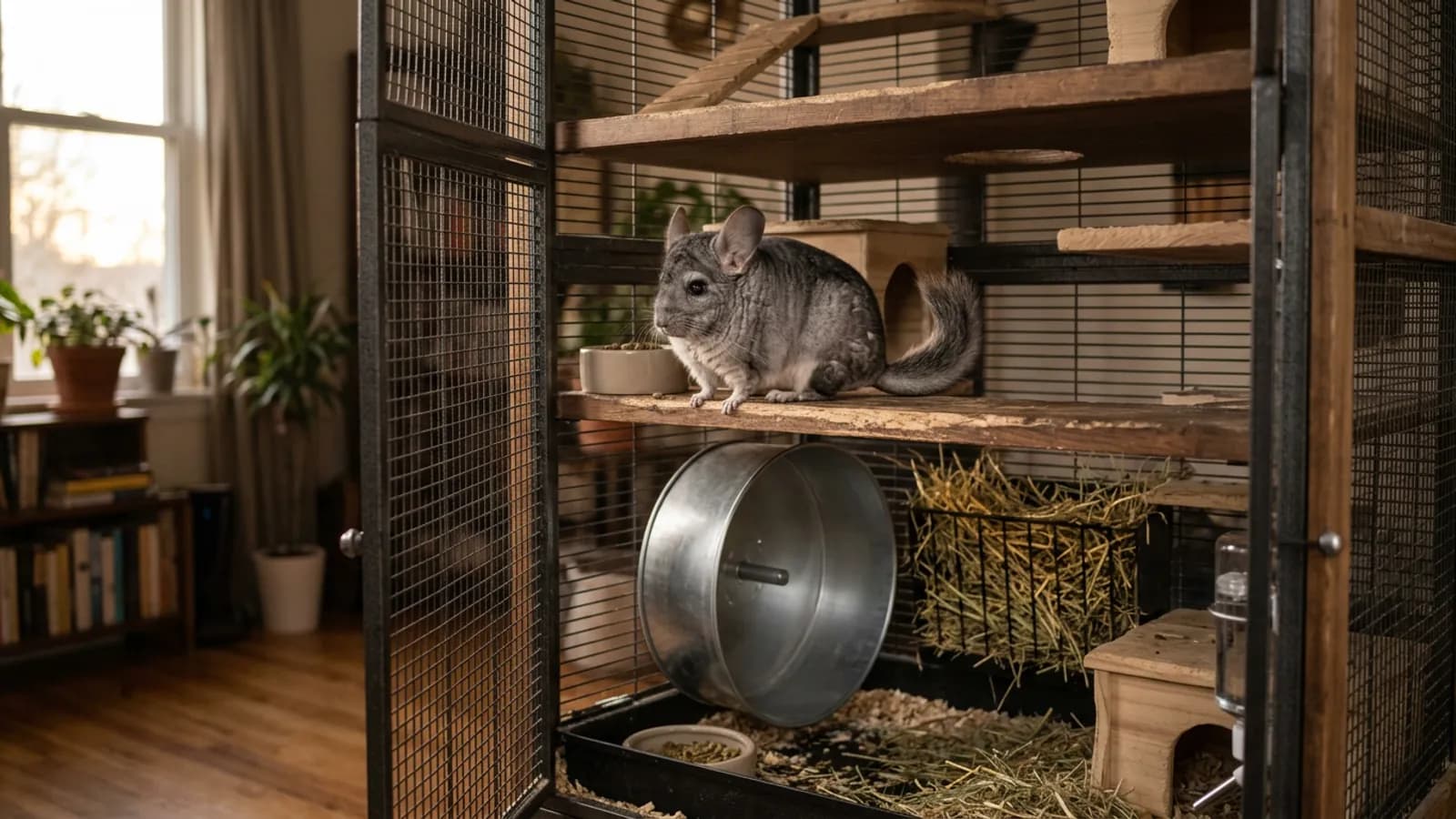
A good chinchilla cage setup is not a single purchase you make once and forget. It is a stack of decisions about height, materials, floor space, ventilation, and where in your home the whole thing sits, and getting one of those wrong quietly cancels out the ones you got right. I have kept chinchillas for about ten years, and the setups I see go wrong almost never fail because someone did not care. They fail because someone bought the cage first, on price, and then tried to make the animal fit it. That is backward. In this piece I want to walk you through the setup the way I build it now, in the order that actually matters, so you can spend your money once instead of twice. If you want the target spelled out before the shopping list, start with what an ideal chinchilla cage is built around.
The cage is the foundation, so buy it once
Everything else in your setup hangs off the cage, literally and figuratively, so this is where to be stubborn. Chinchillas are climbers and jumpers, and they use vertical space in a way that flat floor area cannot replace. That means height is the number I look at first. A cage that is wide but short forces a leaping animal into a shallow box, and you lose the natural up-and-down movement that keeps them fit and mentally busy. I want a tall cage with multiple full levels, made of metal bars and wood, with real wooden ledges rather than a single ground floor.
Materials are not a style choice here. Skip plastic anywhere the animal can reach, because chinchillas chew constantly and swallowed plastic is a genuine gut-blockage risk, not a theoretical one. Bar spacing should be narrow enough that a chinchilla cannot get its head through. I use a wire-and-wood cage built for the species rather than something repurposed from another pet.
Critter Nation double unit small animal cage As an Amazon Associate I earn from qualifying purchases.
If you are comparing specific models, I have written separately about how to choose a chinchilla cage without buying the wrong one twice and about whether the Critter Nation cage is right for a chinchilla, because those two questions come up more than any others. The short version: bigger and taller is almost always the right call, and a cage you think is a little too large is usually just right. There is a broader walkthrough on the chinchilla enclosure as well if you want the reasoning behind the dimensions.
One warning that saves people real money and heartache. When you see a "chinchilla and cage" bundle for sale, treat the cage as unknown until you have measured and inspected it, because those listings often pair a healthy animal with a cage that is far too small. I dug into why in what a chinchilla and cage for sale listing is really selling you. Buy the animal and the cage as two separate decisions, even when they arrive together.
Ledges, floors, and what your chinchilla actually stands on
Once the frame is right, the inside is about giving four feet somewhere safe to land. I use solid wooden ledges at staggered heights so the chinchilla can hop from one to the next without a straight vertical drop, and without a landing so far below that an older or heavier animal jars its joints. Kiln-dried pine or a chinchilla-safe hardwood works well. Arrange the ledges so there is always a route up and a route down, and leave clear airspace for the jumps rather than cramming every level with clutter.
The wire floor question is the one I feel most strongly about. Standing full time on a bare wire grid can cause bumblefoot, which is a painful sore-footed infection on the underside of the foot, and it is entirely preventable. If your cage came with a wire base, cover it with solid resting surfaces so the animal is never forced to stand on wire for long stretches. Wooden ledges, a fleece-covered platform, or solid tiles all give the feet a break. A ceramic or stone tile does double duty in warm weather, which I will come back to.
For bedding under the cage, kiln-dried pine shavings or paper-based bedding both work. Avoid cedar and avoid scented or dusty products, since the oils and dust are hard on a chinchilla's sensitive respiratory system. Whatever you choose, spot clean daily and do a full change often enough that the cage never smells of ammonia, because that smell is your nose telling you the air is already bad for the animal's lungs.
The wheel is not optional, and the surface is the whole point
A chinchilla needs to run, and in a home the wheel is how that need gets met on the nights when out-of-cage time is not possible. But the wheel is also the single piece of equipment I see people get dangerously wrong, so let me be blunt about it. The running surface must be solid. A wire-rung or mesh wheel can catch a toe, a foot, or even the whole leg mid-stride, and the injuries that follow are exactly as bad as they sound. There is no version of a wire wheel that is acceptable for a chinchilla.
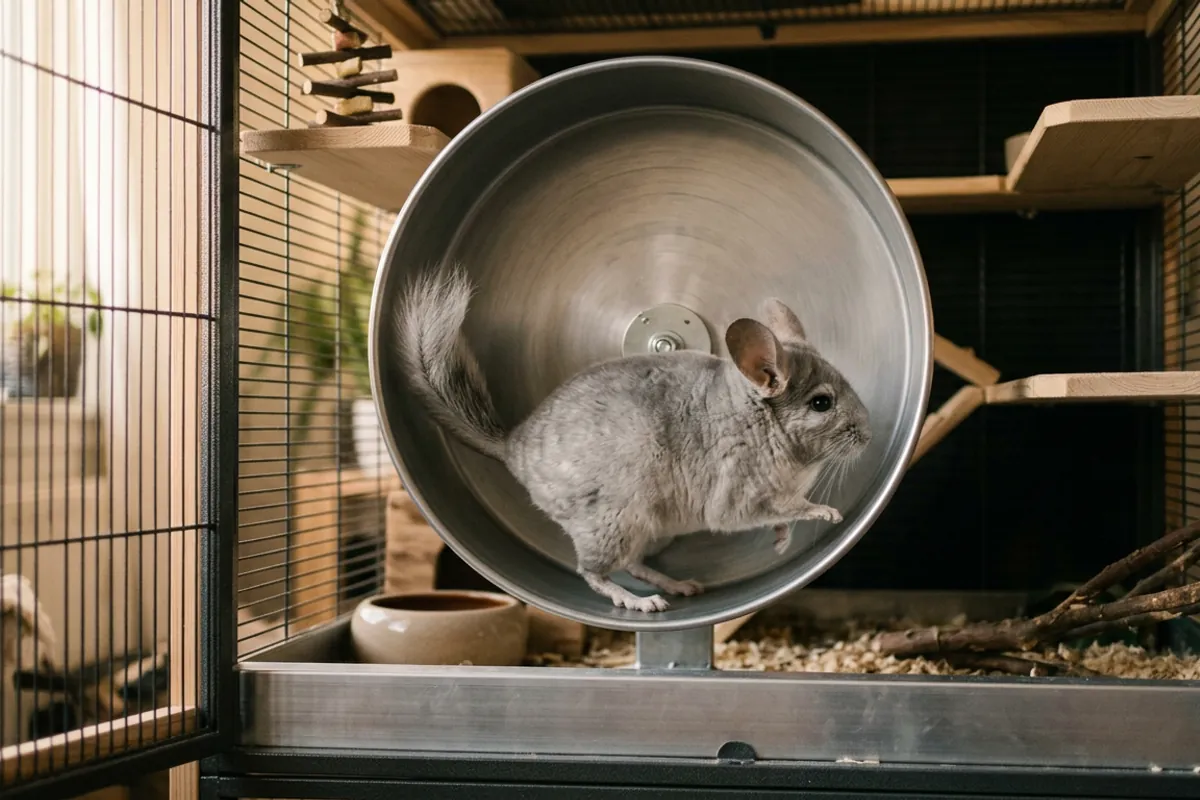
Size matters too, because a wheel that is too small forces the spine into a permanent curve while the animal runs, and that is not something you want happening for hours a night. I want a large-diameter wheel with a solid metal or wood running track and a stand sturdy enough that it does not wobble or tip.
15 inch Chin Spin solid surface chinchilla wheel As an Amazon Associate I earn from qualifying purchases.
Mount or place it where a fast-running chinchilla will not fling bedding across the room every night, and check the axle and fasteners regularly, since a wheel gets a lot of hard use. If your wheel is quiet, solid, and correctly sized, it will be one of the most used objects in the entire setup.
Hay, pellets, and water: placing the daily things
Here is the part of the setup people underbuild, and it is the part that keeps the animal alive and healthy day to day. Chinchillas eat grass hay as the foundation of the diet, and they need unlimited access to it around the clock. Not a handful in the morning. Constant. The fibre keeps the gut moving and, just as importantly, keeps those ever-growing teeth worn down. My Juniper came to me as a neglected rescue with dental disease, and managing her every day is why I will not soften this: skimp on hay and you are setting up for painful, expensive tooth problems down the line. If you want the full picture on that, chinchilla teeth problems and spotting malocclusion is worth your time.
So the setup needs a hay source the animal can reach at any hour, kept clean and dry. A hay rack or a refillable box keeps the hay off the cage floor so it does not get soiled and wasted.
Oxbow Western Timothy Hay, 40 oz bag As an Amazon Associate I earn from qualifying purchases.
Timothy is my everyday hay, and buying it in bulk is genuinely cheaper per pound and means you never run out, which is the failure mode that actually happens in real homes.
Oxbow Western Timothy Hay, 9 lb box As an Amazon Associate I earn from qualifying purchases.
Pellets are a supplement, not the main event. I give a measured daily amount of plain, chinchilla-formulated pellets, roughly a tablespoon or two per day for an adult, in a heavy ceramic dish the animal cannot tip or chew apart. No colourful muesli mixes, no seeds, no dried fruit pieces baked in. Those get picked over for the sweet bits and leave the balanced part uneaten. For water, a glass bottle with a metal spout mounted at a comfortable height is easier to keep clean and clog-free than an open bowl, and it stays cleaner through the night. Check the spout every day, because a stuck ball valve means an animal with no water, and that is an emergency in a matter of hours.
Chewing is diet too, in a sense, so build wood into the setup from day one. Untreated apple wood and other safe woods give the teeth something to work against between meals, and variety keeps a bored chinchilla interested.
emours apple wood chew sticks, 40 count As an Amazon Associate I earn from qualifying purchases.
I go deeper on which woods are safe and why they are dental care rather than decoration in chinchilla chew toys.
The dust bath belongs in the routine, not the cage
Chinchillas do not bathe in water. Ever. Their dense fur traps moisture against the skin, and a wet coat that cannot dry properly invites fungal skin infections and, in a chilled animal, worse. They clean themselves by rolling in fine dust, which is actually a very fine volcanic pumice powder, not sand and not literal dirt from the garden. That dust works its way down to the skin and carries oils and moisture away, which is exactly what water cannot safely do.
For the setup, this means a dust bath is a scheduled item, not a permanent fixture in the cage. I offer a dust bath a few times a week, leave it in for ten to fifteen minutes, and then take it out. Leaving it in full time means the chinchilla uses it as a toilet and over-bathes, which can dry the skin out. A deep, enclosed bath house contains the mess far better than an open bowl, since a rolling chinchilla throws dust everywhere.
Lixit Blue Beauty chinchilla dust, 3 lb As an Amazon Associate I earn from qualifying purchases.
I have written the whole routine out in the chinchilla dust bath, done right from dust to schedule, and if you have seen the words sand or dirt used loosely, a chinchilla dirt bath is not dirt clears up why the wording matters. The one thing I will repeat here because it is a genuine health point: if you ever find your chinchilla actually wet, that is a problem to solve, not a bath, and chinchilla wet, a soaked coat and what it means explains why.
Where you put the cage decides everything about heat
You can build a perfect cage and still put the animal in danger by where you set it down. This is the part of setup I am most relentless about, and I have earned that. Pebble came to me from a rehome out of an overheated attic, and her first summer brought a heatwave near-miss that ended with a night at the emergency vet. Everything I believe about placement comes from that night.
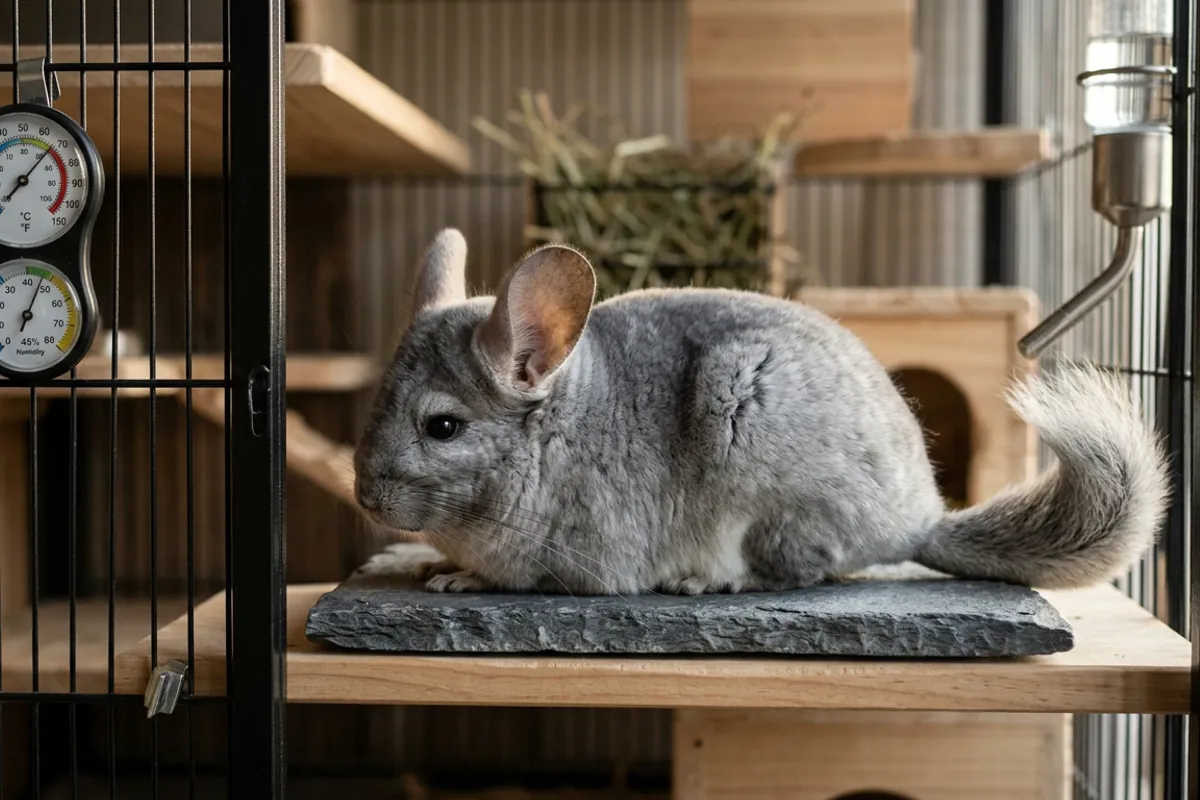
Chinchillas are built for a cool, dry climate, and their thick fur that makes them so soft also makes them terrible at shedding heat. The comfortable range is 60 to 70°F, which is 15 to 21°C. Above 75°F, about 24°C, you are into risky territory. At 80°F, roughly 27°C, and up you are in an emergency, and it arrives faster when the air is humid, because a chinchilla cannot dump heat into already-wet air.
So the cage goes on an interior wall, out of direct sun, away from radiators, heat vents, and the hot pocket of air that collects near the ceiling and in upper floors. Do not put it in a conservatory, a sunroom, or an attic. Give it airflow but not a cold draught blowing straight on it. I keep a combined thermometer and humidity gauge right at the cage so I am reading the animal's actual air, not the number on a thermostat across the room.
digital thermometer and humidity gauge with remote probes As an Amazon Associate I earn from qualifying purchases.
For the warm months, a chilled solid surface gives the animal a place to press its belly and shed heat, and it is one of the simplest, safest cooling aids there is because there is nothing to malfunction.
Kaytee Chinchilla Chiller granite stone As an Amazon Associate I earn from qualifying purchases.
If you want the full protocol, including what to do when the power to your air conditioning fails on the worst day of the year, read chinchilla heat safety and learn the warning signs of heat stroke before you need them. There is also a heat danger calculator that turns temperature and humidity into a plain risk read. None of this is optional in summer, and drooling, lying flat, bright red ears, or laboured breathing mean you cool the animal and call an exotics vet now, not in the morning.
A DIY chinchilla cage setup, and how to judge the best one
Plenty of good keepers build their own, and a DIY chinchilla cage setup can be excellent as long as you hold it to the same standard as anything bought. The rules do not relax because you built it yourself. Every surface a chinchilla can reach must be safe if chewed, which rules out plywood with its glues, most paints, pressure-treated lumber, galvanized coatings on some hardware, and anything plastic. Use solid untreated safe wood and appropriate metal mesh, and finish edges so nothing can snag a foot. Build tall, build in solid ledges and jumps, and leave yourself easy access for daily cleaning, because a setup that is a pain to clean is a setup that gets cleaned less.
So what makes the best chinchilla cage setup? Not the most gadgets, and not the most expensive frame. The best setup is the one that meets every core need reliably: unlimited clean hay and fresh water at all hours, a large solid-surface wheel, safe solid footing with no forced wire standing, safe wood to chew, a dust bath offered on a sensible schedule, and a location that holds a safe, stable temperature through the hottest week of the year. If it does those things every single day without you having to remember to intervene, it is the best setup, whatever it cost.
I keep a running version of this on the chinchilla cage setup hub and fold it into the wider chinchilla care picture, because setup is not separate from care. Build the space around the animal's real biology, put it somewhere cool, and then the daily work gets a lot simpler. That is the whole point of doing the setup right the first time.