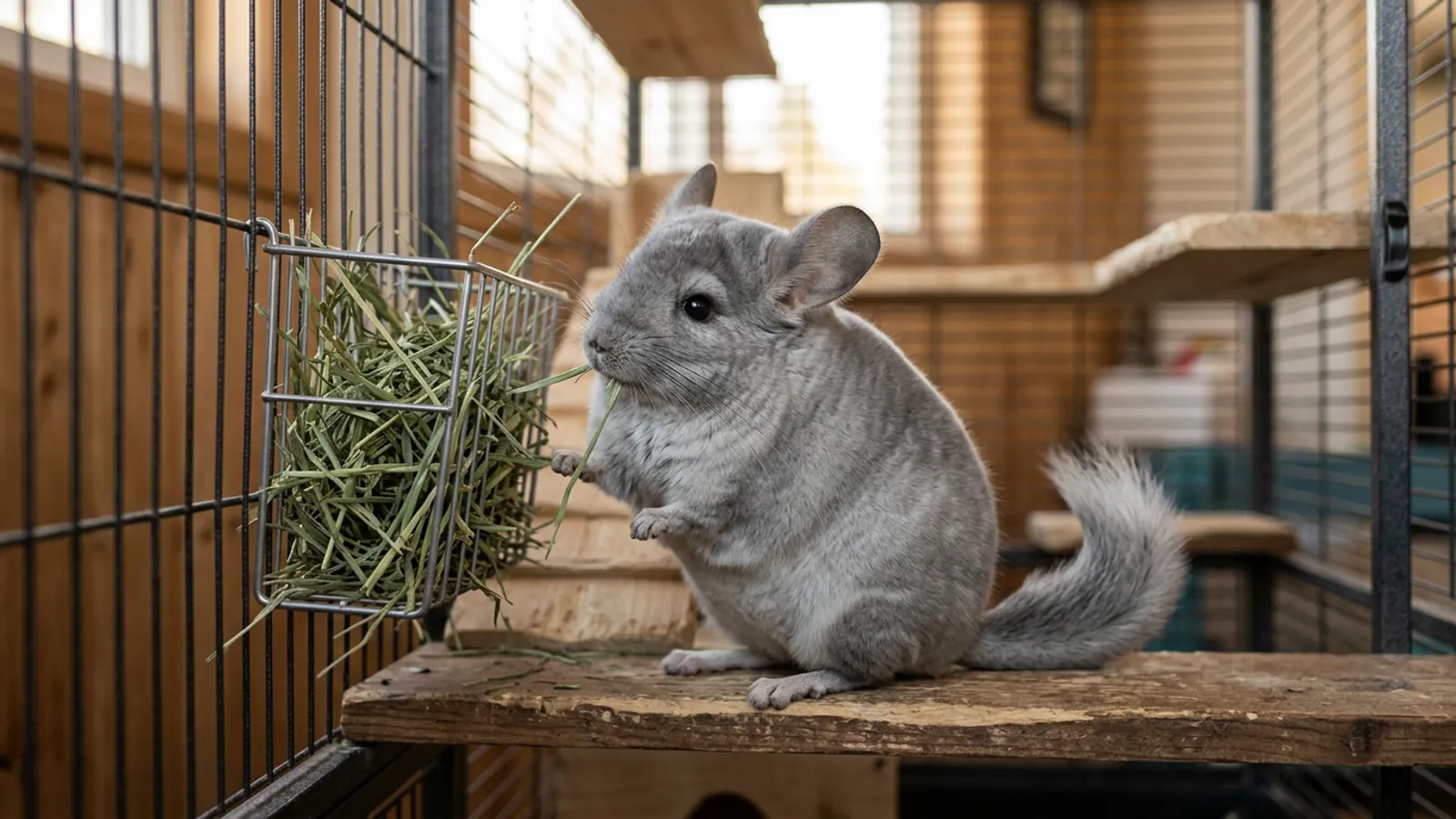
A chinchilla hay feeder is the least glamorous thing in the cage and quietly one of the most important. Hay is not a side dish for a chinchilla, it is the entire meal, and it has to be there around the clock. That makes the way you present it matter almost as much as what you buy. Loose hay dumped on the cage floor gets sat on, urinated on, and abandoned. Hay pushed through the bars ends up in a heap on the shelf below. Hay in the wrong holder becomes somewhere a foot or a head can get caught while you are asleep.
I have kept chinchillas for about ten years and I have tried most of the hay holder designs sold for small animals, plus a couple I built myself. Some are fine. A few are genuinely dangerous. Here is how I tell them apart, and what I have settled on.
What a hay feeder has to do
A chinchilla is a grazing animal whose gut only works properly when fiber keeps moving through it. Hay is not a meal you serve twice a day, it is the background of the whole day and night, always available, never running out. Plain pellets sit on top of that as a measured supplement, not as the main event. If you want the long version of the reasoning, I wrote it out in why chinchilla hay is the whole meal.
So a feeder has one real job: keep a fresh supply of hay in front of the animal at all times, in a condition it will eat. That breaks into four things I judge every design on.
It has to keep hay off the cage floor. Chinchillas are tidy about almost nothing. They pee where they stand and kick bedding everywhere, and hay lying on the floor is soiled within hours. Soiled hay is refused hay, and refused hay means less fiber going in than the animal needs.
It has to keep hay dry. Damp hay grows mold, and mold makes chinchillas seriously ill. A feeder sitting under a dripping water bottle spout is a mold farm you built on purpose.
It has to be safe unsupervised. Your chinchilla is busiest at 2am, when you are not there to notice a leg through a gap. Anything with a moving part, a fabric net, or an opening that narrows is being tested every single night.
It has to be easy for you to refill. This sounds like a convenience point and it is not. A feeder that is fiddly to open gets refilled late, and late refills are how a cage ends up empty overnight.
The feeder styles, one by one
Metal racks and hoppers mounted outside the bars
This is the design I keep coming back to. A plain uncoated metal rack or hopper hangs on the outside of the cage wall or door, and the chinchilla pulls strands through the bars. The hay never touches the floor, it never gets sat on, and you refill it without opening the cage. Bar spacing on a proper chinchilla cage is narrow enough that only hay comes through, and the animal cannot get into the rack itself.
The catch is that not every cage takes one. It needs a flat vertical bar panel and enough clearance outside. A tall metal and wood cage with correct bar spacing generally works. Critter Nation double unit small animal cage As an Amazon Associate I earn from qualifying purchases.
Wooden hay boxes and hoppers inside the cage
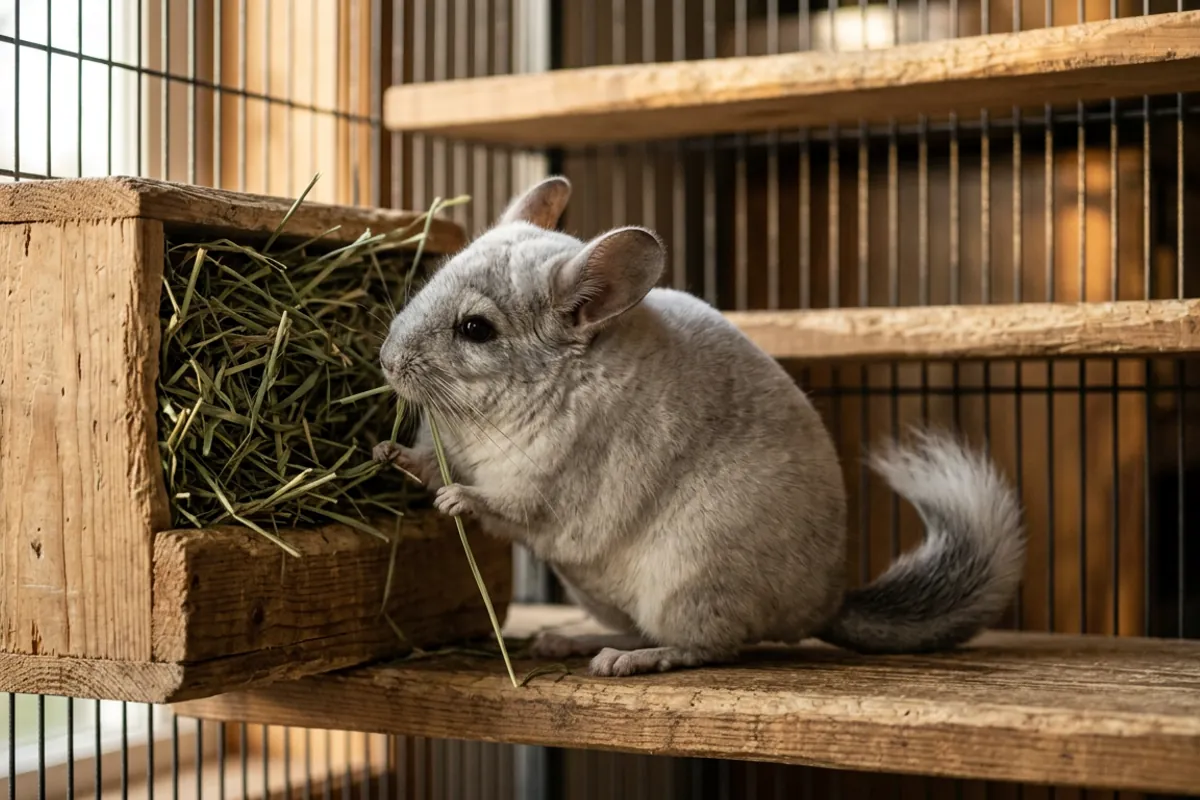
An open wooden box on a ledge, or a simple hopper with a slotted front, is the other design I trust. It is a chew toy and a chinchilla hay holder at the same time, which is a feature rather than a problem as long as the wood is safe and untreated. Kiln dried pine, apple, willow, and aspen are all fine. Check my list of chinchilla safe wood before you buy anything sold as a small animal accessory, because plenty of it is glued, varnished, or made of a species I would not have in the cage.
Expect to replace it. A wooden hay feeder for a chinchilla is a consumable, not furniture.
Hay balls and hanging spheres
The wire spheres that clip shut and hang from the cage roof are sold everywhere and I do not use them. The wire gaps on most of them are exactly the size that will admit a chinchilla's head or foreleg, and a hanging object that swings makes that worse rather than better. The clip mechanisms are usually spring loaded too. There is a whole category of small animal gear that would be fine for a guinea pig and is not fine for an animal that can clear six feet straight up in the dark.
Hay bags, nets, and slings
Fabric hay bags are popular with rabbit and horse people and they have no place in a chinchilla cage. Chinchillas chew fabric, they swallow the fibers, and swallowed fabric does not pass. Nets add a snagging hazard on top of that. I will not use either, and I would not use a chewed up sock or a knotted rag as a hay holder for the same reason.
Plastic clip-on feeders
Plastic is the easiest no in this whole article. Chinchillas chew what they live with, plastic shards go through the gut edge first, and I have seen enough cheap plastic accessories reduced to splinters in a week to be done arguing about it. If the only feeder your cage came with is plastic, take it out and put a metal or wooden one in.
Cardboard tubes and stuffed toys
Stuffing a plain cardboard tube with hay is a legitimate enrichment trick, and mine will work at one for a while. It is not a feeder. It holds a handful, it goes soggy, and it ends up on the floor. Use it as a toy alongside the real hay supply, never instead of it.
The hazards I check for before anything else
Whatever style you pick, I check the same short list before it goes in the cage, and I check it again after a month of chewing because the shape changes.
Any gap that could take a head or a limb is out. The dangerous ones are not the big openings, they are the wedge shaped gaps that a leg slides into and then jams. Look for slots that narrow, V shapes between wires, and the space between a hanging feeder and the cage wall.
Any moving part is out. Spring loaded lids, hinged doors on hay balls, and anything that can close on an animal. A chinchilla will find the one position where it pinches.
Powder coated or plain stainless steel is what I look for. Painted finishes are out, and so is heavily galvanized wire a determined chewer can work through to the bare zinc underneath. An intact powder coat is fine, which is the same standard the cage itself is held to; a chipped one is not, because whatever comes off gets tasted and eventually eaten.
Sharp cut wire ends are out. Run a finger over every edge. Cheap racks are often finished badly at the weld points, and a chinchilla pressing its face in to reach hay meets that edge with an eye.
Glue, varnish, stain, and pressure treated wood are out. Untreated wood only, no exceptions, on the assumption that every gram of it will eventually be eaten.
Where the feeder goes, and how high
Placement decides how much of the hay gets eaten, and most people get this slightly wrong by putting it wherever there happens to be room.
Mount it at ledge height, so the chinchilla can sit up on a wooden ledge and eat with its front paws free. That is the natural feeding posture and they will use a feeder positioned for it far more than one they have to stretch or crouch for. In a tall multi level cage I put one in the upper half, where they spend most of their time.
Keep it away from the water bottle. Not near, away. Bottles drip, and a wet patch of hay in the bottom of a feeder is exactly the hay that gets ignored for a week and then goes moldy.
Do not site it directly under a favorite ledge or the wheel. Whatever is above the feeder eventually lands in the feeder. That includes droppings, which are harmless in themselves, and urine, which is not.
Keep it well clear of the dust bath. Fine volcanic dust settles into hay, and hay caked in dust gets refused. I take the bath house out between sessions anyway, which solves this and several other problems.
If you keep two chinchillas, fit two feeders in different parts of the cage. Chinchillas guard resources more than people expect, and the quieter one of a pair should never have to negotiate for access to the food that keeps its gut moving. The rest of my layout thinking is in how to build a chinchilla cage setup that keeps the animal healthy.
The best hay feeder for a chinchilla
My answer is dull, and I have stopped apologizing for it. The best hay feeder for a chinchilla is a plain uncoated metal rack mounted on the outside of the cage, with a simple untreated wooden hay box on an upper ledge as a second station. That combination has beaten every clever design I have paid money for.
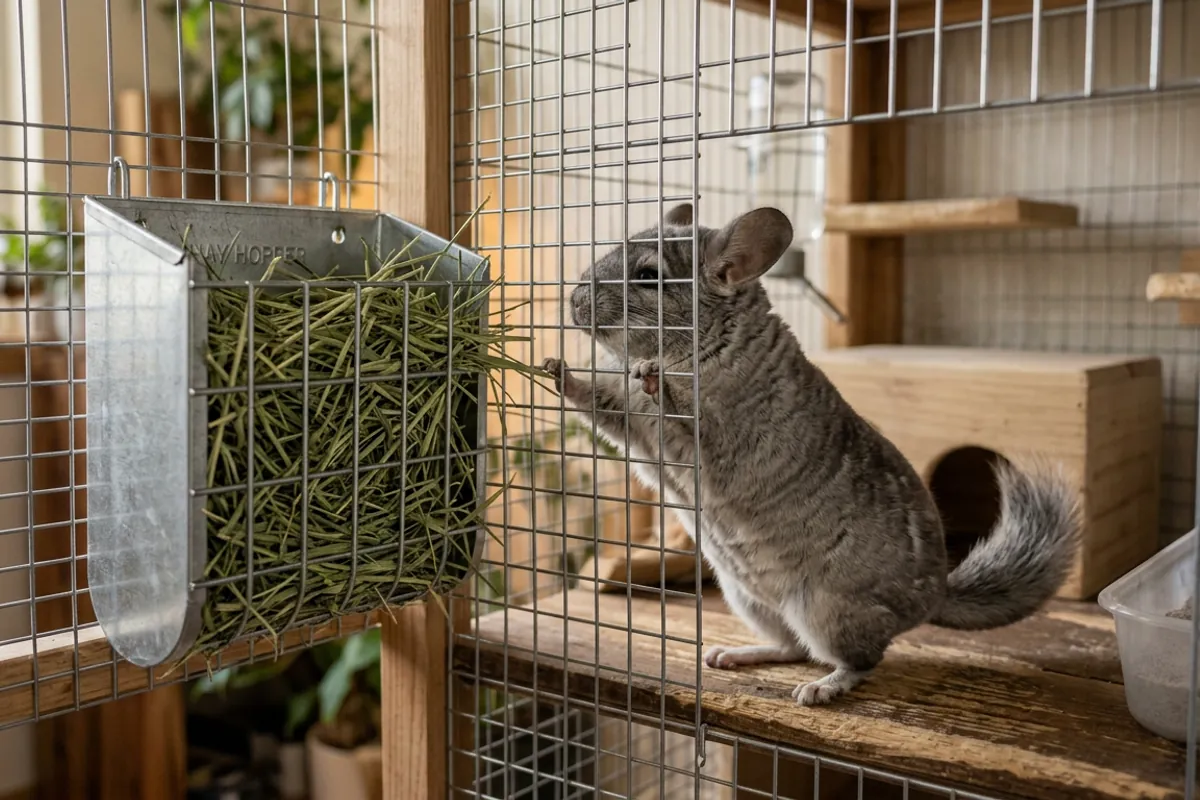
The metal rack does the work. It holds enough for a full day, it keeps hay dry and clean, and I can refill it from outside without turning the cage into an event. The wooden box catches the chinchillas who prefer to sit inside their food, and it doubles as something to gnaw when the mood takes them.
If nothing on the market fits your cage, build the wooden one. A five sided box of untreated kiln dried pine, screwed rather than glued, with the screw heads countersunk and covered, takes twenty minutes. It costs almost nothing and it is the only version where you know exactly what is in the wood. Apple branch pieces work for the same job and get chewed enthusiastically. emours apple wood chew sticks, 40 count As an Amazon Associate I earn from qualifying purchases.
What I would not do is spend a lot. There is no premium hay feeder that improves an animal's health over a plain one. Put the money into hay quality and into the cage itself, which are the two things that move the needle.
Filling it, cleaning it, and reading the leftovers
Fill the feeder generously every single day. Not a pinch, not a top up on top of yesterday's leftovers, but a proper fresh handful with the old material pulled out. Chinchillas sort through hay and eat the leafy parts first, so a feeder that looks half full is often full of the stems they have already rejected. Judging by volume alone is how people end up with an animal quietly eating less each day.
Good timothy hay should smell green and sweet and feel slightly coarse. If it smells musty, looks gray, or has any white bloom on it, bin the whole batch. I buy a retail bag of timothy for everyday use and a bale sized quantity when I have somewhere dry and airy to store it. Oxbow Western Timothy Hay, 40 oz bag As an Amazon Associate I earn from qualifying purchases.
Buying in bulk is cheaper per kilo and only worth it if storage is dry, off the floor, and not in a hot room. Oxbow Western Timothy Hay, 9 lb box As an Amazon Associate I earn from qualifying purchases.
Clean the feeder itself once a week. Empty it completely, brush out the hay dust, wipe it down, and let it dry fully before it goes back. Dust and fines pack into the bottom corners of a rack and hold moisture, and that is where mold starts.
Waste is normal. A chinchilla pulling out three strands to eat one is not being difficult, it is doing what it would do on a hillside. Some spill on the floor is the price of a well used feeder. What is not normal is hay consumption dropping. If the feeder is barely touched for a day, look at the droppings, because chinchilla poop tells you something is wrong before anything else does.
What a hay feeder cannot fix
A feeder is a delivery system. It does not make a chinchilla eat.
My Juniper came to me as a neglected rescue with dental disease, and I manage her teeth every day. When her molars are giving her trouble, she stands at a full feeder of excellent hay and does not eat it, or she picks up strands and drops them half chewed. No feeder design in the world touches that problem. Reduced hay intake, dropped food, drooling, a wet chin, or weight loss means an exotics vet appointment, not a new accessory. I am an experienced keeper and not a vet, and dental work is squarely on the far side of that line. There is more on what to watch for in spotting malocclusion before it turns serious.
Heat is the other thing a feeder will not solve. Chinchillas eat less when they are too warm, and appetite dropping off in summer is a warning sign about the room, not the hay. Keep them at 60 to 70°F (15 to 21°C). Once the room passes 75°F (24°C) you are in danger, and at 80°F (27°C) and above it is an emergency, worse when the air is damp. Pebble came to me out of an overheated attic and nearly did not survive her first summer with me, and that night at the emergency vet is why this is not negotiable. Fix the temperature first, then worry about the feeder.
And a feeder does not compensate for a cage that is too small or too short. Hay in front of an animal that cannot move properly is not good husbandry, it is one correct thing in a bad setup. Get the cage right, mount a plain metal rack on it, keep it full, and the boring part of chinchilla feeding is solved.