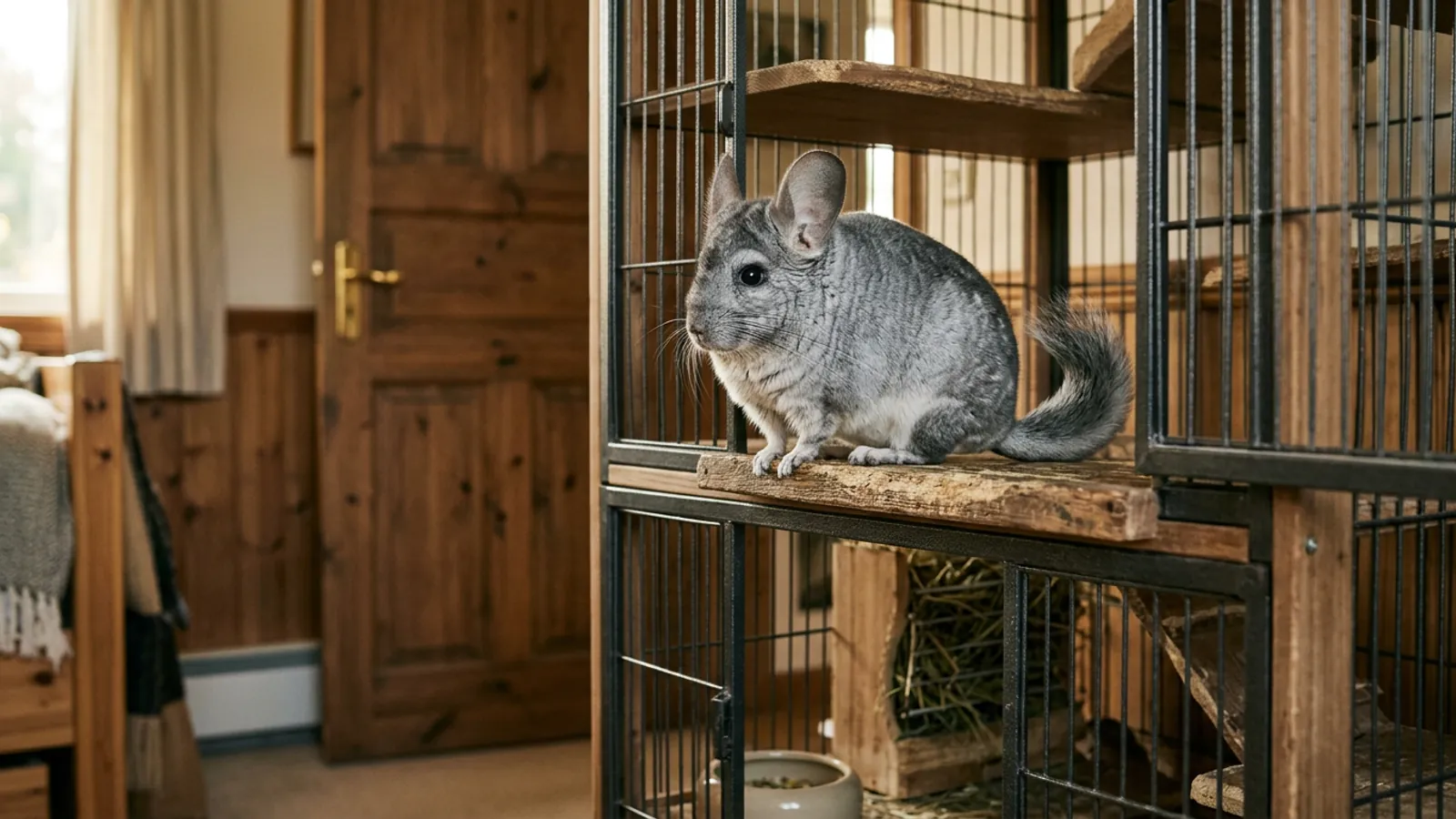
A chinchilla and dog can share a home. I want to say that up front, because the internet is full of people who will tell you it is fine and just as many who will tell you it is impossible, and neither camp is being honest with you. It is possible. It is also one of the setups I watch fail the fastest, usually not in a single dramatic moment but in a slow grind of stress that the owner never sees until the chinchilla is sick. I have kept chinchillas for about ten years, and the mistake I see over and over is treating this like a friendship question when it is a predator and prey question. Getting that straight is the whole thing.
What your dog sees
Start with biology, not personality. Your dog is a predator. However soft and lazy and devoted it is on the couch, somewhere in it is a hunting animal, and a small fast-moving furry thing that darts and freezes triggers exactly the circuit that a hunting animal is built around. This is prey drive, and it is not a training failure or a sign of a bad dog. A herding breed, a terrier, a sighthound, a mutt with some of any of that in it, will lock onto a chinchilla the way it locks onto a squirrel through a window. Some dogs have very little of it. Some have an enormous amount. You do not always know which you have until the trigger appears.
The chinchilla, for its part, is prey. Not "acts nervous sometimes" prey, but an animal whose entire body is engineered around not being eaten. It has huge ears, eyes set to the sides of its head for a wide field of view, a startle reflex that fires before it thinks, and a coat that releases in a panic so a predator ends up with a mouthful of fur while the animal bolts. That last trick is called a fur slip, and it is a clue to how this species reads the world. It expects to be hunted. A dog in the room is not a neutral housemate to a chinchilla. It is the thing its nervous system has spent millions of years learning to fear.
So when people ask whether their chinchilla and dog will get along, I gently reframe it. The dog might tolerate the chinchilla. The chinchilla will almost never truly relax around the dog. Those are not the same as friendship, and pretending they are is where animals get hurt.
The stress you cannot see is the one that kills
The dramatic risk is obvious: a dog gets to a chinchilla and it is over in seconds. A chinchilla weighs about a pound. A dog does not need to be aggressive or even bite hard; a single grab, a shake, a paw pin, and you have a dead or catastrophically injured animal. That is real and it happens, and it is why physical separation is non-negotiable, which I will get to. But it is not the risk I think owners underestimate most.
The risk I underestimate least is chronic stress. A chinchilla that lives within sight, sound, and smell of a predator it cannot escape does not habituate the way we hope. It stays in a low, grinding state of alarm. You will not see it as drama. You will see it as a chinchilla that eats a little less, that sits hunched instead of exploring, that stops taking its dust bath with enthusiasm, that startles at nothing. Stress in this species does not stay psychological. It suppresses the immune system, it changes gut motility, and in a prey animal that already hides illness on instinct, by the time you notice something is wrong it has usually been wrong for a while.
I lean hard on this because I live with a rescue, Juniper, who came to me neglected and took months to stop flinching at ordinary household movement. Watching an animal slowly decide it is safe teaches you how much invisible cost fear carries. A chinchilla that never gets to make that decision, because a dog it fears is always on the other side of the bars, pays that cost every day.
Separate rooms, not just separate cages
Here is the setup I would insist on, and I do mean insist. The chinchilla lives in a room the dog does not enter. Not a corner of the living room with a baby gate. A room with a door that closes, that the dog is not allowed into, ever, as a standing rule the whole household follows. The point is not only to stop a physical breach. It is to give the chinchilla a territory where the predator's sound and smell are dampened enough that the animal can stand down.
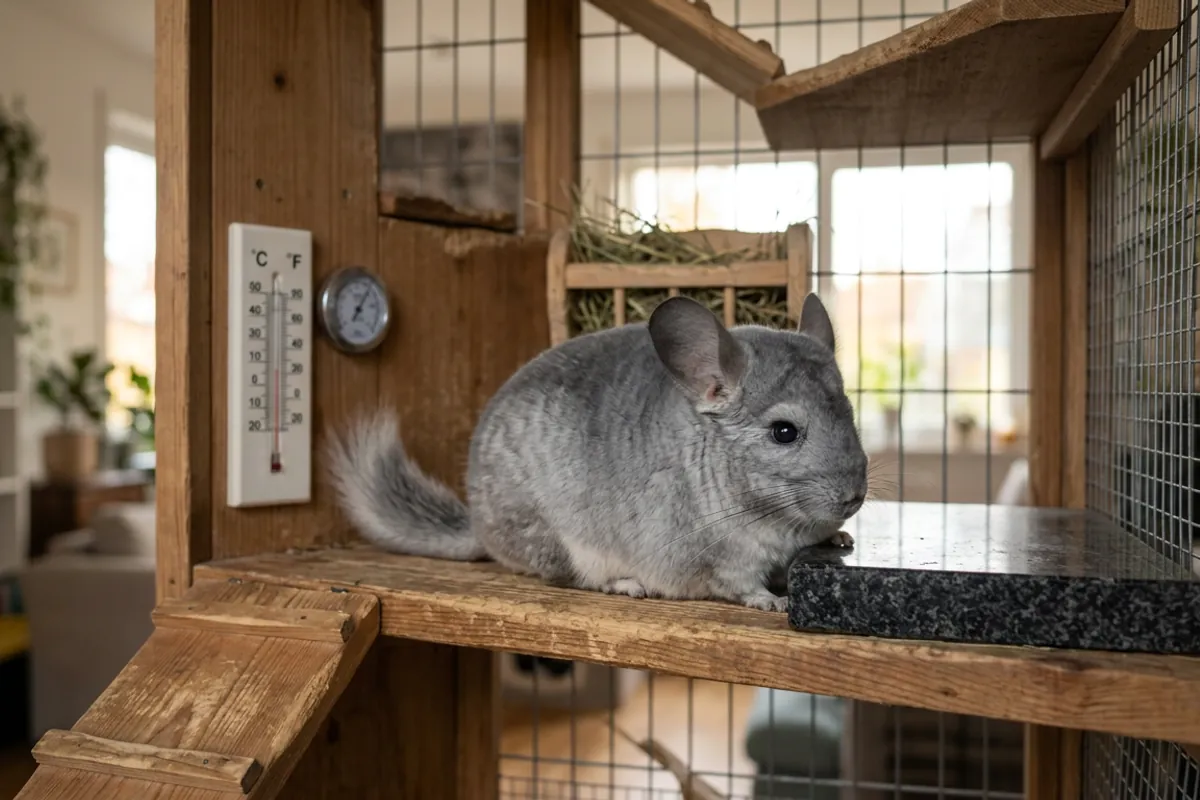
The cage itself has to be the right cage regardless, but with a dog in the house it carries extra weight, because it is the last barrier if a door gets left open. A tall metal and wood cage with a secure door latch, not a flimsy hutch and nothing plastic, is what you want anyway.
Critter Nation double unit small animal cage As an Amazon Associate I earn from qualifying purchases.
Plastic bin-style "cages" and clip-together panels are a bad idea with any chinchilla because they chew through them, and they are a genuinely dangerous idea when a determined dog is on the outside. If you want the longer version of how to choose one and not buy the wrong thing twice, I wrote that up separately in how to choose a chinchilla cage without buying the wrong one twice, and the Critter Nation writeup covers the specific cage most keepers land on. Whatever you pick, check the latch. Dogs learn to nose things open. Carabiners on the doors are cheap insurance.
One more placement rule: not on the floor. A cage a dog can circle, paw at, and press its face against at eye level keeps the chinchilla in a permanent staredown. Height and distance both help. The cage up off the ground, ideally in the dog-free room, is calmer for everyone.
Why I do not do supervised playtime together
This is where I part ways with a lot of cheerful advice online. People love the idea of the dog and the chinchilla meeting, sniffing, coexisting on a blanket while the owner watches. I do not do it, and I would not, and I want to be clear about why rather than just saying no.
Supervision is slower than a dog. Prey drive, once it fires, moves faster than your hand. You can be sitting right there, attentive, and a dog can cross the gap and grab before you have finished the thought "no." I am not willing to bet an animal's life on my reaction time against a predator's, and neither should you. The chinchilla also gets no benefit from these meetings. It is not lonely for the dog. It does not need to make friends. All the meeting does is stack more fear onto an animal I am trying to keep calm.
Chinchilla out-of-cage time matters enormously, because these animals need to run and jump and burn energy in a safe space every day. But that time happens in the dog-free room with the door shut, with the dog on the other side of it. The exercise need is real; the answer is a secured room and a good solid running surface, not a shared session.
15 inch Chin Spin solid surface chinchilla wheel As an Amazon Associate I earn from qualifying purchases.
Skip anything with rungs or a wire mesh running surface, by the way. Wire wheels catch feet and break legs, dog or no dog. A chinchilla out of its cage in a dog-proofed room, with a solid wheel and safe things to climb, gets everything it needs from playtime without ever being in reach of the thing that scares it.
Sound and smell carry through walls
Even with the door shut, a chinchilla knows the dog is there. Its hearing is far better than ours, and it reads scent constantly. A barking dog, a dog that scrabbles at the closed door, a dog that whines outside the room, all of that reaches the chinchilla and keeps it primed. This is the part people forget once they have solved the visual and physical problem. Out of sight is not out of the nervous system.
You cannot soundproof a house, but you can manage the worst of it. A dog that has learned the chinchilla room is off limits and boring is quieter than a dog that fixates on the door. That is a dog-training project as much as a chinchilla one: the room is dull, nothing interesting happens there, no attention is given for scratching or barking at it. White noise or a small fan in the chinchilla's room can blur the sound of the dog moving around, and in a warm month that fan is doing double duty, which brings me to a thing that gets overlooked entirely.
The dog changes the room's heat, and heat is the real killer
I am relentless about temperature, because I nearly lost my first chinchilla, Pebble, to a heatwave in her first summer, a night at the emergency vet that rebuilt how I do everything. Chinchillas are built for a cold, dry mountain climate. Their comfortable range is roughly 60 to 70°F, which is 15 to 21°C. Above about 75°F, which is 24°C, you are into risky territory, and 80°F, which is 27°C, and up is an emergency, and it comes on faster in humid air because a chinchilla cannot shed heat well through that dense coat.
Here is what a dog has to do with that. A dog is a furnace. A medium or large dog in a room raises the ambient temperature noticeably, and if your solution to the sound problem was to keep the chinchilla in a smaller, more enclosed room with the door shut, you have just built a warmer, less ventilated box. The dog-free room needs the same heat discipline as any chinchilla room, and shutting the door for safety must not turn it into a heat trap. Put a thermometer in there and watch it.
digital thermometer and humidity gauge with remote probes As an Amazon Associate I earn from qualifying purchases.
A thermometer that also reads humidity is worth it, because the humidity number changes where the danger line sits. On hot days a granite or ceramic cooling stone in the cage gives the chinchilla a cold surface to lie against and pull heat out of its body.
Kaytee Chinchilla Chiller granite stone As an Amazon Associate I earn from qualifying purchases.
Chill the stone in the fridge, not the freezer, so it is cold but not so cold it hurts. None of this replaces keeping the room cool with air conditioning or serious ventilation. If you want the full heat playbook, I keep it at chinchilla heat safety, the warning-sign rundown is at chinchilla heat stroke warning signs, and there is a heat danger calculator that takes temperature and humidity together. Heat kills chinchillas quietly and quickly, and a dog in the house makes the room math harder, not easier.
Reading whether it is working
Because a chinchilla hides distress so well, you have to look for the quiet signals rather than wait for loud ones. The animal I want to see is one that is up and active in its waking hours, which for a chinchilla is dawn, dusk, and through the night; that eats through unlimited hay steadily and leaves normal droppings; that takes its dust bath with real gusto, rolling and flipping; and that comes to the bars curious rather than freezing at the back.
The animal I worry about is hunched and still, eating less, ignoring the dust bath, producing smaller or fewer droppings, or startling at ordinary sounds it used to ignore. A chinchilla making distress sounds, a sharp repeated bark or a continuous alarm call, is telling you plainly that it does not feel safe; I wrote about what those noises mean in chinchilla sounds. Any drop in appetite or change in droppings in a prey animal is a see-the-vet signal, not a wait-and-see one, and it needs an exotics vet specifically, not a general small-animal clinic. Gut stasis in a chinchilla is an emergency, and stress is one of the things that triggers it.
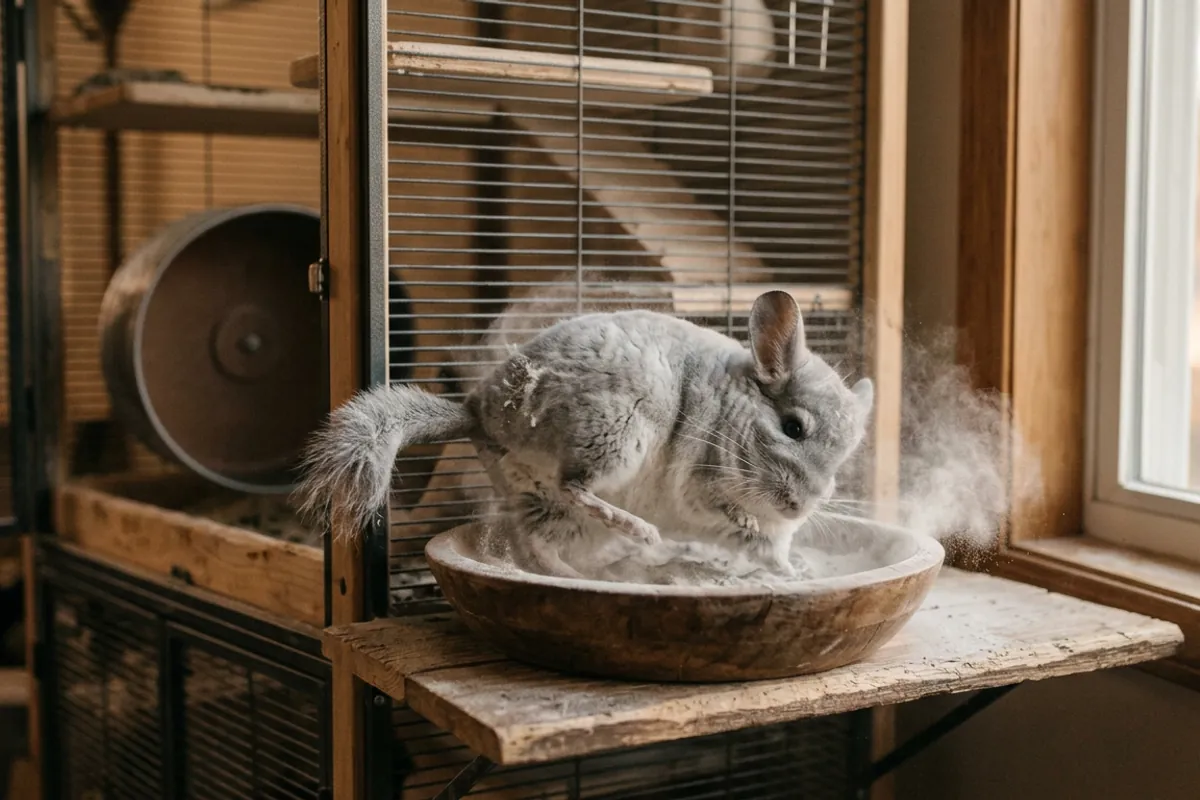
Keep the dust bath routine rock solid through all of this, because it is both a health need and a stress readout. A chinchilla never bathes in water; it rolls in fine volcanic dust to keep that dense coat clean and its skin healthy. If you are new to it, the chinchilla dust bath done right covers the schedule and the dust itself.
Lixit Blue Beauty chinchilla dust, 3 lb As an Amazon Associate I earn from qualifying purchases.
Offer it a few times a week, watch how the animal takes it, and treat a sudden loss of interest as data.
When a chinchilla and dog household can work
I do not want to leave you thinking it is hopeless, because it is not, and plenty of people do this well for years. The households that work share a pattern. The dog is on the calmer end of the prey-drive spectrum and, more importantly, is trained to leave the chinchilla's room and cage entirely alone, so the two animals are never testing each other. The chinchilla has a real territory of its own, a dog-free room with a door, where sound and smell and heat are all managed and it can relax. The separation is a household rule everyone follows without thinking, not a thing that depends on someone remembering to close a door. And the owner watches the chinchilla for the quiet signs, not just the loud ones, and treats appetite and droppings as the early-warning system they are.
What does not work is optimism as a plan. "They will get used to each other," "my dog would never," "I only leave the door open for a minute" are the sentences that come before a vet bill, or worse. Treat the dog as a predator that loves you and the chinchilla as a prey animal that fears the dog no matter how much either of them loves you, build the setup around those two facts, and you can absolutely give both animals a good life under one roof. Before you commit to it, it is worth reading what these animals ask of you generally in chinchilla as pets, because a chinchilla is a demanding animal even without a dog in the picture. Add the dog, respect the biology, and keep the door shut. That is the job.