The question I get asked most often is a simple one: how do you care for a chinchilla? The honest answer starts with a thermometer, not a cuddle. A chinchilla is a high-altitude animal wearing the densest fur of any land mammal, and almost every rule that follows flows from that single fact. They cannot shed heat well, they cannot handle rich food, and they must never get wet. So learning how to care for a chinchilla is mostly learning to build a cool, dry, quiet, slightly boring little world, and then having the discipline to leave it alone. I have kept chinchillas for about ten years, through one heat scare I will never forget, and what follows is the owner-to-owner version of what actually keeps one alive and well.
Start with temperature, because heat kills fastest
If you remember one thing from this whole page, make it this. Heat is the fastest way to lose a chinchilla, and it moves quicker than most new owners expect. Pebble came to me from a rehome out of an overheated attic, and her first summer brought a heatwave that ended in a night at the emergency vet. That scare is why I am relentless about a single range. A chinchilla is comfortable between 60 and 70°F (15 to 21°C). Above 75°F (24°C) you are already in risky territory, and 80°F (27°C) and up is an emergency, faster still when the air is humid, because humidity steals what little cooling they can manage.
So put a thermometer where the animal actually lives, at the cage, not across the room where the reading flatters you. I keep a combined thermometer and humidity gauge clipped at Pebble's level so the number I read is the number she feels. digital thermometer and humidity gauge with remote probes As an Amazon Associate I earn from qualifying purchases. A granite or ceramic cooling stone gives her somewhere to dump heat on a warm afternoon, and she will move onto it on her own when she wants it. Kaytee Chinchilla Chiller granite stone As an Amazon Associate I earn from qualifying purchases. Neither of those replaces air conditioning in a real heatwave. If your room cannot hold under 75°F (24°C), that is the thing to solve before anything else. I keep chinchilla temperature and the warning signs of heat stroke close at hand, and there is a heat danger calculator on the site for the borderline days.
Hay is the whole meal, not a side
A chinchilla's gut is built to process a steady flow of coarse, fibrous grass, and it runs into trouble the moment that flow stops. So grass hay is not a snack or a bonus. It is the meal, offered unlimited, available every hour of every day. A gut built for constant fiber can slow to a halt, a condition called stasis, after even a day of running empty, and a stopped gut is an emergency, so the hay pile is never allowed to run out. Timothy hay is the standard I feed, and I want it fresh and green, smelling like a summer field, not dusty and brown. I buy it in a box for everyday convenience and in bulk when I want the freshest, cheapest supply. Oxbow Western Timothy Hay, 40 oz bag As an Amazon Associate I earn from qualifying purchases. Oxbow Western Timothy Hay, 9 lb box As an Amazon Associate I earn from qualifying purchases.
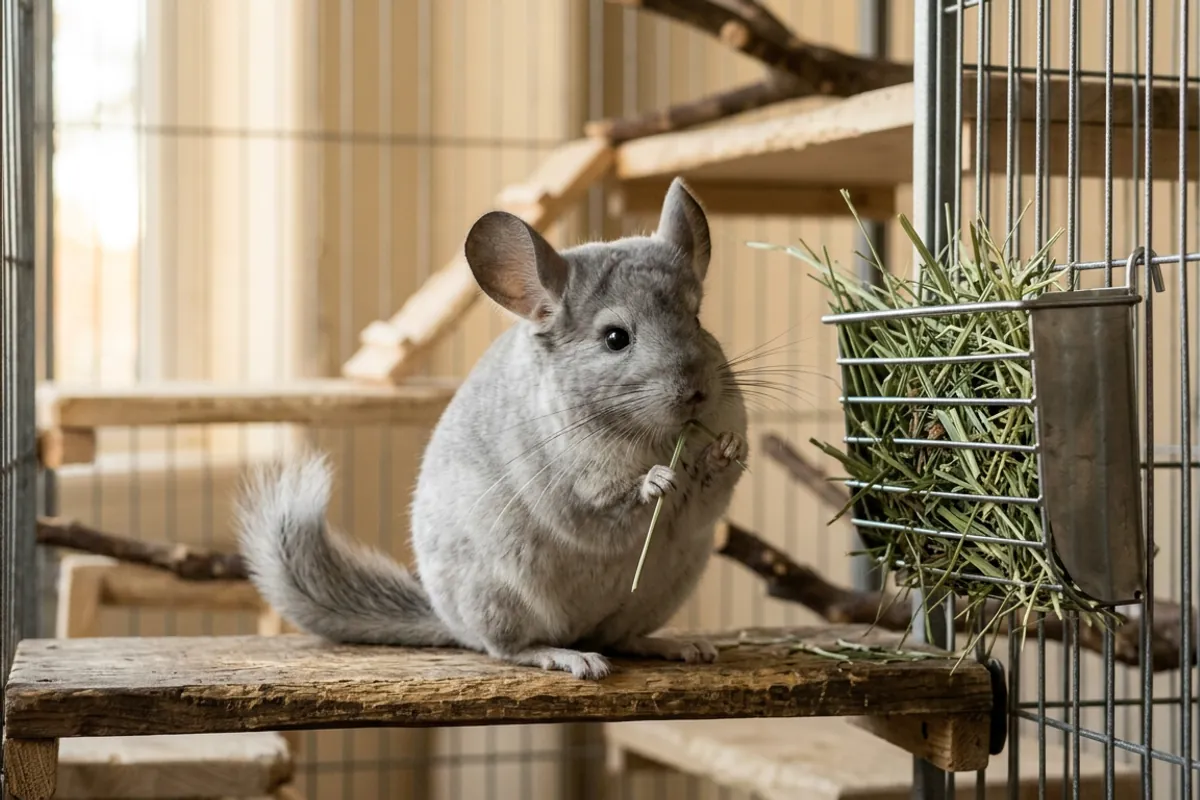
Pellets come second, and they are a supplement, not the plate. A small measured amount of plain, chinchilla-specific pellets, usually a tablespoon or two a day depending on the animal, covers the nutrients hay alone can miss. Skip anything with colorful bits, seeds, dried fruit, or nuts mixed in, because a chinchilla will pick out the sugary pieces and leave the healthy ones, and sugar and fat are hard on them. Fresh water, changed daily, always available, ideally from a bottle rather than a bowl they will foul or tip. Treats are where good intentions do the most damage, so keep them tiny and rare: a single plain rosehip or a small piece of plain hay-based chew, not fruit, not yogurt drops. I go deeper on all of it in timothy hay for chinchillas and chinchilla pellets.
The cage: tall, metal, and boring on purpose
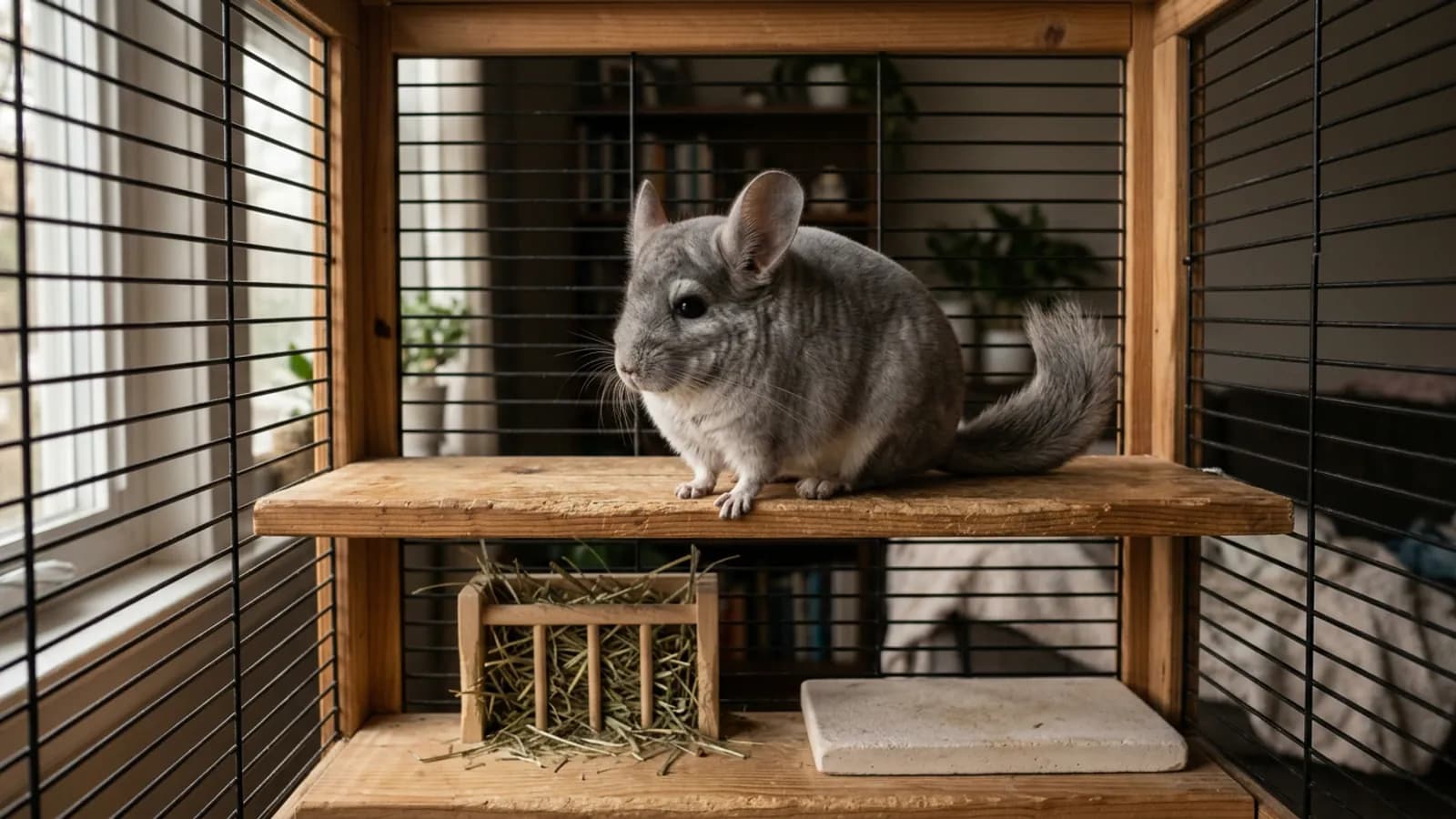
Chinchillas climb, so floor space matters less than height and levels. You want a tall cage made of metal bar and wood, with solid wooden ledges at different heights so they can jump and perch the way they would on rock in the wild. Plastic has no place in it. They chew everything, and swallowed plastic can block a gut that is not built to pass it. A wire-and-wood cage with a deep metal base is what I use and what I recommend. Critter Nation double unit small animal cage As an Amazon Associate I earn from qualifying purchases. Bigger is always better, and I would not go below a cage roughly three feet tall for a single chinchilla. The floor they stand on should be solid, not bare wire mesh, because standing on bars all day damages their feet.
Bedding is kiln-dried pine or paper, never cedar, whose oils irritate their airways. Give them a wooden hide to sleep in, a couple of ledges, a hay feeder, a water bottle, and a chew or two, and resist the urge to cram it full. A cluttered cage is harder to keep clean and no kinder to the animal. Spot clean daily, do a full change weekly, and keep the whole thing out of direct sun and away from radiators and kitchens. If you are setting up from scratch, how to build a chinchilla cage setup walks through it step by step, and why a chinchilla cage has to be metal explains the plastic rule in full.
Dust baths, never water
This is the rule people get wrong most charmingly, because a wet chinchilla looks like it needs a towel and a cuddle, and it needs neither. A chinchilla's coat is so dense that water soaks in and cannot dry, and trapped damp against the skin leads to fungal infection and worse. They never bathe in water. Instead they roll in fine volcanic dust, which lifts oil and moisture out of the fur the way nothing else can. Give them a dust bath two or three times a week, for ten to fifteen minutes, then take the dust away so they do not sit in it or use it as a toilet.
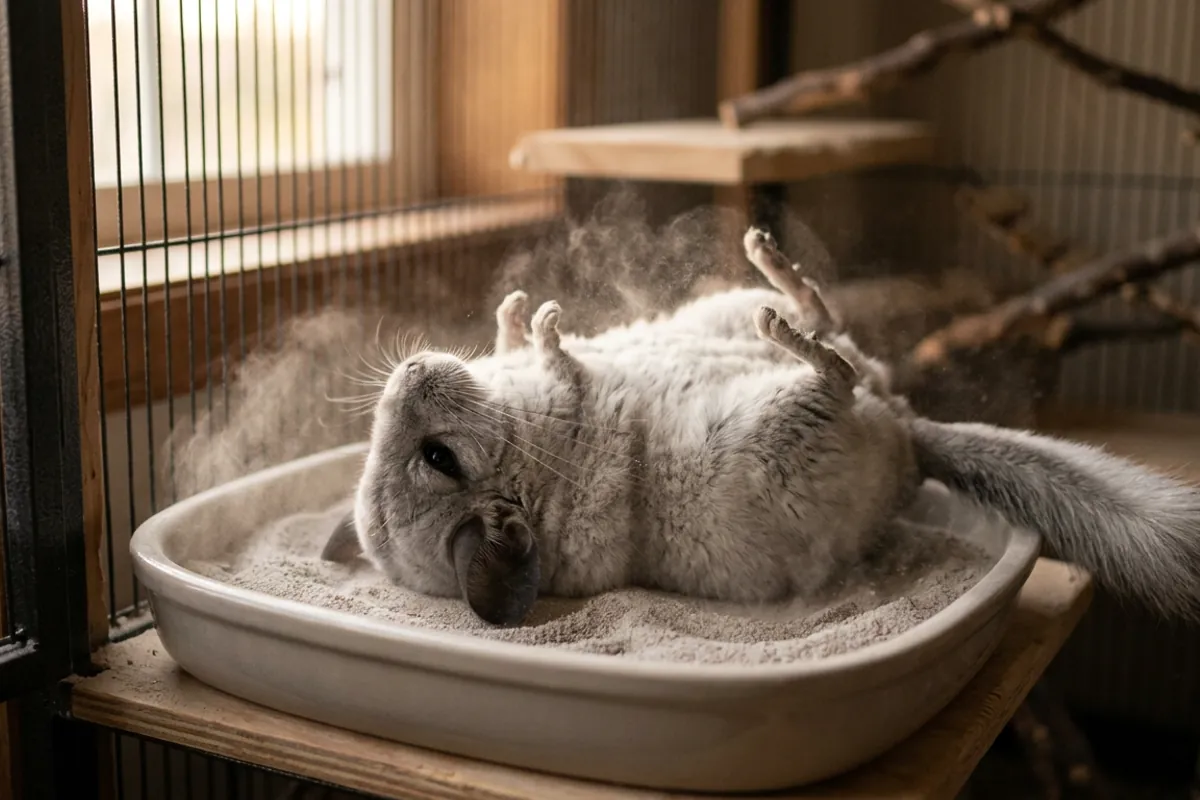
Use proper chinchilla bathing dust, the fine pumice kind, not sand, which is too coarse and abrades the coat. Lixit Blue Beauty chinchilla dust, 3 lb As an Amazon Associate I earn from qualifying purchases. A heavy open bowl or a purpose-made bath house both work; I like something with high sides to keep the dust off the cage. If your chinchilla is bathing daily and still looks greasy, or you are in humid weather, that is worth a second look rather than more dust, since over-bathing dries the skin out. The full method is in the chinchilla dust bath, and what bathing dust really is covers what to buy.
Teeth that never stop growing
A chinchilla's teeth grow continuously for its whole life, and the only thing that keeps them the right length is grinding coarse food and gnawing hard, safe wood. This is not optional enrichment. It is dental care. Juniper came to me as a neglected rescue with dental disease I still manage day to day, and watching up close what happens when teeth do not get worn down is why I am uncompromising about two things: unlimited hay, which does most of the grinding, and a real variety of chews.
Offer several textures of safe wood, apple, pear, and willow among them, so they actually use their teeth rather than ignoring one tired block. emours apple wood chew sticks, 40 count As an Amazon Associate I earn from qualifying purchases. Avoid anything treated, painted, or from a stone-fruit tree like cherry or plum, which can be toxic. Watch for the early signs that teeth are going wrong: drooling or a wet chin, dropping food, weight loss, pawing at the mouth, or a sudden preference for softer food. Dental problems in chinchillas are common and they hide well, so any of those signs is a call to an exotics vet, not a wait-and-see, because the roots grow where you cannot see them. I keep chinchilla teeth problems and chinchilla chew toys on hand for the details.
Exercise, handling, and a mind that needs a job
Chinchillas are crepuscular, most awake at dawn and dusk, and they are athletes. A large solid-surface running wheel lets them burn that energy safely; a wire wheel can catch a foot or a tail and break it, so I will not use one. 15 inch Chin Spin solid surface chinchilla wheel As an Amazon Associate I earn from qualifying purchases. Beyond the wheel, they need out-of-cage time in a chinchilla-proofed room: nothing to chew that can hurt them, no gaps to vanish into, no other pets loose, and no open water or exposed cords. Half an hour of supervised hopping most evenings does more for a chinchilla than any toy.
Handling is a slow game. Most chinchillas do not want to be held the way a new owner hopes, at least not at first, and forcing it teaches them that hands mean trouble. Sit on the floor, let them come to you, and let them learn that you are furniture with treats. They startle easily, and a frightened chinchilla can release a patch of fur to escape a grip, which is normal biology and a sign you moved too fast, not a wound. Chinchillas are social and often do well in a same-sex pair, but pairs must be introduced slowly and carefully, and a single well-handled chinchilla with plenty of your time can be perfectly content. If you want a running wheel done right, what a chinchilla on a wheel really needs covers the safe kind.
What healthy looks like, and when to call the vet
Once the environment is right, day-to-day care for your chinchilla is mostly watching. A healthy chinchilla is bright-eyed, active at dusk, eating hay constantly, and producing plenty of dry, firm droppings. The droppings are your daily health readout: fewer of them, softer ones, or none at all means the gut has slowed, and a gut that stops is an emergency. Weigh your chinchilla weekly on a small kitchen scale, because steady weight loss shows up on a scale long before it shows in that thick fur.
Chinchillas hide illness until they are quite unwell, which is why the small signs matter so much: a chinchilla sitting hunched, not eating, drooling, breathing hard, or too warm to the touch needs an exotics vet, not a home remedy and a hope. Not every clinic sees exotics, so find one that does before you have an emergency, and keep a small fund set aside, because the after-hours visit always comes at the worst possible time. That is the whole of it, really. Get the temperature right, keep the hay unlimited, keep the water and the plastic and the cedar out of it, and give them dust, wood, and a wheel. Do that, and how to care for a chinchilla stops being a worry and becomes a quiet, rewarding routine that can run for fifteen years or more.