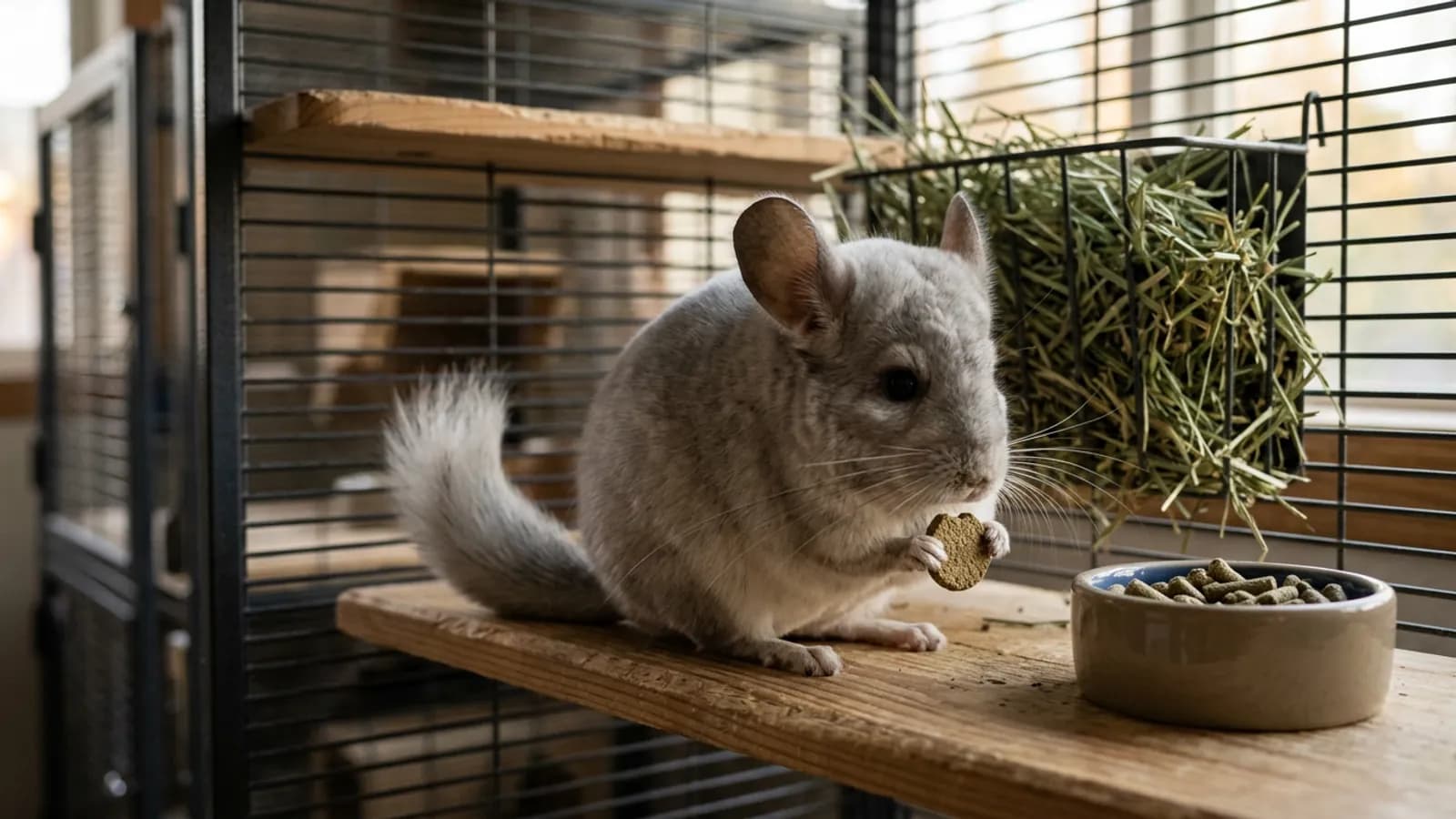
Most of what I want to say about chinchilla pellets fits in one sentence: they are the smallest part of the diet, and the part people worry about most. Hay is the meal. Pellets are a measured supplement that fills the gaps hay leaves, and the whole job of a good pellet is to be boring, uniform, and eaten in the amount you give rather than picked apart. After about ten years of keeping these animals, I have watched far more harm come from the wrong pellet, or from too much of the right one, than from any hay. So this is the honest owner-to-owner version of what to buy, how much to give, and what the labels are hiding.
Pellets are a supplement, not the meal
The single most common mistake I see is treating the pellet bowl as dinner and the hay rack as a garnish. It is backwards. A chinchilla's gut is built to grind through large volumes of coarse grass fiber all day, and that constant chewing is also what keeps the teeth worn down. Pellets are dense, low-fiber, and eaten in seconds. If a chinchilla fills up on pellets, it eats less hay, chews less, and the teeth do not get the wear they need. I learned how fast that spiral goes with Juniper, my dental rescue, and I do not want anyone else to learn it that way.
So set the frame before you buy anything: unlimited grass hay in front of the animal at all times, fresh every day, and a small daily portion of plain pellets on top. If you want the full picture of how the pieces fit together, I laid it out in the chinchilla diet guide. For pellets specifically, the rule that matters is that they never replace hay and never become the thing your chinchilla prefers.
What a good chinchilla pellet actually is
A good pellet is a plain, uniform, extruded or pressed pellet where every piece is identical. That uniformity is not cosmetic. It is the whole point. When every pellet is the same, the chinchilla cannot pick out the parts it likes and leave the rest, which means it actually eats the balanced formula you paid for instead of a self-selected diet of the tastiest crumbs.
The base is usually alfalfa or a timothy and alfalfa blend, with the protein sitting somewhere around 16 to 20 percent and fiber high, ideally in the mid-teens or above. Fat should be low, in the low single digits. Those are the ranges I look for, and the exact best numbers are genuinely debated among keepers and breeders, so I will not pretend there is one perfect figure. What is not debated is the shape of a good product: plain pellets, no visible seeds, no dried fruit, no colored bits, no nuts, no corn kernels.
If a bag looks like trail mix, put it back. Those muesli-style mixes are the worst thing on the shelf dressed up as the most appealing. A chinchilla will eat the sugary, fatty pieces first and leave the fibrous pellet behind, so you get an unbalanced diet and a fat chinchilla in the same bag. The colorful mix is designed to look wholesome to you, not to feed the animal well.
How much, and how often
Here is the number people ask for first: roughly one to two tablespoons of pellets per adult chinchilla per day. That is the widely accepted range, and I want to be honest that the exact amount is not a precise science. It varies with the animal's size, age, activity, and how much hay it is actually eating. A growing kit, a pregnant or nursing female, or a recovering animal may need more, and those are cases to work out with an exotics vet rather than guess at.
For a healthy adult, I give a level portion once a day and I do not top it up when the bowl empties. An empty pellet bowl in the evening is normal and fine. It nudges the chinchilla back to the hay rack, which is exactly where you want it. If the pellets are gone in minutes and the hay sits untouched, that is a sign you are giving too much pellet, not too little.
Weigh your chinchilla now and then on a small kitchen scale so you have a baseline. Steady weight with good hay intake tells you the portion is right. Creeping weight gain usually means the pellet portion or the treats need to come down. And treats really are a separate conversation, because most of what gets sold as chinchilla treats has no business in the diet at all, which I go into in the treats guide.
Reading the label without getting fooled
Turn the bag over and read the ingredient list, because the front is marketing and the back is the truth. The first ingredient should be a forage, alfalfa or timothy, not a grain or a sugar. You want to see a fiber-forward formula and you do not want to see molasses, added sugars, corn as a main ingredient, or a long list of fruit and seed inclusions.
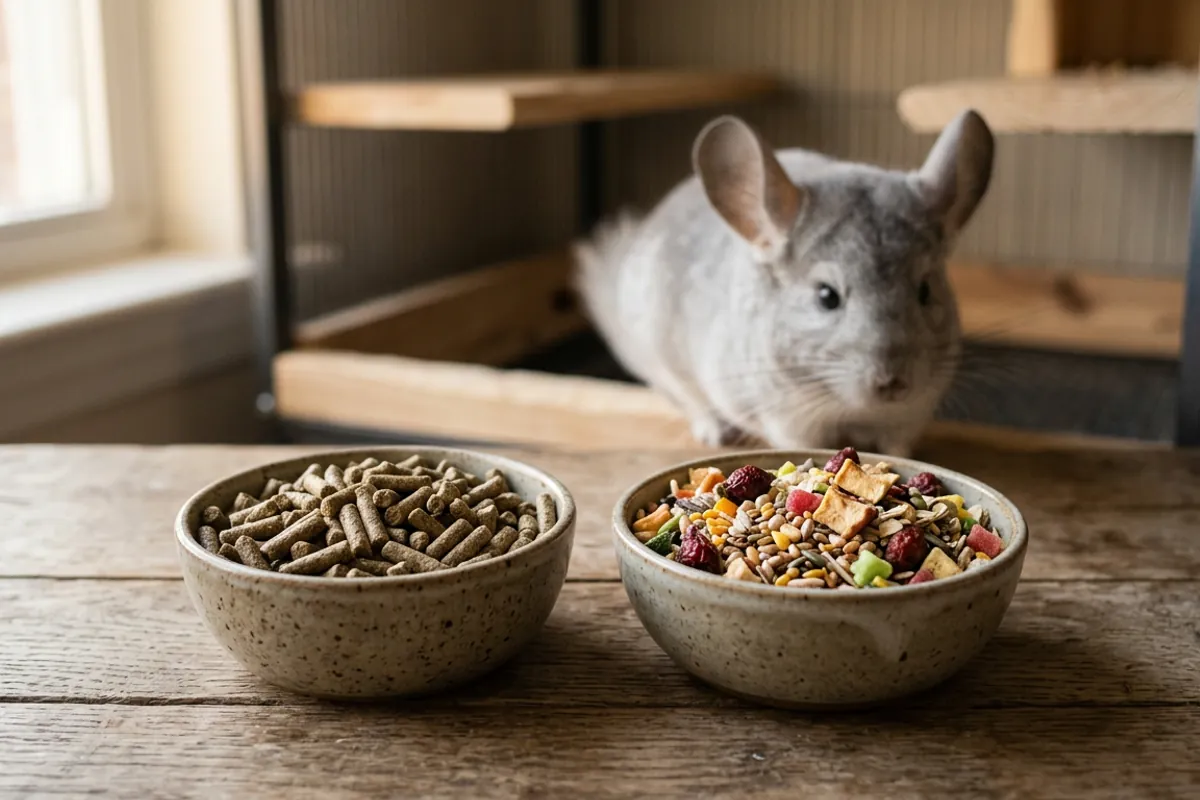
Watch the wording, too. "Chinchilla food" on the front does not guarantee a plain pellet inside, and plenty of bags marketed straight at chinchilla owners are muesli mixes. The label tells you what the animal will actually be offered. If you see uniform pellets described and a short, forage-led ingredient list, you are probably looking at something worth buying. If you see a photo of a colorful mix, you already have your answer.
One more thing the label will not tell you: freshness. Vitamin content in fortified pellets degrades over time, so a best-by date that is close, and a bag that is not enormous relative to how fast one or two chinchillas eat, matter more than they seem to. I would rather buy a smaller bag more often than store a giant sack that goes stale before it is half gone.
The brands people actually ask about
I get asked to name names, so I will, with the caveat that I have no sponsorships and no product I am paid to push. Judge any of these by the ingredient list on the bag you can actually get, because formulas and availability change by country.
Mazuri chinchilla pellets are the ones most breeders and long-term keepers reach for, and for good reason. It is a plain, uniform pellet with a forage base and a straightforward fortified formula, no junk inclusions. When people ask me for the best chinchilla pellets as a default, Mazuri is usually where I point them, simply because it does the boring job well and is widely available.
Jr Farm chinchilla pellets are common in Europe and, in their plain pelleted form, are a reasonable choice. The brand also sells mixed products with extras in them, so this is exactly the case where you read the bag rather than the brand. A plain Jr Farm pellet is fine. A Jr Farm mix with dried bits is the muesli problem again.
Vitakraft chinchilla pellets are where I get more cautious. Vitakraft sells a wide range, and a lot of what carries the name is the colorful mix-style food with seeds and shaped pieces that I would not feed. If you are looking at a Vitakraft product, look very hard at whether it is a plain uniform pellet or a mix, and skip it if it is a mix.
Charnwood chinchilla pellets come up mostly with UK keepers, and the plain pelleted version is another that gets used successfully. Same rule applies: the plain pellet is the product, not any mixed variant.
None of these is magic. The best pellets for chinchillas are whichever plain, uniform, forage-based, fortified pellet you can reliably buy fresh where you live and keep buying, because consistency matters more than chasing the perfect brand. Which brings me to the next point.
Switching pellets without upsetting the gut
A chinchilla's digestive system does not like sudden change. If you are moving from one pellet to another, whether because you found a better formula or because your usual bag is out of stock, do it gradually over a week to ten days. Mix a little of the new pellet into the old, increase the new and decrease the old day by day, and watch the droppings. Healthy droppings stay firm, dry, and regular. Soft stool, fewer droppings, or a chinchilla that goes off its food are signs to slow down.
This is also why I keep a bit of buffer stock rather than running a bag to empty. Being forced into an overnight switch because the shelf was bare is a gut-upset waiting to happen. Buy your next bag before the current one runs out, and you will never have to make an abrupt change.
If a chinchilla suddenly refuses pellets it has always eaten, do not just assume it is fussy. Loss of appetite in a chinchilla is a genuine warning sign, and combined with drooling, a wet chin, or weight loss it can point to dental disease. That is a vet call, not a food-swap experiment. I wrote about spotting teeth problems early because catching malocclusion before it turns serious is one of the few things that genuinely changes the outcome.
Storage, and keeping the good in the pellet
Fortified pellets are only as good as their vitamins, and heat, light, air, and time all degrade them. Keep the bag sealed, cool, dark, and dry. I decant into an airtight container and keep it out of any warm spot, which in summer matters more than people think, because the same temperatures that threaten the chinchilla also cook the nutrients out of its food. If you want the reminder on ambient heat, chinchillas are comfortable at 60 to 70°F (15 to 21°C), risk starts climbing above 75°F (24°C), and 80°F (27°C) and up is an emergency, faster in humid air, which is as true for where you store the food as for where the animal lives.
Do not buy in bulk beyond what your animals will eat in a couple of months. A cheaper price per pound is no bargain if half the bag oxidizes before it is used. Small and fresh beats large and stale every time.
When the pellet is not the real problem
Sometimes people come to me convinced they need a better pellet when the pellet was never the issue. If a chinchilla is losing weight, the first questions are almost always about hay and teeth, not the pellet brand. Is unlimited fresh grass hay actually available and actually being eaten? Hay is the foundation, and a good timothy hay box kept full is worth more than any pellet upgrade. Oxbow Western Timothy Hay, 40 oz bag As an Amazon Associate I earn from qualifying purchases. If you go through a lot of it, buying timothy hay in bulk can keep the rack full without constant restocking, as long as you store it dry and it stays green and sweet-smelling. Oxbow Western Timothy Hay, 9 lb box As an Amazon Associate I earn from qualifying purchases.
The other half of the picture is chewing. Pellets do almost nothing to wear teeth down, hay and safe wood chews do. An apple wood chew variety pack gives the constant gnawing that keeps continuously growing teeth in check. emours apple wood chew sticks, 40 count As an Amazon Associate I earn from qualifying purchases. Juniper taught me that no pellet, however good, fixes teeth that are not being worn down. If the diet is right and an animal is still struggling, that is the line where a keeper stops adjusting food and an exotics vet takes over.
So keep pellets in their proper place. Buy a plain, uniform, forage-based, fortified pellet, give one to two tablespoons a day, store it fresh, switch it slowly, and never let it crowd out the hay. Get that right and the pellet becomes what it should be: the quiet, unremarkable supplement sitting behind a rack of hay the animal actually lives on. If you want the wider view of what belongs in the bowl and what never should, the guide to what a chinchilla can eat covers the rest.