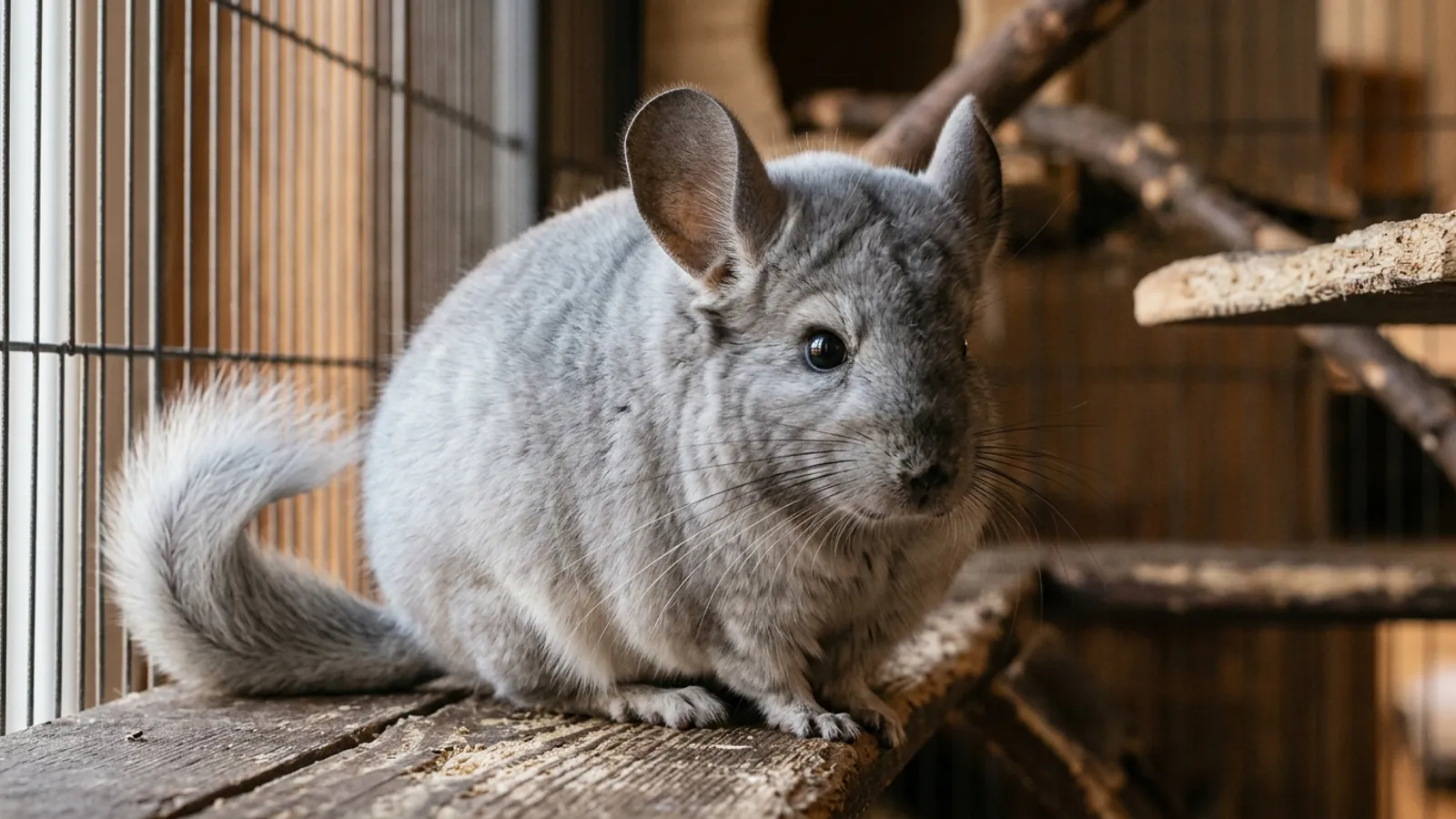
A chinchilla is fluffy in a way that no other pet you have held comes close to, and once you understand why, half the odd-looking rules I follow to keep Pebble and Juniper alive suddenly make sense. People reach for the word the second they see one, and they are right, but they rarely know how right. When I say chinchilla fluffy, I do not mean a soft coat that feels nice under your hand. I mean fur so dense that a flea cannot crawl through it, so dense that water cannot dry out of it, and so dense that a warm afternoon can kill the animal wearing it. The fluff is not decoration. It is the single most extreme thing about a chinchilla, the reason it survives where it comes from, and the reason it needs care that looks nothing like keeping a rabbit or a cat. Everything below is the biology behind the fluff, and why every strand of it changes what you do at home.
What people mean when they say fluffy
Pick up a chinchilla for the first time and your brain refuses to believe your hand. There is almost no sense of an animal under there, just a warm cloud that happens to have a face and a bushy tail. That feeling is not softness in the way a kitten is soft. It is density. Your own hair, and a dog's, and a cat's, grows roughly one strand from each follicle in the skin. A chinchilla grows a whole bundle from every single follicle, dozens of fine hairs fanning out from one point, packed so tightly that the coat behaves more like felt than like fur.
That is why you cannot part it down to the skin the way you can with most animals. Blow on a dog and you see skin. Blow on a chinchilla and the fur just parts into a little crater and springs back. The hairs are also extraordinarily fine, far thinner than a human hair, which is what gives the coat that weightless, almost liquid feel. Fine plus dense plus many-per-follicle is the whole trick. None of it happened by accident, and none of it is cosmetic. It is insulation, built for a place most pet owners would find hard to imagine.
Where all that fluff came from, high in the Andes
Chinchillas are not a soft-focus fantasy animal. They come from the Andes mountains of South America, from high, dry, rocky slopes where the air is thin and the nights are brutally cold. A coat like that is what you grow when you are a small rodent living where the temperature can swing from sun-warmed rock to freezing dark within a single day, and where there is nowhere to burrow deep for warmth. The fur traps a thick layer of still air against the skin and holds body heat in. For an animal that size, in that climate, it is the difference between morning and not.
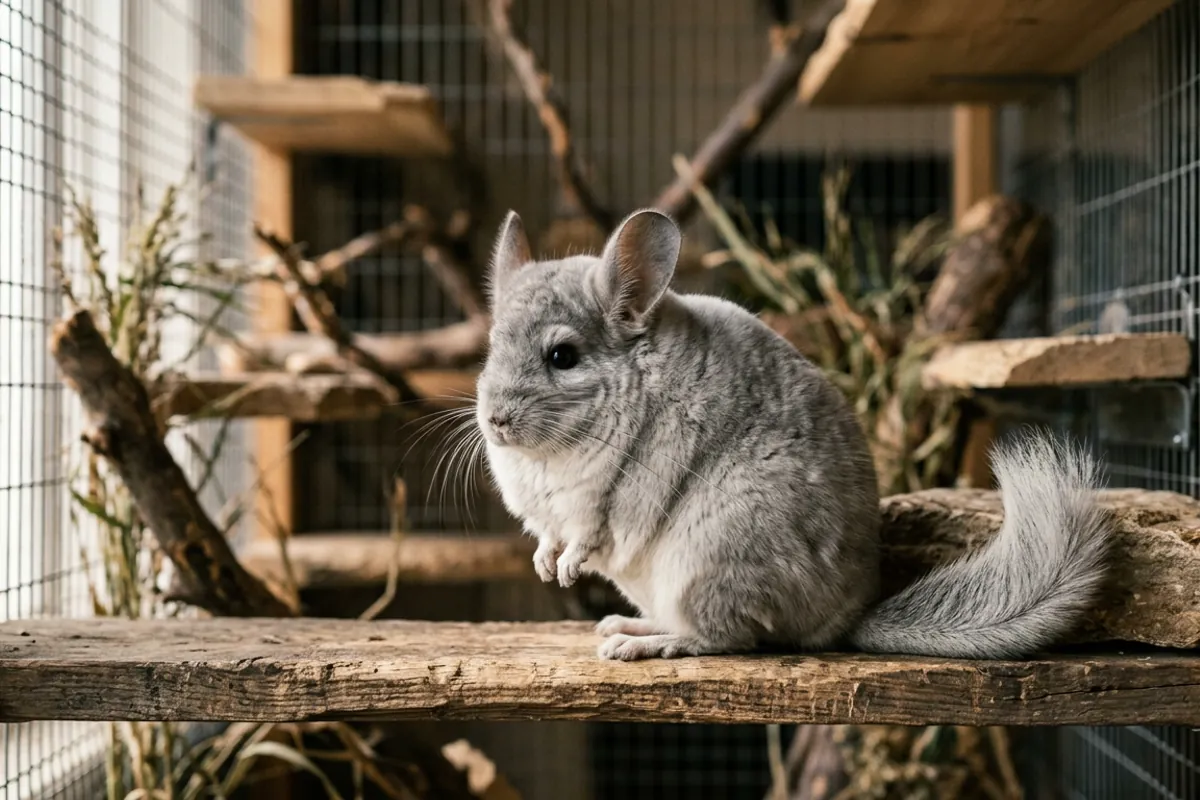
I keep coming back to this because it explains everything that follows. The coat was engineered by that environment to solve one problem, keeping a small body warm in the cold and dry. It was never built to shed heat, never built to handle damp, and never built for a centrally heated living room in summer. When you understand what a chinchilla in the wild is really like, you stop being surprised by the fur and start respecting it. Everything people find charming about the fluff is a cold-mountain adaptation wearing a cute face, and the mismatch between that mountain and your home is where the real care work lives.
The hairs-per-follicle number, and what it really tells you
You will see figures quoted everywhere. The one people love is around twenty thousand hairs per square centimeter, and the claim that fifty or more hairs grow from a single follicle. I will be clear about these: the exact counts vary from source to source, and I would not stake anything on a precise number, because I have seen it reported several ways. What is not in dispute, and what every keeper and biologist agrees on, is that the chinchilla has the densest fur of any land mammal. That part you can rely on. The precise strand count is trivia. The density is a fact you build husbandry around.
Here is the practical payoff of that density, and it is genuinely useful. The fur is so tightly packed that external parasites cannot establish in it. A flea needs to move through the coat and reach the skin, and in a chinchilla it simply cannot, it gets stuck and suffocates in the pile. That is a real advantage, and it is why a healthy, dry chinchilla does not need flea treatment the way a dog does. But the same density that locks parasites out also locks moisture in, and that is where the fluff stops being a gift and starts making demands.
Why fluffy means water is completely off the table
This is the rule that is not negotiable, because getting it wrong is dangerous. A chinchilla must never be bathed in water. Not a rinse, not a quick dip, not a damp cloth worked down to the skin. The reason is the fluff itself. That felt-dense coat soaks water up and then refuses to let it go. Where a dog shakes off and air-dries in an hour, a chinchilla stays wet to the skin for a very long time, and a coat that stays wet against warm skin is a perfect place for fungal infection to take hold. On top of that, a wet chinchilla chills, because the wet fur can no longer trap the air layer it depends on for warmth. If you want the full picture of what a soaked coat does, I wrote about a wet chinchilla separately, but the short answer is that the density that makes the fluff wonderful is exactly what makes water so hard to reverse.
So how does an animal with the densest fur on land stay clean? It bathes in dust. In the wild it rolls in fine volcanic grit, and that powder is what wicks oil and moisture out of the coat and keeps every strand separated and dry. At home you give it the same thing, a bowl or enclosed house of proper chinchilla dust, two or three times a week, and you let the animal flip and roll in it. A dedicated dust bath setup keeps the mess contained and gives them room to move.
Lixit Blue Beauty chinchilla dust, 3 lb As an Amazon Associate I earn from qualifying purchases.
That is the cleaning system for the fluffiest animal you will ever own. No water, no shampoo, no wiping, just dust and the animal's own rolling. If you want the detail on powder and schedule, the dust bath done right covers it, but the principle comes straight from the biology in this article: a coat that cannot dry cannot get wet, so you clean it dry.
The cruel twist, the fluff that traps heat
Here is the part I am relentless about, and it comes from the worst night I have had as a keeper. Insulation does not choose a direction. A coat that brilliantly holds heat in when it is cold is a coat that brilliantly holds heat in when it is hot, and a chinchilla cannot take the fur off. They cannot sweat their way out of trouble the way we do, and they shed excess heat mainly through those big rounded ears, which is a tiny radiator for a body wrapped in the densest fur on land. That means a chinchilla overheats far more easily than its size suggests, and the fluff you fell in love with is the reason.
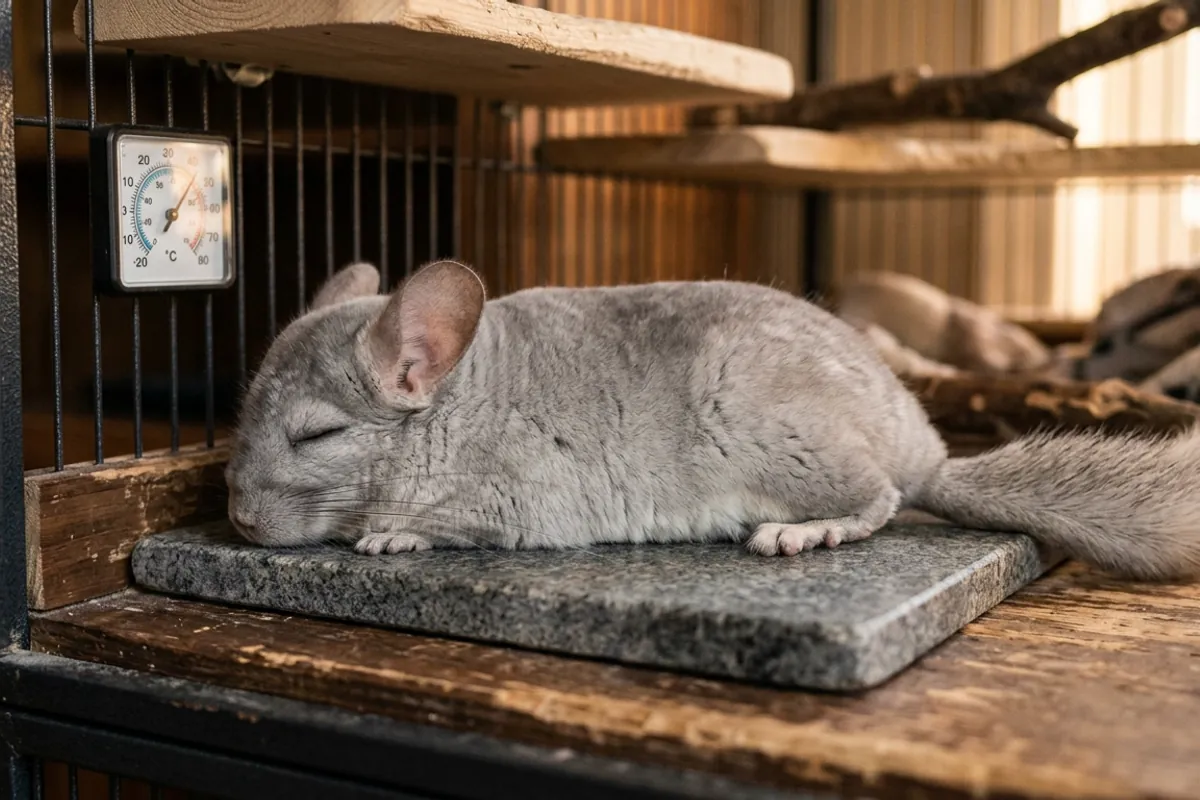
The numbers are not negotiable, and I keep them exactly as they are. A chinchilla is comfortable between 60 and 70°F, which is 15 to 21°C. Above 75°F, or 24°C, you are into risky territory. At 80°F, which is 27°C, and up, you are in an emergency, and humid air makes all of it worse and faster, because damp air strips away what little cooling the ears can manage. Pebble came to me from an overheated attic, and her first summer brought a heatwave that put her at the emergency vet overnight. That scare is why I will not write a friendly version of this. The fur is why the heat rule exists.
So watch the actual temperature where the cage sits, not the forecast, with a thermometer on the cage itself.
digital thermometer and humidity gauge with remote probes As an Amazon Associate I earn from qualifying purchases.
Give them something cold to lie against on hot days, a chilled solid stone they can press their belly and those ears into.
Kaytee Chinchilla Chiller granite stone As an Amazon Associate I earn from qualifying purchases.
And know the danger line cold. If you want to check your own room against the risk, I built a heat danger calculator, and the warning signs of heat stroke are worth reading before you ever need them. Panting, lying flat and stretched out, bright red ears, and dullness are the signs the fluff has turned against the animal, and that is a straight-to-the-vet situation, not a wait-and-see one.
Fur slip, the fluff they will throw away to survive
The coat has one more trick, and it startles new owners badly the first time they see it. A chinchilla can release a whole patch of its own fur on purpose. Grab one too hard, or frighten it, and it will let a clean chunk of fur come away in your hand, leaving a smooth bald patch of skin behind. It is called fur slip, and it is not injury in the way a wound is. It is a deliberate escape mechanism. In the wild, a predator that gets a mouthful of fur instead of chinchilla comes away with nothing, and the chinchilla is gone. The fluff is, in a real sense, disposable armor.
The catch is that it grows back slowly, sometimes taking months to fill in properly, and a chinchilla that keeps slipping fur is telling you it is being handled too roughly or is under stress. So the lesson is a handling lesson. Never grab a chinchilla by a fistful of body, support it gently and let it feel secure, and if you see a bald square appear, treat it as feedback, not as a health crisis. I go deeper on the mechanism and the fixes in fur slip, but for the purposes of understanding the fluff, this is the point: the coat is so central to the animal's survival that evolution built it to be sacrificed on demand. That is how much the fluff matters to a chinchilla.
Keeping the coat healthy without wrecking it
None of this density survives on its own. A healthy, spectacular coat is the outward sign of an animal that is doing well on the inside, and a dull, greasy, or patchy coat is usually the first thing I notice when something is off. The single biggest input is diet, and it is boring on purpose: unlimited grass hay as the whole meal, with a measured amount of plain pellets on the side, and nothing sugary or fatty. Good fiber in equals good fur out. That is the same hay-first rule that keeps their teeth worn down and their gut moving, and the coat rides on top of it.
The second input is the dust bath, done in moderation. Two or three baths a week is right for most chinchillas. More than that, and you can strip the coat and skin too dry, which leaves it flaky and can make the animal scratch. Less than that, and oil and moisture build up and the fluff starts to clump and look stringy. You are aiming for a coat that separates cleanly and springs back, and the dust schedule is how you tune it. Do not brush a chinchilla the way you would a long-haired cat, the coat is not built for it and you can pull fur out.
The third input is watching. Run your eyes over the coat when you handle them. Matting, a damp patch, a greasy chin, a bald square, thinning around the flanks, these are all the fur reporting on the animal underneath. A damp chin can mean drooling from a tooth problem, which is why coat condition and dental health are tied together. If the coat looks wrong and you cannot fix it with diet and dust within a week or two, that is a conversation with an exotics vet, not something to keep guessing at. I am an experienced keeper, not a vet, and the line I draw is simple: husbandry problems I fix at home, and anything that looks like disease goes to someone with the training to treat it.
One last thing on the fluff itself. If you are looking at an angora chinchilla with an unusually long, plush coat, understand that the extra length raises the stakes on everything above, longer fur mats more easily, traps more heat, and needs a more careful eye. The standard coat is already the most extreme fur on any land animal. That is the real answer to why a chinchilla is so fluffy. It is a cold-mountain survival system that ended up living in your home, and respecting what it is for is most of what good chinchilla keeping means.