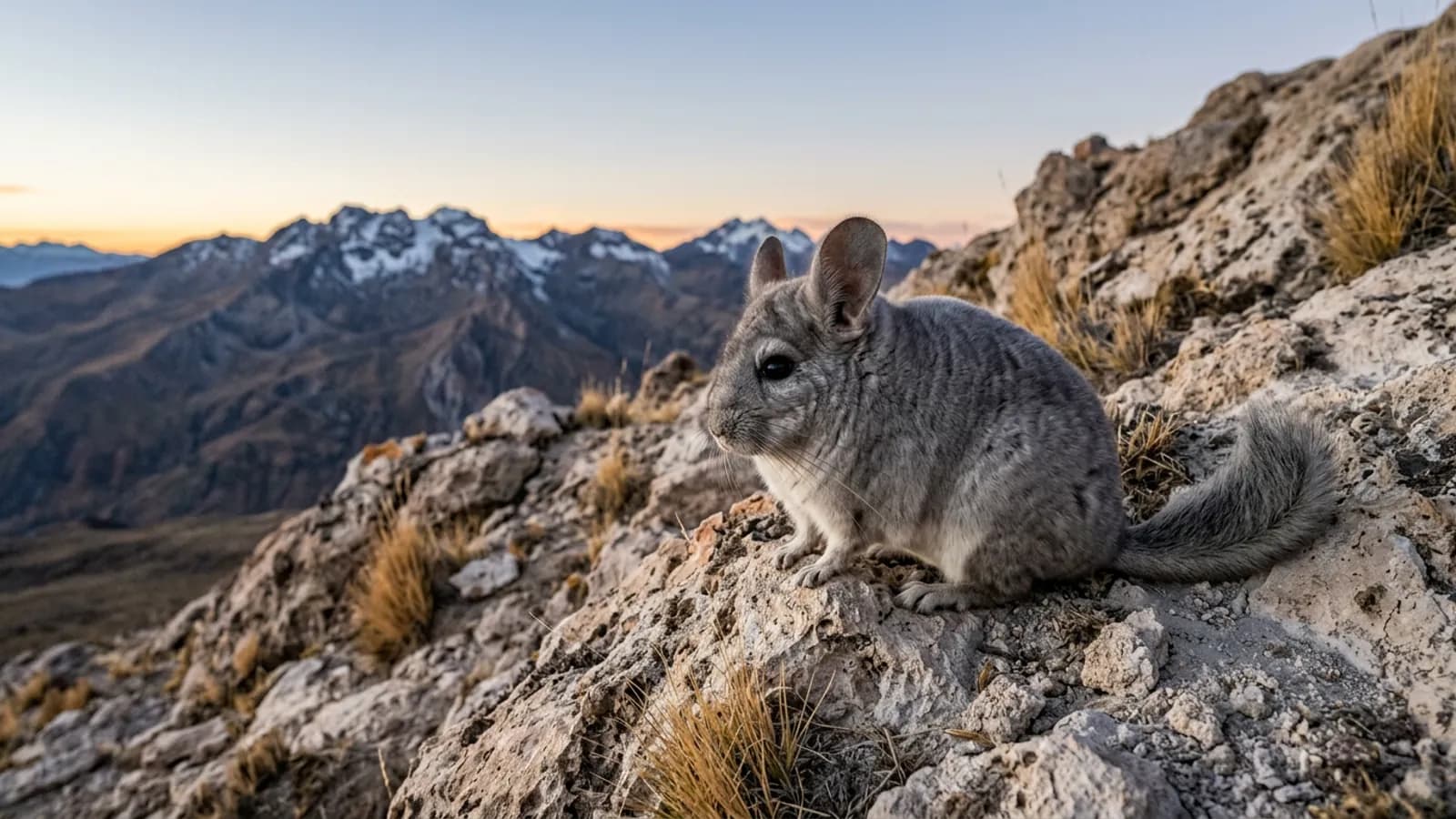
When people picture a chinchilla in the wild, they tend to imagine something soft perched on a mossy branch in a warm forest. The real animal lives somewhere much harsher, and once you have seen the place it actually comes from, most of the care rules I follow at home stop feeling like arbitrary fuss and start feeling obvious. I have kept chinchillas for about ten years, and the single most useful thing I ever learned was not a product or a clever trick. It was the mountainside. Almost everything odd about these animals, the dust baths, the panic about heat, the endless hay, traces straight back to a cold, dry, rocky slope in South America. This is the honest version of where your chinchilla comes from, and what the wild still dictates about the one sitting in your living room.
Where a chinchilla in the wild actually lives
Chinchillas are native to the Andes mountains of South America. Historically they ranged across parts of Peru, Bolivia, Chile, and Argentina, but the wild animals that remain today cluster in a few pockets of northern Chile. This is not gentle country. They live on rocky, arid ground at altitude, with different species favoring different heights, from a few hundred meters up to around 5,000 meters (roughly 16,000 feet) above sea level, where the air is thin, the daytime sun is fierce, and the temperature crashes hard at night. Vegetation is sparse: tough grasses, small shrubs, hardy herbs, and the occasional cactus clinging to broken ground. There are no lush branches and no rainforest. Picture scrubby, sun-bleached rock, wind, and cold clear nights, and you have the chinchilla's real address.
That environment explains the shape of the animal. Everything about a chinchilla, from its coat to its behavior to its gut, was tuned by a place that is dry, cold after dark, and short on both cover and food. Keep the mountainside in your head and the care almost writes itself.
Two species, and the one on your lap
There are two species of chinchilla. Chinchilla lanigera is the long-tailed chinchilla, and it is the one that became the pet you know; nearly every chinchilla living in a home today is a lanigera. Chinchilla chinchilla, still often called the short-tailed chinchilla, is stockier with smaller ears and a shorter tail, and it was hunted hardest for the fur trade. Both are considered endangered in the wild.
Here is a fact that reframes the whole hobby. Most pet chinchillas descend from a tiny founder group. In the 1920s an American mining engineer brought roughly a dozen chinchillas out of the mountains to California, and the bulk of the world's pet population traces back to that handful of animals. When people ask me why domestic chinchillas are still so close to their wild cousins in temperament and needs, that is the answer. There simply has not been much time, or much genetic distance, between the mountain and the cage. You are not keeping a farm animal that was reshaped over thousands of years. You are keeping a wild animal that moved indoors very recently, and it still expects the mountain. If you want the full biology-to-care picture in one place, I keep it in what a chinchilla really is.
Cold nights and the densest fur on land
The chinchilla wears the most famous coat in the rodent world, and it earns the fame. Chinchillas have the densest fur of any land mammal. Where a human grows a single hair from each follicle, a chinchilla grows a whole bundle, more than 50 hairs out of one point in the skin. That coat is a direct answer to those freezing Andean nights. It traps a thick layer of warm air against the body and keeps a small animal alive through cold that would otherwise finish it.
The problem is that a coat built to hold heat in is terrible at letting heat out. A wild chinchilla on a cold slope almost never has to shed heat; a pet chinchilla in a warm house has to do it constantly, and it is badly equipped for the job. Chinchillas do not sweat the way we do. They dump excess heat mostly through their large, thin ears, which work like radiators, and they pant only once they are already in trouble. That is why I am relentless about temperature, and why I built this whole site around it. My Pebble came out of an overheated attic, and her first summer brought a heatwave and a night at the emergency vet that I will never forget.
Keep the numbers exact, because they save lives. The comfortable range for a chinchilla is 60 to 70°F (15 to 21°C). Above 75°F (24°C) you are in risky territory, and 80°F (27°C) and up is a genuine emergency, faster still in humid air, because damp wrecks what little cooling they can manage. A cooling stone gives them a cold surface to stretch out on when a room warms up. Kaytee Chinchilla Chiller granite stone As an Amazon Associate I earn from qualifying purchases. And a thermometer and hygrometer on the cage wall means I am reading the real number instead of trusting how the room feels to me. digital thermometer and humidity gauge with remote probes As an Amazon Associate I earn from qualifying purchases. If you want the whole heat story, I have written out the temperature that keeps yours alive and the warning signs of heat stroke, and there is a heat danger calculator that turns temperature and humidity into one clear risk read.
Why they bathe in dust and never in water
That same dense coat is the reason a chinchilla must never get wet. In the wild, chinchillas keep clean by rolling in fine volcanic dust. The mountains they live in are coated in powdered ash and pumice, and a chinchilla flips and rolls in it, driving the fine particles down through the fur to the skin. The dust absorbs oil, moisture, and grit, then shakes back out and carries the dirt with it. It is a dry-cleaning system, and it works because the environment is dry.
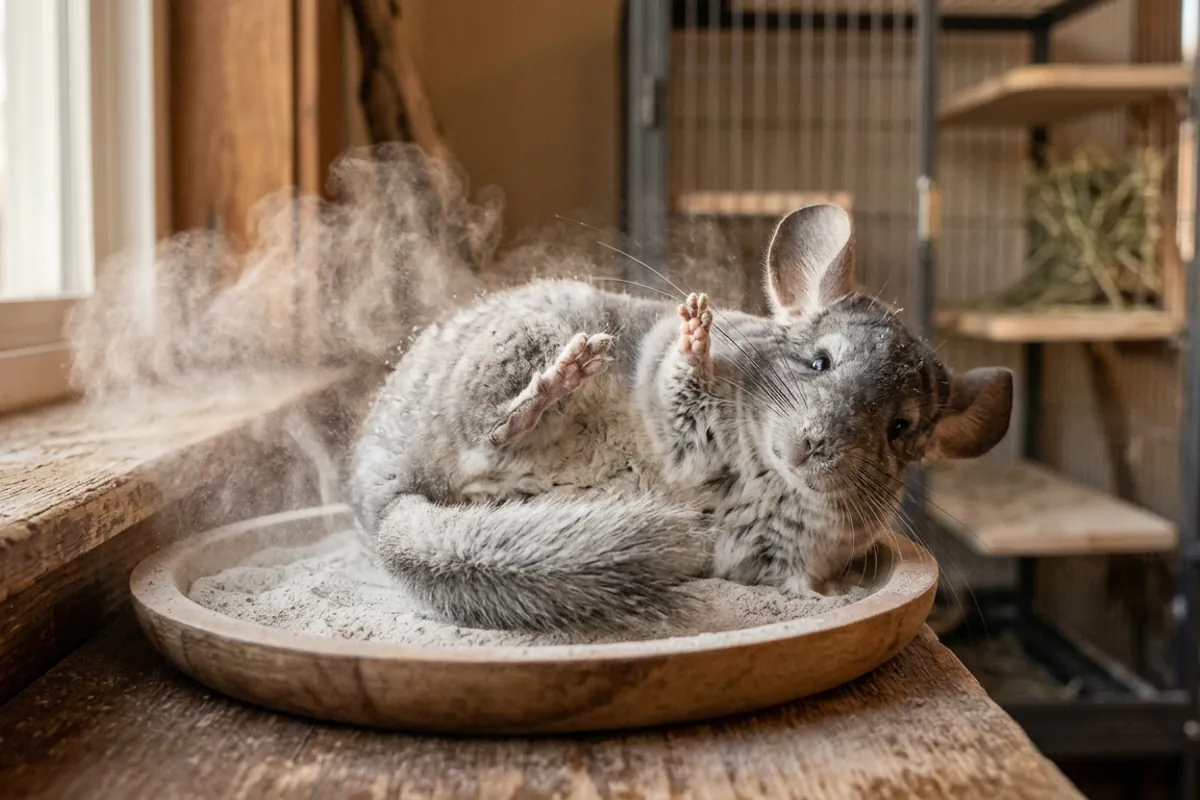
Water is the opposite. A coat that dense soaks up water like a sponge and holds it against the skin for a very long time, and a damp chinchilla in a warm spot is an open invitation to fungal skin infections. This is not a preference or a quirk; it is biology. So we copy the mountain. I give my two a dust bath a few times a week using proper chinchilla dust, which is finely ground volcanic pumice, not play sand and not anything gritty. Lixit Blue Beauty chinchilla dust, 3 lb As an Amazon Associate I earn from qualifying purchases. A few minutes is plenty, and I take the bath back out afterward so they do not sit in it or use it as a toilet. The details of how often and how much matter more than people expect, so I laid them out in the dust bath done right and in what bathing dust really is. If yours ever does get soaked, that is a different problem worth understanding fast, which I covered in chinchilla wet.
What a wild chinchilla eats
Food on that mountainside is thin and tough. A wild chinchilla grazes on dry grasses, seeds, small shrubs, herbs, and whatever hardy plants it can reach between the rocks. There is no fruit stand, no sugar, and no rich green pasture. It is a high-fiber, low-fat, low-sugar diet made mostly of coarse plant material that takes real work to chew and to digest.
That is exactly why the right diet at home is unlimited grass hay first, a measured amount of plain pellets second, and treats kept to almost nothing. Timothy hay stands in for the coarse mountain grasses; it is the whole meal, not a garnish, and it should be in front of your chinchilla all day and all night. I keep good timothy hay available at all times and refill it before it runs low. Oxbow Western Timothy Hay, 40 oz bag As an Amazon Associate I earn from qualifying purchases. The gut of a chinchilla is a fiber-processing machine tuned to that sparse wild diet, and it does badly with the sugary, fatty foods people want to hand out. Fruit, nuts, seed mixes, dried yogurt drops, all of it is a mismatch for an animal built to eat dry grass. When someone asks me what went wrong after a bout of soft stool or bloat, the answer is very often a diet that drifted too far from the mountain. I go deeper on getting it right in timothy hay for chinchillas and in chinchilla food.
Teeth built for tough, gritty plants
Chewing coarse wild plants all day did something specific to chinchilla teeth: it made them grow forever. A chinchilla has open-rooted teeth, front and back, that keep growing throughout its whole life. In the wild, the constant grinding of tough, gritty vegetation wears them down at roughly the same rate they grow, and the two stay in balance. It is a beautiful piece of engineering as long as the tough food keeps coming.
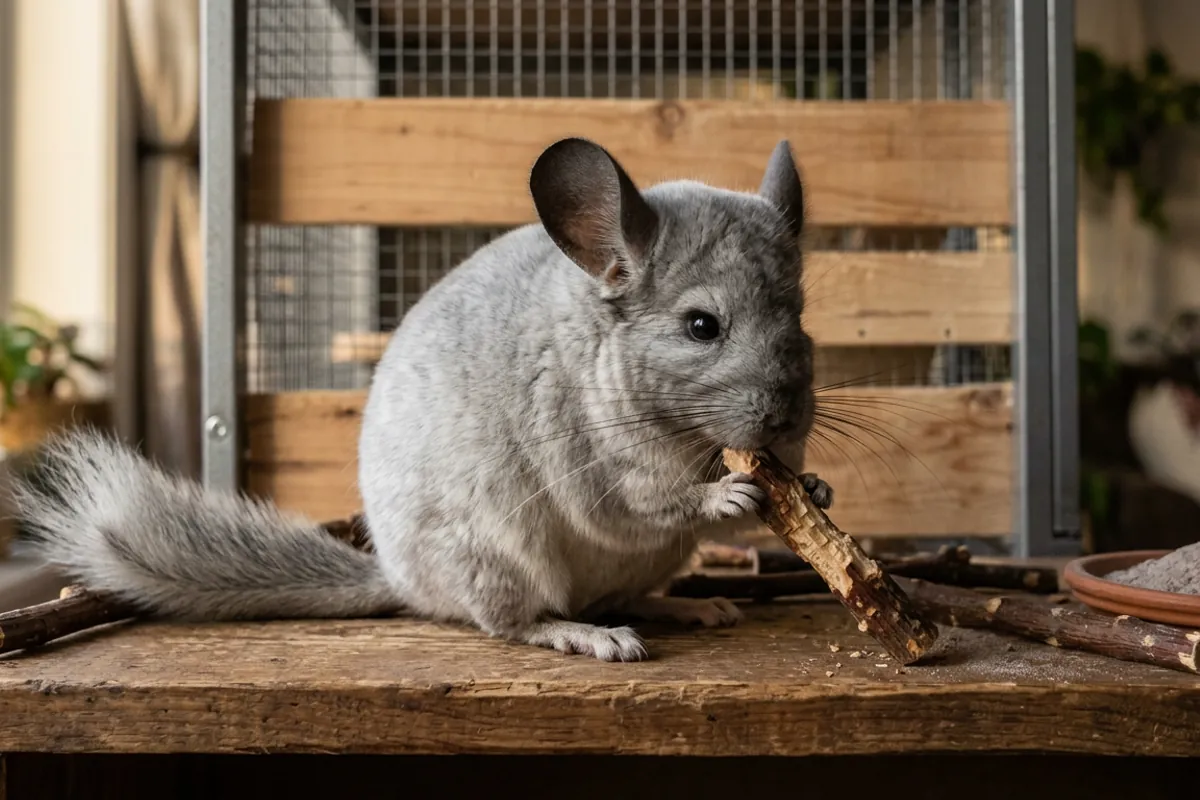
Take away that food and the balance breaks. This is the part I am hardest about, because I live with it. My Juniper came to me as a neglected rescue with dental disease, and I manage her teeth every single day. When the back teeth stop wearing evenly they can form sharp spurs and overgrow, and malocclusion is painful, expensive to treat, and sometimes never fully fixed. The defense is the wild diet plus real things to gnaw: unlimited hay does most of the work, and a variety of safe wood chews does the rest. emours apple wood chew sticks, 40 count As an Amazon Associate I earn from qualifying purchases. I deliberately mix up the shapes and textures, because on the mountain they were never gnawing the same single thing twice. If you notice drooling, a wet chin, dropped weight, or a chinchilla that clearly wants food but keeps backing off it, that is not a wait-and-see situation. That is a visit to an exotics vet who knows chinchilla mouths, and the sooner the better. I have written more on catching it early in chinchilla teeth problems and on picking chews in chinchilla chew toys.
Colonies, crevices, and staying alive
A chinchilla in the wild is not a loner. They live in colonies, social groups that can range from a small band to well over a hundred animals sharing a stretch of rocky ground. They shelter in cracks between the rocks and in burrows, tucking into crevices through the hottest part of the day and coming out to feed around dawn and dusk and into the night. That crepuscular rhythm is still wired into your pet. It is why yours often sleeps through the afternoon and wakes up busy and loud in the evening, right when you are winding down.
Survival on an exposed slope means staying out of a lot of mouths. Hawks and owls hunt them from the air, foxes and other small carnivores from the ground, and snakes from the cracks. A chinchilla's answers are speed, astonishing vertical jumps, freezing in place, and one strange last-resort trick: fur slip. When a predator grabs it, a chinchilla can release a clean patch of fur and bolt, leaving the attacker with a mouthful of nothing but fluff. You may see the tame version of that at home if you handle yours roughly or it truly panics, which is one more reason to be gentle and let a nervous chinchilla come to you. I explained the mechanism in chinchilla fur slip.
All that agility is also a clue about space. These are animals built to leap between rocks, so a home cage has to be tall, made of metal and wood, with solid ledges set at different heights to jump between. If you add a wheel it must have a solid running surface, never open wire that can catch a foot or a tail. 15 inch Chin Spin solid surface chinchilla wheel As an Amazon Associate I earn from qualifying purchases. Getting the enclosure right the first time saves money and stress, which is why I walked through it in the best chinchilla cage.
Why wild chinchillas are nearly gone
The reason you will almost certainly never see a chinchilla in the wild is grim and worth carrying with you. That famous fur made them a target. Through the 1800s and into the early 1900s they were hunted in enormous numbers for the pelt trade, and because each animal is small it took many pelts to make a single coat, so the killing ran into the millions. Populations collapsed. Hunting protections eventually came, but poaching, mining, and habitat loss have kept the wild animals in trouble ever since, and both species are still classed as endangered today. How long they live out there is honestly not well documented, and I will not invent a number; what is clear is that a hard mountain life is shorter and rougher than a well-kept captive one, where chinchillas can reach well into their teens.
I think that history should sit with anyone who keeps one. The animal on your shelf is a survivor of a species we very nearly wiped off its own mountain for a coat. It does not need a wire wheel, a plastic cage, a warm room, or a bowl of sugary treats. It needs the wild translated into a home: cool, dry, tall, full of hay and things to chew, with dust to bathe in and quiet places to hide. Get those few things right and you are not fighting the animal at all. You are handing back the parts of the wild that kept it alive in the first place.