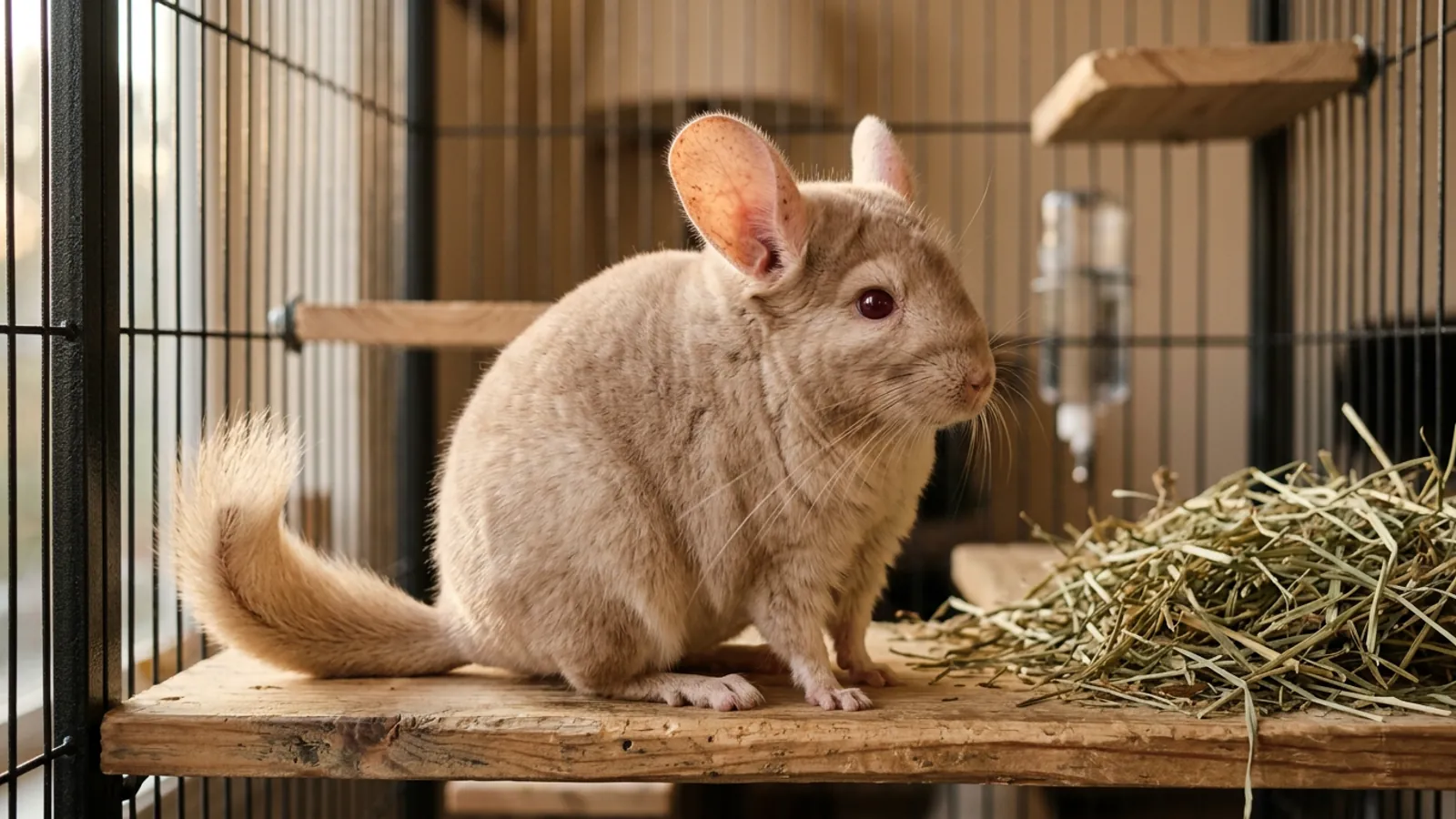
A beige chinchilla stops people in a way a gray one never quite does. The coat is warm and sandy instead of slate, the ears are pink with a scatter of little freckles, and the eyes catch the light red instead of black. I understand the pull, because the first time I met one in person I stood there longer than I meant to. But I am going to be clear with you from the first line, the way I would be if you were in my kitchen asking about it. Beige is a color, and the color is the only thing it changes. Under that sandy fur is the same animal I have kept for about ten years, with the same fragile tolerance for heat, the same appetite for hay, and the same teeth that never stop growing.
What a beige chinchilla is
Beige is one of the long-established chinchilla color mutations, and the one you are most likely to meet is dominant. That word does real work, so let me unpack it. A dominant gene shows itself with only one copy present, which is why beige turns up readily in the pet trade and why a single beige parent can pass the look to its kits. Most of the mutations people call rare are recessive, hiding until two carriers happen to meet. Beige does not hide.
The coat runs from a warm beige to a light tan across the back and sides, softening to cream or near white on the belly. Two features give it away even from across a room. The ears are pink rather than gray, and they usually carry small darker freckles, which is my favorite quiet detail of the whole mutation. The eyes range from deep ruby to a lighter pinkish red. None of that is dye or grooming or a "special" line, it is simply less of the dark pigment a standard gray lays down in its fur, skin, and eyes. If you want to see where beige sits among the rest, I laid the family out in chinchilla colors.
The history of the beige mutation is a little tangled, with more than one early line feeding into what we now lump together as beige, and I am not going to pretend the record is cleaner than it is. What matters for you as a keeper is simpler: the beige in front of you is almost certainly the dominant type, and its coat tells you nothing about its health.
Heterozygous and homozygous beige
Because beige is dominant and shows up differently with one copy versus two, the same name covers two visibly different animals. A heterozygous beige carries one beige gene and one standard gene. It tends to be a medium, warm beige, the shade most people picture. A homozygous beige carries two beige genes and comes out much lighter, sometimes so pale it reads as cream or nearly white, with brighter pink ears and redder eyes.
Here is the part that matters, and it is real husbandry rather than trivia. Two of the flashiest chinchilla mutations, the dominant white and the velvet, are lethal when an animal inherits two copies, which is why responsible breeders never pair two of them together. Beige is not one of those. A homozygous beige is a healthy, viable animal, and pairing two beiges carries no special genetic danger from the beige gene itself. I still would not encourage anyone to breed for color, for reasons I will get to, but the beige gene is not hiding a loaded chamber the way white and velvet do.
The beige sapphire chinchilla and other combinations
Beige gets more interesting, and more expensive, when it meets other mutations. Because it stacks with the recessive dilutes, breeders combine it to soften and lighten those colors.
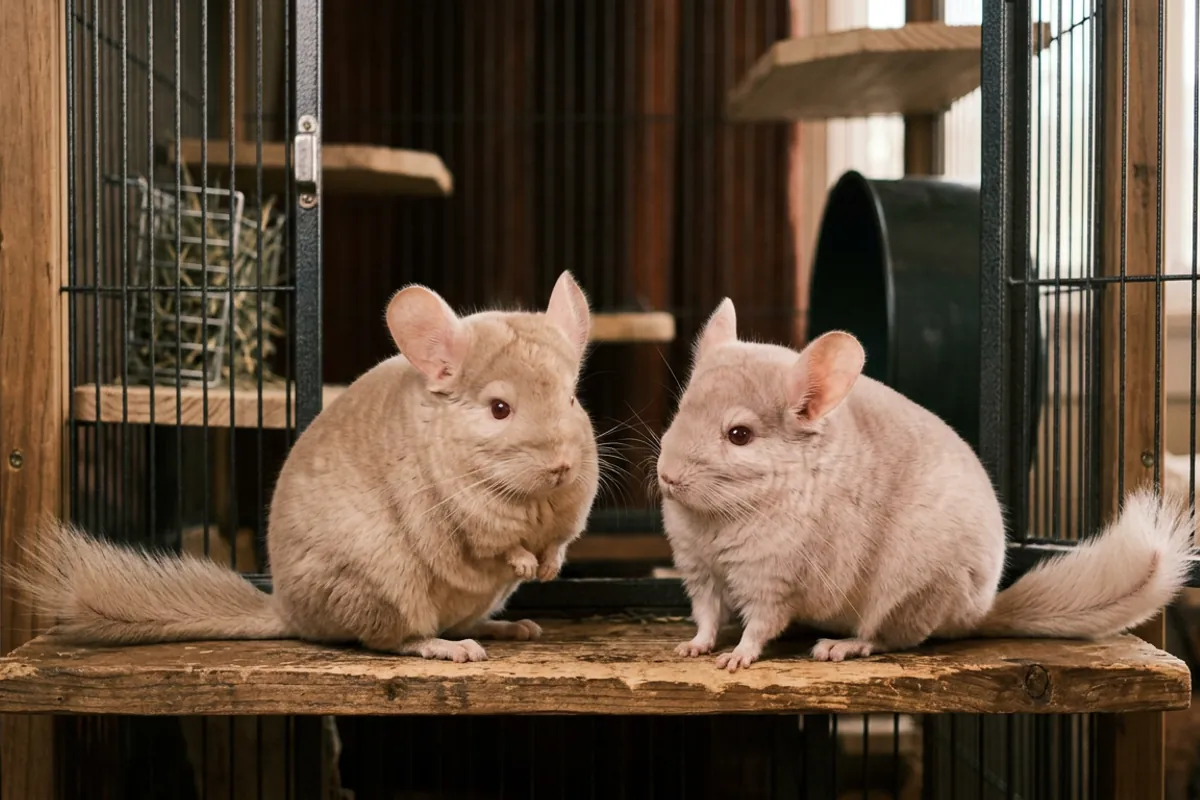
A beige sapphire chinchilla is beige carried on top of the sapphire mutation. Sapphire on its own is a pale, cool, bluish gray, a recessive and genuinely uncommon color; lay beige over it and you get a very soft, pale coat with a warm pink cast instead of a cool blue one. Beige sapphire is rare mostly because sapphire is rare to begin with, not because the beige half is hard to produce. If the sapphire side is what draws you, I wrote about it plainly in what a chinchilla sapphire really is.
The same logic gives you the other combinations you will see advertised. Beige laid over violet gives a soft, dusty pastel. Beige combined with ebony, sometimes with the velvet gene layered on, is where a lot of the animals sold as tan come from. Beige crossed with white produces the pale, freckled coats people list as pink white. This is exactly the point where naming gets loose and the marketing creeps in, because every breeder wants a name that sounds like a jewel. If a listing leans harder on the color name than on the animal's health, that tells you something about the seller. I sorted the uncommon colors from the marketing in rare chinchilla colors.
What the beige gene changes, and what it doesn't
This is the part I most want to land, because it is the whole reason the article sits in our facts and biology corner rather than a shopping guide. The beige gene changes pigment. It does not change the animal.
A beige chinchilla is the same size as a gray one, needs the same climate, eats the same diet, lives about the same span, and is no more or less friendly by virtue of its coat. Temperament in chinchillas is individual and shaped by handling and patience, not written into the color gene. I have heard people insist that beiges are calmer, or that some particular color is nippier, and I have never seen anything but coincidence behind it. If you want the plain read on personality, it comes down to the specific animal and how it was raised.
The one true consequence of the gene is cosmetic and follows straight from the biology. Less dark pigment in the fur, skin, and eyes is what makes the coat sandy, the ears pink, and the eyes red. That is it. Everything downstream, the cage, the temperature, the hay, the dust, is identical to what any chinchilla needs, and I will spend the rest of the article on it because that, not the color, is what keeps the animal alive.
The pink ears and red eyes
Two questions come up every time, and both deserve a straight answer rather than a reassuring one.
First, the eyes. A red or pink eye means there is less pigment in the iris, and it is fair to ask whether that makes the animal more sensitive to bright light. By analogy with other pink-eyed animals it is plausible, and some keepers feel their red-eyed chinchillas squint or hide more in a bright room. I want to be straight with you: I have not seen this proven for chinchillas, and I would not state it as fact. It also barely matters in practice, because chinchillas are most active around dawn and dusk and do best out of harsh, direct light anyway. Keeping the cage out of direct sun and away from a glaring window is standard good practice for every color, and it happens to cover the light question for a beige too. Direct sun is a heat trap as much as a light one, which brings me to the ears.
Second, those pink ears are not just pretty, they are a window onto how a chinchilla sheds heat. Chinchillas dump excess warmth through their large, thin ears, and on a pale beige you can sometimes see them flush a deeper pink when the animal is warming up. Treat that as a small bonus, never as your instrument. A flushed ear on a beige might catch your eye a moment sooner, but the number on a thermometer is what you act on, not the shade of an ear.
The care is identical, and here is what that means
Everything from here would be the same if the animal were slate gray. It is worth saying in full anyway, because the color never earns a shortcut.
Heat is the thing that will hurt a chinchilla fastest, and it is personal for me. Pebble came to me out of an overheated attic, and her first summer brought a heatwave that put us in the emergency vet overnight. That night is why I am relentless about temperature. Chinchillas are comfortable from 60 to 70°F (15 to 21°C). Above 75°F (24°C) you are in risky territory, and 80°F (27°C) and up is an emergency, faster still when the air is humid, because a dense coat that never evolved to shed heat cannot cool an animal down in a warm room. Put a combined thermometer and hygrometer on the cage so you are reading the real number, not guessing. digital thermometer and humidity gauge with remote probes As an Amazon Associate I earn from qualifying purchases. Give a chilled stone the animal can lie against on a hot afternoon. Kaytee Chinchilla Chiller granite stone As an Amazon Associate I earn from qualifying purchases. If you want to see exactly where your room lands, we built a heat danger calculator, and the fuller argument lives in chinchilla heat safety.
Food is the next non negotiable, and it is Juniper's lesson. Juniper came to me as a neglected rescue with dental disease I still manage every day, and watching what happens when teeth do not get worn down is why I am uncompromising here. A chinchilla eats unlimited grass hay first, always, because the long chewing is what grinds down teeth that grow for the animal's whole life. Timothy hay is the everyday staple, and I keep it coming in bulk so the supply never lapses. Oxbow Western Timothy Hay, 9 lb box As an Amazon Associate I earn from qualifying purchases. Plain pellets are a measured supplement on top of the hay, not the meal, and treats stay tiny and rare. Give plenty of safe wood to gnaw as well, because chewing is dental care, not decoration. emours apple wood chew sticks, 40 count As an Amazon Associate I earn from qualifying purchases. The full diet is laid out in chinchilla hay.
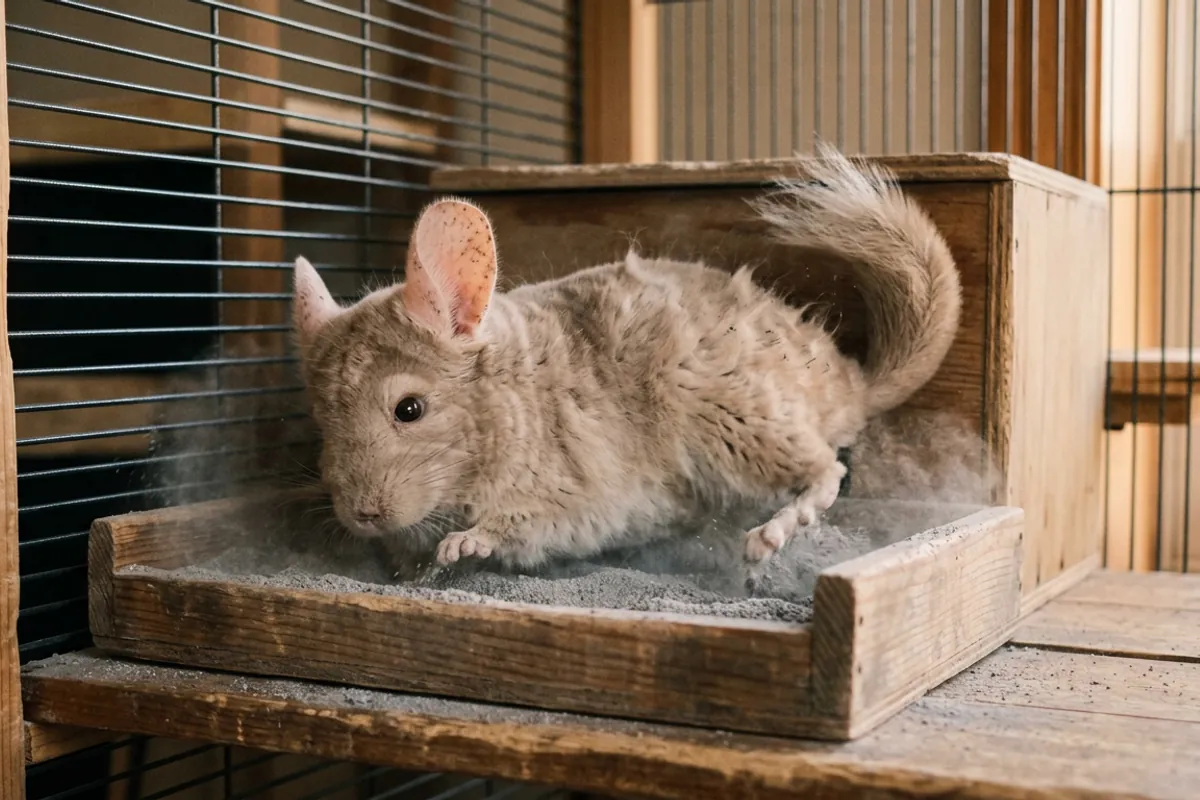
A beige never bathes in water, and neither does any chinchilla. That dense fur soaks like a sponge, stays wet to the skin, and grows fungus. They clean themselves by rolling in fine dust, which is really a volcanic pumice powder, a few times a week. Lixit Blue Beauty chinchilla dust, 3 lb As an Amazon Associate I earn from qualifying purchases. There is more on how and how often in the chinchilla dust bath.
The cage is the last big one. It has to be tall, made of metal and wood, with wooden ledges to jump between, and no plastic anywhere, because a chinchilla will chew plastic and swallow what it breaks off. Critter Nation double unit small animal cage As an Amazon Associate I earn from qualifying purchases. If you add a wheel, it has to be a solid running surface; a wire or rung wheel catches feet and legs and breaks them. 15 inch Chin Spin solid surface chinchilla wheel As an Amazon Associate I earn from qualifying purchases. I walked through the whole build in chinchilla cage setup.
Buying a beige chinchilla without getting burned
Because beige is a dominant, common color, it should not carry a jewel-store premium. A standard heterozygous beige sits near the normal price for a pet chinchilla in your area. The lighter homozygous animals and the fancier combinations like beige sapphire cost more because they are harder to produce, but beige alone is not rare, and a seller pricing an ordinary beige as though it were should make you pause. Color is the easiest thing to charge extra for and the least important thing you are buying.
Put the color last on your checklist, under everything that predicts a healthy decade. Look for clear, bright eyes with no crust, a clean nose and a dry chin, since a wet chin can mean dental trouble brewing. Look for a steady weight, an alert animal that moves well, and clean back teeth if you can get a look. Ask what it has been fed and how it has been housed. I would rather you bring home a plain gray from a keeper who did everything right than a stunning beige sapphire from someone who kept it warm and fed it seeds. If adoption appeals to you, both of mine were rehomes, and there is a fuller guide in how to buy a chinchilla and a look at cost in what a chinchilla really costs.
A beige chinchilla is a beautiful animal, and the color does delight me, because it does. Just hold the two thoughts at once. The sandy coat and the pink freckled ears are lovely, and they change nothing about the ten years of cool rooms, unlimited hay, and dust baths the animal in front of you is counting on. Get that part right, and the color is pure bonus.