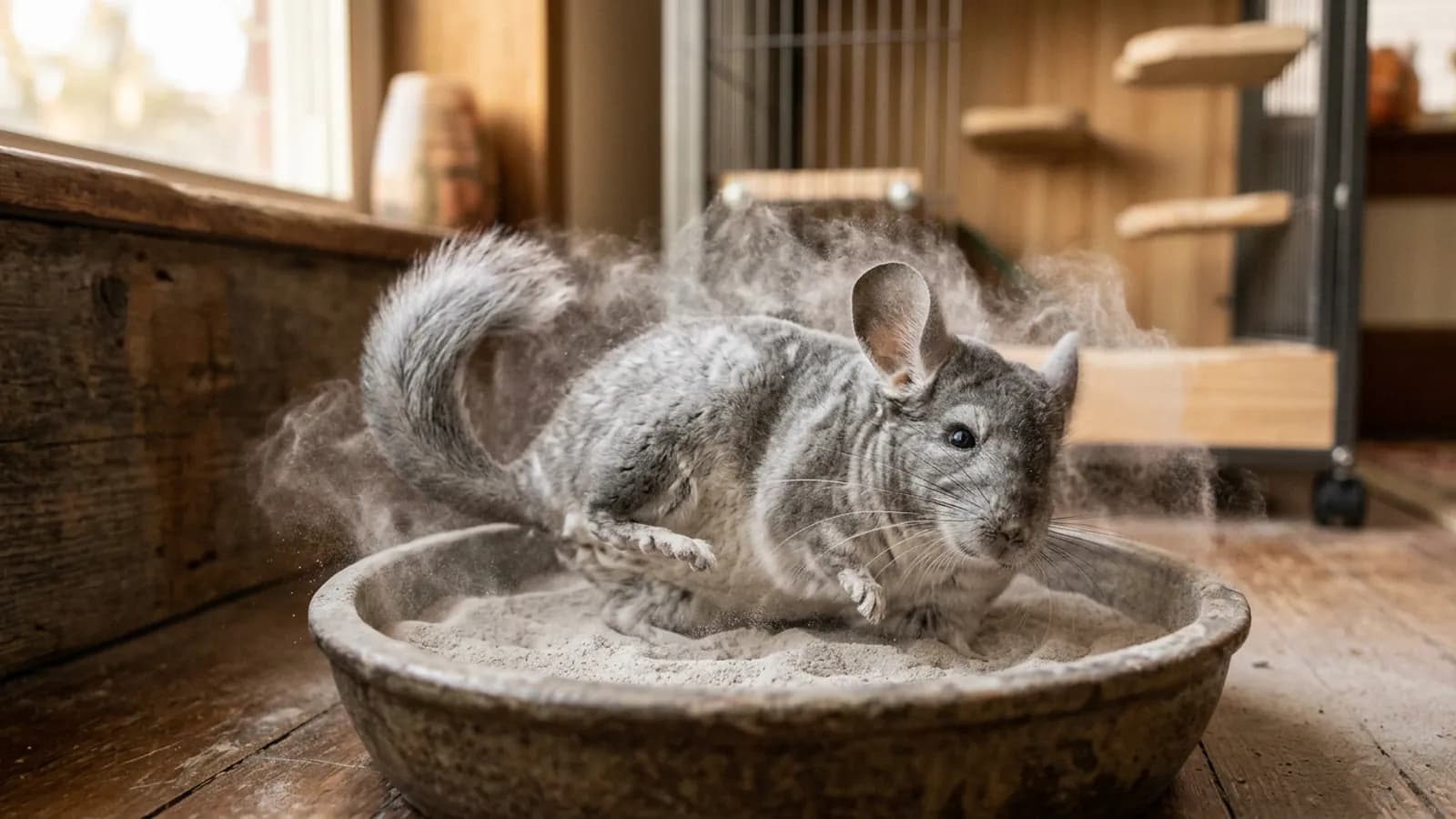
If you have been searching for a chinchilla sand bath, you have already tripped over the one thing that matters most, and it is the word sand. Chinchillas do roll around in something that looks like pale sand, they do it with their whole body, and watching a chinchilla taking a sand bath is the single most satisfying thing you will ever see a small animal do. But the material in the bath is not sand. It is dust, a fine volcanic pumice powder, and the gap between the two is the gap between a coat that stays healthy and one that gets scraped up slowly over months. So this whole piece is really about getting one thing right: giving your chinchilla the roll it needs, in the material that will not hurt it, no matter what the bag on the shelf calls it.
Why the word sand causes so much trouble
I have kept chinchillas for about ten years, and I still see "sand bath" more often than "dust bath" in searches and on product labels. I understand why. When you watch Pebble flip onto her side and churn through the powder, it looks exactly like a bird taking a dust bath in dry sand at the edge of a path. The motion is the same. The powder even pours like sand when you tip the bag.
The problem is that the resemblance stops at the surface. Sand, the actual mineral stuff you would put in a sandbox or a reptile tank, is coarse and sharp under a microscope. It is made of hard silica grains with cut edges. What chinchillas need, and what has evolved alongside their fur for a very long time, is dust that is far finer and softer than that. So when people talk about a chinchilla in a sand bath, the accurate picture is a chinchilla in a dust bath, and the whole reason I keep hammering the point is that buying the wrong thing because the label said sand is one of the easiest mistakes to make and one of the slowest to notice.
If you want the fuller story on the powder itself, I wrote it up in what bathing dust for chinchillas really is, and the technique end lives in the chinchilla dust bath done right. This article is the one I point people to when they typed sand and need to unlearn it before they buy.
What the dust really is, and what real sand does to a coat
Chinchilla bathing dust is finely ground volcanic pumice, or a close mineral equivalent milled to roughly the same softness. It is light, it is powder-fine, and it slips down between the hairs all the way to the skin. That is the entire job. A chinchilla coat is astonishingly dense, with many separate hairs growing from a single follicle, which is why the fur traps warmth and moisture so well and why it cannot dry out on its own the way a cat or a dog coat does. The dust works by absorbing the oils and any dampness held against the skin, then falling away and carrying that grime with it. No water, ever. A chinchilla never bathes in water, and a soaked coat is a genuine problem rather than a clean one, which I get into in chinchilla wet.
Real sand cannot do this. The grains are too big to reach the skin, so they sit in the outer coat, and because they are hard and sharp they abrade the hair shafts as the chinchilla rolls. You do not see it happen in one bath. You see it over weeks as the coat starts to look rougher, and you can end up with broken hairs and skin irritation. Sharp grit near the eyes is its own hazard. So the rule is simple and non-negotiable: fine milled bathing dust yes, play sand or reptile sand or builder's sand never. If you pour some into your palm and it feels gritty rather than powdery, it is the wrong product, whatever the front of the bag promised. Good bathing dust feels like flour or talc, not like the beach.
How to give the bath the right way
The technique matters as much as the material. Here is how I run it, and none of these numbers are exotic. They are the settled keeper consensus.
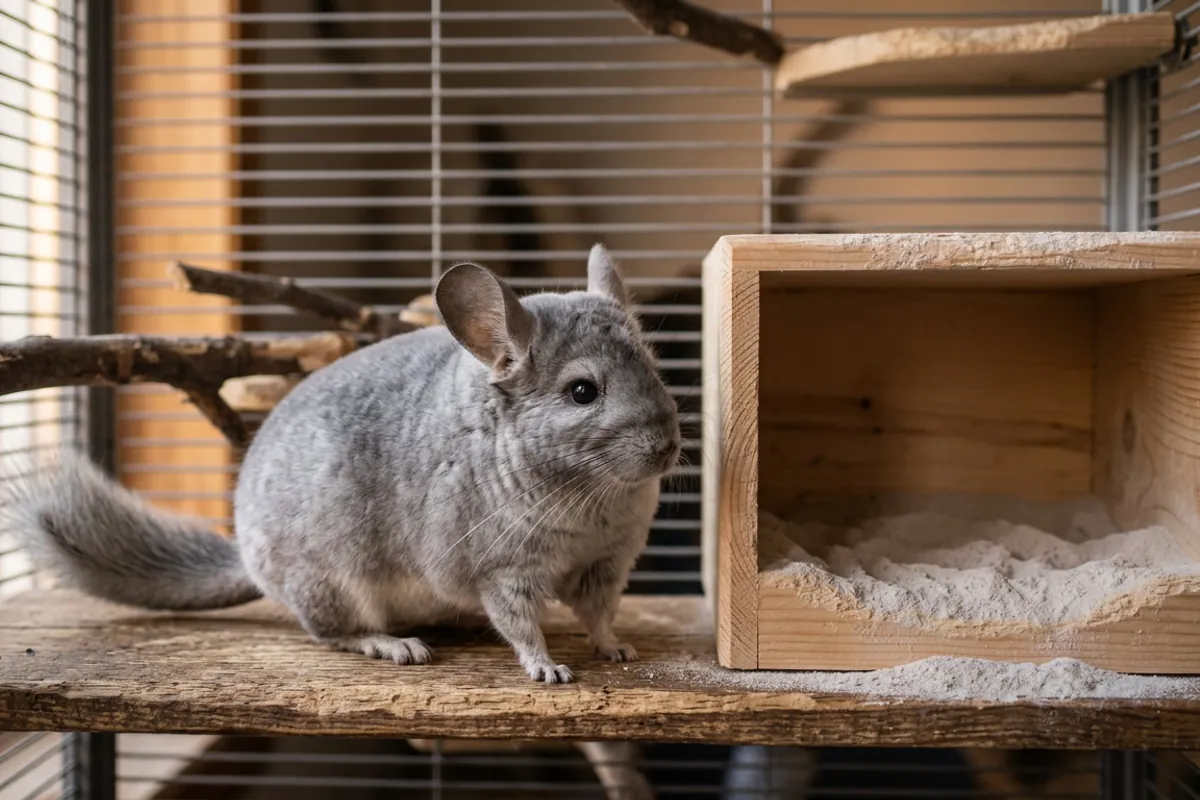
Offer the bath two to four times a week. In a dry home the lower end is fine; if your air is humid, or the coat is looking a little greasy at the part, lean toward the higher end. What you are aiming for is a coat that stays fluffy and separates cleanly, not one bathed on a rigid clock.
Give a depth of about one to two inches of dust in the container. That is plenty for a chinchilla to flip and dig in. More than that just wastes dust and makes a bigger cloud.
Leave the bath in for around ten to fifteen minutes, then take it out. This is the step people skip, and it is the important one. A dust bath left in the cage all day gets used as a toilet, gets damp and gross, and tempts the chinchilla to overbathe, which dries the skin out and can leave it flaky and itchy. Bath in, roll, bath out. I keep a lidded container so the same dust can be reused for several sessions before I refresh it, sieving out droppings between uses.
Watch a session at least sometimes rather than always walking away. A healthy chinchilla dives in and rolls with obvious enthusiasm. A chinchilla that ignores the bath, or paws at its eyes afterward, is telling you something, and I come back to that at the end.
If you need somewhere to start on the dust itself, a plain milled chinchilla bathing dust with no added scent or "conditioner" is what you want. Lixit Blue Beauty chinchilla dust, 3 lb As an Amazon Associate I earn from qualifying purchases. Fragrance and additives are marketing, not care, and the last thing you want next to those big sensitive eyes is perfume.
The bath house, the bowl, and why some setups fail
You can bathe a chinchilla in almost any heavy, open, chew-safe container, and you can also buy a purpose-made bath house. Both work. What matters is a few practical things.
It has to be heavy or anchored enough that an enthusiastic roll does not tip it over. A ceramic bowl, a heavy glass dish, or a solid house all do the job. Lightweight plastic tubs skate around and crack, and I avoid plastic in a chinchilla's world anyway because they chew everything.
It should be roomy enough for a full sideways flip. If the chinchilla can barely turn around, it cannot bathe properly, and you will see it try and give up. An enclosed house with one opening has the nice side benefit of keeping most of the dust cloud inside rather than coating the whole cage and the room. That said, expect some dust everywhere regardless. It is fine powder by design, and it travels. I bathe mine in a spot I do not mind wiping down.
Whatever you use, keep it out of the cage between sessions along with the dust. The container is bath equipment, not furniture. For how the bath fits into the rest of the habitat, the chinchilla cage setup guide covers where everything belongs.
What the bag actually says: Kaytee and the sand labels
Because "sand" is the word shoppers use, a lot of products lean into it on the label even when the contents are correct. Kaytee chinchilla bath sand is the one people ask me about most, and here is the honest read: the well-known chinchilla bathing products from the mainstream brands are, in practice, fine dust rather than coarse sand, whatever the front of the bag says. The name is chasing the search term, not describing grit.
So do not panic if the product you are eyeing has sand in its name. Do the palm test instead. Tip a little into your hand. If it is powder-fine and slips through your fingers like talc, it is the right stuff and the label is just using the popular word. If it is visibly grainy and feels sharp, put it back, no matter how reputable the brand. Trust your fingers over the marketing.
Two other things to check while you are reading the bag. Skip anything scented, colored, or sold as a conditioning additive, for the eye and airway reasons already covered. And be wary of anything explicitly sold as reptile or terrarium sand that has wandered into the small-animal aisle. That really is sand, and it is the coarse, sharp kind you do not want anywhere near a chinchilla coat.
Chinchilla bath sand for hamsters, and why the crossover mostly goes the wrong way
This one comes up constantly, so it is worth its own section. People who keep both animals, or who have a bag of chinchilla dust already, ask whether chinchilla bath sand for hamsters is fine, or whether a chinchilla sand bath for hamsters is the same thing with a different pet in it. The short version: it is not a clean swap, and the crossover usually goes the wrong direction.
Hamsters do enjoy and benefit from a sand bath, but what a hamster actually wants is sand, the real granular kind, typically washed and sanitized children's play sand or a sand marketed for hamsters. Hamsters dig and dust-roll in it, and the slightly larger grains suit them. Chinchilla bathing dust is much finer than that, and the concern many small-animal keepers raise is that such fine powder can be more irritating to a hamster's airways, since it hangs in the air and is easy to breathe in. So using chinchilla dust as hamster sand is the questionable move, not the other way around.
I want to be honest about the limits of my knowledge here. I keep chinchillas, not hamsters, and the guidance around hamster bathing substrates is more a matter of small-animal community consensus than something backed by the kind of hard husbandry numbers I can stand behind for chinchillas. What I can tell you plainly is this: do not put coarse hamster or play sand in a chinchilla's bath, because it will scratch the coat, and if you keep hamsters, look up substrate advice written specifically for them rather than assuming chinchilla dust is interchangeable. When two species need different things, matching them to save one bag is a false economy. It is the same lesson I keep returning to in chinchillas as pets, the honest version: the care follows the animal, not your convenience.
When the bath is telling you something is wrong
A dust bath is not just grooming. It is one of the clearest daily readouts you get on a chinchilla's health, and I have learned to read it.
A chinchilla that suddenly stops bathing, or bathes far less, is worth watching closely. It can mean nothing, or it can be an early sign that the animal feels off. Pair it with any other change, less hay eaten, quieter behavior, and it moves up my worry list.
Rubbing at the eyes, squinting, or weepy or crusty eyes after bathing points at dust irritation, and if it keeps happening even with clean fine dust and shorter sessions, that is a vet conversation, not a home experiment. Eyes are not something to guess at.
Overbathing is the flip side. A chinchilla with the bath left in all day, rolling constantly, can end up with dry, flaky, irritated skin. If the skin looks dry or the coat looks dull despite plenty of bathing, cut the frequency, not raise it. The dust removes oil, and there is such a thing as too clean.
And then there is heat, which is where I stop being warm and get blunt, because this is the scare that made me the keeper I am. Pebble's first summer brought a heatwave and a night at the emergency vet, and it rewired how I think about temperature. A chinchilla is comfortable at about 60 to 70°F, which is 15 to 21°C. Above 75°F, or 24°C, you are into risky territory, and 80°F, or 27°C, and up is an emergency, faster still in humid air. Do not offer a dust bath when your chinchilla is hot or the room is warm. Rolling is exertion, it generates heat, and a struggling chinchilla does not need more of it. Cool the environment first. A cage thermometer and hygrometer so you actually know the numbers is worth more than any bathing accessory. digital thermometer and humidity gauge with remote probes As an Amazon Associate I earn from qualifying purchases. If you are not sure what overheating looks like, read the heat stroke warning signs before you need them, not after.
None of this should scare you off the bath. A dust bath, done with fine milled dust, offered a few times a week and taken back out, is one of the simplest and most reliable pleasures you can give a chinchilla, and one of the honest joys of keeping them. Just get the material right, ignore the word sand on the bag, and let your fingers and your chinchilla tell you the rest.