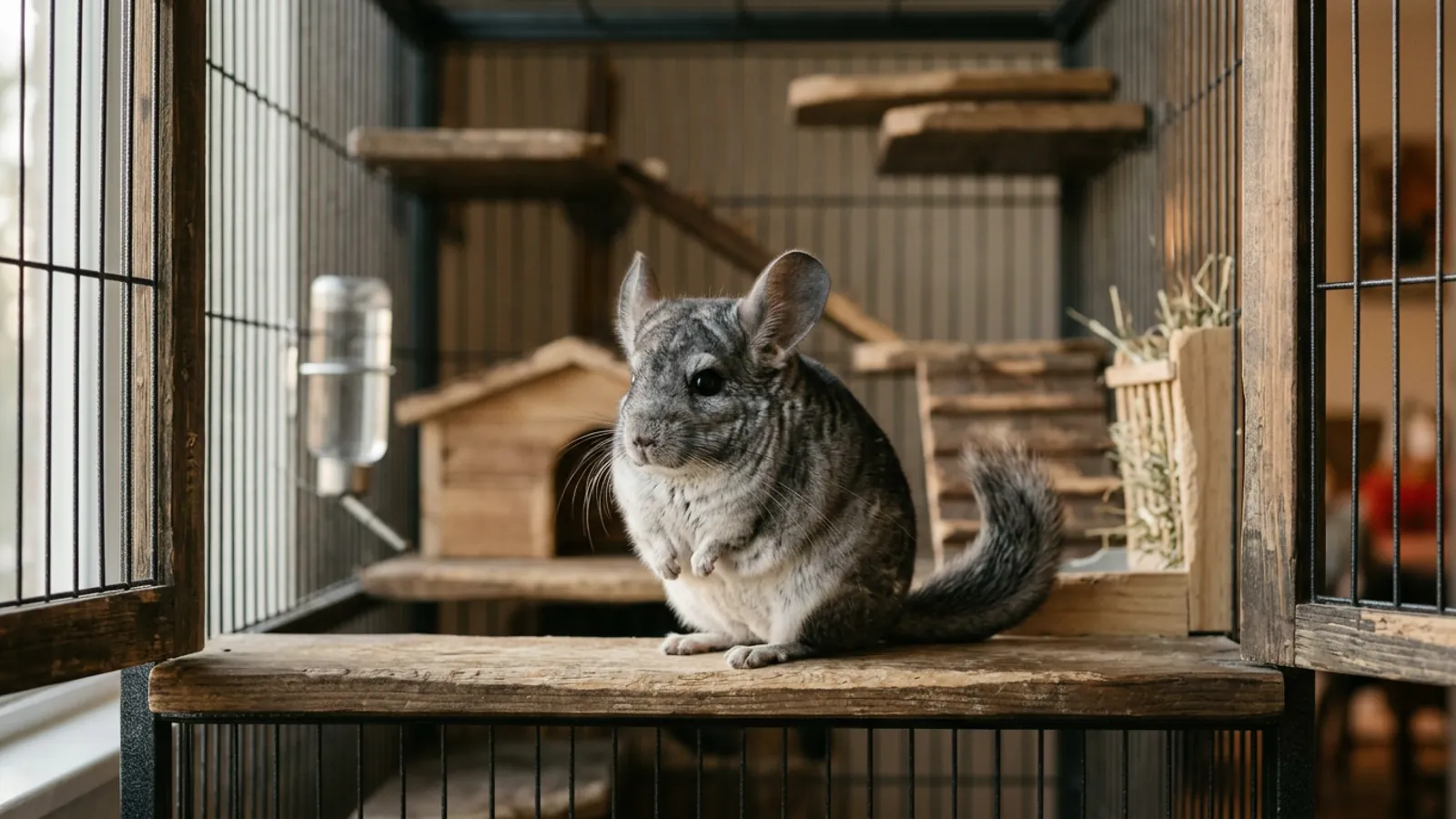
If you typed "chinchilla mini" into a search bar, you were probably after one of two things: a pocket sized version of an animal that is already small, or an explanation for why a rabbit keeps turning up under those same words. I want to settle both, because in about ten years of keeping chinchillas I have watched people buy the wrong animal, or the wrong idea of an animal, off the back of that one phrase. Here is the summary, and I will spend the rest of this piece backing it up. There is no miniature breed of the chinchilla I keep. The animal comes in one size, and that size is already small. The word "mini" gets attached to it for two unrelated reasons, and only one of them is even a chinchilla.
What people mean by a chinchilla mini
I have seen the phrase used three ways, and pulling them apart is the whole job here.
The first is someone hoping a breeder somewhere sells a dwarf or teacup chinchilla, the way you can find a miniature line of a dog or a rabbit. The second is someone who has met a real chinchilla, been startled by how small it turns out to be under all that coat, and is simply describing what they held. The third, and this one snags a lot of people, is the Mini Rex rabbit, which is bred in a coat color that the rabbit world literally calls chinchilla. Search "chinchilla mini rex" and you are looking at a rabbit, not the rodent I keep on my shelf.
Only the middle meaning is true to the animal. A chinchilla is small. The other two are a wish and a mix-up, and both are worth taking apart before you hand anyone money.
There is no dwarf or teacup chinchilla
Let me kill the wish first, because it costs people the most. There is no recognized miniature, dwarf, or teacup breed of the pet chinchilla. Nobody has bred the species down into a smaller line the way dog and rabbit fanciers have. When you see a listing advertising a "mini chinchilla" or a "teacup" anything, one of a few things is going on, and none of them is good news.
Sometimes it is just a young kit sold as if its baby size were permanent. It is not; it will grow into a standard adult. Sometimes it is a runt, an underweight animal from a poorly managed litter, and small size there is a sign of a rough start, not a feature you want to pay extra for. And sometimes it is pure marketing, a word bolted on to make a normal animal sound rare and to justify a higher price. A chinchilla's price already varies more than it should; a "mini" label is exactly the kind of story that inflates it without changing the animal.
If you do end up with an undersized animal, do not panic, but do get it in front of an exotics vet to rule out the reasons a chinchilla stays small: poor early nutrition, a heavy parasite load, or dental trouble that makes eating painful. A small adult is more often a health flag than a breed trait.
What does vary is color and sex. The many named types you have read about, the rare colors and the velvets and the mosaics, are coat mutations, not size mutations. And within any litter, females tend to run a little larger than males. That is the extent of the natural variation. There is no gene anyone selects for that turns out a pocket sized chinchilla, and a seller who tells you otherwise is either mistaken or counting on you being.
How small a chinchilla is
Here is the part that surprises people, and it is the plain reason the word "mini" ever attaches at all: the animal really is little. A healthy adult chinchilla weighs roughly 400 to 600 grams, which is somewhere around a pound. The body runs about 10 inches long, with a bushy tail adding several inches on top. Newborn kits are smaller still, arriving at roughly 30 to 60 grams, fully furred with their eyes open and ready to move within hours. That newborn weight is the smallest a healthy chinchilla ever legitimately is, and it is a stage, not a size you can buy and keep.
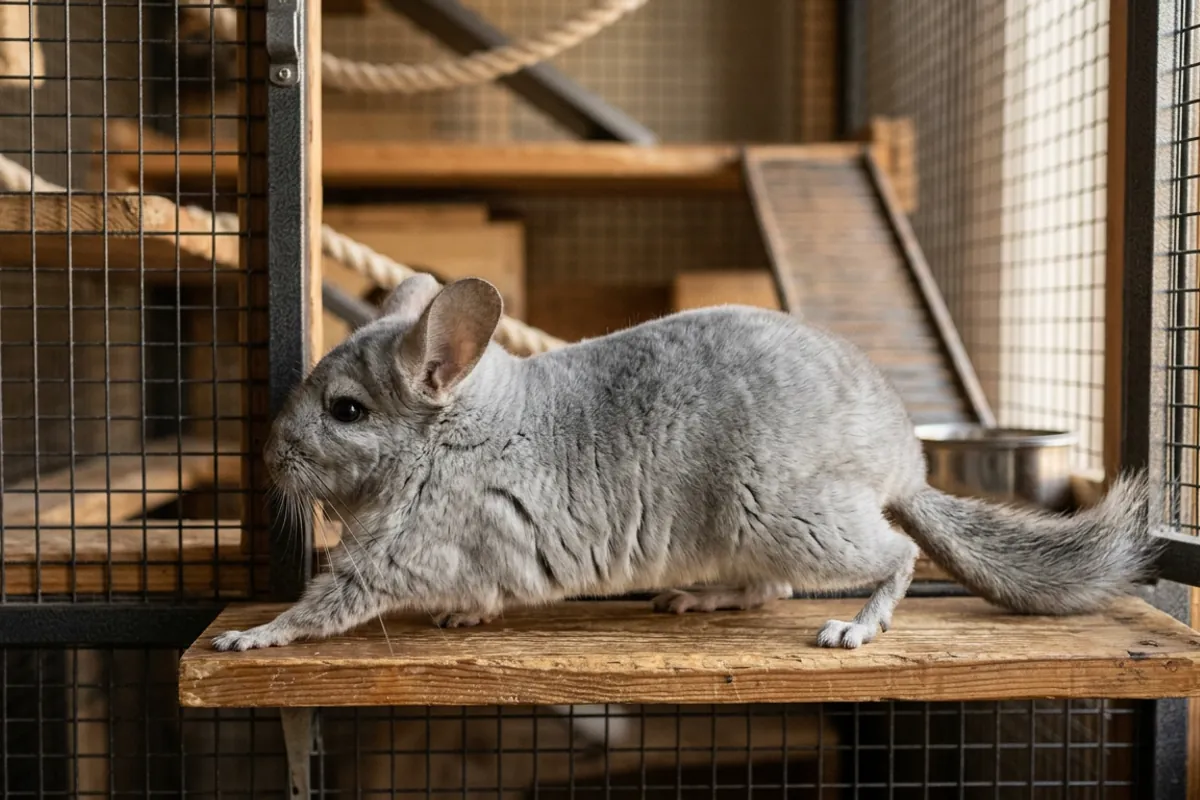
The reason a chinchilla feels bigger in a photo than it does in your hands is the fur. Chinchillas carry the densest fur of any land mammal, with more than 50 hairs growing from a single follicle where you or I grow one. All that coat is what a predator grabs, and it is what makes the body look substantial. Push that coat aside in a dust bath and the animal underneath is startlingly slight, mostly leg and lung and a fast little heartbeat. I wrote a whole piece on how small a chinchilla really is, fur and all, because that gap between how they look and what they weigh trips up nearly everyone the first time they lift one.
That small size has a practical edge people forget. A chinchilla can slip through a gap that looks far too narrow, because the body compresses in a way the fluffy outline hides, so cage bar spacing and playpen panels matter more than they would for a chunkier pet. And a light, quick animal is easy to hurt if you grip too hard or it leaps from a height; they are fast, they are fragile, and they do not enjoy being clutched. Small here means delicate, not convenient. None of it makes them "mini" in the marketing sense. It just means the standard chinchilla is a small animal by nature, and there is nowhere smaller to go.
The two wild species, and why neither is a mini either
If you go looking for a smaller chinchilla in the wild rather than the pet trade, you still will not find one. There are two species, and the biology here is worth knowing because it settles the question for good.
The pet on your shelf is almost certainly Chinchilla lanigera, the long-tailed chinchilla. The other species, the short-tailed chinchilla, sometimes still called Chinchilla brevicaudata, is the stockier and heavier of the two, not the smaller. So even if you counted wild species as separate "types," the second one goes the wrong direction for anyone hunting a miniature. Both evolved high in the Andes of South America, in cold, dry, rocky country, and that origin is the source of nearly every care rule I follow. Both were also hit hard by the historic fur trade, and the short-tailed in particular is endangered in the wild, which is one more reason the pet trade rests almost entirely on captive-bred lanigera. If you want the field version of the animal, I go into it in what a chinchilla in the wild is really like and in the broader chinchilla facts that change how you keep one.
The takeaway is simple. Whether you look at pet lines or wild species, the chinchilla tops out at small and does not shrink further. There is no mini tier below the one you already see.
The chinchilla mini rex is a rabbit, not the rodent
Now the mix-up, and this is where "chinchilla mini rex" comes from. The Mini Rex is a small rabbit breed, known for a plush, velvety coat, and it is bred in a long list of recognized colors. One of those colors is called chinchilla. It is named that because the banded, salt and pepper agouti pattern of the rabbit's fur mimics the look of the rodent I keep, all slate undercolor and dark tipped guard hairs. The name is a compliment paid to my animal's coat. It is not a claim that the two are related.
So a "chinchilla mini rex" is a Mini Rex rabbit wearing chinchilla coloring. It is a rabbit. It eats like a rabbit, which means fresh greens and vegetables that would give my chinchillas trouble. It does not take a dust bath, and unlike a chinchilla it can be bathed in water if it truly needs it. Its teeth, ears, gut, and lifespan follow rabbit rules, not chinchilla ones. If that is the animal you want, wonderful, but do not read chinchilla care into it. This same borrowed name shows up all over, and the through line is always the same: the word "chinchilla" on a rabbit describes a color, and nothing about the care.
If you came here for a mini chinchilla and it turns out you meant the rabbit, that is fine. It is just a different animal with a different manual, and the worst outcome is bringing one home expecting it to behave like the other.
Care does not shrink just because the animal is small
Here is the trap I most want you to avoid. People reach for a small pet expecting a small commitment, and the chinchilla punishes that assumption harder than almost any animal I know. Being little changes almost nothing about what it needs. In a few ways it makes the stakes higher.
Start with heat, because it is the one that kills. Chinchillas evolved for cold mountain air and cannot shed heat the way a thinner coated animal can. The comfortable range is 60 to 70°F (15 to 21°C). Above about 75°F (24°C) you are into risky territory, and 80°F (27°C) is an emergency, sooner if the air is humid. My Pebble came out of an overheated attic and gave me a heatwave near-miss and a night at the emergency vet in her first summer, and that scare is why this is not negotiable. A small body overheats fast. Keep a thermometer and hygrometer on the cage so you are reading the real number, not guessing. digital thermometer and humidity gauge with remote probes As an Amazon Associate I earn from qualifying purchases. On warm days I give a chilled stone the animal can lie against to dump heat. Kaytee Chinchilla Chiller granite stone As an Amazon Associate I earn from qualifying purchases. If you want to see how fast the risk climbs, the heat danger calculator does the math for you.
The cage does not shrink either. A small animal that jumps and climbs like a chinchilla needs height, and it needs metal and wood, never plastic, which they chew and can swallow. I keep mine in a tall metal and wood cage with wooden ledges at different levels. Critter Nation double unit small animal cage As an Amazon Associate I earn from qualifying purchases. Exercise means a wheel with a solid running surface, big enough that the back does not curve; a wire or rung wheel catches feet and breaks legs. 15 inch Chin Spin solid surface chinchilla wheel As an Amazon Associate I earn from qualifying purchases.
Food is where small really does not mean less. The whole diet is unlimited grass hay, timothy or a similar meadow hay, in front of them all day, every day. Oxbow Western Timothy Hay, 40 oz bag As an Amazon Associate I earn from qualifying purchases. Plain pellets are a measured supplement on top, not the meal. This matters more than any other rule after heat, because a chinchilla's teeth grow for life and only constant chewing of coarse hay wears them down. My Juniper is a rescue whose dental disease I manage day to day, and watching what happens when teeth stop wearing evenly is why I am uncompromising about hay and about a real variety of chews. emours apple wood chew sticks, 40 count As an Amazon Associate I earn from qualifying purchases. There is nothing "mini" about the amount of hay a chinchilla goes through.
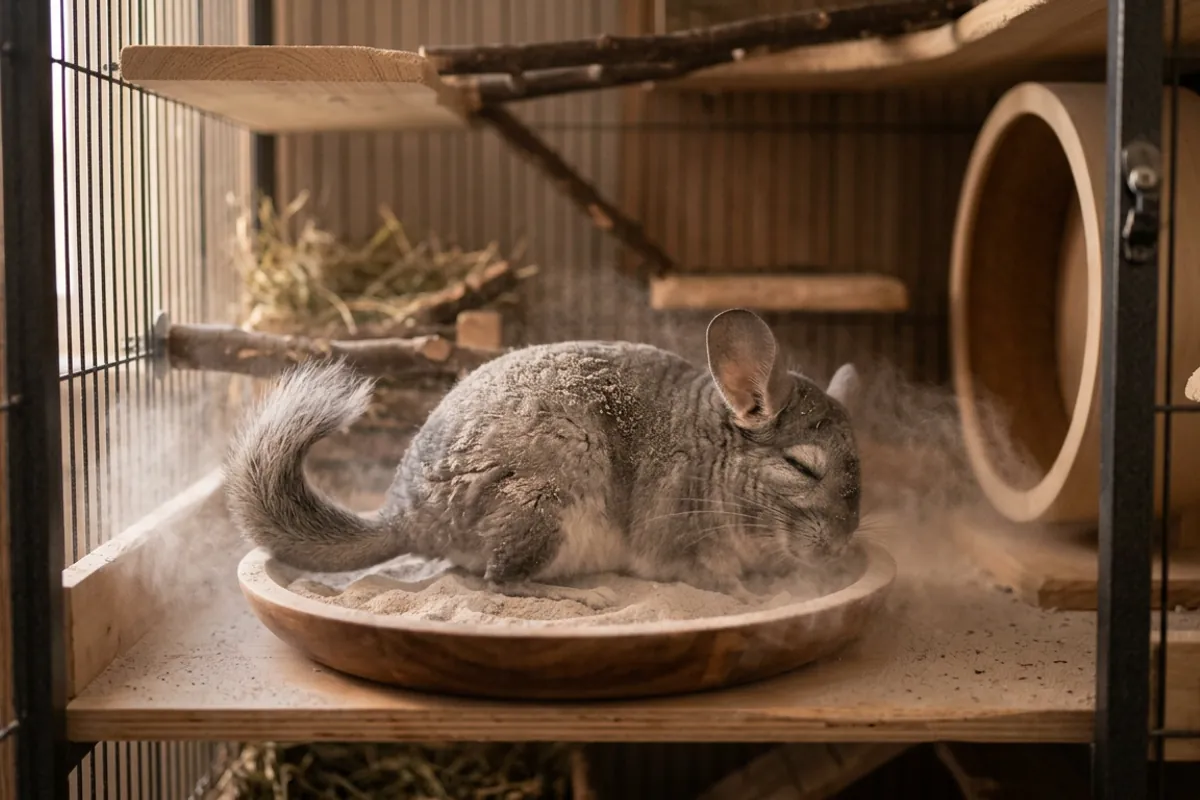
Then there is the bath, which is the detail that most sets this animal apart. Chinchillas never bathe in water. That dense coat holds moisture against the skin and grows fungus and rot. They clean themselves by rolling in fine volcanic dust, a couple of times a week, in a dish deep enough to roll in. Lixit Blue Beauty chinchilla dust, 3 lb As an Amazon Associate I earn from qualifying purchases. I cover the how and how often in the chinchilla dust bath done right. Small animal, absolute rule: dust, never water.
What "mini" never buys you is a smaller commitment
If there is one thing I want you to carry off this page, it is that the size of a chinchilla tells you almost nothing about the size of the job. These animals commonly live 10 to 20 years, often well into their teens with good care. That is a decade or two of stable temperatures, unlimited hay, dust baths, vet funds set aside for an exotics vet who sees chinchillas, and a tall cage you did not cut corners on. A hamster sized body does not come with a hamster sized commitment.
So the answer to "chinchilla mini" is this. If you wanted a dwarf version of the rodent, it does not exist, and anyone selling one is selling you a young kit, a runt, or a story. If you wanted the Mini Rex rabbit, that is a real and lovely animal, but it is a rabbit and it needs the rabbit manual. And if you simply noticed how small a real chinchilla is, you were right, and now you know the small comes wrapped in a full sized, ten to twenty year responsibility. Go in wanting the actual animal, at its actual size, with its actual needs. That is the version that ends well. If you are still deciding, my broader guide to what a chinchilla really is walks through the biology behind every rule I mentioned here.