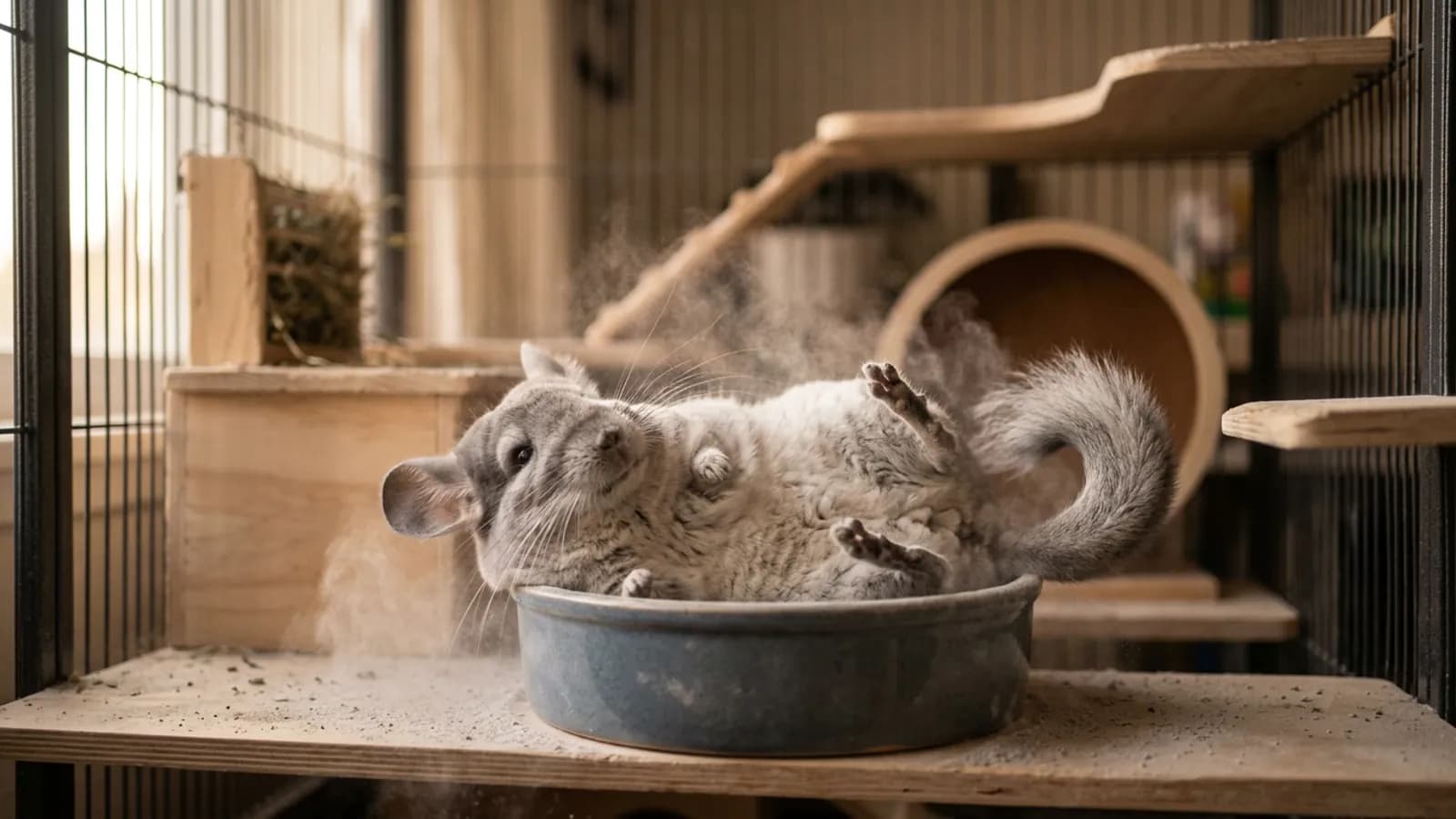
Watching a chinchilla taking a dust bath is one of the small joys of keeping these animals, and it is also one of the most important routines you will ever set up for them. It is not a bath the way we picture one. There is no water anywhere in it. A chinchilla taking a bath is rolling in fine dust, flipping onto its back, kicking up a little cloud, and shaking it out again. That rolling is not only play. It is how the animal keeps the densest fur of any land mammal clean, dry, and free of the oil and moisture that would otherwise mat it into a real problem. Get the dust bath right and most coat and skin trouble never starts. Get it wrong, or skip it, and you invite the opposite.
I have kept chinchillas for about ten years, and the dust bath is one of the few pieces of their care that is genuinely simple once you understand what it is for. This is the whole thing, from what the dust has to be to how deep, how long, and how often, plus the handful of times you should change the routine or stop it altogether.
Why a chinchilla bathes in dust and never in water
To understand the dust bath you have to understand the coat. A chinchilla grows something on the order of fifty hairs out of a single follicle, where you or I grow one. The result is a coat so dense, roughly twenty thousand hairs per square centimeter by the usual estimate, that skin parasites cannot get a foothold and water cannot easily get out. That density is the whole reason these animals feel like a cloud and the whole reason they cannot get wet.
If water soaks down to the skin, that fur does not dry the way a dog or cat coat dries. It holds the moisture against the skin, and warm damp fur is exactly what fungus wants. A soaked chinchilla can develop skin infection and can chill dangerously, because it cannot shed the water on its own. This is why I get twitchy any time someone pictures a "bath" and reaches for a sink. If you want the longer version of what a soaked coat and a drooling chin actually mean, I wrote about that separately in chinchilla wet. The short version: a chinchilla taking a bath should never once touch water.
Dust does the job water would do for other animals. The fine particles work down through the coat, absorb the small amount of skin oil and any trapped moisture, and then the chinchilla flips and shakes it all back out, carrying the oil and dirt with it. It is dry cleaning in the most literal sense. A chinchilla taking a powder bath is running that whole process in a few busy minutes.
What the dust actually has to be
The word "dust" matters, and so does the word people reach for by mistake, which is sand. What a chinchilla needs is a fine, soft, powder-textured dust based on volcanic pumice. It should feel like flour or talc between your fingers, not gritty. Sand, the coarse stuff from a hardware store or a reptile aisle, is the wrong thing. Its edges are sharp under a microscope, and instead of polishing the coat it abrades the hair shafts and can irritate the eyes. If a bag says sand but pours like powder, read the actual material; the honest ones are pumice or a similar fine volcanic ash. I go into the material question in more depth in the chinchilla sand bath is really a dust bath, because the naming causes real confusion.
For most keepers the practical answer is a commercial chinchilla dust made for exactly this. Blue Cloud is the one most people land on, and it is a genuine volcanic pumice dust rather than a repackaged sand; I walk through it in blue cloud chinchilla dust. Any comparable fine pumice dust made for chinchillas works.
Lixit Blue Beauty chinchilla dust, 3 lb As an Amazon Associate I earn from qualifying purchases.
A few things I will name plainly. Do not use flour, cornstarch, baby powder, or anything from the kitchen or the human bathroom; they clump against the skin and some carry additives you do not want a chinchilla inhaling. Do not reach for cat litter dust or "chinchilla sand" sold for reptiles. And do not chase scented dusts, which add fragrance chemicals to something the animal breathes at close range for no benefit. Plain fine pumice dust is the whole answer. If you want the full breakdown of what qualifies, it is in what bathing dust for chinchillas really is.
The container the bath goes in
The dust needs to sit in something deep, heavy, and hard to tip. Chinchillas roll with real force, and a light dish becomes a launched dish. I like a heavy ceramic bowl with high sides, or an enclosed bath house with a single opening, which is my preference because it keeps most of the flying dust inside rather than across the whole cage.
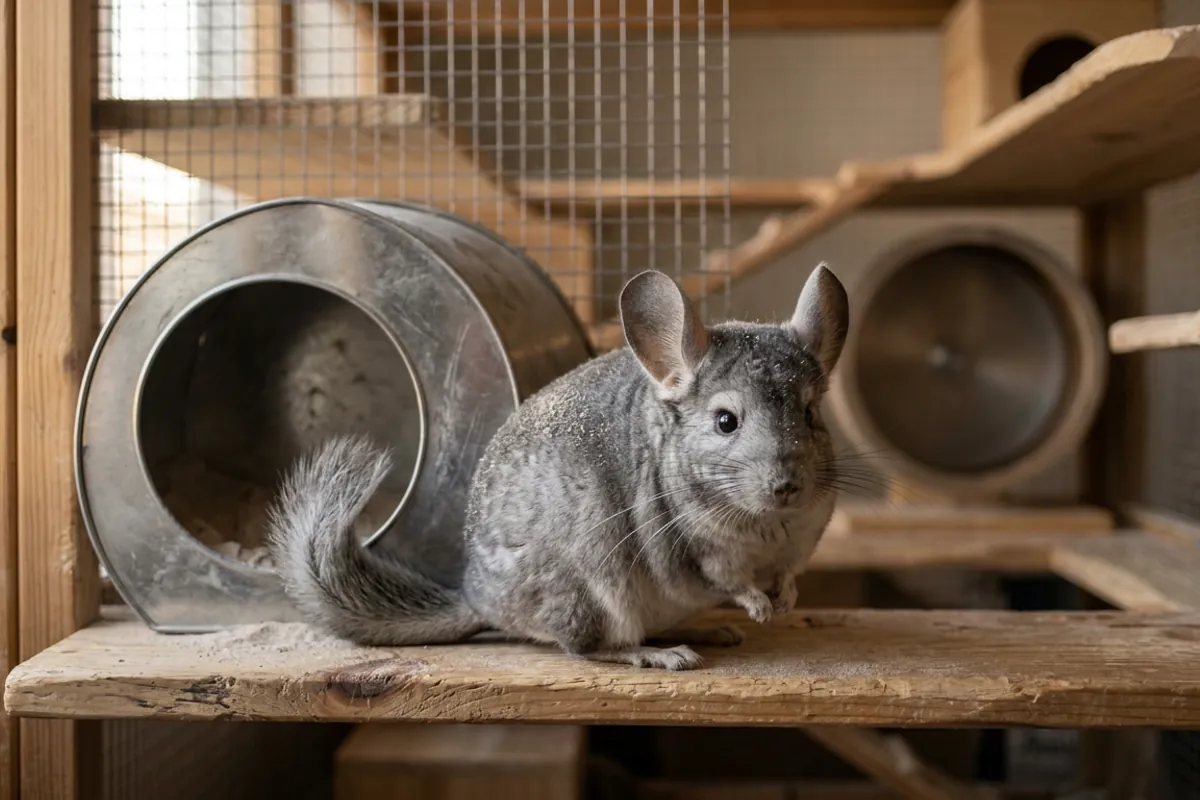
Whatever you use, it has to be big enough for the animal to flip over completely without hitting a wall, and it has to be metal, ceramic, or glass rather than plastic that a bored chinchilla will gnaw. An enclosed house also solves the mess problem better than an open dish, because a chinchilla taking a dust bath throws dust a surprising distance. If you are still building out the rest of the cage around it, cage accessories for chinchillas covers which additions actually earn their place, and the bath house is one of the few that always does.
I do not leave the bath in the cage all day, and I will come to why in a moment. The container comes in for the bath and goes back out again.
How much dust, how long, and how often
Here are the numbers I actually use, and where they come from is simple experience backed by what most keepers and rescues settle on.
Depth: about one to two inches of dust in the bottom of the container. Enough that the animal can work it into the coat, not so much that half the bag goes to waste. You are not filling a tub; you are giving a rolling surface with some depth to it.
Time: ten to fifteen minutes is plenty. That is long enough for a thorough set of rolls and short enough that the chinchilla does not start treating the dish as a toilet or a bed, which it will if you leave it in. When the rolling slows down and the animal is mostly sitting in it, the bath is done.
Frequency: two to three times a week for most chinchillas in a normal, dry home. That is the range I would put in bold if I could. More often than that, especially every day, tends to dry the skin out and leave it flaky and itchy. Less often than about once a week and the coat starts to look greasy and clumped, and for a long-coated animal that can slide toward matting. So two or three times a week is the working default, and you adjust from there by watching the coat rather than the calendar.
You can reuse the dust across several baths. Sift out the droppings and any obvious debris after each session, and replace the whole lot when it looks dingy or stops feeling soft, which for me is every couple of weeks depending on how many animals use it. Buying dust in a larger quantity is cheaper per bath and means you never run out mid-week.
What a good bath looks like, and what a problem one does not
A healthy chinchilla taking a dust bath is unmistakable. Fast, flat rolls, flipping fully over, a little cloud each time, ears up, the whole thing over in a few minutes of enthusiasm. That is the picture you want, and it doubles as a wellness check. A chinchilla that suddenly loses interest in a bath it used to love is telling you something, and it is worth paying attention to.
A few signs the routine needs adjusting. Flaky, dandruff-looking skin or a chinchilla scratching more than usual usually means too-frequent bathing or too long in the dust; cut back to twice a week and shorten the sessions. A greasy, clumped, or dull coat means the opposite, not enough bathing, so add a session. Red or weepy eyes after baths point at either a dust that is too coarse or a bath house so enclosed the dust hangs thick; switch to a finer pumice dust or a more open container.
Some behaviors are not bath problems at all. Chinchillas leave little tufts of fur in the dust sometimes, and a released patch of fur under stress or a too-firm grab is a defense mechanism called fur slip rather than anything the dust did. I explain that in chinchilla fur slip so you do not blame the dish for it. And if the bath turns into a bathroom, with the chinchilla urinating in it, that is almost always the sign you left it in too long; pull it after fifteen minutes and the habit usually stops.
Heat and humidity change the rules
This is the part I will not soften, because it is the part that once put one of mine, Pebble, in the emergency vet overnight during her first summer. Chinchillas are built for a cool, dry climate, and heat is the thing most likely to kill one. The comfortable range is 60 to 70°F, which is 15 to 21°C. Above 75°F, or 24°C, you are into risky territory, and 80°F, 27°C, and up is an emergency that comes faster in humid air.
Humidity matters to the dust bath specifically. In damp weather the dust absorbs moisture from the air and works less well, and a warm, humid room is exactly the condition where a coat can hold dampness against the skin. On a hot, sticky day I do not add a bath to the animal's workload; I get the room cool and dry first. A cheap thermometer and humidity gauge on the cage takes the guesswork out of this, and I would not keep a chinchilla without one.
digital thermometer and humidity gauge with remote probes As an Amazon Associate I earn from qualifying purchases.
Cooling comes from the environment, not the bath. A chilled stone the chinchilla can lie against helps on a warm afternoon far more than an extra roll in the dust does.
Kaytee Chinchilla Chiller granite stone As an Amazon Associate I earn from qualifying purchases.
If you want the full heat picture, chinchilla temperature has the numbers and chinchilla heat stroke warning signs covers what a heat emergency actually looks like. The dust bath is a comfort and a coat routine; it is never a way to cool an overheated animal, and no amount of it substitutes for a cool room.
When to change the routine or stop it
A few situations call for judgment rather than the standard schedule.
Around a nursing mother and very young kits, keep bath time short and the dust clean, since kits will try to roll too and can inhale more than is good for them; some keepers offer the bath only briefly and remove it promptly. After a new chinchilla arrives, give it a day or two to settle before offering a bath, so the first roll happens in a calm animal rather than a terrified one.
Stop and rethink if the eyes are red or crusty, if there is any patch of missing fur that is not a clean fur-slip release, or if the skin looks inflamed, scabbed, or has a spreading flaky patch. Fungal skin infection, called ringworm, can look like broken, flaky patches of fur, and dust alone does not treat it. That is a line I send people across every time: an exotics vet, not a schedule change. A chinchilla that stops bathing entirely, or that seems to hurt when it moves in the dish, has told you something is wrong beyond the coat, and that is a vet visit too.
None of this makes the dust bath complicated. Fine pumice dust, a deep and heavy container, an inch or two of depth, ten to fifteen minutes, two or three times a week, adjusted by watching the coat and never run on a hot or humid day. Do that, keep the room in the 60 to 70°F range, and a chinchilla taking a dust bath stays one of the easiest and most reliable parts of keeping these animals well.