The question I get asked more than almost any other is whether you can potty train a chinchilla, and the answer is a split one. You can teach most chinchillas to urinate in one place, and that single change removes nearly all the smell from the room. You cannot teach one to hold its droppings, and anyone who tells you otherwise is either guessing or selling something. I have kept chinchillas for about ten years. Both of mine, Pebble and Juniper, use a corner box for urine, and both of them also leave droppings on every ledge in the cage, every night, for as long as they live. Below is what worked here, what will never work anywhere, and how to tell a training problem apart from a health problem.
The short answer, and what litter training buys you
Can chinchillas be litter trained? Most can be trained for urine, some quickly, some never. I have never seen a reliable published success rate, and I would not trust one if I did, because it would depend entirely on how the owners defined success. What I can tell you is what keepers consistently report and what I have seen in my own cages: a good number of chinchillas already urinate in one favored corner before anyone tries to train them. Chinchilla litter training is mostly a matter of noticing that habit and putting a box where the habit already is.
What you gain is worth the effort. Urine is the entire odor problem with this species. Droppings are dry and almost scentless; urine soaked into bedding, wood, or a plastic pan is what makes a room smell like a pet shop. If the urine lands in one washable box, you spot-clean that box daily and strip the whole cage far less often.
What you do not gain is a house-trained animal. Litter box training does not carry over to floor time, it does not stop droppings, and it does not survive a chinchilla deciding, for reasons of its own, to switch corners. Go in expecting a large reduction in mess, not a clean cage.
Why the droppings will never be trainable
Chinchillas are hindgut fermenters running on a diet that is almost entirely grass hay. Fiber goes in continuously and comes out continuously. A healthy chinchilla is producing droppings while it eats, while it runs, while it sits on your shoulder, and while it sleeps. There is no holding phase to train, because there is no meaningful gap between input and output.
You will see counts quoted in the hundreds per day. I have never sat down and counted, and I would treat any precise figure with suspicion. What matters is the pattern, not the number: healthy droppings are firm, dark, oval, dry, and near odorless, and a steady stream of them is one of the better daily signs that the gut is working. I go into the details of what different droppings mean in chinchilla poop, and I check them every single morning.
Chinchillas also produce softer caecotrophs, which they re-ingest directly, so you rarely see one. That is normal digestion, not a mess to clean up.
This is why the answer to "do chinchillas use a litter box" is a qualified yes. They will use it as a toilet for urine. They will also sit in it, sleep in it, kick the litter out of it, and leave droppings absolutely everywhere else. Anyone building a cleaning routine around the assumption that droppings can be contained is going to be disappointed. Build the routine around a small hand brush and a daily sweep of the ledges instead.
Finding the corner your chinchilla already picked
Do not start by deciding where the box should go. Start by watching where it already goes. Give it three to seven days of paying attention before you buy anything.
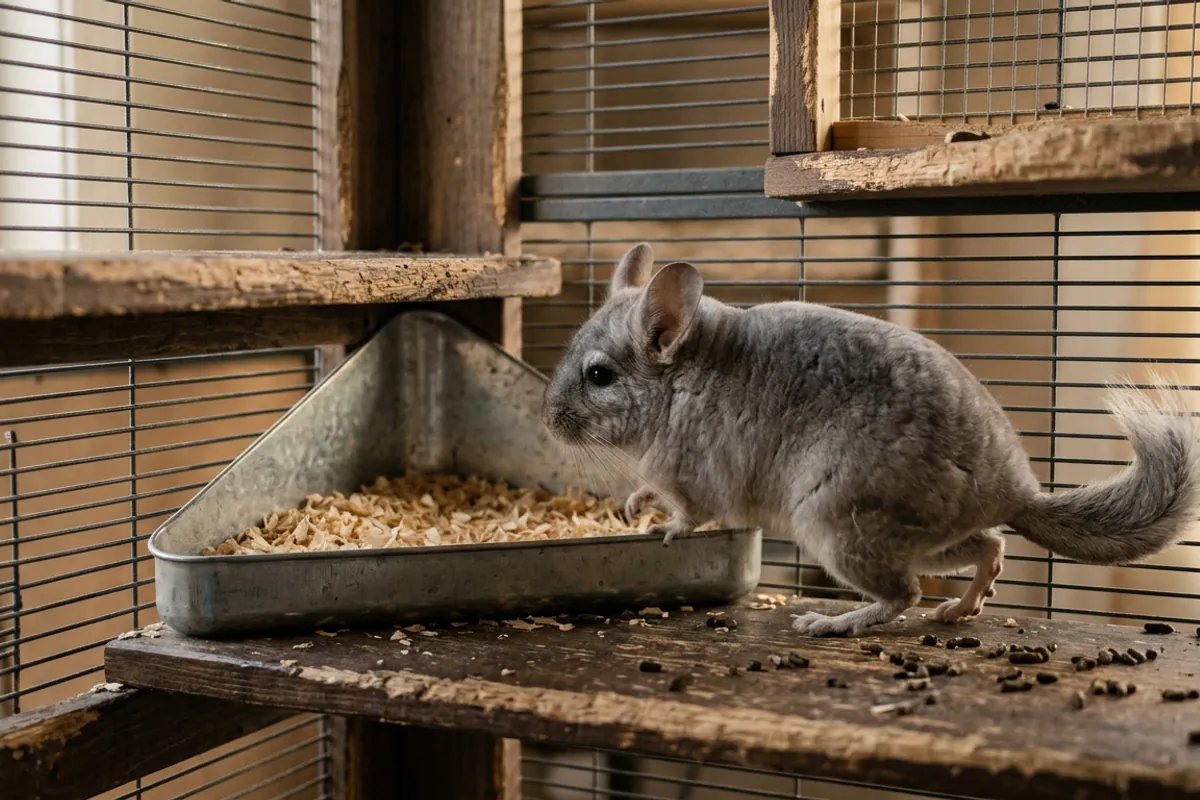
The signs are easy to read once you know them. Look for one patch of bedding that is darker and packed down, a stained spot on the cage pan, or a yellowish mark on a wooden ledge. Put your nose near a few corners; the difference between the toilet corner and the rest of the cage is obvious. In my experience the chosen spot is usually the most sheltered one, often under a shelf, often the corner furthest from the food and the hidey house. Chinchillas are prey animals and they like doing vulnerable things where they feel covered.
If your cage is fully lined with bedding, pull the bedding back for a day or two so the pan shows the stain more clearly. If your chinchilla is currently urinating inside its wooden house, that is a separate problem and the house needs replacing, because wood absorbs urine and never really comes clean.
Some chinchillas use two corners. Some use whichever corner they happen to be near. If yours has no clear preference after a week of watching, chinchilla toilet training is still worth trying, but lower your expectations. A chinchilla with no existing habit is much harder to move than one with a habit you can simply furnish.
Choosing a litter box that survives a chinchilla
The single most important rule: no plastic. Chinchillas chew plastic, they swallow what they chew, and plastic in the gut is a surgical emergency in an animal this size. Most cat and small-pet litter trays sold in shops are plastic, and a plastic corner tray in a chinchilla cage is a chewing target sitting at ground level, in the corner they visit most. It is a bad idea however cheap it is.
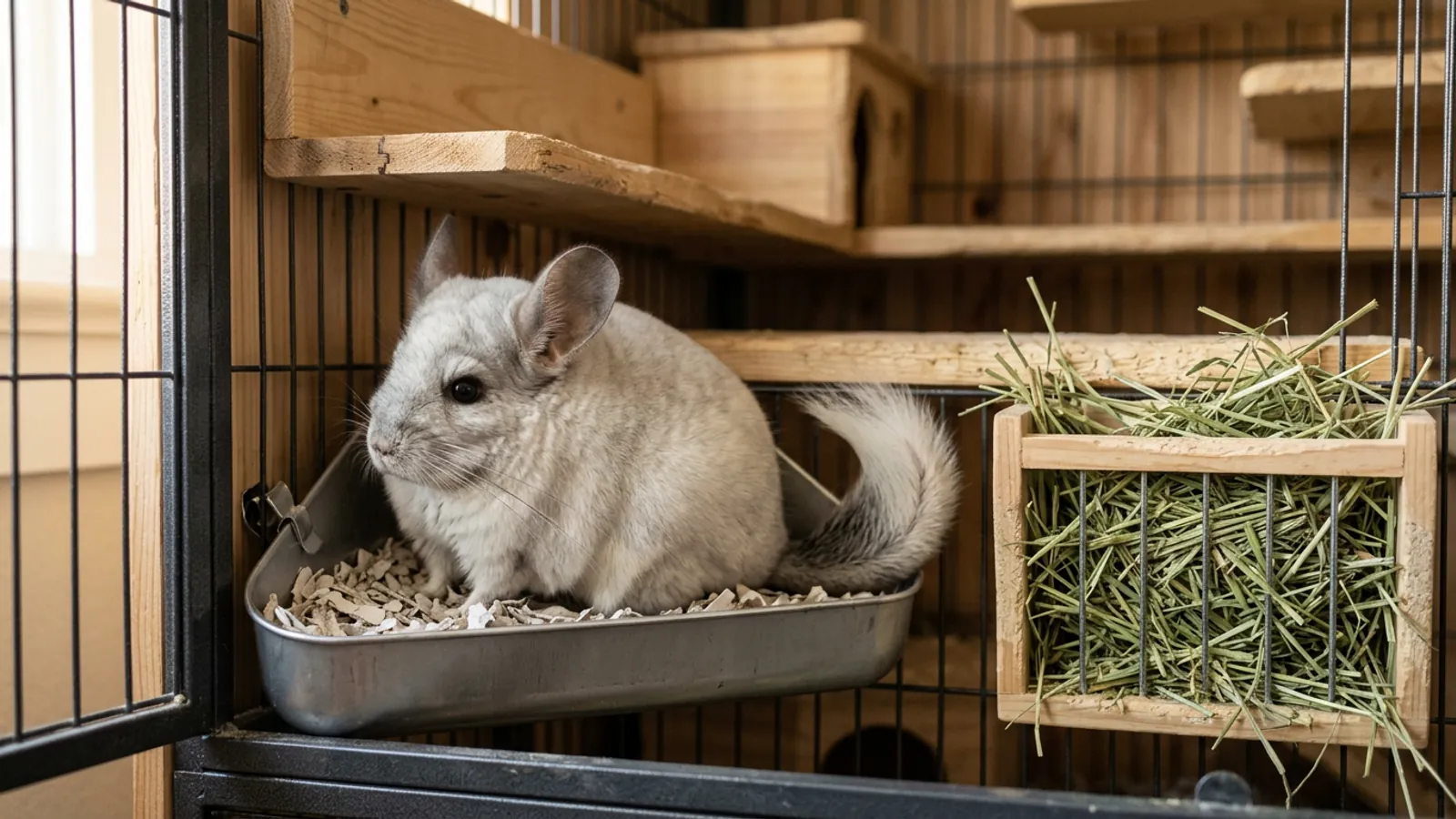
What I use is a metal corner pan, the sort sold for ferrets, with hooks that clip to the cage bars. Metal does not absorb urine, it washes clean, and it cannot be eaten. A heavy ceramic or terracotta dish also works if you cannot find metal, though a determined chinchilla can shove one around. A plain untreated wooden box is acceptable as a stopgap, but wood soaks up urine and holds odor, so treat it as a consumable and replace it when it starts to smell after washing.
Size matters more than people expect. The box needs to be big enough for the chinchilla to turn around in and sit in comfortably, with a low enough lip to hop over without thinking about it. If the box is a squeeze, it gets ignored.
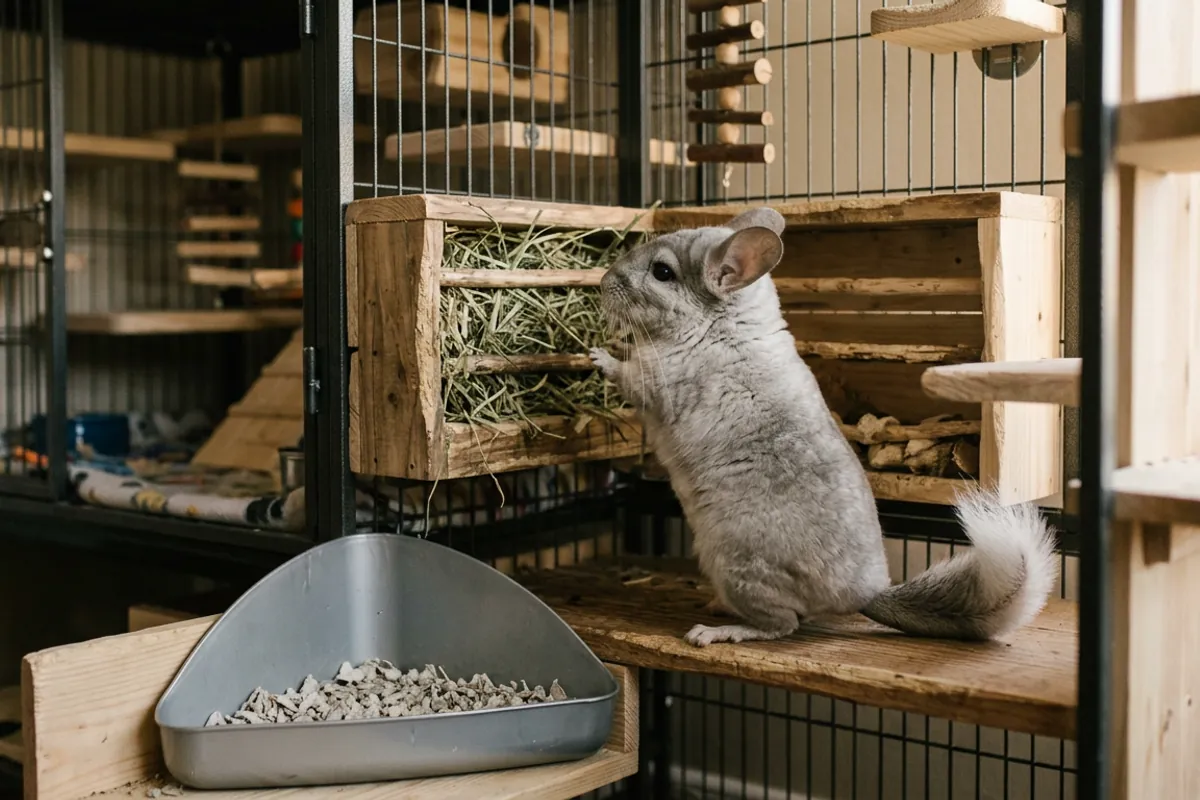
Anchoring matters too. A light box that tips or slides gets treated as a toy rather than a toilet. Hook it to the bars, or wedge it into the corner of a proper tall metal and wood cage where the bars hold it in place. Critter Nation double unit small animal cage As an Amazon Associate I earn from qualifying purchases.
Expect some chewing on the box edge regardless of material. The fix is not scolding, it is giving the teeth somewhere better to go, which means a real spread of safe wood chews in the cage at all times. emours apple wood chew sticks, 40 count As an Amazon Associate I earn from qualifying purchases.
What goes in the box, and what never belongs there
The litter is where people get hurt, because the pet aisle is full of products that are fine for cats and dangerous for a chinchilla.
Safe choices, in the order I would pick them:
- Plain paper-based bedding, unscented and dye free. Very absorbent, very boring, which is exactly what you want.
- Aspen shavings. Widely trusted, no aromatic oils.
- Kiln-dried pine shavings. Widely used and generally accepted, though I will be straight with you: some experienced keepers avoid all pine on principle. If that debate bothers you, use aspen or paper and skip it entirely.
Never put these in a chinchilla litter box:
- Cedar, in any form. The aromatic oils are a respiratory and liver concern and there is no upside.
- Clumping clay cat litter. It is dusty, it is swallowed, and it clumps just as well inside a gut as it does in a tray.
- Anything scented, deodorized, or dyed.
- Corn cob litter. It molds readily, and I will not put a swallowable pellet that swells into a gut that cannot vomit.
- Walnut shell or sand. Sand is not bathing dust and does not behave like it.
- Bathing dust itself. It is not absorbent and it does not belong under a urinating animal.
Keep the layer shallow, roughly a finger's depth, and change it often rather than piling it deep. A deep box invites digging and gets used as a bed.
One related point, because it comes up constantly: the dust bath is not a toilet, and some chinchillas will urinate in it if you leave it in the cage. That is one of the reasons the bath goes in for 10 to 15 minutes and comes straight back out. I go through both meanings of the chinchilla bathroom, dust and waste, in the chinchilla bathroom explained.
The full material list I trust, and the ones I refuse outright, is in chinchilla safe bedding.
How to potty train a chinchilla, step by step
Here is how to potty train a chinchilla, in the order I would do it.
Seed the box with their own scent. Once the box is in the corner they already use, take a scoop of the urine-damp bedding from that corner and put it in the box, along with a few of their droppings. Scent is the whole mechanism. A clean, unfamiliar box in a familiar corner means nothing to them.
Make the rest of the corner unappealing. Clear the bedding away from the floor immediately around the box so the box is the softest, most absorbent option in that corner. Chinchillas seem to prefer urinating on something that soaks up, and if the box is the only such thing nearby, the odds tilt your way.
Do not scrub the scent out too early. For the first couple of weeks, empty the box and rinse it, but do not sterilize it with strong cleaner every day. Leave a little of the old litter in. After the habit sets, wash it properly.
Put the hay above the box, not in it. A lot of chinchillas urinate while they are standing at the hay rack, so positioning a rack over or beside the box works in your favor. Hay stays in the rack; hay lying in the litter gets soiled and must not be eaten. Oxbow Western Timothy Hay, 40 oz bag As an Amazon Associate I earn from qualifying purchases.
Never punish. No shouting, no spray bottles, no pushing the animal's nose into anything. Chinchillas do not connect a telling-off with something they did thirty seconds ago, and all you build is a chinchilla that is afraid of you and of the box. I also do not run this on treats. Chinchilla treats are tiny by necessity and sugar is a genuine health problem in this species, so a treat-based program would do more harm than the training is worth.
Give it a month. In my experience some chinchillas take to a box within days. Some take weeks. Some never do. I give it a month of consistency before deciding which kind I have.
When litter training does not take
Plenty of times the answer to "can you litter train chinchillas" turns out, for your specific animal, to be no. Before you accept that, check the ordinary causes.
If you keep more than one chinchilla, they may each have their own preferred corner. Put a box in every corner that shows staining rather than trying to negotiate a shared one. If you stripped and re-bedded the whole cage recently, you may have erased the scent map, and the habit has to rebuild from nothing. If you moved the box to a corner that suits your cleaning routine, move it back; the animal picks the corner, not you.
A box being used as a bed is not a failure, as long as urine still lands in it. It just means more frequent changes.
One behavior that looks like a training failure but is not: a startled or annoyed chinchilla, and females do this more than males in my experience, can rear up and spray urine deliberately as a defense. That is communication, not a bathroom accident. It means you are handling too much, too fast, or at the wrong time of day. Back off and rebuild trust. There is more on reading these signals in chinchilla behavior.
Floor time is its own category. No amount of chinchilla litter box training carries over to a room. Keep out-of-cage sessions on a surface you can wipe, accept that droppings will be scattered, and put a second box out if you like, understanding that it may be ignored entirely.
When a change in bathroom habits is a vet problem, not a training problem
This is the part I care most about, because litter habits are a health readout and a sudden change in them is often the first thing an owner notices.
Get to an exotics vet, urgently, if you see any of the following. Fewer droppings than usual, smaller and drier droppings, or none at all: gut slowdown in a chinchilla is life threatening and gets seen the same day, not next week. Diarrhea or persistently soft, misshapen droppings. Straining, hunching, or vocalizing while urinating. Blood-tinged or red-stained urine. A chinchilla that abandons a well-established corner for no reason you can explain, which can point to bladder stones or a urinary infection rather than a lapse in chinchilla litter training.
Wet, urine-stained fur on the belly or between the back legs needs attention too. A soaked coat does not dry properly on this species and urine scald follows fast; I go through what a wet chinchilla means in chinchilla wet.
Drooling combined with a drop in droppings usually means teeth. Juniper came to me as a neglected rescue with dental disease, and managing her day to day is why I am so rigid about unlimited hay and a real variety of chews. Teeth that are not being worn down eventually stop the animal eating, and the dropping count falls first. See chinchilla teeth problems for what to look for.
Heat is the other cause of a sudden change, and it is the one that kills fastest. A chinchilla that has stopped eating, stopped moving, and stopped producing droppings on a warm day is not being stubborn about its box. Comfortable is 60 to 70°F (15 to 21°C), above 75°F (24°C) is risky, and 80°F (27°C) or higher is an emergency, faster still in humid air. Pebble came to me out of an overheated attic and had a near miss in her first summer that ended at the emergency vet, and that night is why those numbers are not negotiable. Check the room against chinchilla heat safety before you check the litter box.
I am an experienced keeper, not a vet, and none of the above is a diagnosis. It is a list of the moments when the right move is a phone call to someone qualified rather than another week of training. If you have not found an exotics vet yet, do that now, while nothing is wrong. Get the box in the right corner, expect droppings everywhere forever, and treat every change in the pattern as information worth acting on.