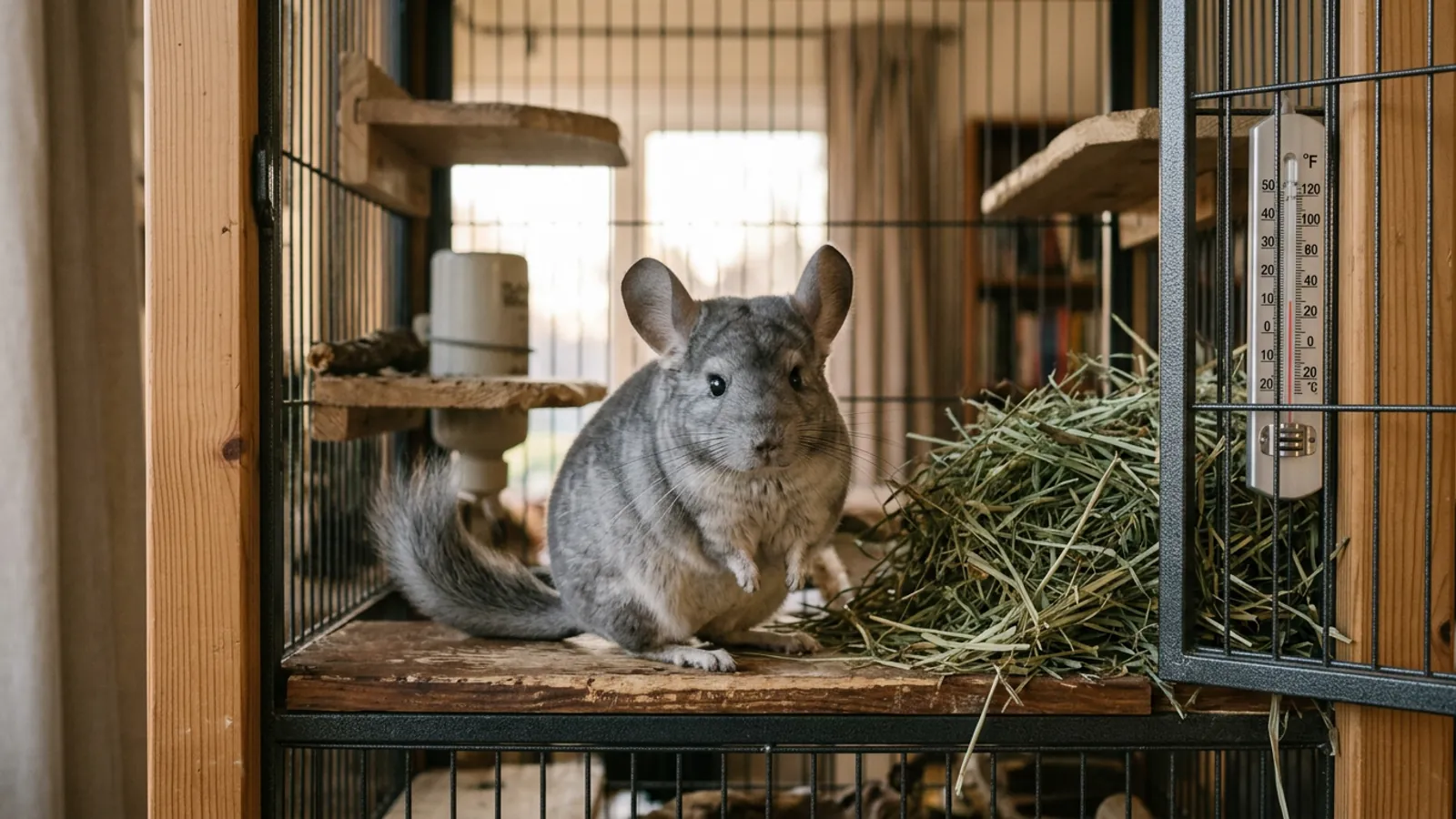
If you have landed here typing "chinchilla how to take care" into a search bar, I want to give you the essentials up front. A chinchilla is not a hard animal to keep well, but it is unforgiving of the specific things it needs, and most of those things are not obvious from a pet store shelf. I have kept chinchillas for about ten years, starting with Pebble, who came to me from a rehome out of an overheated attic, and later Juniper, a neglected rescue whose teeth I manage every single day. Between the two of them they have taught me that good chinchilla care is mostly a short list of non-negotiables done consistently, not a long list of clever tricks. This is that short list, in the order that keeps an animal alive.
Heat is the thing that will kill your chinchilla first
I lead with temperature because I learned it the hard way. Pebble's first summer brought a heatwave, and I nearly lost her to it. One night at the emergency vet rewired how I think about this whole animal, and this is not negotiable: heat is the single most likely thing to kill a pet chinchilla.
Chinchillas evolved in the high, cold Andes. That dense, gorgeous fur that made you want one in the first place is a fur that traps heat, and a chinchilla cannot sweat or pant its way out of trouble the way a dog can. The comfortable range is 60 to 70°F, which is 15 to 21°C. Above 75°F (24°C) you are into risky territory. At 80°F (27°C) and up you have an emergency, and humid air makes it worse and faster, because moisture in the air strips away what little cooling the animal can manage.
So before you buy the cage, before you pick a name, answer one question: can you hold the room your chinchilla lives in below 75°F on the hottest week of your year? If that means air conditioning, then air conditioning is not optional gear, it is life support. I keep a thermometer and humidity gauge on the cage itself, not across the room, because the temperature that matters is the one where the animal sits. A simple combined cage thermometer and hygrometer does the job. digital thermometer and humidity gauge with remote probes As an Amazon Associate I earn from qualifying purchases.
For the hot days, a chinchilla can lie against a chilled slab of stone to dump body heat, and a granite or marble cooling stone kept in the fridge and swapped out gives them somewhere to do that. Kaytee Chinchilla Chiller granite stone As an Amazon Associate I earn from qualifying purchases.
That is a comfort measure, not a rescue. It does not replace a cool room. If you want to know exactly where your setup sits against the danger line, I built a chinchilla heat danger calculator that takes temperature and humidity together, and I wrote out the warning signs in Chinchilla Heat Stroke: Warning Signs Every Owner Should Know. Please read both before your first summer, not during it.
Hay first, and it is not close
If heat is the fastest killer, teeth and gut are the slowest. Both come down to diet, and the diet is simpler than the marketing wants you to believe.
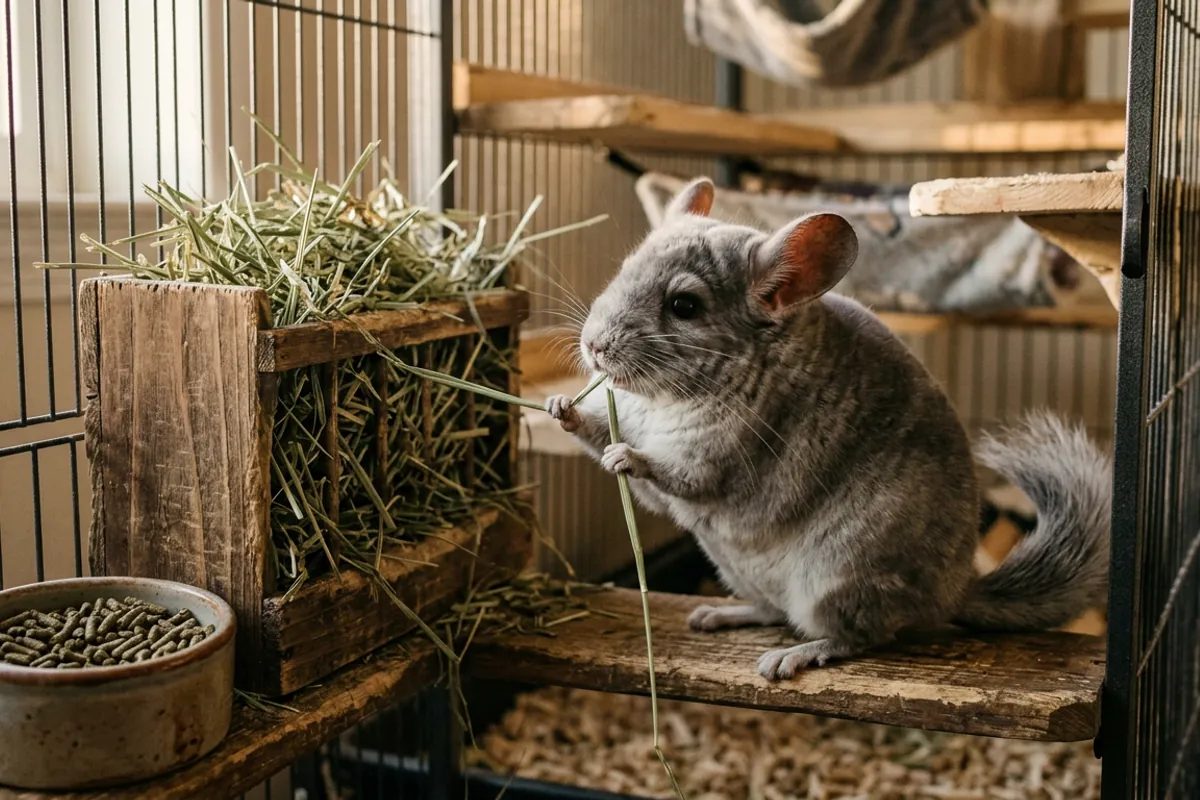
A chinchilla's core food is grass hay, available all the time, in unlimited amounts. Timothy hay is the standard, and it should never run out, day or night. This is not a garnish or a treat. Grass hay is the whole foundation for two reasons at once. It is the long-fiber roughage that keeps the gut moving, and chinchilla guts are prone to dangerous slowdowns, and it is the tough, abrasive chewing that grinds their teeth down. Chinchilla teeth grow for the animal's entire life, and hay is the main thing wearing them back.
I buy hay in a way that means I never face an empty bin at an awkward hour. A steady supply in a hay box on the cage keeps it clean and in front of them. Oxbow Western Timothy Hay, 40 oz bag As an Amazon Associate I earn from qualifying purchases.
For anyone with more than one chinchilla or who simply hates reordering, buying timothy hay in bulk works out cheaper and means you are never tempted to ration it. Oxbow Western Timothy Hay, 9 lb box As an Amazon Associate I earn from qualifying purchases.
After hay comes a measured amount of plain pellets, and the word measured matters. A chinchilla left to fill up on pellets will eat less hay, and less hay means worse teeth and a lazier gut. Plain, grass-based pellets with no colorful bits, no seeds, no dried fruit, no muesli mix. Those mixes let the animal pick out the sugary pieces and leave the fiber, which is the opposite of what you want. I go into the full picture of the diet, including the fresh things that are safe in tiny amounts and the many that are not, in what can a chinchilla eat. The one rule to carry away here: hay is unlimited, everything else is measured, and sugar and fat are how you slowly wreck a chinchilla.
The cage: tall, metal, and bigger than you think
Chinchillas are athletes. They climb, they leap, they bounce off walls, and a cage that suits a hamster is a cruelty to a chinchilla. What you want is height and vertical levels they can jump between, a frame of metal wire with solid wooden ledges, and no plastic anywhere they can reach. Plastic is not a style choice to a chinchilla, it is something they will chew, swallow, and get an intestinal blockage from. A metal wire and wood cage with wooden shelves at staggered heights is the shape you are looking for. Critter Nation double unit small animal cage As an Amazon Associate I earn from qualifying purchases.
Skip the wire-floored levels and the wire wheels. Wire running surfaces catch and injure feet and hocks, and a chinchilla can break a leg in a bad rung. If you give a wheel, and most chinchillas love one, it must have a solid running surface, big enough that the animal is not forced to arch its spine. A solid-surface wheel is one of the few pieces of gear I would call close to essential for a bored indoor chinchilla. 15 inch Chin Spin solid surface chinchilla wheel As an Amazon Associate I earn from qualifying purchases.
Set the cage somewhere cool, out of direct sun, away from radiators and drafty windows, and out of the loudest part of the house, because chinchillas are prey animals and constant startle is its own kind of stress. I walk through the choices that people most often get wrong, and the ones they end up buying twice, in how to choose a chinchilla cage.
Dust baths, never water baths
Here is the one that surprises new owners most: a chinchilla must never get a water bath. Their fur is so dense that water soaks in, will not dry properly, and traps damp against the skin, which grows fungus and can make an animal seriously ill. They clean themselves by rolling in fine dust instead.
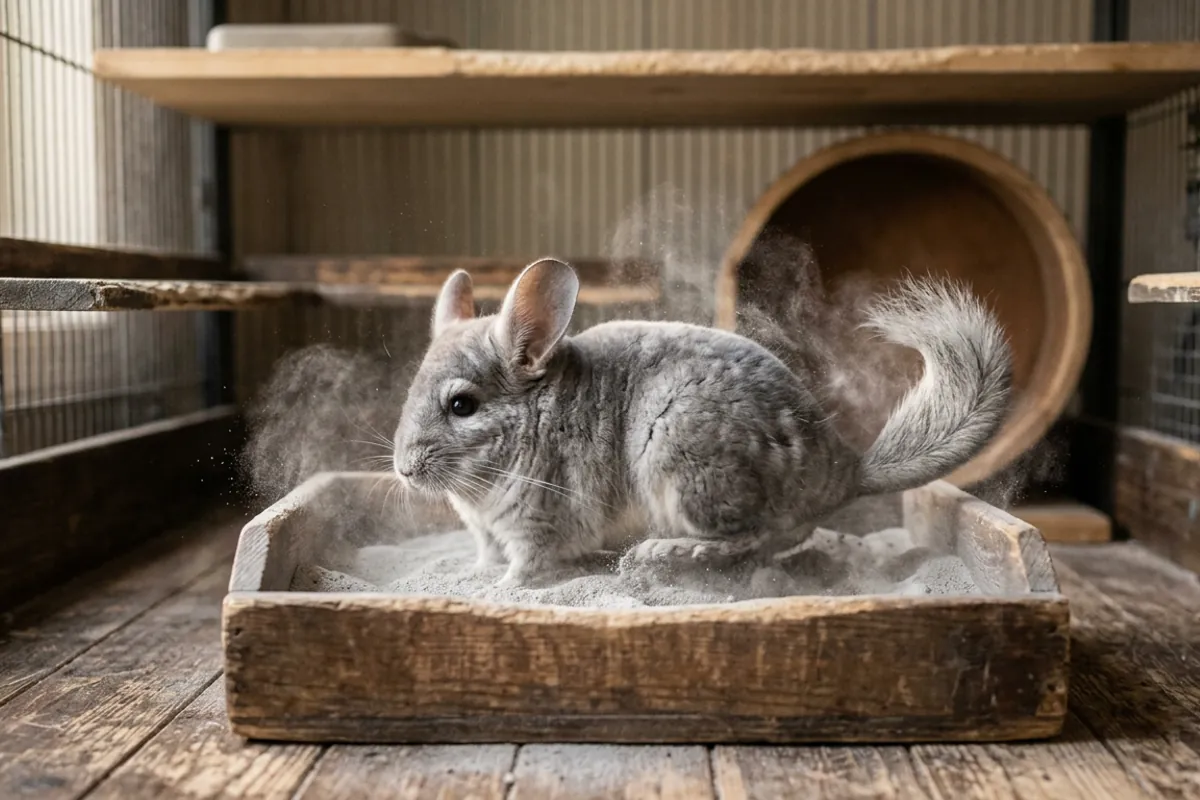
The dust is not garden dirt. It is a fine volcanic pumice powder made for the purpose, and it works by getting down through the fur to absorb oil and moisture, then carrying it away as the chinchilla shakes it out. You offer it in a bath a few times a week, let them roll for a few minutes, and then take it away so they are not sitting in soiled dust or breathing it constantly. A tub and the right chinchilla dust is all it takes. Lixit Blue Beauty chinchilla dust, 3 lb As an Amazon Associate I earn from qualifying purchases.
How often depends on your home's humidity, and I would not bathe daily, because too much dust dries the skin out. I wrote the full schedule and the dust-versus-dirt confusion out in the chinchilla dust bath done right. Watching a chinchilla flip and spin in its dust is one of the real pleasures of keeping one, so this is a chore that never feels like one.
Teeth and chews: watch them before there is a problem
Juniper is the reason I am uncompromising about this. She came to me with dental disease already set in, and I manage it day to day, so I have watched up close what happens when teeth do not get worn down. Chinchilla teeth grow continuously, and if they are not ground back by chewing, they overgrow and can develop points and spurs that cut the mouth, or grow at bad angles into what is called malocclusion. A chinchilla with tooth pain stops eating, and a chinchilla that stops eating declines fast.
Unlimited hay is the first line of defense, because it does most of the grinding. The second is a real variety of safe wood to gnaw. Not one lonely stick, but several different textures and shapes, so they use them. Apple, pear, and other safe fruit-tree woods are good, and a variety pack of apple wood chews keeps them interested rather than bored of the same block. emours apple wood chew sticks, 40 count As an Amazon Associate I earn from qualifying purchases.
Learn what a healthy eating chinchilla looks and sounds like, so you notice early when something changes. Drooling, a wet chin, dropping food, eating slower, weight loss, or picking at hay it used to devour are all reasons to act. Teeth are the one area where you cannot fully fix things at home: an exotics vet can file overgrown teeth and see the roots on an X-ray that you never can. I have written up the warning signs in Chinchilla Teeth Problems and gathered the health picture at chinchilla teeth and health. When in doubt on teeth, you see the vet. That line does not move.
Handling, routine, and the fact that they live at night
A chinchilla is not a cuddly starter pet, and it is kinder to know that going in. They are crepuscular, most active at dawn and dusk, and many are lively deep into the night. If you want an animal that curls up on your lap in the evening, this is not that animal, and forcing it will only stress you both.
What they give you instead is real personality once they trust you, and that trust is earned slowly on their terms. Sit near the cage, let them come to you, offer a single safe treat by hand, and let handling be brief and gentle at first. Never grab a chinchilla by the tail near the base or scruff it roughly, and be aware they can release a patch of fur when frightened, called fur slip, as a predator escape. Out-of-cage time in a chinchilla-proofed room, meaning no exposed wires, no gaps behind furniture, no houseplants, and nothing plastic to chew, lets them burn energy and bond with you.
A chinchilla is a decade-plus commitment, often fifteen years and sometimes twenty, so the routine you build now is a routine for a long time. I unpack the lifespan and what shortens or lengthens it in how long chinchillas really live. Two chinchillas often do better than one for company, though pairing them takes care and they should be the same sex unless you genuinely intend to breed, which is a serious undertaking I would talk you out of casually in what breeding asks of the animal.
When to handle it yourself and when to call the vet
Good daily care prevents most problems, but you still need to know where your line is. Feeding, cleaning, dust baths, chew rotation, temperature control, and daily observation are all yours. Weigh your chinchilla regularly on a kitchen scale, because steady weight is one of the earliest honest signals that things are fine, and a quiet drop is one of the earliest signals they are not.
The moment to stop improvising and find an exotics vet, specifically an exotics vet, because many general vets rarely see chinchillas, is any of these: not eating or not passing droppings, signs of heat stress, labored breathing, drooling or a wet chin, eye or nose discharge, a wound, or simply an animal that has gone flat and stopped being itself. Chinchillas hide illness until it is advanced, so by the time it is obvious, it is often urgent. I would rather you make a vet appointment that turns out to be nothing than wait on one that turns out to be everything. Find your exotics vet before you have an emergency, not during one.
So how hard is it, really?
People ask me how hard it is to take care of a chinchilla, or the flip side, how easy chinchillas are to take care of, and the answer sits in the middle. The daily work is light: fresh hay, clean water, a measured scoop of pellets, a dust bath a few times a week, some out-of-cage time, and a daily look to make sure everything is normal. None of that is difficult. What makes chinchillas demanding is not effort, it is precision and length. You cannot let the room get hot. You cannot let the hay run out. You cannot cut corners on the cage or the teeth. And you have to keep doing it for fifteen years or more.
So it is easy in the day-to-day and hard in the discipline, and that is the truest thing I can tell you. If you can commit to the short list of non-negotiables in this article and keep to it, a chinchilla is a wonderful, long-lived, characterful animal to live with. If you are looking for a low-commitment pet you can be a little careless with, this is not it, and I would rather you know that now. For the full-cost side of that commitment, including the vet fund I think every owner needs, I laid it out in what a chinchilla really costs, and for the plain overall picture, chinchilla as pets after ten years. Everything ties back to one idea: learn the biology, respect the non-negotiables, and the rest is just showing up every day.