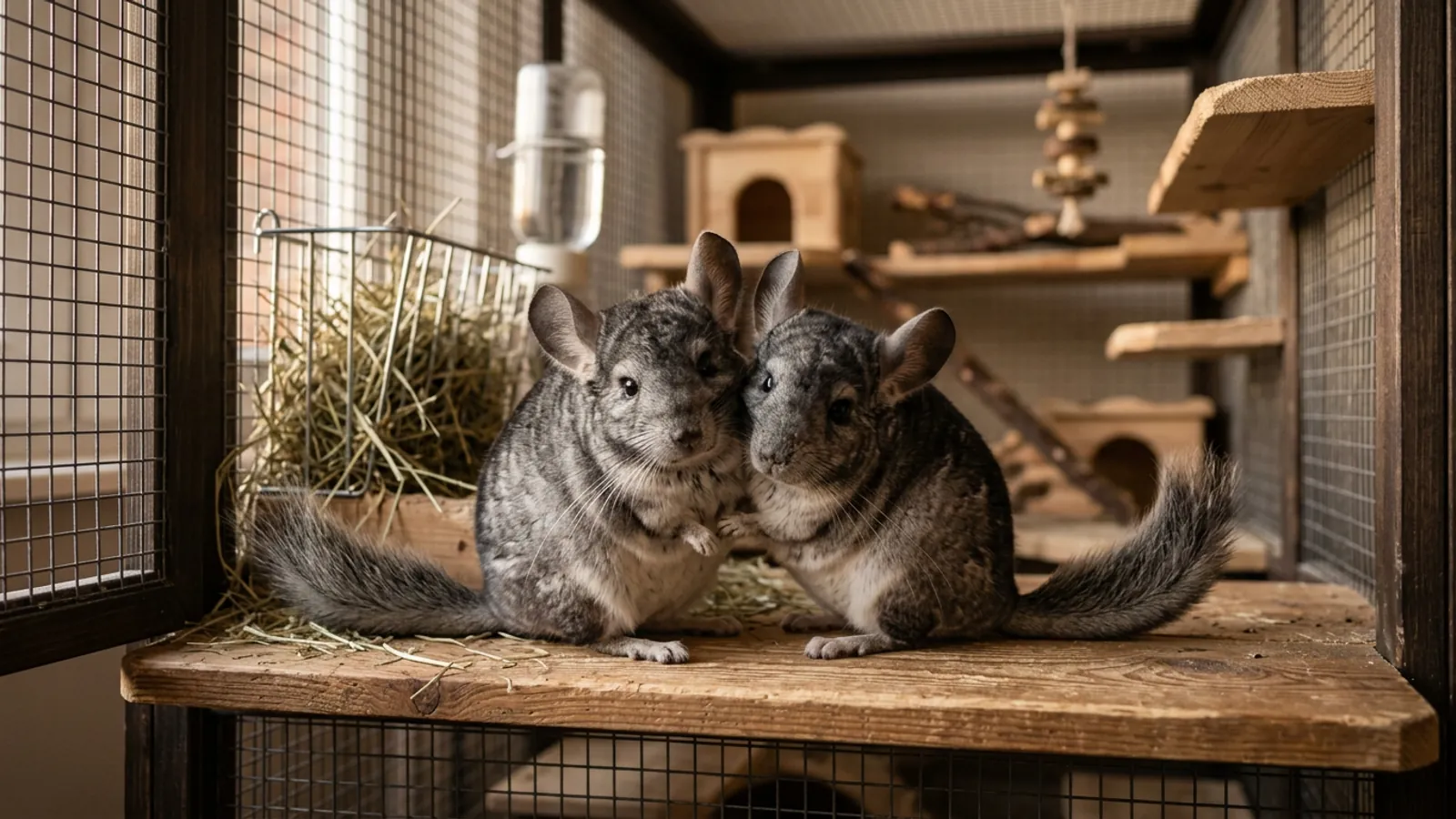
Do chinchillas need a friend is the question I get more than almost any other, and it usually arrives with guilt attached. Someone has read that chinchillas are social animals, looked at the one chinchilla sitting alone in a cage at midnight, and decided they have been failing it this whole time. I want to take the guilt out of the question first, because guilt is what makes people buy a second chinchilla on a Saturday afternoon and drop it straight into the resident's cage. That is how chinchillas end up at the emergency vet with a torn ear at eleven at night. Chinchillas are social, a good pair is a real pleasure to keep, and a badly matched pair can seriously injure or kill. Everything below is about telling the difference before it costs you an animal.
What a friend means to a chinchilla in the first place
Wild chinchillas live in colonies in rocky Andean terrain, wedged into crevices, sleeping in contact with each other and relying on the group for warning calls when something moves overhead. Domestic chinchillas are not far removed from that. Watch a bonded pair and you will see the leftovers of it: they sleep pressed together, they groom each other's faces and ears, and they take turns being the one sitting up while the other sprawls out. That is real, and it is not marketing. If you want the fuller picture of what their original habitat still dictates about your setup, I wrote about it in what a chinchilla in the wild is really like.
But here is what people skip when they quote the colony biology at you. A colony is not a cage. In the wild, a chinchilla chooses who it sits near, and when a neighbor becomes a problem it leaves. There is somewhere to go. A cage removes both of those things at once. You are not offering your chinchilla a colony, you are offering it one specific individual, permanently, with no exit and no appeal. Social species does not mean any two individuals will get along, any more than being a social species means you would enjoy being locked in a studio flat with a stranger for fifteen years.
So the useful version of the question is not "are chinchillas social". They are. It is "can I run a pairing in a way that is safe for both animals, and am I set up to end it fast if it goes wrong".
Do chinchillas need a friend
No, not in the sense that a solo chinchilla will waste away without one. Yes, in the sense that a working companionship is genuine, round-the-clock enrichment that you cannot personally provide at three in the morning.
A single chinchilla does well when it has a tall cage with real climbing routes, unlimited grass hay, a proper spread of chews, safe out-of-cage time, and a person who shows up at its hours rather than theirs. I have kept chinchillas for about ten years and I have never seen a well-kept single chinchilla decline for lack of a cagemate. What I have seen decline is chinchillas kept in small cages with nothing to chew and no interaction, which people then diagnose as loneliness because loneliness has an easy fix and a bad setup does not.
You should know that this puts me softer than the main welfare charities, and I am not going to hide that from you. The UK ones are the clearest: the RSPCA says chinchillas must not be kept singly, and the PDSA, the Blue Cross and the Royal Veterinary College all recommend keeping them in pairs as the default. If you want the mainstream position stated plainly, that is it, and it is not a fringe view.
I will be straight about the limits of what sits behind it. When a European food safety panel reviewed the welfare literature for this species recently, it reported that no published scientific evidence was found on whether individually housed chinchillas experience isolation stress, and that the recommendation rests on reasoning by analogy from other group-living rodents plus one small study. That is a professional consensus with a stated gap underneath it, which is a different thing from a settled finding, and the charities are honest enough to be reasoning from the precautionary side of it. Note too that the two big veterinary reference works, which are the sources I lean on hardest everywhere else on this site, say nothing about companionship at all.
So: default to a pair, because that is what the people who set welfare standards advise and the downside of being wrong in that direction is small. Keepers disagree about the single-chinchilla case loudly, and anyone who tells you the answer is obvious in either direction is telling you about their confidence, not the evidence. My own position, that a well set up single does fine, is a considered one from a decade of keeping them, not a proven one.
What I am confident about is the asymmetry of the risk. A single chinchilla that is a bit bored costs you nothing but effort to fix. A failed pairing costs a vet bill, a second cage bought in a panic, and sometimes an animal. So do not add a second chinchilla to solve a problem. If yours is bar-biting, nipping, or restless, fix the cage, the chewing, and the routine first. What chinchilla biting really means covers most of what is going on there. Get a second chinchilla because you want to keep two chinchillas, with the budget, space, and patience that implies.
What makes chinchilla pairs likely to work
The best odds by a wide margin belong to a pair that is already bonded. Rescues and rehomes regularly have two animals who have lived together for years and must not be separated, and taking them as a unit skips the entire risky part. If you want two, start there. What chinchilla adoption really asks of you goes through how that process usually runs.
Before you match anything, get both animals sexed by an exotics vet. I am serious about that, and it is not fussiness: chinchillas are commonly mis-sexed, the veterinary manuals warn that a female's anatomy can be extruded and mistaken for a penis, and a pet shop label is a guess often enough that keepers treat it as one. Everything that follows about same-sex pairing rests on the sexes being what you think they are.
Failing a bonded pair, match on age as well as sex. There is one combination the manuals do flag as dangerous rather than merely unpromising, and it is an older female housed with a young male: they record that older females commonly kill young males kept in the same cage. Females are also the larger and more assertive sex in this species, which is worth knowing before you assume two girls is the gentle option. Young animals under about a year tend to accept each other more readily than settled adults, though plenty of adult pairs work fine. Whether two females or two males pair more easily is disputed among keepers. I have heard confident claims in both directions and I do not think either is well supported, so I would not plan around it. Match the individuals, not the rule.
Do not house a male with an unneutered female unless you intend to breed, and I would encourage you not to intend that. Chinchilla gestation runs about 111 days, one of the longest of any rodent, kits are born furred and mobile, and a female can conceive again within a day or two of giving birth. One accidental pairing becomes two litters before you have understood the first. Neutering a male is possible, but it is not a routine snip: their anatomy makes hernia a real concern and it belongs with an exotics vet who does rodents regularly, followed by a waiting period before any introduction. What breeding a chinchilla asks of the animal is the long version.
The physical setup for two is not the setup for one with an extra hut jammed in. You want more cage, and you want duplicates: two hides with two exits each, two hay feeders at opposite ends, two water bottles, and a top shelf long enough that both animals can hold the high ground at the same time. Height is what matters most, which is why I keep coming back to tall multi level cages built from metal and wood. Critter Nation double unit small animal cage As an Amazon Associate I earn from qualifying purchases. Anything with one entrance is a trap, not a hide. Dead-end tubes are where a cornered chinchilla gets bitten.
How to introduce two chinchillas slowly
Every introduction I would defend takes weeks. Some take months. If you are on a deadline, do not start.
Quarantine comes first, before any of the social work. A new chinchilla stays in a separate room, ideally with separate air. I give it about a month, which is my own practice rather than a figure I can point you to in a veterinary source, because I have not found one that names a period for this species, and you handle the resident first and the newcomer second every single time. Ringworm in particular can sit on a healthy-looking animal and spread through a household, and it is miserable to clear once it is loose. How to spot chinchilla ringworm is worth reading before, not after.
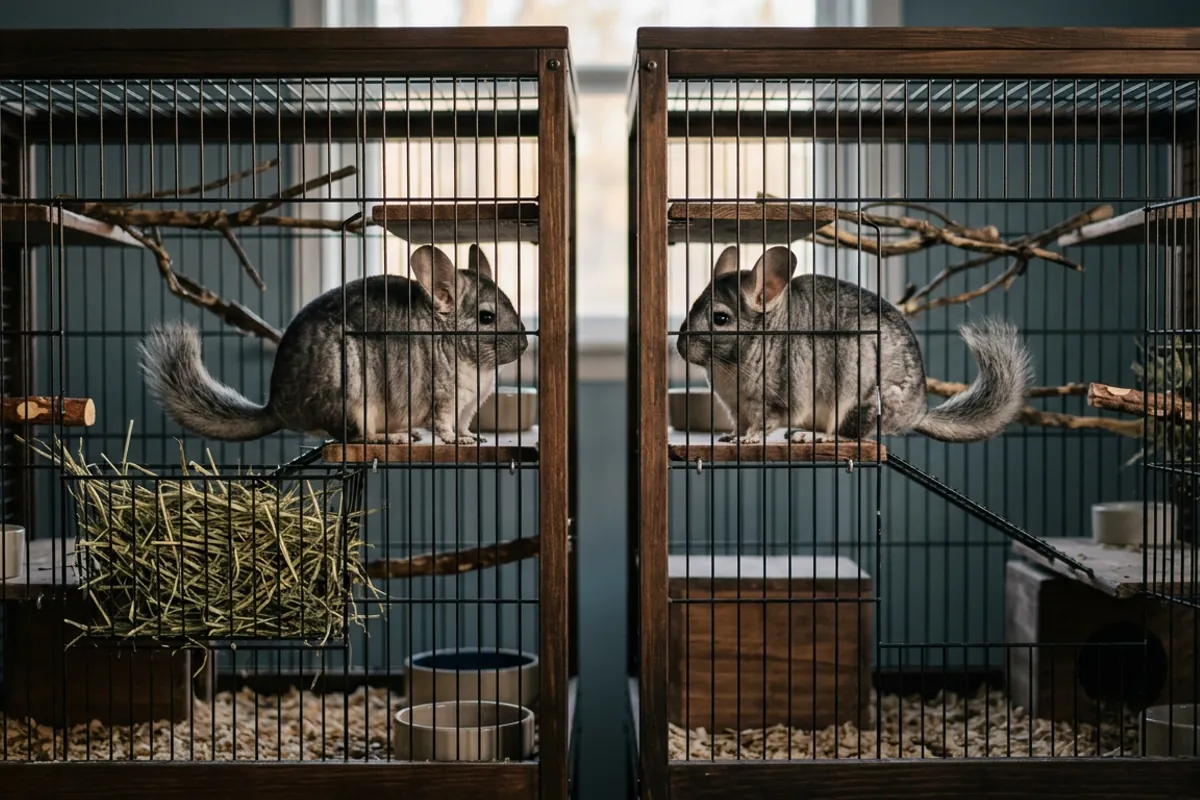
After quarantine, the sequence I use is this. Put the two cages in the same room with a gap between them, wide enough that neither can get a nose or a toe through to the other. Leave them like that for a week or two and just watch. Then start swapping: move each chinchilla's hut into the other's cage, then swap the chinchillas between cages entirely for a day at a time. Scent does most of the early work.
Keep the baths separate throughout this stage, and use them for scent rather than for contact: give each animal its own bath house, then swap the dust between them so each spends time in the other's smell. That is the version the welfare charities describe, and it is the one I follow. I do not use a shared bath as a first meeting. Two animals that have never met, in one container neither can back out of, is the worst geometry you could pick for a first encounter, and a bath is exactly where a chinchilla is most absorbed and least watchful. The first face to face meeting goes in open neutral floor space instead, where either animal can walk away. Lixit Blue Beauty chinchilla dust, 3 lb As an Amazon Associate I earn from qualifying purchases. Then neutral floor space, somewhere neither has claimed, in short supervised sessions that get longer only if the previous one was calm.
They move into a shared cage last, and it should be a cage that has been stripped, scrubbed, and rearranged so it belongs to neither of them. Even then, do not leave them alone overnight until you have seen repeated calm sessions and, ideally, the two of them choosing to sleep in contact.
Keep a thick towel within reach the entire time. If a fight starts, you throw the towel over one animal and lift it out. Never put a bare hand between two fighting chinchillas. Their bite is built for gnawing wood and it will go straight through a finger.
Chinchilla fighting signs I watch for
Not every scuffle is a fight. Short chases, a brief squabble over the best shelf, mild teeth chattering, and mounting as a dominance gesture all happen in perfectly stable chinchilla pairs. Mutual grooming and sleeping in contact are the signs you want. What chinchilla behavior is really telling you covers the normal repertoire in more detail.
The loud chinchilla fighting signs are hard to miss once you know them. Standing upright on the hind legs, front feet raised, is a squaring-up posture. Urine spraying, most often from a female at a male or a pushy cagemate, is a serious back-off signal. Sustained aggressive teeth chattering aimed at the other animal is different in tone from contented grinding, and the harsh alarm call carries across a room. Prolonged chasing that the other animal cannot escape, rather than a two-second dart, is a bad sign. So is any wrestling that ends in a locked, rolling ball.
Then the physical evidence, which often shows up before you catch the act. Loose fur in tufts on the cage floor means somebody got grabbed and released their coat, which is exactly what fur slip is for. Neatly trimmed patches or chewed whiskers mean one animal is barbering the other. Check ears, feet, tail base, and genitals, because that is where bites land.
The quiet signs are the ones people miss, and they matter most. One chinchilla that never leaves the hide. One that only eats after the other has finished, or waits for the bottle. One holding the cage floor while the other permanently owns the top shelf. Weight loss in either animal, or a drop in the number and size of droppings from one of them, which is often the first hard evidence that something is wrong at all. What chinchilla poop tells you is the cheapest daily check you have, and with a pair you have to work out whose is whose, which usually means weighing both animals weekly instead.
The uncomfortable truth about chinchilla fighting is that a pair which has been fine for three years can break. A rearranged cage, a new cage, one animal getting ill, a female cycling, or a hot spell can all tip it. Watch closely after every change.
When to separate, and why the second cage comes first
If you keep a pair, own two full cages before you introduce them. Not a carrier, not a plan to buy one, two cages. Fights do not schedule themselves for shop opening hours.
Separate immediately and permanently for any blood, any limp, any torn ear, any wound at all. Bite wounds on chinchillas abscess readily under that dense coat, and by the time you can see swelling it is well established. That is an exotics vet call, not a wait-and-see, and finding a chinchilla vet before you need one is a job for a quiet Tuesday rather than a crisis. Separate temporarily for the quiet signs too, and use the side-by-side setup while you decide.
Reintroducing after a genuine fight sometimes works once, after everything has healed and with the full slow protocol again. After a second serious fight I stop. At that point you are not solving a misunderstanding, you are overriding two animals who have told you clearly what they want.
Heat deserves its own mention here, because two bodies in one cage is warmer than one, and heat-stressed chinchillas are short-tempered chinchillas. The comfortable range is 60 to 70°F (15 to 21°C). Above 75°F (24°C) the risk begins, and 80°F (27°C) or higher is an emergency, and humid air shortens the time you have. Pebble came to me from an overheated attic and gave me a near-miss and a night at the emergency vet in her first summer, which is why this is not negotiable. Keep a thermometer and hygrometer at cage height, not on the far wall. digital thermometer and humidity gauge with remote probes As an Amazon Associate I earn from qualifying purchases. If you have to break up a cage in a heatwave, do it. Two chinchillas in separate cages in a cool room beats a bonded pair in a hot one, every time. The heat danger calculator will tell you where you stand.
Keeping one chinchilla well on purpose
If you decide on one, keep one properly and stop apologizing for it. The work goes into the cage and the routine.
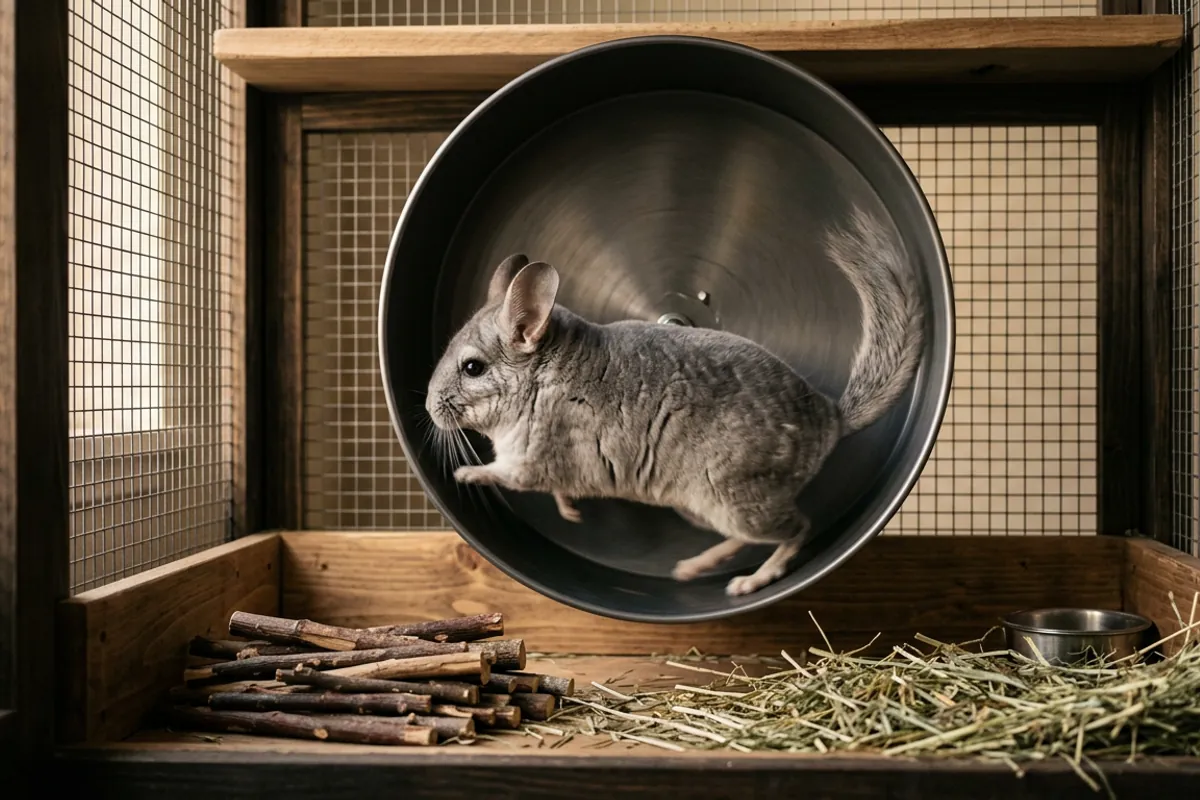
Height and climbing routes first, then unlimited grass hay, always available and never rationed. Hay is the whole meal, not a side dish, and pellets are a small measured supplement on top of it. Oxbow Western Timothy Hay, 40 oz bag As an Amazon Associate I earn from qualifying purchases. Then chews, and I mean variety rather than one sad wooden block. Juniper came to me as a neglected rescue with dental disease I still manage day to day, and watching what happens when teeth do not get worn down is why I keep several wood types in rotation and swap them before they get boring. emours apple wood chew sticks, 40 count As an Amazon Associate I earn from qualifying purchases. A wheel earns its place for a single chinchilla, provided the running surface is solid. Wire wheels and mesh wheels catch feet and break legs, so what goes in is a wheel with a solid, continuous running surface. 15 inch Chin Spin solid surface chinchilla wheel As an Amazon Associate I earn from qualifying purchases.
Then show up. Chinchillas are most active at dusk, dawn, and through the night, so evening is your window. Sit on the floor of a chinchilla-proofed room, let yours come to you, and let it use you as furniture. Twenty minutes every night beats two hours on Sunday. Talk to it while you do other things in the room, so your presence is ordinary rather than an event.
One caution: do not read tameness as happiness. A chinchilla that keeps its distance can be perfectly well, and a friendly one that stops eating is not. Appetite, droppings, weight, and activity tell you the truth. Behavior towards you tells you about its personality.
Pebble, Juniper, and two cages in one room
Mine live in two cages, side by side with a gap, in the same room. They see each other, hear each other, smell each other, and share every alarm call and every dust bath schedule, but neither can bite the other.
That is partly a management decision. Juniper's dental disease means I need to know exactly what she has eaten and how much, and a shared hay feeder makes that impossible to track. Spotting malocclusion before it turns serious depends on catching small changes in intake, and small changes vanish the moment two animals eat from the same pile. It is partly temperament, too. Pebble is settled and Juniper is not, and I did not like what I saw in the early sessions.
I will own that this is a compromise. Two cages in one room is not the same as a bonded pair sleeping in a heap, and I am not going to pretend otherwise. What it is, is safe, and after ten years I would rather have two intact chinchillas with a wall of bars between them than one chinchilla with a chewed ear.
So: do chinchillas need a friend? They benefit from one, when the pairing is right and you have the space, the second cage, and the patience to do introductions over months rather than an afternoon. They do not need one to live a full and healthy life. If you can run a pairing properly, it is a good thing to do. If you cannot, keeping one chinchilla well is not a consolation prize, and it is certainly not a failure.