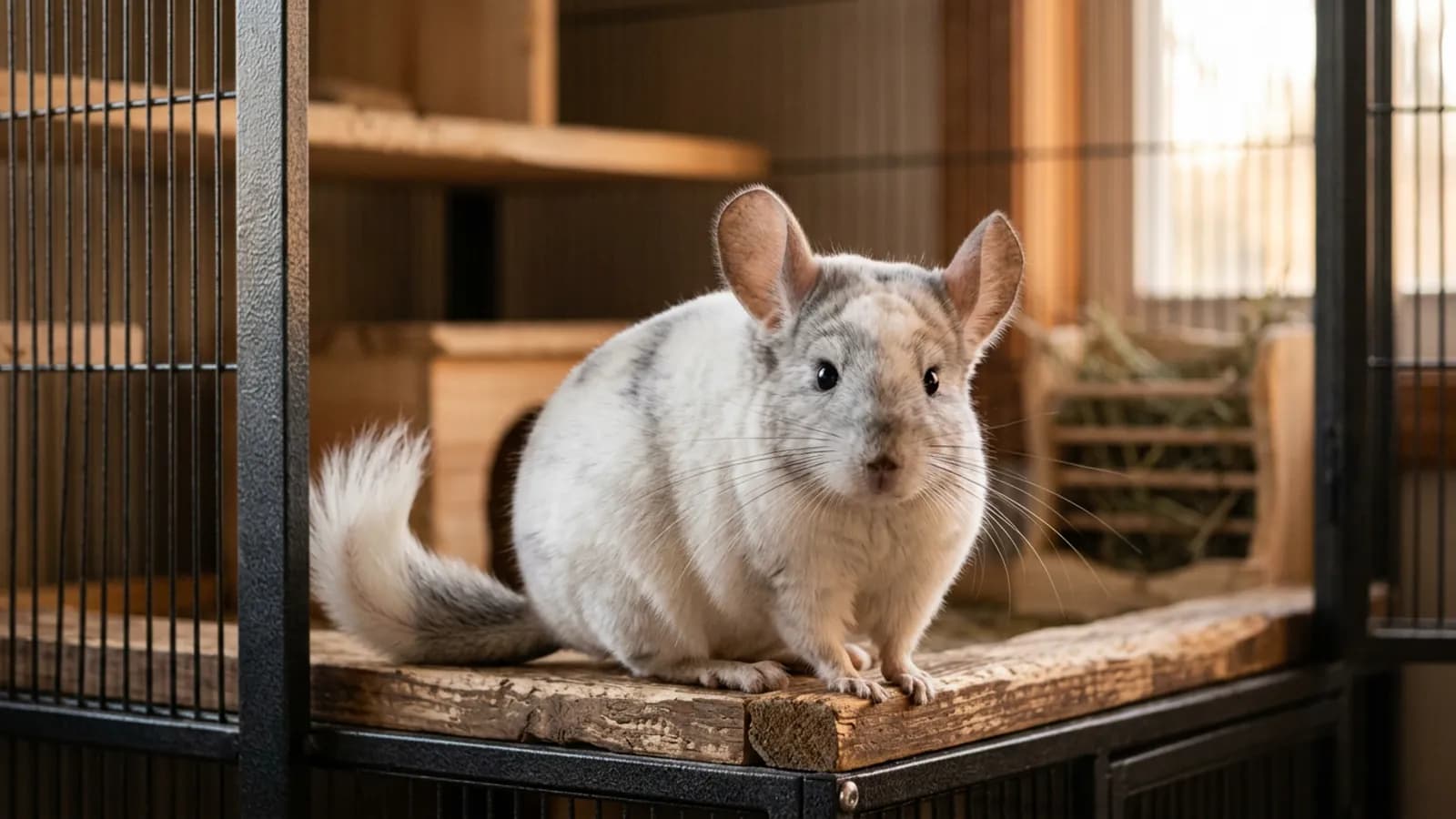
A chinchilla mosaic is not a color the way beige or black is a color. It is a pattern: a white coat carrying patches, flecks, or a saddle of darker fur, so the animal reads as marked rather than one flat shade. People say "mosaic chinchilla" as if it named a breed or a fixed color, and it is neither. It is a white based mutation that turns up in a hundred different arrangements, from a nearly all white animal with a smudge of grey between the ears to one that looks almost standard grey wearing white blazes. That variety is exactly why the word confuses people, and why a listing that just says "mosaic" tells you less than the seller thinks it does.
I want to say up front that neither of my own two is a mosaic. Pebble is a standard grey and Juniper is close to it, so I am not writing this from a mosaic in my own cage. I am writing it from years of looking at other keepers' animals, reading the breeding literature the hobby leans on, and untangling the same three questions every time someone messages me a photo: what is this, is it healthy, and did I pay too much for the pattern. Those are the questions worth answering, and the color is the least important of the three.
What "mosaic" actually names
Wild chinchillas are grey. The soft silver grey you picture is the standard, the color the animal wears in the mountains of South America, and every other color you see in captivity is a mutation stacked on top of that baseline. A mosaic chinchilla is one of those mutations, and the thing it changes is where pigment lands, not what pigment is available.
Instead of an even wash of color from nose to tail, a mosaic distributes it in patches. You get white ground with grey markings, or a grey animal broken up by white. The markings can be symmetrical or scattered, a neat cap or a random spatter, and no two are laid out the same way. This is why the pattern gets called a mosaic in the first place: it looks assembled out of pieces.
The trouble is that the hobby uses the word loosely. One breeder's "mosaic" is another's "white mosaic" is another's "pinto," and the naming has never been standardized the way a kennel club standardizes a dog breed. So when you read the term, treat it as a rough description of a look, not a precise genetic label. If you want to know what an animal actually carries, you have to look at its parents and, honestly, trust the breeder, because you cannot read a genotype off a coat. If the underlying biology of what a mutation is and is not changing interests you, the general chinchilla overview walks through why color sits on top of a body plan that never changes.
The white gene behind every mosaic
Every mosaic traces back to the white mutation, the same gene that produces the animals people just call white chinchillas. It is a dominant mutation, which means one copy is enough to show it, and it first appeared in captive stock decades ago and spread from there. A mosaic is simply the white gene expressed as a patchy, marked coat rather than an evenly pale one.
Because white is dominant and mixes readily with the other color mutations, "mosaic" almost never travels alone. It combines. Put the white gene together with beige and you get the paler, warmer variations. Put it with ebony and you get the high contrast dark ones. The white gene is the common thread; the base it is painted over is what gives you the named variants people ask about. That is the whole logic of chinchilla color genetics: a handful of mutations, stacked in different combinations, producing a long catalog of names.
I lean on the same honesty here that I do with every color question. I am an experienced keeper, not a geneticist, and the exact inheritance of some of these combinations is still argued over by people who breed far more than I ever will. Where the community agrees, I will tell you. Where it does not, I would rather say so than hand you false precision. The white chinchilla explainer and the violet writeup both take the same line, because color is the one area where confident nonsense spreads fastest.
How far the white can go: extreme mosaic
The amount of white in a mosaic sits on a sliding scale, and at the far end of that scale is what people call an extreme mosaic chinchilla. An extreme mosaic is a mosaic where the white has taken over almost the whole coat, leaving only faint markings, a hint of grey at the ears or along the back, or in some animals barely any visible color at all. From across a room an extreme mosaic can look like a solid white animal, and the distinction only shows up close.
There is no clean cutoff between a heavily marked mosaic and an extreme one. It is a spectrum, and where a breeder draws the line between "mosaic" and "extreme mosaic" is partly a judgment call. That vagueness matters when money is involved, because "extreme" gets used as a selling word. A very pale, very clean coat can be genuinely striking, and I understand why people want one, but the label itself is not a guarantee of anything except how much white the animal happens to carry.
One thing the amount of white does not change is the animal's needs. A near white extreme mosaic is not more delicate, not more prone to illness, and not built any differently than a grey. It has the same dense coat, the same appetite for hay, the same intolerance for heat. The color reads dramatic; the chinchilla underneath is ordinary in every way that counts.
Beige mosaic and ebony mosaic: the same pattern over a different base
The two combinations people ask about most are the beige mosaic chinchilla and the ebony mosaic chinchilla, and they sit at opposite ends of the contrast range.
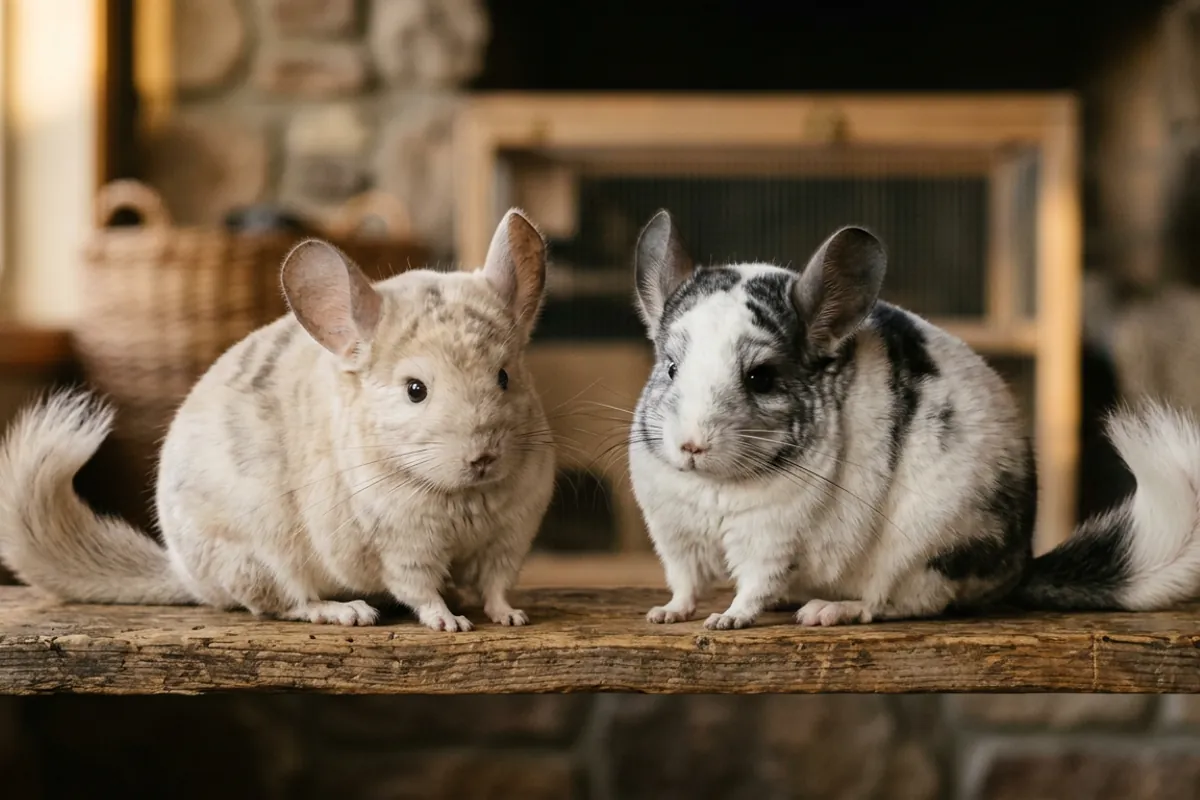
A beige mosaic is the white pattern laid over the beige mutation. Beige is a warm, dilute color that softens grey into a creamy tan and often comes with lighter, ruby toned eyes. Stack the mosaic pattern on top and you get a pale animal with soft cream or beige markings rather than hard grey ones, the whole thing low in contrast and gentle looking. If you want to understand the beige half of that on its own, the way one mutation shifts warmth without touching anything structural, the brown chinchilla explainer covers the closest relative to it in plain terms.
An ebony mosaic is the opposite. Ebony is the mutation that produces the deep, glossy, near black fur, and unlike most colors it tends to carry through the whole coat rather than fading on the belly. Put the mosaic pattern over ebony and you get high contrast: crisp white ground broken by dark, rich patches. Ebony is also unusual in that its depth is polygenic, built up over generations of selective breeding rather than switched on by a single gene, so ebony mosaics vary a lot in how dark the dark parts actually are. Two ebony mosaics from different lines can look quite different, and that is expected, not a flaw.
Both of these are real, established combinations, and both are just the mosaic pattern wearing a different base color. Neither is a separate kind of animal. If you find the darker ones handsome, that is a fine reason to want one. Just know that you are choosing a look, and the look is the entire difference.
What the pattern never changes
Here is the part I care about most, because it is the part that keeps animals alive. A mosaic chinchilla, beige or ebony or extreme, needs precisely the same care as a standard grey. The color mutation changed pigment. It did not change the animal's biology, and every care rule on this site applies to a mosaic without a single adjustment.
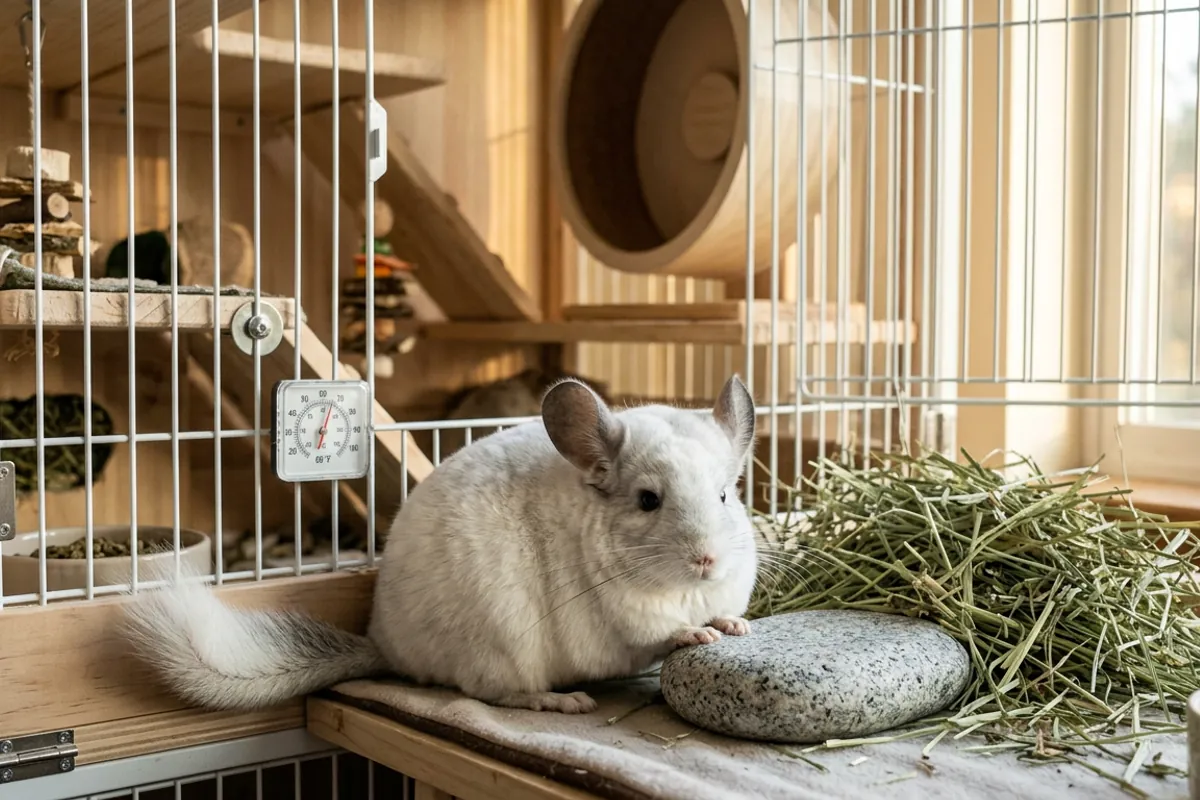
Start with heat, because heat is what nearly cost me Pebble in her first summer and it is the thing I will never soften. Chinchillas are built for cold mountain air and they cannot shed heat well. The comfortable range is 60 to 70°F, which is 15 to 21°C. Above 75°F, about 24°C, you are into risky territory, and 80°F, roughly 27°C, is an emergency, faster still when the air is humid. A mosaic's pale coat does not buy it any tolerance here. It is the same dense fur that traps the same heat. Keep the room cool, watch the thermometer honestly, and if you want a hard number for your own setup, run it through the heat danger calculator. A cage thermometer and hygrometer on the cage, not across the room, is the cheapest insurance you will ever buy. digital thermometer and humidity gauge with remote probes As an Amazon Associate I earn from qualifying purchases. A cooling stone gives a hot animal somewhere to dump heat, though it is a comfort measure, never a substitute for actually cooling the room. Kaytee Chinchilla Chiller granite stone As an Amazon Associate I earn from qualifying purchases.
Diet does not change either. A mosaic eats unlimited grass hay first, always, with a measured amount of plain pellets as a supplement and nothing more exotic than that. Juniper is why I am rigid about this: I manage her dental disease every day, and I have watched up close what happens when teeth do not get worn down. Hay is not a side dish, it is the whole dental care plan, because the chewing is what keeps the constantly growing teeth in check. Keep good timothy hay in front of the animal at all times. Oxbow Western Timothy Hay, 40 oz bag As an Amazon Associate I earn from qualifying purchases. Pair that with a real variety of safe wood chews so there is always something to gnaw, because monotony gets ignored and ignored chews mean unworn teeth. emours apple wood chew sticks, 40 count As an Amazon Associate I earn from qualifying purchases. If the teeth themselves worry you, the teeth and health page covers what to watch for and when it stops being something you can manage at home.
And a mosaic bathes in dust, never water, exactly like every other chinchilla. That dense coat holds water against the skin and will not dry properly, which invites fungal trouble and worse. The animal cleans itself by rolling in fine volcanic dust, and that is the only bath it ever gets. If any of that is new to you, the dust bath guide lays out the how and the how often, and it is the same for a pale mosaic as for a grey. Lixit Blue Beauty chinchilla dust, 3 lb As an Amazon Associate I earn from qualifying purchases.
The pattern is skin deep, or rather fur deep. Everything under it is a chinchilla, with a chinchilla's needs.
Buying a mosaic: what the label is worth
When you see a mosaic advertised, the color is usually doing some of the pricing. Rarer or more dramatic looking patterns, and "extreme" anything, tend to carry a premium over a plain grey. Whether that premium is worth paying is entirely up to you, but be clear eyed about what you are buying: you are buying a coat, not a better animal.
I would spend the money elsewhere. What actually determines whether the next ten or more years go well is the animal's health and how it was raised, not its markings. So when you meet a mosaic, run the same checks you would for any chinchilla. Look for clear eyes and a dry nose, clean and dry fur with no bald patches, steady breathing, and an alert animal that moves normally. Ask the age, ask what it eats, and watch for the warning signs that a listing is really a flip rather than a bred and cared for animal. The guide to buying a chinchilla for sale covers those red flags in detail, and they matter far more than the color does.
Be a little skeptical of the label itself, too. Because the naming is loose, a seller calling something a "beige mosaic" or an "extreme mosaic" may be using the term the way they learned it, which may not be the way the next breeder uses it. If the exact genetics matter to you, ask about the parents. If they only matter to you because the animal is pretty, then the label is just a description, and you can decide with your own eyes whether it is worth the asking price.
The one line a breeder cannot cross
If you are only keeping a mosaic as a pet, you can skip the worry in this section, but you should still know it exists, because it explains why responsible breeders are careful and why some litters are small.
The white gene that produces every mosaic is widely understood to be lethal in its double dose. An animal that inherits the white gene from both parents generally does not survive to be born. This is the accepted view across the breeding community, and it has one hard consequence: you do not breed a white to a white, which in practice means you do not breed a mosaic to another mosaic or to any other white based animal. Doing so risks the lethal combination and reliably produces smaller, weaker litters for no gain.
I am not a breeder and I do not encourage pet owners to become one on a whim, because breeding chinchillas asks far more of the animals than most people expect going in. But the lethal white factor is exactly the kind of thing that separates someone who knows what they are doing from someone pairing two pretty animals and hoping. If breeding is genuinely on your mind, read what breeding a chinchilla actually asks of the animal first and pair mosaics only with standards or non white colors, never with each other.
The mosaic is one of the more eye catching things the chinchilla coat can do, and there is nothing wrong with loving the look of one. Just hold the two facts together: the pattern is beautiful, and the pattern is the only thing that is different. Everything else is a chinchilla, and a chinchilla needs cool air, endless hay, dust to roll in, and someone who does not confuse a rare coat for a rare animal.