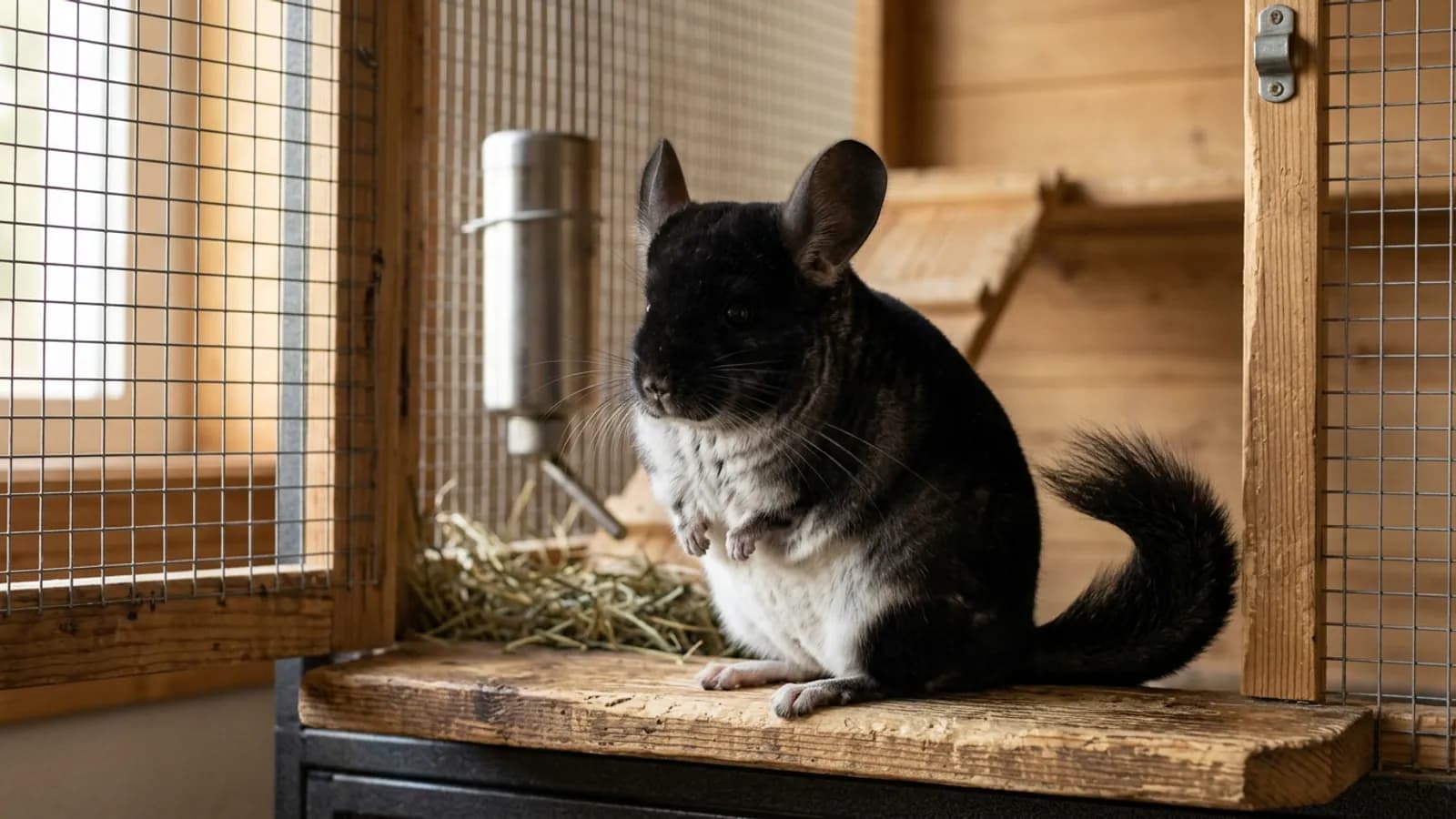
The first time someone showed me a black velvet chinchilla, I understood why the name sticks. The fur across the back and head is a deep, near-black veil that fades to a clean white belly, and the whole coat carries a sheen a standard grey does not. But that colour is a specific mutation with a real genetic story behind it, and once you know the story you stop overpaying for the wrong animal and start caring correctly for the one you have. A velvet chinchilla is not a different species, not a rare exotic, and not one bit more delicate than a grey standard. It is a colour gene sitting on top of the same animal, and everything that keeps a grey chinchilla alive keeps a black velvet alive too.
What a black velvet chinchilla actually is
The word that matters here is velvet, and in chinchilla circles it has a precise meaning. Velvet is short for "Touch of Velvet," usually written TOV, a dominant colour mutation that first showed up in a breeder's herd decades ago. You will still hear it called Gunning black after the breeder credited with it. A black velvet is a standard grey chinchilla carrying that one velvet gene, which lays a dark, dense veil of pigment over the head and down the back.
It helps to know what a black velvet is not. There is no true solid-black standard chinchilla in the way people picture a black cat. The very dark chinchillas you see are almost always velvet, ebony, or a combination of the two, and each of those is a named, understood mutation rather than a mysterious rarity. So when a listing says "black chinchilla" with no other detail, it is usually describing a black velvet or an ebony, and it is worth asking which. The colour is real and it is striking, but it is a known quantity, not a unicorn.
The velvet gene does not only pair with grey. Breeders lay it over other base colours to get beige velvet, violet velvet, and sapphire velvet, each one the base colour with that same dark veiling on top. If you have read about the sapphire or violet mutations, picture those with a velvet mask added. Black velvet is simply the version where the base is standard grey, and it is the most common and the most dramatic of the group.
The markings that tell a velvet from a standard grey
If you want to read a chinchilla's colour honestly, look past the general impression of "dark" and check the specific markings, because velvet has a signature. The veiling is heaviest over the face and the top of the head, giving a dark mask, and it runs down the spine as a deep saddle. The sides lighten as they curve toward the belly, and the belly itself stays white and clean. That fade from near-black back to white underside is the classic velvet look.
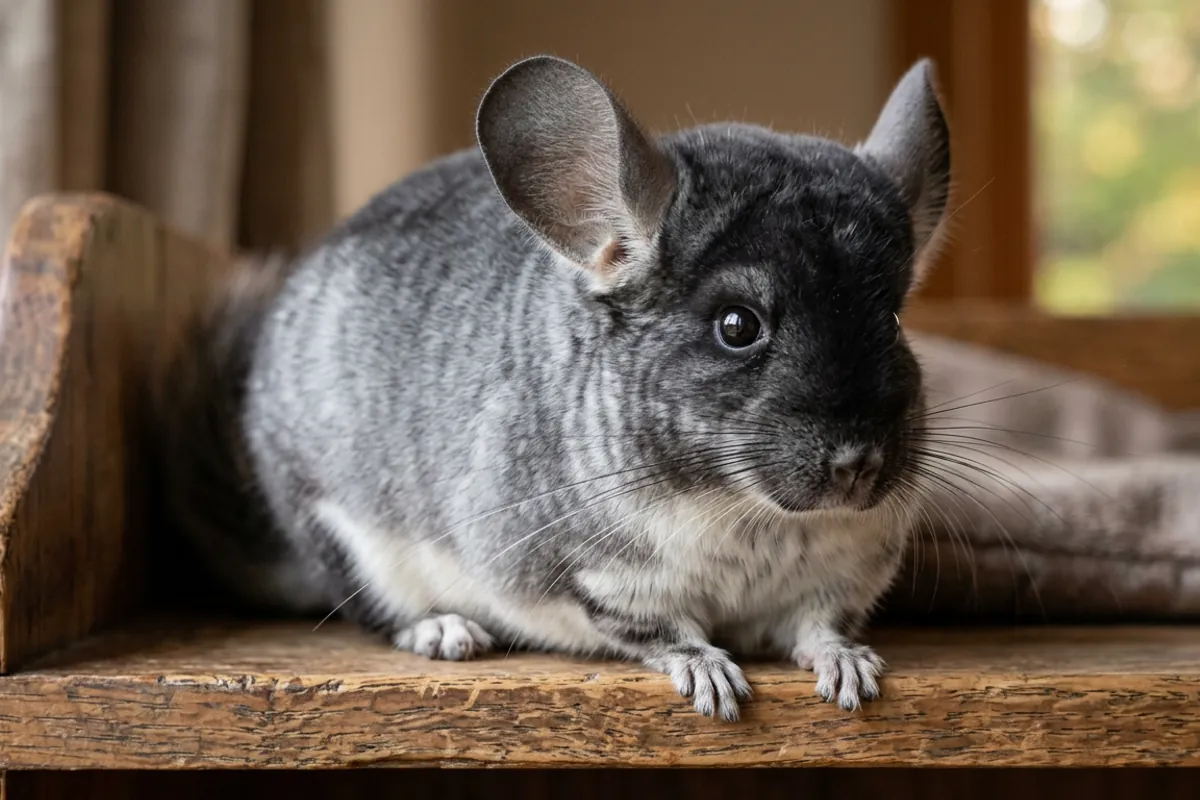
The single most reliable tell is on the front legs. A black velvet has distinct dark bars or stripes running across the front paws, a marking a plain grey standard does not carry. Breeders lean on those paw bars to identify velvet quickly, and you can too. If a seller calls an animal a velvet but the front feet are plain, ask questions. The white belly plus the barred front paws together are what separate a black velvet from an ordinary dark grey.
None of this affects the fur's texture, by the way. The coat feels like any other chinchilla coat, which is to say absurdly soft and dense, roughly sixty hairs growing from a single follicle. The "velvet" name is about how the deep, even pigment looks under light, not about a different fur type. It is the same fur, same density, same care.
The velvet gene and its lethal catch
Here is the part that surprises people, and it is the reason black velvets are never quite as common as demand would suggest. The velvet gene is dominant, so a chinchilla only needs one copy to show the colour. But two copies are a problem: breeders widely hold that the velvet gene carries a lethal factor when an animal inherits it from both parents. The homozygous embryos, the ones with a double dose, do not survive to birth.
The practical result is that every living black velvet is heterozygous. It carries exactly one velvet gene and one non-velvet gene, and it cannot carry two. Cross two black velvets and, on paper, a quarter of the pairings that would have been double-velvet simply are not born, another half come out as velvets carrying a single gene, and the last quarter come out as plain non-velvets. So even a velvet-to-velvet pairing does not produce a litter of all velvets, and it wastes part of the litter to the lethal factor. Responsible breeders account for this and often pair a velvet with a non-velvet instead.
I am a keeper, not a breeder, and I want to be honest about the line I am drawing here. I am telling you this so you understand why the colour behaves the way it does and why "we bred two blacks to get more blacks" is a red flag, not a selling point. If you are actually thinking about producing chinchillas, that is a much larger commitment than colour genetics, and I have written separately about what breeding really asks of the animal. The short version: colour is the least of it.
Ebony velvet, where two dark genes stack
The darkest chinchillas of all are usually not pure velvet. They are ebony velvet, and the distinction is worth getting right because "chinchilla ebony velvet" gets used loosely for anything black.
Ebony is its own separate mutation, and it behaves differently from velvet. Where velvet lays a dark veil over the top and leaves the belly white, ebony spreads dark pigment everywhere, including the belly, so an ebony chinchilla loses that white underside and darkens all the way around. Ebony is also additive: it comes in a range from light ebony through medium to what breeders call extra-dark, because stacking more ebony genes over generations deepens the colour. A well-bred dark ebony can look almost uniformly charcoal.
Put the two together and you get ebony velvet, sometimes written TOV ebony. Now the animal has velvet's dark facial mask and barred front paws plus ebony's wrap-around dark belly, and the result is the closest thing to a solid black chinchilla that actually exists. The very best of them are glossy and deep and nearly even from spine to belly. Even so, I would stop short of calling any of them truly black in the way ink is black. Look closely in good light and you will still see the silver-grey chinchilla structure underneath the pigment. That is not a flaw. It is what a black and white chinchilla piece and every honest colour guide keep coming back to: these are variations in how pigment is distributed, not new coat materials, and the underlying animal is the same chinchilla every time.
What the colour never changes about care
This is the section I would tape to the cage, because it is where colour myths do actual harm. A black velvet's dark coat changes nothing about how you keep it alive. It is not hardier, it is not more fragile, and its heat tolerance is exactly the same as a grey standard's. People sometimes assume a dark animal soaks up more heat and needs extra caution, and others assume a "premium" colour must be tougher. Both are wrong. Every chinchilla, whatever its colour, is a high-altitude animal built to shed heat, and every one of them is in danger in the same temperature band.
Keep the room at 60 to 70°F (15 to 21°C). Above 75°F (24°C) you are in risky territory, and 80°F (27°C) and up is a genuine emergency, arriving faster when the air is humid because a chinchilla's only real cooling is through its ears and it cannot pant its way out of trouble. This is not a colour rule, it is a chinchilla rule, and it is the one that matters most. I keep a plain cage thermometer and hygrometer on every enclosure so I am reading the actual number near the animal, not guessing from a wall thermostat across the room. digital thermometer and humidity gauge with remote probes As an Amazon Associate I earn from qualifying purchases. A cooling stone the chinchilla can lie against gives it somewhere to dump heat on a warm afternoon. Kaytee Chinchilla Chiller granite stone As an Amazon Associate I earn from qualifying purchases. If you want the full picture, I keep the warning signs of heat stroke close at hand, because catching it early is the whole game.
The rest of the care is just as colour-blind. A black velvet eats unlimited grass hay first, always, with a measured amount of plain pellets as a supplement and never a pile of pellets as the main meal. Good timothy hay is the foundation of the whole diet and the thing wearing the teeth down. Oxbow Western Timothy Hay, 40 oz bag As an Amazon Associate I earn from qualifying purchases. That constant chewing is not optional. Chinchilla teeth grow for the animal's whole life, and my Juniper, a rescue whose dental disease I manage every single day, is the reason I am uncompromising about it. Hay plus a real variety of safe wood chews keeps teeth worn, and letting that slide leads to the kind of dental problems you do not want to meet. emours apple wood chew sticks, 40 count As an Amazon Associate I earn from qualifying purchases.
And the coat, dark as it is, still gets cleaned the only way a chinchilla coat should: with dust, never water. A black velvet rolls in fine volcanic pumice dust a few times a week, and that dust is what keeps the dense fur from going greasy and matted. Lixit Blue Beauty chinchilla dust, 3 lb As an Amazon Associate I earn from qualifying purchases. A wet chinchilla is a real problem, because that same density that makes the fur beautiful also makes it nearly impossible to dry to the skin, and damp fur invites fungus and chill. The colour does not change one word of that.
Buying a black velvet without being misled
Because velvet is genuinely popular, the colour gets used to justify a higher price, and sometimes the story behind the animal gets fuzzy to match. A few habits keep you honest here.
First, ask exactly what the animal is: black velvet, ebony, or ebony velvet, and what it was bred from. A seller who knows their herd can tell you, and one who calls everything dark "black" without more detail may not be tracking genetics carefully. Second, treat the lethal-factor point as a filter. If someone is proudly pairing velvet to velvet and does not mention the losses, they either do not understand the gene or are not being straight with you. Third, and most important, do not let a striking colour distract you from the animal's health. A bright-eyed, active, correctly-weighted grey standard is a far better buy than a dull, sniffly, thin black velvet, every time. Colour is the last thing on the checklist, well behind clear eyes, dry nose, clean rear, good weight, and a curious temperament.
I have written the longer version of this in how to buy a chinchilla without regretting it later, and the throughline is the same: the colour is real, the animal is what you are actually taking home, and the two deserve very different amounts of your attention. While you are at it, make sure you are set up before the animal arrives. A tall metal-and-wood cage with wooden ledges and no plastic, a solid-surface wheel rather than a bar or wire one, unlimited hay, and dust on hand matter far more than the shade of the coat. Critter Nation double unit small animal cage As an Amazon Associate I earn from qualifying purchases.
Sorting out the names once and for all
The vocabulary trips people up more than the biology does, so here is the whole thing in plain terms. Velvet, or TOV, is a dominant gene that lays dark veiling over the head and back and puts bars on the front paws, while leaving the belly white; a black velvet is that gene on a standard grey base. Ebony is a different, additive gene that darkens the whole animal, belly included, across a range from light to extra-dark. Ebony velvet is both genes at once, and it is the darkest, most nearly-solid look you will find. None of the three is a solid-black chinchilla in the literal sense, because the silver-grey structure is always there under the pigment.
That is really the heart of it, and it is the same lesson every colour on this site keeps teaching, whether you are looking at a brown chinchilla or asking whether an albino label even fits. The coat is where the mutation shows. The animal underneath is a chinchilla, with a chinchilla's absolute need for cool air, unlimited hay, constant chewing, and dust instead of water. Get those right and a black velvet will be exactly as long-lived, as bright, and as good a companion as any grey in the room. The colour is the part you notice first and the part that matters least.