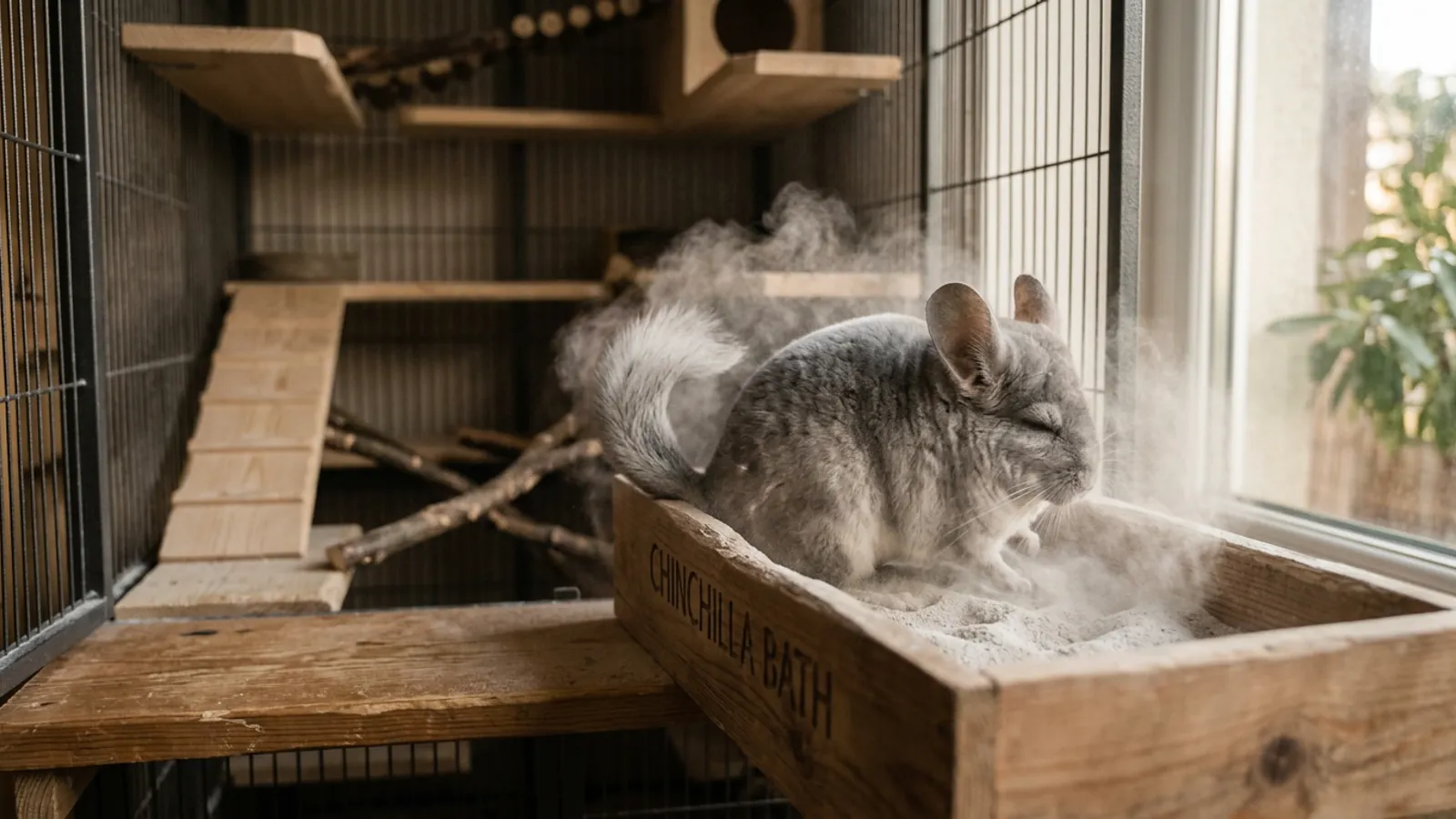
When people search for a chinchilla bathroom, they usually mean one of two things, and both matter to keeping the animal healthy. Sometimes they mean the dust bath, the ritual that stands in for every bath a chinchilla will ever take, because a chinchilla must never touch water. Other times they mean the literal question: where does the animal go to the toilet, and can you teach it to keep that mess in one place? I have kept chinchillas for about ten years, and I get asked about both versions of the question constantly, so this article covers both. The short answer up front: the dust bath is the only bath your chinchilla needs, and its toileting habits can be nudged but never fully controlled. The longer answer is where the real care lives.
What people mean by a chinchilla bathroom
There is a genuine reason this phrase is confusing. In a chinchilla's life, cleaning itself and relieving itself happen in completely separate places, and neither one works the way it does for a dog or a cat.
The cleaning half is the dust bath. A chinchilla keeps its coat clean by rolling in fine dust, not by getting wet, and that rolling is the closest thing it has to a shower. So when someone calls the dust bath the chinchilla's bathroom, they are not wrong in spirit. It is the grooming station, the spa, the thing the animal looks forward to.
The toileting half is separate. Chinchillas produce a lot of small, dry droppings, scattered wherever they happen to be, plus urine that goes in corners. There is no single tidy bathroom corner unless you build one and get lucky. Understanding both halves keeps you from making the two dangerous mistakes I see over and over: people trying to wash a chinchilla with water because they think dust is not enough, and people assuming a chinchilla will litter train like a rabbit. Neither holds. If you want the deep version of the grooming side, I wrote it up in the chinchilla dust bath, done right from dust to schedule; this article ties both sides together.
The dust bath is the only bath your chinchilla gets
Let me be blunt about the water question because it is the one that can harm the animal. A chinchilla's fur is the densest of any land mammal, with something like fifty to eighty hairs growing from a single follicle. That density is what keeps them warm in the cold Andes, and it is also why water is a trap. Water soaks into that coat and cannot dry out fast at the skin, and damp fur held against the skin grows fungus and rots. A wet chinchilla can chill dangerously or develop a skin infection you will not see until it is well underway. So there is no bathtub, no sink, no "just a quick rinse." Ever.
What replaces water is dust, and not any dust. The right material is fine volcanic pumice, a soft powdery grit that slips down between the hairs, absorbs oil and moisture, and carries it back out when the chinchilla shakes off. I go into exactly what the dust is and is not in what bathing dust for chinchillas really is, and how to use it, because people sometimes buy sand or craft dust and wonder why their chinchilla's skin is a mess. Buy dust sold specifically for chinchillas. Lixit Blue Beauty chinchilla dust, 3 lb As an Amazon Associate I earn from qualifying purchases. A purpose-made bath house with proper chinchilla dust is the whole setup. Sand scratches, and the wrong grade of dust either does nothing or irritates the skin.
Setting up the dust bath and how often to offer it
The bath itself should be a container the chinchilla can climb fully into and turn around in, deep enough that the dust stays put when the animal flips. Many people use an enclosed house with a single opening because it keeps most of the flung dust inside rather than coating the room, and a chinchilla will happily dive in. Put in about an inch or two of dust, enough to roll in, not so much that it is wasteful.
Offer the bath two to three times a week, for roughly ten to fifteen minutes each time, and then take it out. That last part matters as much as the schedule. A dust bath left in the cage all day becomes a litter box: the chinchilla urinates and defecates in it, then rolls in the soiled dust, which defeats the entire point. Leaving dust available around the clock also lets the animal over-bathe, and too much dust strips the coat's natural oils and leaves the skin dry, flaky, and itchy. So the routine is simple: put it in, let them roll, take it out.
How often within that two to three range depends on your home. In a humid climate or a damp season, coats hold moisture and you may lean toward the higher end. In a very dry environment, less is plenty, and you watch the skin for dryness. I will say plainly that the exact ideal frequency is not settled to a single number, and anyone quoting you a precise one is guessing. Start at three times a week, look at the coat and skin, and adjust. A greasy, clumpy coat means bathe more often; flaky skin and scratching means less.
Where a chinchilla goes to the toilet
Now the other bathroom. Chinchilla droppings are the easy part of ownership. They are small, dry, firm oval pellets, and a healthy adult produces a lot of them, dozens a day, dropped wherever the animal is moving. They have almost no smell, they do not stain, and they sweep or vacuum up cleanly. There is no controlling where they land, and there is no need to. This is one of the reasons chinchillas are cleaner housemates than people expect, a point I make in chinchilla as pets, after ten years of keeping them.
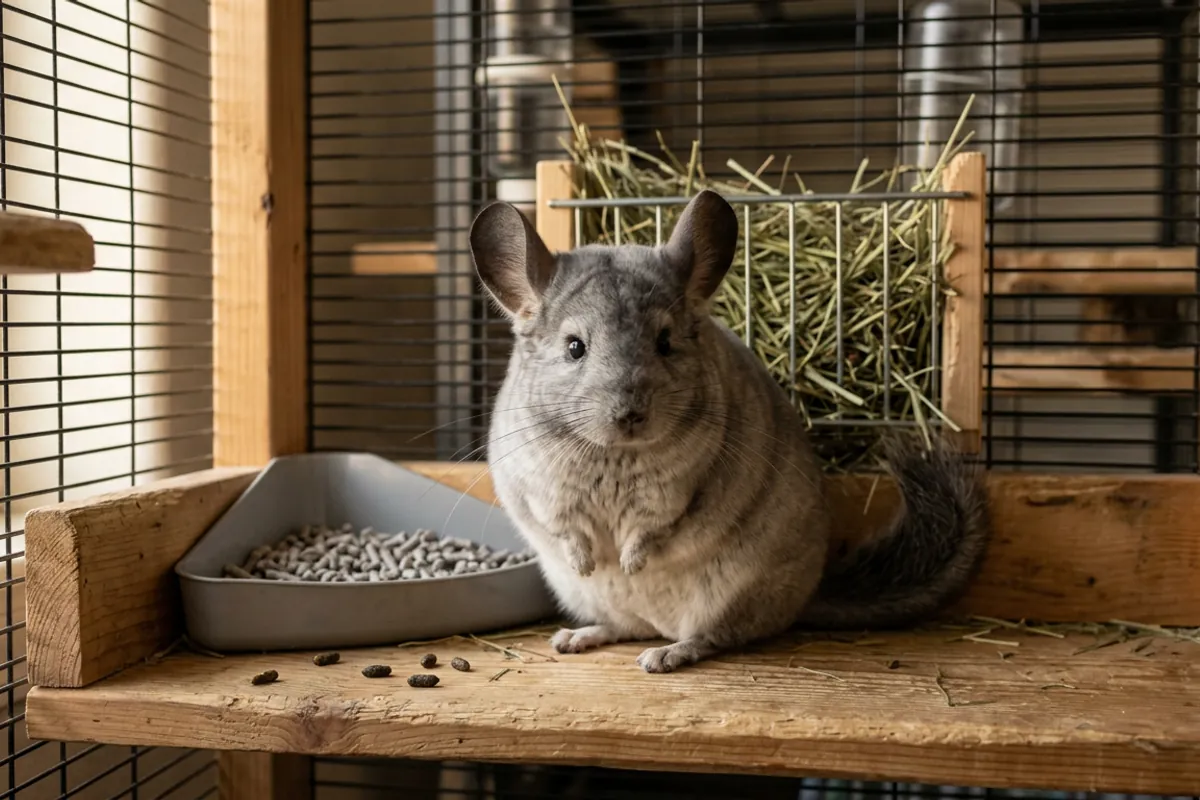
Urine is the part with an odor, and chinchillas do tend to pick favorite spots for it, usually a corner or under a ledge. This is the behavior you can sometimes work with, and it is why the litter question is worth its own section. But set your expectation now: you are managing urine placement, not droppings. The pellets go where the chinchilla goes.
The pellets are also one of your best daily health readouts, which is why I never treat cage cleaning as purely cosmetic. I will come back to what they tell you at the end.
Can you litter train a chinchilla
Partly, and only for urine. Some chinchillas take to a small litter pan placed in the corner they already favor, especially if you seed it with a few of their own droppings and some soiled bedding so it smells right. Because they are creatures of habit, a chinchilla that has chosen a urine corner will often keep using a pan you put there. That is the trick: you are not teaching a new habit so much as putting a container under an existing one.
Manage your expectations, though. Many chinchillas never bother with a pan, droppings will still scatter across the cage regardless, and a chinchilla that has decided on a different corner will not be argued out of it. If it works, treat it as a bonus that makes spot cleaning easier, not as a system you can rely on.
The litter you use matters for safety. Do not use clumping clay cat litter, ever. If a chinchilla nibbles it, and they nibble everything, it can swell and clump inside the gut. Skip scented litters and any wood shavings with strong aromatic oils, which is the same caution I give about pine and cedar in bedding. Safe choices are paper-based pelleted litter or kiln-dried pine pellets, both of which absorb urine and its smell without the oils. And never fill the pan with bath dust as a shortcut, because then the chinchilla will roll in a soiled toilet, which brings us right back to the problem the removable dust bath is meant to prevent.
Keeping the whole cage bathroom-clean
Because droppings land everywhere, cage hygiene is a daily habit rather than a weekly event, and the cage design either helps you or fights you. A tall cage made of metal and wood, with solid wooden ledges rather than wire floors, is far easier to keep clean and far kinder to the feet. Critter Nation double unit small animal cage As an Amazon Associate I earn from qualifying purchases. Wire floors let droppings fall through, which sounds convenient until you realize they also cause bumblefoot, painful sores from standing on wire. I would rather sweep a solid ledge. If you are still choosing a cage, how to choose a chinchilla cage without buying the wrong one twice walks through what matters.
My routine looks like this. Every day I scoop out the visible droppings and wipe the urine corner or empty the litter pan, and I refresh water and hay. Every week or so I do a deeper clean: change the bedding, wipe the ledges, and check the wooden shelves and chews for urine-soaked spots, because wood that stays wet grows bacteria and mold. Wooden ledges that get regularly soiled should be scrubbed and fully dried, or replaced. This is also when I check the chew toys, since a chinchilla with plenty to gnaw keeps its teeth worn down and, not incidentally, chews less on the things you would rather it left alone. emours apple wood chew sticks, 40 count As an Amazon Associate I earn from qualifying purchases.
For bedding under the cage, kiln-dried pine or paper-based bedding both work and both control odor. Avoid anything scented, avoid cedar, and avoid the temptation to mask smell with air fresheners near the cage, since a chinchilla's respiratory system is sensitive.
One thing I want to connect here, because people miss it: hay and bathroom output are linked. A chinchilla eats unlimited grass hay first, with a measured amount of plain pellets as a supplement, and that fiber-heavy diet is exactly what produces those dry, tidy, frequent droppings. When the hay slips and the diet drifts toward treats or too many pellets, the droppings are the first thing to change. Keeping good hay in front of them at all times is a bathroom decision as much as a feeding one. Oxbow Western Timothy Hay, 40 oz bag As an Amazon Associate I earn from qualifying purchases. For a household with more than one chinchilla, buying in bulk saves both money and trips. Oxbow Western Timothy Hay, 9 lb box As an Amazon Associate I earn from qualifying purchases. I lay out the whole feeding logic in chinchilla diet, food, and hay.
Heat, dust, and why the bathroom routine changes in summer
I cannot write about the dust bath without saying something about heat, because the two intersect in a way that has scared me personally. My chinchilla Pebble came out of an overheated attic, and her first summer brought a heatwave near-miss and a night at the emergency vet. That is why I am relentless about temperature, and why I bring it up in an article about bathing.
Chinchillas are comfortable at 60 to 70°F (15 to 21°C). Above about 75°F (24°C) you are in risky territory, and 80°F (27°C) and up is a genuine emergency, faster and more deadly when the air is humid, because that dense coat cannot shed heat and chinchillas do not sweat. The reason this touches the bathroom routine is that a hot, panting chinchilla should not be shut into an enclosed dust house where air is still and heat pools. On a hot day I skip or shorten the bath rather than trap the animal in a warm box for its own grooming. Cooling comes first.
Practical cooling means a chilled surface the chinchilla can lie against to pull heat out of its body. Kaytee Chinchilla Chiller granite stone As an Amazon Associate I earn from qualifying purchases. And you cannot manage a temperature you are not measuring, so a thermometer and hygrometer on the cage is not optional in warm weather. digital thermometer and humidity gauge with remote probes As an Amazon Associate I earn from qualifying purchases. If any of this is new to you, please read Chinchilla Heat Stroke: Warning Signs Every Owner Should Know and keep the chinchilla heat danger calculator handy. Heat is the fastest way to lose one of these animals, and I will never soften that.
When bathroom habits are telling you something is wrong
The best reason to stay on top of the bathroom is that it is a daily health report, and chinchillas are prey animals that hide illness until it is advanced. You will often see trouble in the droppings before you see it anywhere else.
Watch for these. Droppings that shrink, dry out, or drop sharply in number can mean the gut is slowing, which is serious in an animal built to process fiber constantly. Very few or no droppings, especially with a hunched, quiet chinchilla that is off its hay, points toward gut stasis or a blockage, and that is an emergency, not a wait-and-see. Soft, mushy, or truly runny droppings mean the diet or the gut is off. Any blood, or a sudden change in how much or how often the animal urinates, or obvious straining and discomfort in the urine corner, all warrant a call.
I am an experienced keeper, not a vet, and that is not true. What I can tell you is what a change looks like and when it is urgent; what I cannot do is diagnose or treat it. For any of the signs above, the right move is an exotics vet who knows small mammals, and sooner rather than later. Dental disease sits behind a lot of appetite and dropping changes too, which is why I watch the eating end as closely as the output end. My chinchilla Juniper came to me with dental disease I still manage day to day, and hers was the case that taught me how fast a chinchilla's whole system follows its teeth. If you want the signs to watch, Chinchilla Teeth Problems: Spotting Malocclusion Before It Turns Serious covers them.
Put together, the chinchilla bathroom is really two habits you tend every day: the dust bath that keeps the coat clean without ever touching water, and the toileting you manage rather than control. Keep the dust bath removable and on a sensible schedule, keep the cage swept and the hay unlimited, respect the heat, and read the droppings like the daily report they are. Do that, and the bathroom side of chinchilla keeping stays one of the easy parts.