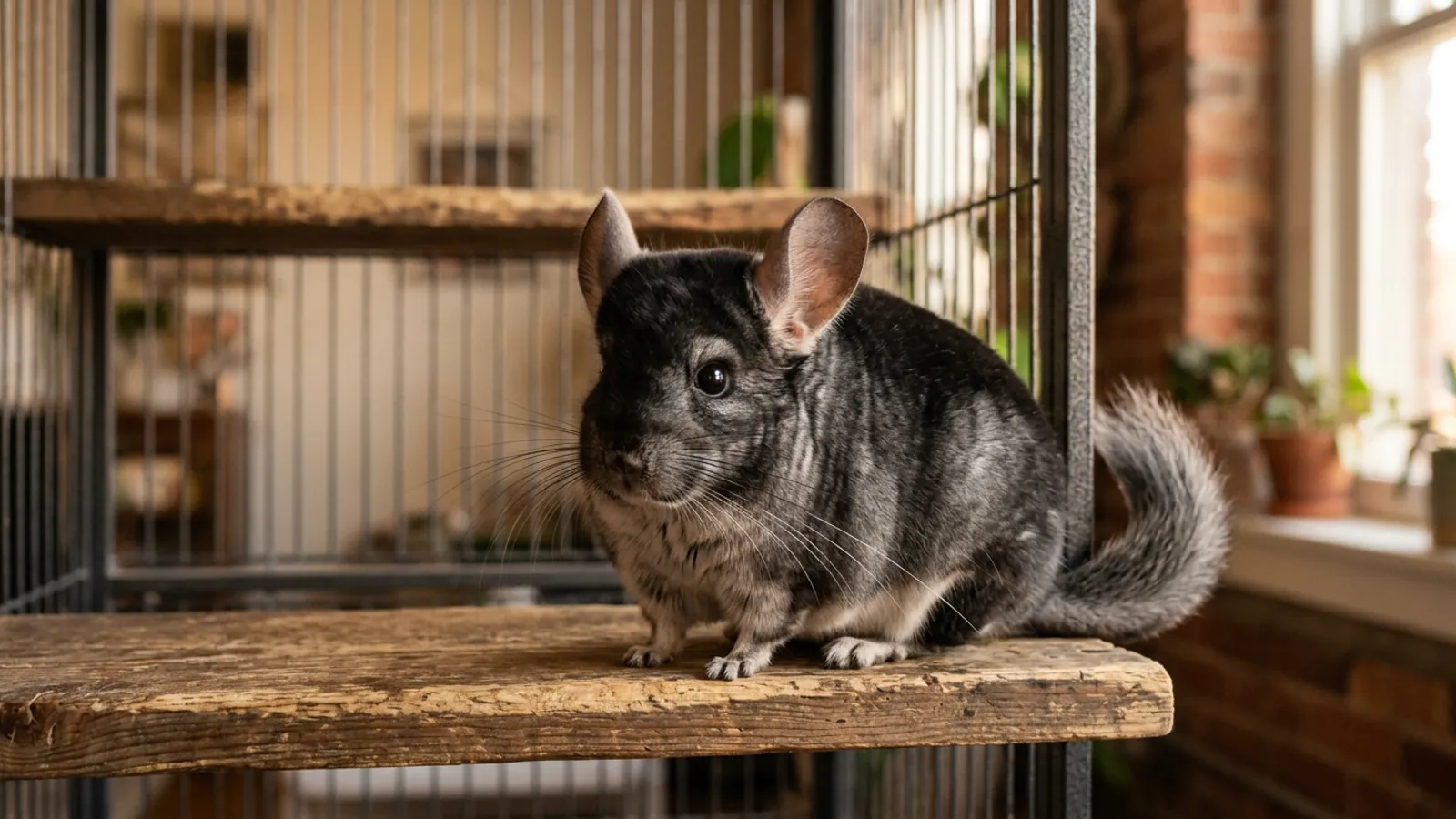
Black pearl chinchillas show up in breeder listings and pet-shop ads with a name that sounds like a jewel, and that is more or less the point. It is a color name, not a breed and not a separate species, and the small premium that sometimes rides on it is buying a look and nothing else. I have kept chinchillas for about ten years, and whenever a fancy color name lands in front of me the question underneath it is always the same: does this change how I care for the animal? For a black pearl it does not. The coat carries a different tone and a different shine. Every rule that keeps the animal alive is identical to the one my standard gray, Pebble, lives by.
What a black pearl chinchilla is
There is no single gene called "black pearl." The name describes a combination of color mutations stacked in one animal, and because no registry polices how breeders use it, the exact recipe behind any given black pearl varies from one breeder to the next. The most common version is a violet chinchilla that also carries the touch-of-velvet gene, what breeders shorten to TOV. Some breeders deepen the effect further with ebony, the mutation that pushes dark pigment down into the belly and adds gloss.
You will also see the same coat sold under other names, because color labeling in this hobby is loose. What one breeder calls a black pearl, another might list as a TOV violet or simply a dark violet, and a third might use "black pearl" for something with ebony in the mix instead. None of them is lying, exactly. They are all describing roughly the same smoky, glossy look through whichever name sells best, which is why the label tells you less than the animal in front of you does.
If you want the pieces on their own, I have written them up separately: the violet is a soft gray with a lilac cast and a white belly, the velvet gene is what gives a black velvet its dark veiling across the back and face, and stacking them is where the smoky "black" and the pearly sheen in the name come from. None of that is exotic once you take it apart. It is two or three well-known mutations that happen to look striking together.
I say all of this plainly because the name does real work in a sales listing. "Black pearl" reads as rare and precious. What you are looking at is a chinchilla whose ancestors were bred to carry a particular set of color genes, sold to you under the most flattering label those genes allow.
Where the name comes from
The "black" is the velvet veiling. In a touch-of-velvet animal, dark pigment lies heaviest over the spine and shoulders and washes down the sides, and the face often carries a darker mask. The "pearl" is the sheen: violet and ebony both tend to give the coat a soft, almost metallic luster in good light, so a well-bred example can look like it has a wet gleam even though the fur is bone dry.
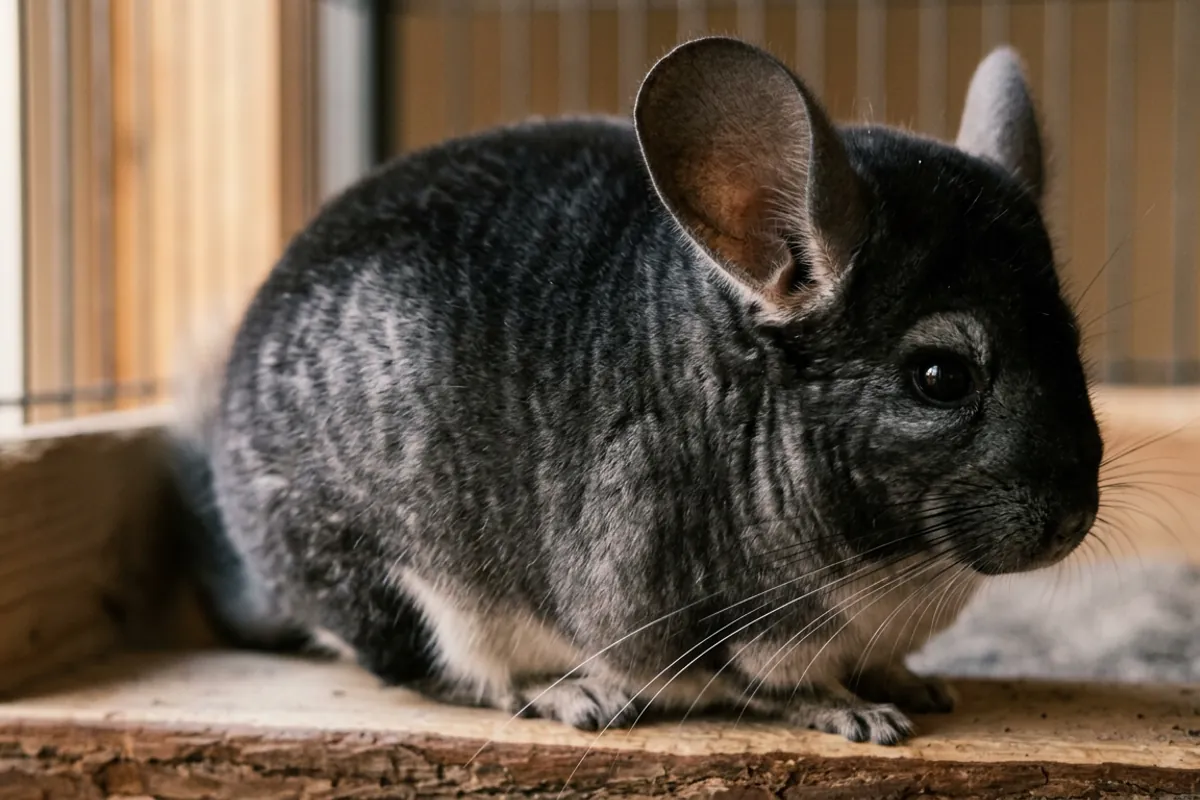
That gleam matters for one reason only. A chinchilla should never be shiny because it is damp. If your black pearl looks slick or clumped rather than softly lustrous, that is not the color, that is a wet coat, and a wet chinchilla is a genuine problem because their dense fur cannot dry the way ours does. The pearl look is dry sheen. Water on that coat is an emergency in slow motion.
What the color never changes
Here is the part I care about most, and it is the same thing I say about every color article on this site. The mutation changes the picture and nothing else. A black pearl is not more delicate, not more robust, not smarter, not friendlier, and not born needing some special diet. It is a chinchilla. It wants the same three things every chinchilla wants: a cool room, unlimited hay, and dust to bathe in.
The genetics behind the coat sit entirely in the pigment. They do not touch the gut, which still runs on grass. They do not touch the teeth, which still grow for the animal's whole life. They do not touch the near-total inability to shed heat, which is the thing that will hurt them first if you get it wrong. I have watched keepers pay extra for a rare color and then house it in a small plastic cage in a warm room, and the color did not save that animal one degree. If you take one thing from this whole piece, take that: rare color labels never buy you a margin on care.
None of this is me talking down a beautiful coat. I like how a black pearl looks as much as anyone. It is me refusing to let the color do work it cannot do. A black pearl can live the same long life any chinchilla can, well into its teens and sometimes beyond with steady care, and it gets there on the exact same husbandry that carries a plain gray. If anything, a fancy color is a reason to be more careful, not less, because it is easy to let the novelty distract from the boring fundamentals that keep the animal alive.
Does a darker coat overheat faster
This is the question I get most about any dark chinchilla, black pearl included, and the answer is more careful than a simple yes or no. Coat color has a real effect on how a surface absorbs radiant heat in direct sun. But a chinchilla should never be in direct sun in the first place, and indoors, under normal room light, the color of the fur is not what decides whether the animal cooks. What decides it is the same for a black pearl as for a white one: air temperature, humidity, and the near-total lack of a way to dump heat.
So I do not treat my darker chinchillas as more heat-prone than the gray ones. I treat all of them as animals that live on a knife edge above room temperature. The comfortable range is 60 to 70°F, which is 15 to 21°C. Above 75°F, about 24°C, you are into risky territory. At 80°F, roughly 27°C, and up, it is an emergency, and it comes faster when the air is humid because a chinchilla in a warm humid room has almost no route left to cool down.
I am relentless about this because Pebble taught me the hard way. Her first summer brought a heatwave, I misjudged the room, and we ended up at the emergency vet overnight for heat stress that came on faster than I believed possible. Nothing about her being a standard gray made that slower or faster than it would have been for a black pearl. The lesson was about the animal, not the color. Put a real thermometer in the room, at cage height, and read it. digital thermometer and humidity gauge with remote probes As an Amazon Associate I earn from qualifying purchases. A cheap thermometer and hygrometer that also shows humidity is one of the few pieces of kit I would call non-negotiable, and if you want to see how heat and humidity combine, the heat danger calculator on this site does the math for you.
When a room creeps up despite your best effort, a chilled solid surface gives the animal somewhere to dump heat through its feet and belly. I keep a cooling stone in the freezer through summer and rotate it in. Kaytee Chinchilla Chiller granite stone As an Amazon Associate I earn from qualifying purchases. It is a stopgap, not air conditioning, and I will say plainly: if you cannot hold the room under about 75°F, that is a housing problem to fix before you bring any chinchilla home, black pearl or otherwise.
The care that stays identical
Feed hay first, and feed it without limit. Grass hay, timothy or a similar meadow grass, is not a side dish, it is the meal, and it is what keeps the gut moving and the teeth worn down. Oxbow Western Timothy Hay, 40 oz bag As an Amazon Associate I earn from qualifying purchases. Plain pellets go alongside it as a measured supplement, a tablespoon or two a day, not as the main event. I have covered the hay-first diet at length, but the basics do not change for a fancy color: unlimited grass hay, a small measured scoop of plain pellets, fresh water, and treats kept to a rare pinch of something safe.
Teeth are the other thing I never relax about, because my second chinchilla, Juniper, came to me with dental disease and I manage it day to day. Chinchilla teeth grow continuously, and the only thing that keeps them in check is chewing, hay above all, plus a real variety of safe wood to gnaw. emours apple wood chew sticks, 40 count As an Amazon Associate I earn from qualifying purchases. A black pearl's teeth grow exactly as fast as Juniper's. Give it plenty to wear them on, and watch for drooling, dropped food, or weight loss, which are signs it is time for an exotics vet, not something you fix at home.
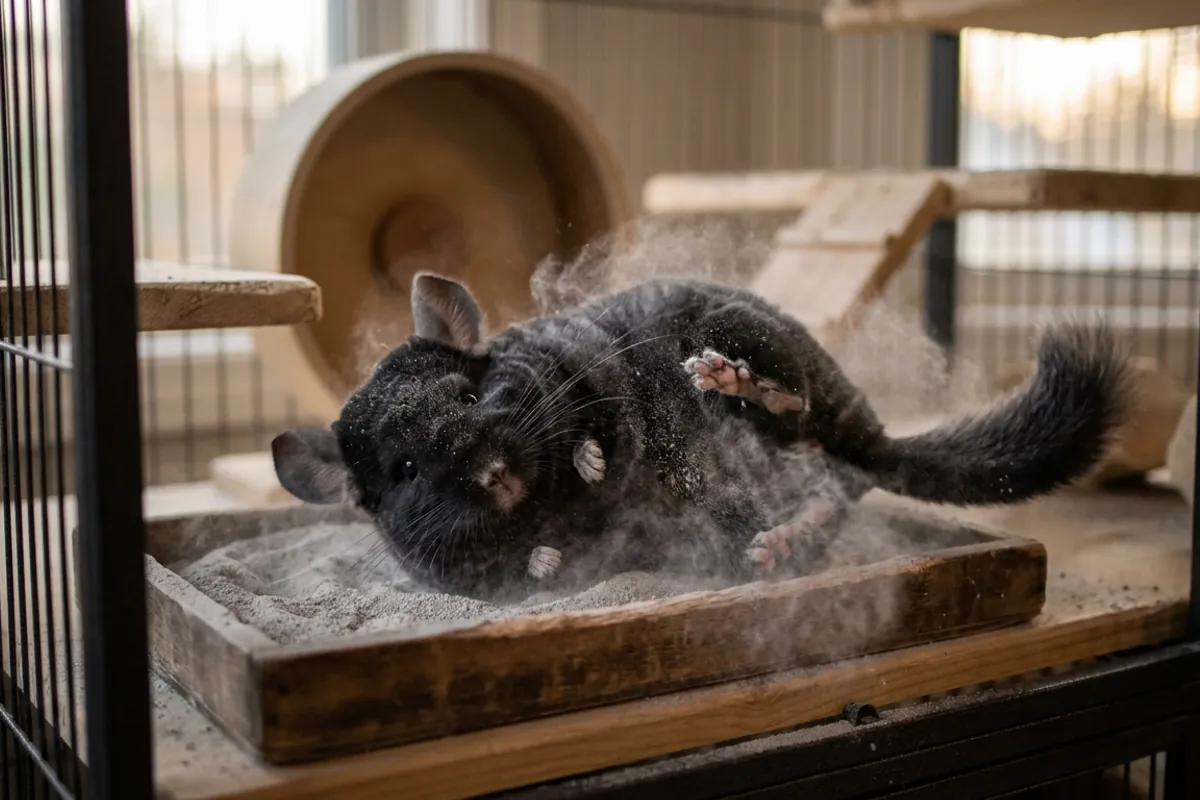
Bathing is dust, never water. Chinchillas clean their coat by rolling in fine volcanic dust that lifts oil and moisture out of the fur. A black pearl needs the same two or three dust baths a week as any other. Lixit Blue Beauty chinchilla dust, 3 lb As an Amazon Associate I earn from qualifying purchases. The pearly sheen in the name looks its best on a chinchilla that dust-bathes on a good schedule, because clean dry fur is what catches the light. Water bathing would flatten that coat and put the animal at real risk, so it never happens.
Housing does not care about color either
The cage rules are the same too. A chinchilla needs a tall metal cage with wooden ledges, room to climb, and nothing plastic within reach of its teeth. Critter Nation double unit small animal cage As an Amazon Associate I earn from qualifying purchases. Height matters more than floor space because these animals are climbers and jumpers, and I have laid out the full cage setup elsewhere. If you add a wheel, it has to be a solid running surface with no rungs or mesh, because wire wheels catch feet and tails and cause real injuries. 15 inch Chin Spin solid surface chinchilla wheel As an Amazon Associate I earn from qualifying purchases. A black pearl is no more or less clumsy than any chinchilla, which is to say it will find a way to hurt itself on bad equipment given the chance.
I name bad gear plainly because color premiums often come bundled with bad advice. A breeder charging extra for a rare coat is not automatically wrong, but the setup a chinchilla needs does not scale with what you paid for it. Cheap cage, wire wheel, plastic hideout, warm room: those are the things that shorten a life, and they do it to a jewel-named chinchilla just as readily as to a five-dollar-cheaper gray.
What to check before you pay
If a black pearl is the chinchilla you want, want it for the look, with your eyes open about what the look costs. Expect to pay more than a standard gray, sometimes considerably more, but understand that the price is a color premium, not a quality or health guarantee. A striking coat on a poorly raised, unsocialized, or sick animal is a bad buy at any price.
So look past the color. Ask to see the animal moving normally, eating hay, with clean eyes, a dry chin, and even teeth if the breeder will show you. Ask how it was raised and handled. If the seller talks only about the color and dodges questions about health, temperature, and diet, that tells you what they care about. I have written up buying a chinchilla if you want the full checklist.
One more thing, for anyone thinking further ahead than a single pet. The velvet gene that gives a black pearl its dark veiling carries a well-known breeding catch: pairing two velvet-carrying animals together is widely avoided among breeders because the doubled-up gene is believed to be lethal to a share of the litter. That is breeder territory, not pet-owner territory, and if you are considering breeding at all it is a reason to learn the genetics properly first rather than pairing two pretty coats and hoping. As a pet, a black pearl asks nothing of you that a plain gray does not. Buy it for the animal, keep it by the same rules, and let the pearl be a bonus rather than the point.