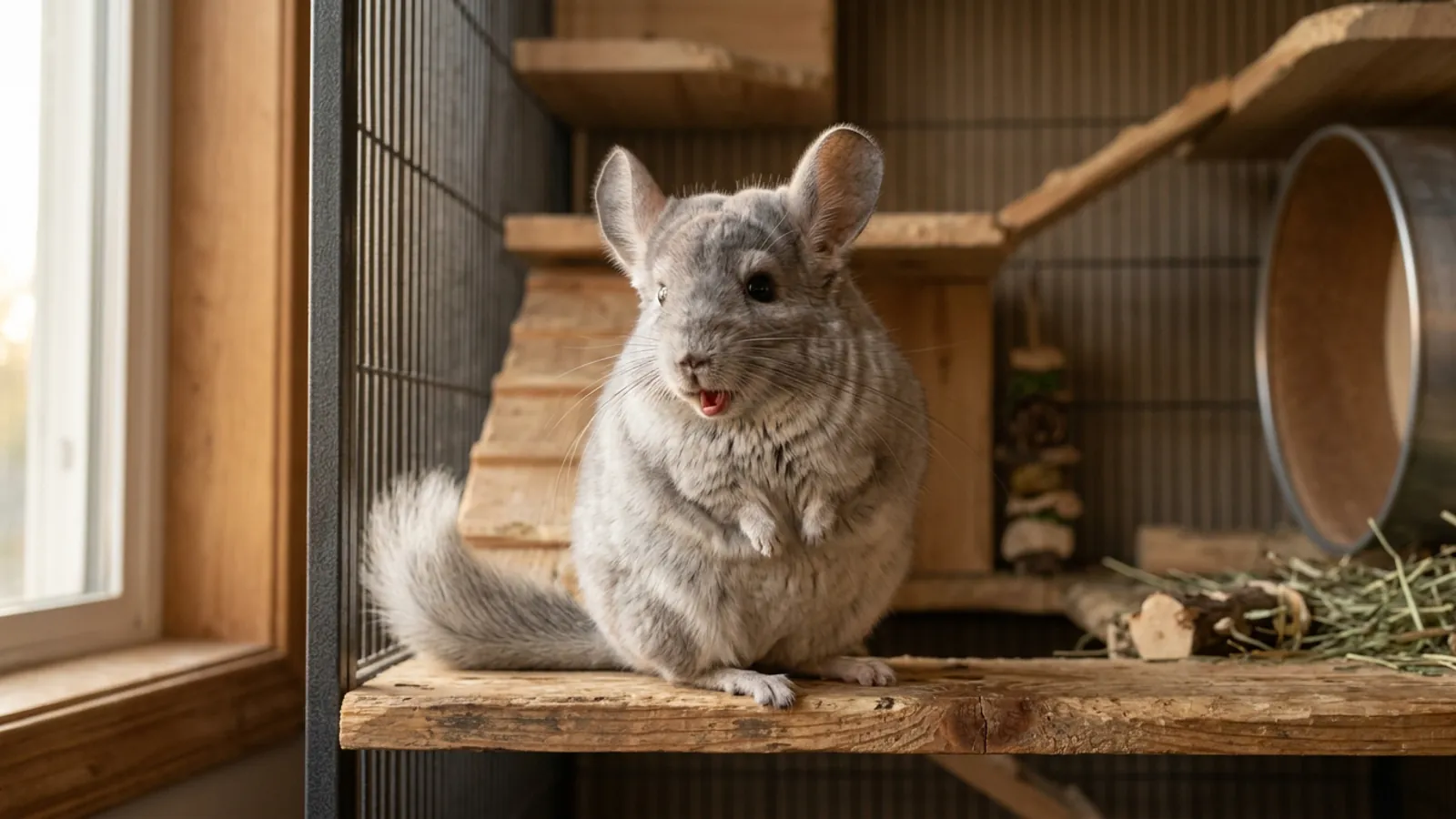
Chinchillas look like they should be silent. A soft gray animal that spends the day dozing in a corner does not seem like it would have much to say. Then you live with one, and you find out that chinchilla sounds are a whole language, running all day and half the night. Pebble talks to me constantly, and after about ten years of listening I have learned that most of it is not random noise. It is information. A chinchilla tells you when it is content, when it is scared, when it wants to be left alone, and when something is genuinely wrong, and it tells you in a surprisingly small set of sounds that you can learn to read. This is the guide I wish I had when Pebble first started making a racket at two in the morning and I had no idea whether to worry.
Why a quiet-looking pet is so vocal
Chinchillas are prey animals from the Andes, and prey animals survive by communicating without being seen. In the wild they live in colonies among the rocks, and a colony that can pass warnings and stay in contact through sound is a colony that keeps more of its members alive. That instinct did not switch off in captivity. Your single pet chinchilla still has the full vocabulary of a colony animal, and it will use it on you because you are its colony now.
That is the first thing to understand about chinchilla sounds and meanings: they are social, not decorative. A sound is aimed at someone. When you learn to hear who a sound is aimed at and what it is asking for, the noise stops being mysterious. It becomes the most honest read you have on how your animal is doing, which matters, because a chinchilla will hide illness until it cannot, and its voice often cracks before its body visibly does.
I want to be plain here at the start. I am an experienced keeper, not a vet. Sounds are a fantastic early-warning system, but they are a reason to look closer and sometimes a reason to call an exotics vet, never a diagnosis on their own.
Contact calls and the soft chatter of a settled chinchilla
The everyday sound, the one you will hear most, is a soft, rhythmic chirping or squeaking. Keepers usually call these contact calls. A relaxed chinchilla makes them the way you might hum around the house: low stakes, just checking in. Pebble does a gentle back-and-forth squeak when I am in the room doing chores, and it clearly means something close to "you are there, I am here, all is well."
You will also hear a quiet grinding or clicking that comes from the teeth, not the throat. A content chinchilla grinding its teeth softly while it dozes is the equivalent of a cat's purr. It is one of the best sounds in the house. Do not confuse it with the loud, sharp teeth chattering that signals a warning, which I will come back to. The contentment version is soft, slow, and paired with a loose, half-asleep body.
A chinchilla working through a pile of hay makes its own steady, busy crunching, and that sound is worth loving too, because a chinchilla that is eating hay well is a chinchilla whose gut and teeth are doing what they should. Hay is the whole foundation of their health, so I keep the rack full at all times. Oxbow Western Timothy Hay, 40 oz bag As an Amazon Associate I earn from qualifying purchases. If you want the reasoning behind why hay comes first and pellets are only a small measured supplement, I go into it in what can a chinchilla eat.
The alarm bark, and learning your chinchilla's version of it
The single most important chinchilla sound to recognize is the alarm bark. It is loud, sharp, and repetitive, a hard "eck, eck, eck" that does not sound cute at all. In a colony it means danger, and a chinchilla will fire it off at a sudden noise, an unfamiliar smell, a cat at the window, or sometimes something you cannot identify at all.
Here is the part nobody tells you: every chinchilla's bark is a little different, and every chinchilla barks at different things. Some are jumpy and bark at the vacuum every time. Some are stoic and only bark when they are truly alarmed. You have to learn your own animal's baseline. Pebble barks rarely, so when she does, I get up and look, because for her it means something real. If your chinchilla barks constantly at nothing, that is worth noting too, because a chronically alarmed animal is a stressed animal, and stress is bad for their gut and their coat.
A bark is not a behavior problem to be corrected. It is a report. The right response is to figure out what triggered it and remove the trigger if you can, not to tell the animal off. Punishing an alarm call just teaches a prey animal that its home is unpredictable, which is the opposite of what you want.
Popcorning, chirping, and what a happy chinchilla looks like
Now the fun part. A happy chinchilla is loud in a completely different register. During play, especially out-of-cage time in a safe room, you will see chinchilla popcorn: sudden vertical jumps, twists in the air, bouncing off walls and furniture like the floor is electric. Popcorning is pure joy and excess energy, and it is usually paired with quick, bright little chirps that sound nothing like the alarm bark.

The first time you see it you might panic, because a chinchilla ricocheting around the room at full speed looks alarming. It is not. It is the single clearest sign you have that your animal feels safe enough to let go. A chinchilla will not popcorn in a place it is frightened of. So the chinchilla popcorn is worth more than any noise a happy chinchilla makes, because it is your animal voting with its whole body that its life is good.
You will also get happy chirps during a dust bath. A chinchilla rolling in fine volcanic pumice dust is doing the thing its whole coat is built for, and many chinchillas chatter and chirp with obvious pleasure through it. If you are new to dust bathing, the chinchilla dust bath, done right walks through the schedule, and I use a deep, heavy bath house that they cannot tip. Lixit Blue Beauty chinchilla dust, 3 lb As an Amazon Associate I earn from qualifying purchases. Remember that this is the only kind of bath a chinchilla ever gets. They never bathe in water, and getting the dense coat wet is dangerous, so keep water baths off the table entirely.
The sounds that mean trouble
This is the section I most want you to read closely, because some chinchilla sounds are your first warning that an animal is sick or in pain, and reading them early buys you time.

The loud version of teeth grinding, the sharp, fast chattering paired with a tense body, is a warning, not contentment. A chinchilla chattering its teeth at another chinchilla, or at you, is saying back off. Take it seriously during handling and especially during introductions.
Watch for a hunched posture with loud, insistent teeth grinding when there is nothing to be defensive about. In a chinchilla that is not facing a threat, that pattern can mean pain, and dental pain is one of the most common sources. Juniper, my rescue, has dental disease I manage every day, and I have learned that changes in how she sounds while eating, more grinding, less steady crunching, drooling, dropping food, are worth acting on fast. Overgrown teeth are miserable and can be fatal, and by the time you can see it from the outside it is often advanced. Constant chewing on the right materials is how healthy teeth stay worn down, so I keep a real variety of safe wood chews in the cage at all times. emours apple wood chew sticks, 40 count As an Amazon Associate I earn from qualifying purchases. If any of this is new to you, chinchilla teeth problems covers what malocclusion looks like before it turns serious.
The one sound that should always move you toward the phone is a wheeze. A whistle on the breath, labored or noisy breathing, or repeated sneezing with discharge is not something to watch and wait on, and sides heaving with effort is an exotics vet call rather than a home-remedy situation. Those sounds are a reason to book rather than to wait and see what they turn into.
Heat makes breathing worse and adds its own sounds. A chinchilla in heat distress may breathe loudly and pant, and panting in a chinchilla is an emergency, not a quirk. Their comfortable range is 60 to 70°F (15 to 21°C). Above 75°F (24°C) gets risky, and 80°F (27°C) and up is a genuine emergency, faster in humid air. Pebble came to me out of an overheated attic, and her first summer brought a heatwave near-miss and a night at the emergency vet, which is exactly why I refuse to soften this. I keep a thermometer with humidity on the cage so I am reading the room, not guessing. digital thermometer and humidity gauge with remote probes As an Amazon Associate I earn from qualifying purchases. A chilled stone gives them a cool surface to stretch out on when the room creeps up. Kaytee Chinchilla Chiller granite stone As an Amazon Associate I earn from qualifying purchases. If you want the full picture of what overheating looks like, chinchilla heat stroke warning signs and the heat danger calculator are the two things I point every new owner at.
Reading sounds while bonding chinchillas
Sound becomes critical when you are introducing two animals, because bonding chinchillas is where things can turn from tense to dangerous in seconds, and the sounds are your play-by-play.
Chinchillas are territorial, and a bad introduction can end in serious chinchilla bite wounds. During a careful introduction you want to hear the vocabulary and read it honestly. Soft chirps and mutual grooming noises are good. Loud alarm barks, sharp teeth chattering, and a high, wavering squeal are the sounds of a chinchilla that is frightened or about to fight. If you hear escalating chatter and see raised fur, cornering, or spraying urine, that is your signal to separate them before anyone gets hurt, not after.
Real bonding with a chinchilla, whether that is between two chinchillas or between you and your animal, is slow and cannot be forced. Whether to pair at all, and what fighting means, is do chinchillas need a friend. I do introductions on neutral ground, in short sessions, with the ability to separate instantly, and I let the sounds set the pace. A chinchilla that goes quiet and settled next to another is telling you the introduction is working. A chinchilla that stays loud and tense over multiple sessions is telling you it is not, and pushing through that is how you get injuries. Some pairs never bond, and that is a legitimate outcome, not a failure of effort.
Bites during a fight need real attention. A chinchilla bite wound can look minor under the fur and still abscess, and a wound you cannot fully see is a wound to have an exotics vet check. If two animals draw blood on each other, separate them for good until you have a proper plan, because a pair that has fought once will often fight again.
When a sound is a reason to call the vet
Most chinchilla sounds are ordinary life: contact chirps, contented tooth-purring, the busy crunch of hay, the bright chatter of a happy chinchilla mid-popcorn. Learning the ordinary is what makes the extraordinary jump out at you. That is the real skill. You are not memorizing a dictionary so much as learning one animal well enough to notice when it stops sounding like itself.
Here is my short list of chinchilla sounds and what they mean at the level of action. A soft chirp or gentle tooth-grind on a relaxed body means all is well, do nothing. A sharp alarm bark means find and remove the trigger. Loud teeth chattering means back off and, if it comes with a hunched posture and no threat around, look hard for pain, especially dental. Any chinchilla wheezing sound, labored breathing, panting, or repeated wet sneezing means call an exotics vet, and treat panting in heat as an emergency while you cool the room. Screaming, a loud distress cry, means something is badly wrong right now, and you go look immediately.
The through-line of everything I have learned in ten years is that the sound is the start of the investigation, never the end of it. Your ears tell you where to point your eyes and your hands. When the read comes back to a health question you cannot resolve at home, the answer is always the same, and I will keep saying it because it saves animals: get to an exotics vet. A chinchilla that is telling you something is wrong deserves to be believed the first time. For the wider picture of what living with these animals asks, chinchilla as pets, after ten years of keeping them is where I put the rest of it.