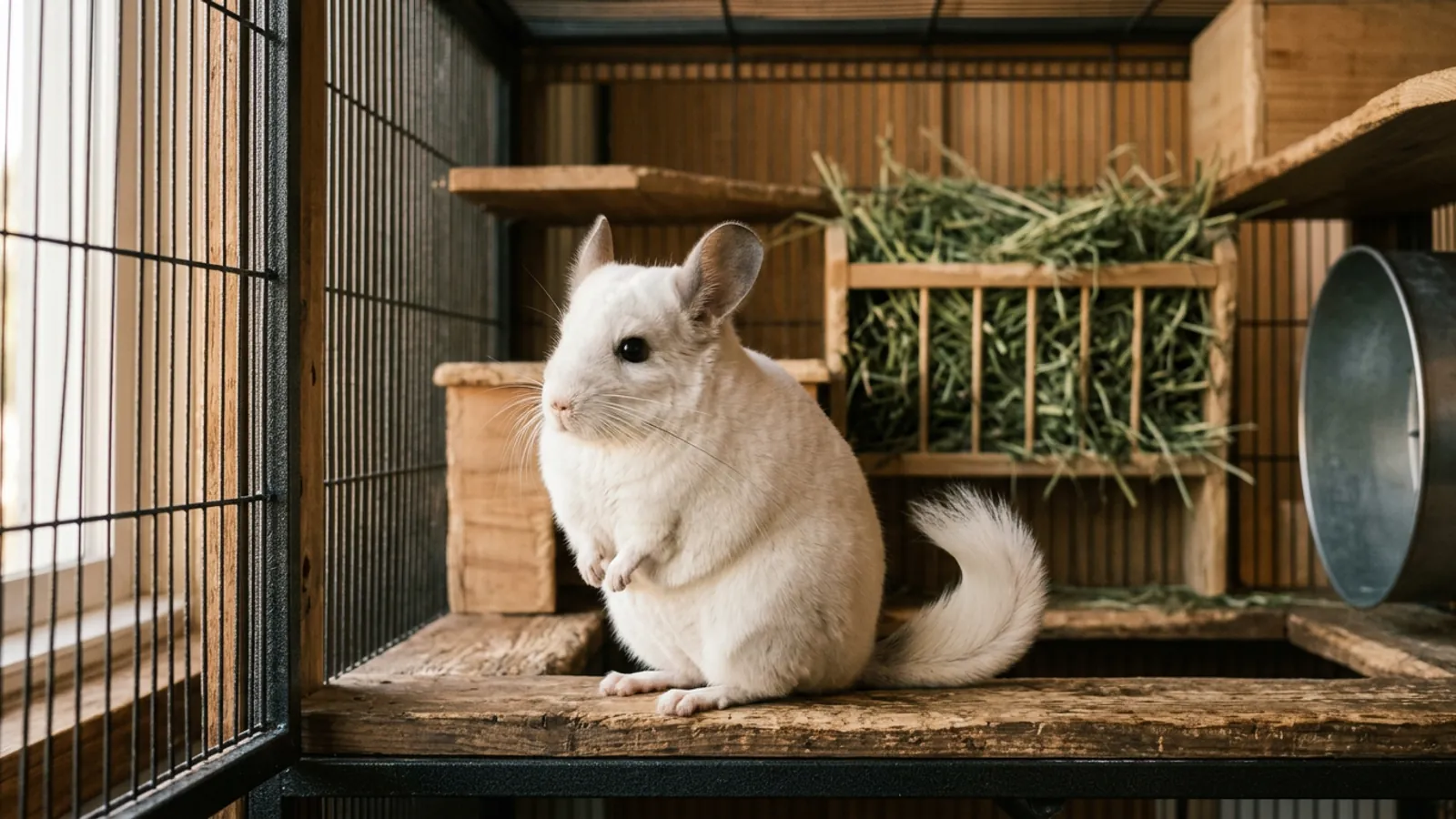
Type chinchilla white into a search bar and you get two very different things mixed together: photographs of snow colored rodents, and photographs of rabbits and cats that borrowed the name. I want to sort that out, because the confusion has a practical edge. People buy a white animal expecting something rarer, calmer, or more delicate than a gray one, and none of that holds up. White is a coat color. It is one gene doing a specific job, and it changes nothing about what the animal in front of you needs from you every day of its long life.
What a white chinchilla is
Every pet chinchilla alive today descends from a small founder group brought out of Chile in the early twentieth century. The wild coat is agouti gray: dark slate at the base of the hair, a pale band, a dark tip. That banding is what gives a standard gray its shifting, smoky look. Every other color you have ever seen in a pet chinchilla is a mutation that appeared in a ranch herd, got noticed, and got bred on.
The white most keepers meet comes from a single dominant gene, generally called Wilson White after the breeder credited with fixing it in the 1950s. Dominant matters more than the name. It means one copy is enough to show, so a white bred to a standard gray produces roughly half white kits, and there is no such thing as a hidden white carrier. If an animal does not look white, it is not passing that gene on.
A white chinchilla is not an albino. This is the single most common misunderstanding and it is worth being blunt about. Albinism removes pigment everywhere, including the eyes, which is why an albino animal has pink or red eyes and pale skin throughout. A white chinchilla usually has dark eyes, often visible pigment on the ear edges or scattered ear freckles, and frequently a bit of gray somewhere on the tail or across the back. The white gene restricts and dilutes pigment rather than deleting it. True albino chinchillas turn up as occasional anecdotes in breeding circles, but there is no established albino line in the pet population, and I would treat any listing claiming one with a lot of skepticism.
One more caveat before the names start flying. Chinchilla color vocabulary is hobby vocabulary. It was built by breeders and ranchers, not by a standards body, and different breeders use the same word for slightly different animals. When someone tells you what color a chinchilla is, the useful follow up question is always which genes are behind it.
The white varieties you will meet
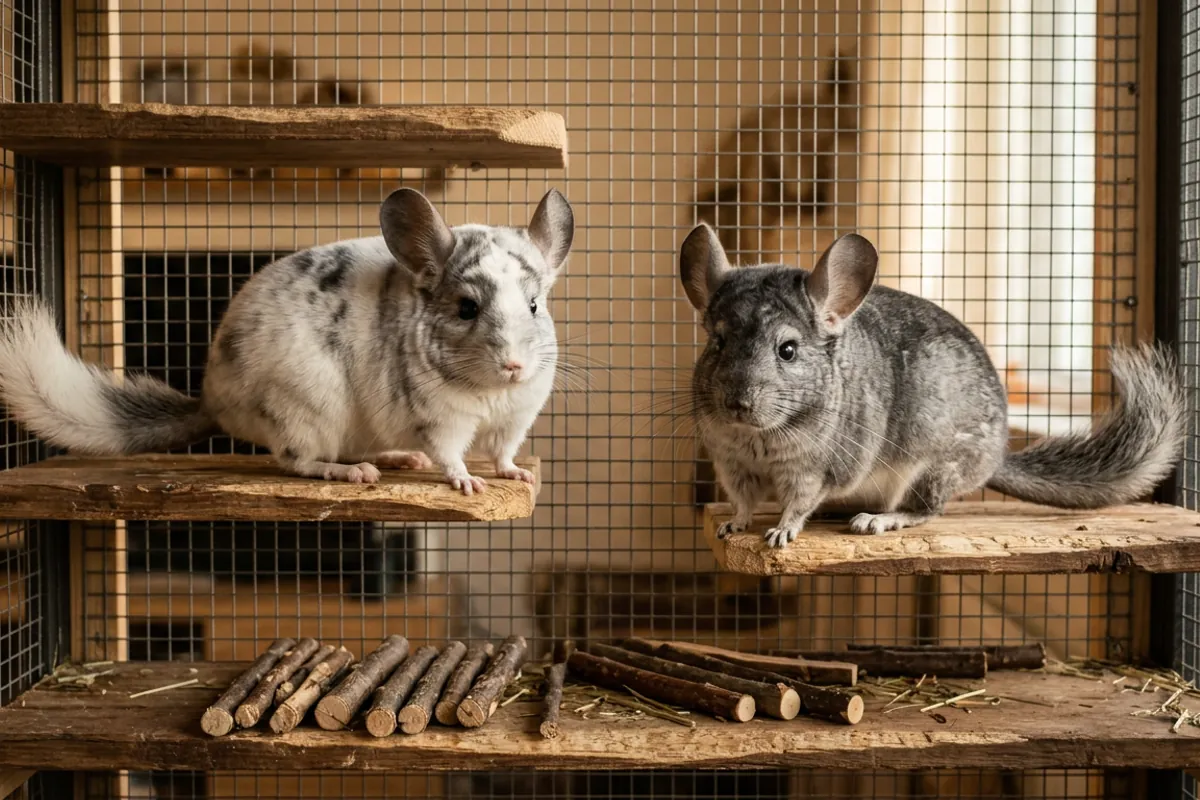
Silver, mosaic, and the all white chinchilla
Because the white gene dilutes rather than erases, most whites keep some gray, and how that gray is arranged gives the variety its name.
A silver is white with fine gray ticking spread fairly evenly through the coat, which reads as a pale, cool silver at a distance. A mosaic is white with gray laid on in patches, blotches, or a saddle across the back, and no two mosaics are marked alike. If you have been searching for a white and gray chinchilla, mosaic is almost certainly the animal in the photograph you liked. A white gray chinchilla and a mosaic are the same thing described by two different people.
An all white chinchilla, sometimes just called a Wilson white, shows very little ticking. Even then, look at the tail tip and the ear edges. There is usually pigment hiding somewhere.
Pink white
Add the beige mutation underneath and you get a pink white. Beige carries ruby toned eyes and pink ears, so a pink white typically has pink ears, eyes that glow reddish in certain light, and a warm champagne cast rather than a cool one. Those ruby eyes are the reason pink whites get mislabelled as albinos more than any other variety.
White ebony
Ebony is the gene that darkens a chinchilla all the way through, including the belly, and it expresses in degrees rather than as an on or off switch. Breeders talk about light, medium, and extra dark ebony, and the degree is heritable. A white ebony chinchilla can therefore be almost anything from white with charcoal ticking to a white animal with a dark wrap across the shoulders and back. Ebony genetics are the messiest part of this hobby, so if the exact look matters to you, judge the animal in front of you rather than the label.
White sapphire, white violet, and white diamond
Sapphire and violet are both recessive, meaning both parents must carry the gene for a kit to show it. Sapphire is a soft, cool blue gray. Violet is a warm gray with the black taken out of it, and I wrote about what violet really is in the piece on whether a purple chinchilla exists. Layer white over either and you get a very pale animal with a faint tint: a white sapphire chinchilla reads as white with an icy blue cast, a white violet as white with a warm lilac one.
White diamond is where naming gets loose. Most breeders using it mean white over the violet plus sapphire combination that is otherwise sold as a blue diamond. Some mean something else. Fancy color names sell animals, and a name is not a pedigree, so ask which genes are behind it and ask to see the parents.
Eyes, ears, and what color cannot tell you
You can learn a surprising amount from two features. The eyes tell you whether beige is in the mix: dark eyes point to a standard based white, ruby or reddish eyes point to beige behind it. The ears tell you how much pigment survived: dark ears, freckled ears, or clean pink ears each go with different combinations.
What color will not tell you is anything that matters for living with the animal. There is no evidence that white chinchillas are friendlier, shyer, more nervous, longer lived, or shorter lived than standard grays. Temperament comes from genetics you cannot see, from early handling, and from how much patience you have in the first few months. I have heard the claim that white fur is finer or more prone to damage than gray, and I have never seen data behind it. Treat it as unproven rather than as a reason to buy or avoid a white.
The fur itself is the same remarkable structure regardless of color. Depending on which source you read, somewhere in the region of 50 to 80 hairs grow from a single follicle, which is what makes the coat so dense that parasites cannot live in it and water cannot dry out of it. That density is the whole reason for the care rules that follow, and the white gene does not thin it by one hair.
The one pairing responsible breeders avoid
Here is the part of white genetics with real consequences. The Wilson White gene is widely believed to be lethal when an animal inherits two copies, meaning white to white pairings lose part of the litter before birth. What breeders observe is consistently smaller litters from those pairings, and the double white embryo failing early is the accepted explanation. I want to be clear that this comes from decades of breeder record keeping rather than from published laboratory genetics, but it is consistent enough that responsible breeders simply do not make the cross.
The same logic applies to black velvet, another mutation believed lethal in double dose, and combining white with velvet is debated for related reasons. If you are looking at a litter and the breeder cannot tell you what the parents were, that is information about the breeder.
None of this is a reason for a pet keeper to worry about their white chinchilla. A single copy of the gene does nothing except make the animal white. It is only a reason not to put two of them together and hope, which is one of several reasons I think casual breeding is a bad idea for almost everyone. If you want the fuller argument, it is in the piece on breeding chinchillas. Buy same sex pairs, confirm the sexing yourself, and let the people keeping pedigrees do the pairings.
White chinchilla, white chinchilla rabbit, and the British chinchilla cat
A large share of white chinchilla searches are not about rodents at all, and the reason is that chinchilla became a color word.
A white chinchilla rabbit is a rabbit. The Chinchilla rabbit breeds were developed to imitate chinchilla fur, and the name stuck to the color pattern. Rabbits and chinchillas need close to opposite care: different diets, different housing, different tolerance for heat and humidity, and rabbits can be bathed in an emergency while chinchillas never can. The differences matter, because people do arrive at a chinchilla site holding a rabbit.
British chinchilla white refers to cats. Chinchilla is a silver shaded coat color in the British Shorthair, a white undercoat with the faintest dark tipping, and it exists in Persians too. Again, a color borrowing the name.
So if you are sizing up a white chinchilla pet, check what species the article you are reading is about. The care advice does not transfer in either direction, and following rabbit advice with a chinchilla is genuinely dangerous around water and around heat.
Color changes nothing about the care
This is the section I most want people to read, because a white chinchilla is a chinchilla first.
Temperature comes before everything. The comfortable range is 60 to 70°F (15 to 21°C). Above 75°F (24°C) you are into risk, and 80°F (27°C) and up is an emergency, arriving faster in humid air because a chinchilla sheds heat mainly through its ears and cannot sweat through that coat. Pebble's first home was a rehome in an attic that turned into an oven in summer, and the heatwave in her first season with me put us at the emergency vet overnight. Everything I say about heat comes from that night, and I do not soften it for anyone. White fur does not buy you a single degree of margin.
Buy a thermometer with a humidity readout, put it at cage height rather than on a far wall, and watch it. digital thermometer and humidity gauge with remote probes As an Amazon Associate I earn from qualifying purchases. A chilled slab of stone in the cage helps a little and is a nice thing to offer, but it is comfort, not cooling. Kaytee Chinchilla Chiller granite stone As an Amazon Associate I earn from qualifying purchases. Air conditioning is the actual answer in a warm climate. If you want to see how your room conditions map onto risk, run the numbers through the heat danger calculator, and learn the warning signs in advance from the piece on chinchilla heat stroke. Red hot ears, lying flat, drooling, labored breathing: that is an exotics vet call, immediately, not a wait and see.
Food is the next fixed rule. Unlimited grass hay, always available, is the foundation of both digestion and dental wear, and if you go through hay quickly, a larger box costs less per pound and keeps the racks full without rationing. Oxbow Western Timothy Hay, 40 oz bag As an Amazon Associate I earn from qualifying purchases. Plain pellets are a measured supplement on top of that, roughly a tablespoon or two a day depending on the animal, not a meal in themselves. No seeds, no dried fruit, no colorful mixes. My Juniper came to me neglected and I manage her dental disease day to day, so I am uncompromising about hay and about chews. Chinchilla teeth grow continuously, and a real variety of safe wood is the cheapest dental care there is. emours apple wood chew sticks, 40 count As an Amazon Associate I earn from qualifying purchases. The full list of what is safe and what is not is in what a chinchilla can eat, and the warning signs of tooth trouble are in chinchilla teeth problems.
Housing is the same for every color: tall, metal and wood, with wooden ledges at different heights and no plastic anywhere a chinchilla can reach it. Critter Nation double unit small animal cage As an Amazon Associate I earn from qualifying purchases. If you offer a wheel, the running surface must be solid. Wire and mesh wheels break legs and strip tails, and I will keep saying so. 15 inch Chin Spin solid surface chinchilla wheel As an Amazon Associate I earn from qualifying purchases. Choosing a cage and the cage setup guide cover the rest.
Keeping a white coat white
Chinchillas never bathe in water. Their fur holds water against the skin for hours, and a soaked coat leads to chilling and to fungal skin infections. They clean themselves by rolling in fine dust, which lifts oil and debris out of the coat.
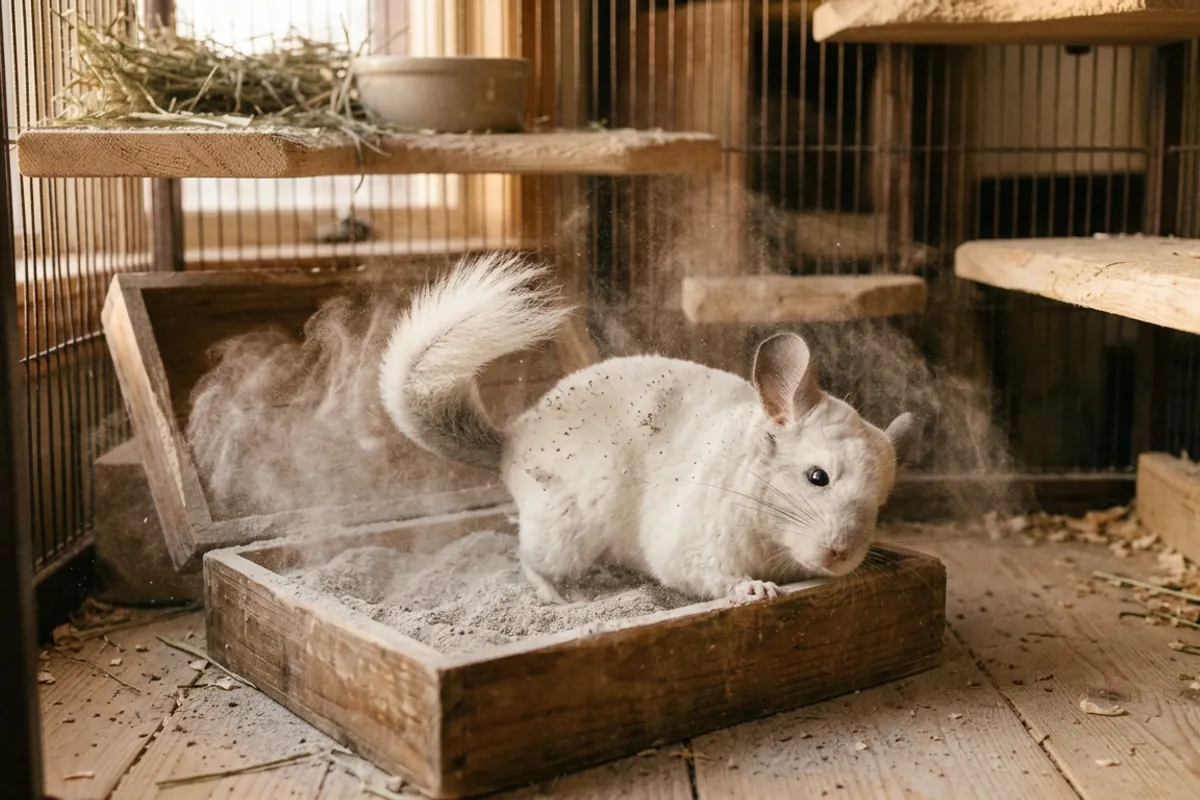
Two to three baths a week, about 10 to 15 minutes each, suits most animals. Take the bath house out afterwards rather than leaving it in, because a chinchilla that bathes all day ends up with dry, flaky skin. Lixit Blue Beauty chinchilla dust, 3 lb As an Amazon Associate I earn from qualifying purchases. If the coat looks greasy or clumped, add a bath. If the skin looks flaky, cut one. The details are in the dust bath guide, which explains why the fine volcanic grade matters and why sand is not a substitute.
White coats do show everything a gray coat hides. Yellowing usually comes from urine on the feet and tail, from a soiled shelf that never gets scrubbed, or from grease building up in a coat that is not getting enough dust. The fix is the same as the fix for a healthy gray chinchilla: dry bedding, wooden ledges wiped down and scraped often, and a regular dust schedule. Never reach for water, shampoo, or a wipe. If the discoloration is on the skin rather than the fur, or comes with bald patches, flaking, or scabs, that is a vet visit and not a grooming problem.
What white costs, and where to find one
Color is priced by fashion and scarcity, so whites, and especially white sapphires and the diamond combinations, sit above standard grays. That premium tells you what a breeder can charge, not whether the animal is healthy. I have laid out what the price reflects and what the real lifetime cost looks like, and the purchase price is a rounding error next to fifteen or twenty years of hay, dust, and an exotics vet fund. Chinchillas commonly live 10 to 20 years in good conditions, which I go through in the piece on life expectancy.
Buy from someone who lets you see the animals, knows the parents, keeps the room cool, and asks you questions back. The warning signs are in buying a chinchilla for sale and finding a chinchilla near you. Rescues rarely have a specific color on hand, and I would take a healthy gray from a rescue over a white from a place that would not show me its hay.
Pick the animal, not the coat. A white chinchilla is a lovely thing to look at, and by the second week what you will be thinking about is the room temperature, the hay rack, and whether those teeth are wearing evenly. That is the hobby, in every color it comes in. If you are still deciding, what keeping chinchillas as pets is like is the piece I would read first.