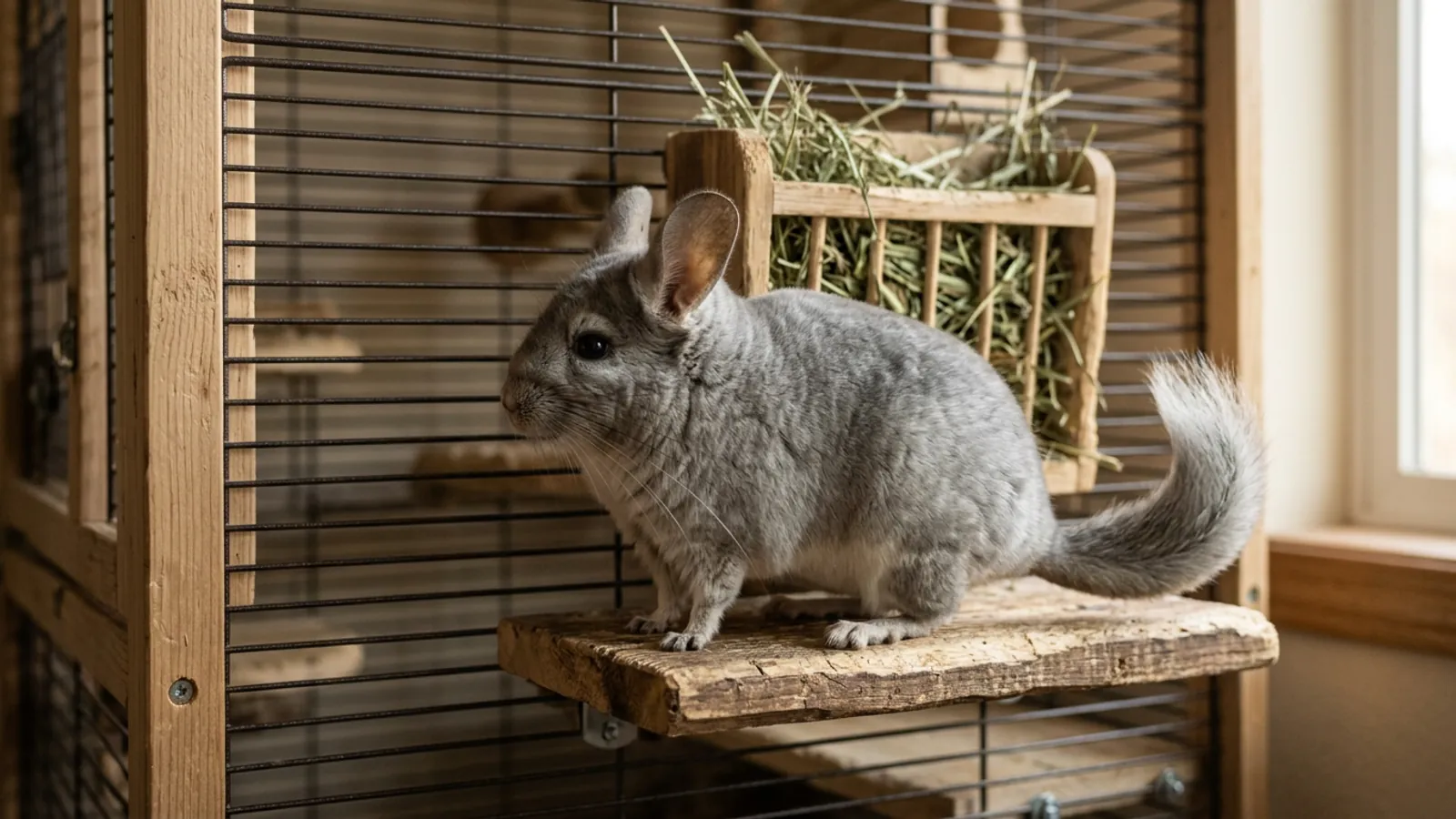
A chinchilla weight log is the cheapest and most useful health record you will ever keep, and almost nobody keeps one. A chinchilla is a prey animal wearing one of the densest coats of any land mammal, so it hides illness twice over: once by instinct, and once under fur that makes a thin animal look plush. A digital scale sees through both. Mine get weighed weekly, it takes about twenty seconds each, and in ten years of keeping chinchillas that habit has caught more problems early than anything else I do. Here is what the numbers should look like, how to take them properly, and what a change means.
How much should a chinchilla weigh
A healthy adult chinchilla usually weighs somewhere between 400 and 600 grams. That is roughly 14 to 21 ounces, or a bit under a pound up to about 1.3 pounds. Females are generally the larger sex, which surprises people who assume the opposite.
If you came looking for a chinchilla weight chart, here is one, written as a list because a tidy table would suggest more precision than the numbers deserve:
- Newborn kits: usually about 30 to 60 grams, with most landing around 35 to 50.
- Kits through the first months: steady gains, weighed daily at first and then every few days.
- Adult males: commonly 400 to 500 grams.
- Adult females: commonly 450 to 600 grams, and some healthy females sit above that.
- Full grown: most reach adult weight between 8 and 12 months, and some keep filling out until about a year and a half.
Chinchilla size and weight track each other loosely. An adult body runs about 10 to 14 inches (25 to 35 cm) with a tail of another 3 to 6 inches (8 to 15 cm), so a longer framed animal at 600 grams may be in better condition than a small framed one at 500.
That is the part most charts get wrong by omission. A published range tells you whether your chinchilla falls inside the population spread. It does not tell you whether your chinchilla is well. The number that matters is your own animal's stable adult baseline, measured by you, on your scale. Once you know that a healthy adult settles at, say, 560 grams and stays there, every future reading has meaning. Without a baseline, 560 grams is just a number in a range.
Why the scale sees what your eyes cannot
Chinchilla fur grows in dense clusters from each follicle, and that coat is why a genuinely underweight chinchilla can look completely normal from across the room. I have watched a chinchilla lose real condition while still appearing round and healthy. The fur does not deflate. It just sits there, hiding the frame underneath.
Hands tell you more than eyes, though still less than a scale. With the chinchilla resting calmly, run your fingers gently over the ribs, along the spine, and across the hips. Ribs should be findable under a thin covering, not sharp ridges standing out. The spine should be palpable but not knife edged. Prominent, angular hip bones mean an animal that has lost condition. A body you cannot feel any structure in at all, where the ribs disappear entirely under a soft layer, is heading the other way.
Do this with a light touch and only during a moment the chinchilla is already tolerating handling. Chinchillas release fur when they are frightened, and a grab that turns into a fur slip has cost you far more than the check was worth.
Even done well, hands are a coarse instrument. A 25 gram loss is invisible to fingers and obvious to a scale, and 25 grams on a 550 gram animal is the kind of early signal that gets a problem treated while it is still small.
How I weigh mine, and how often
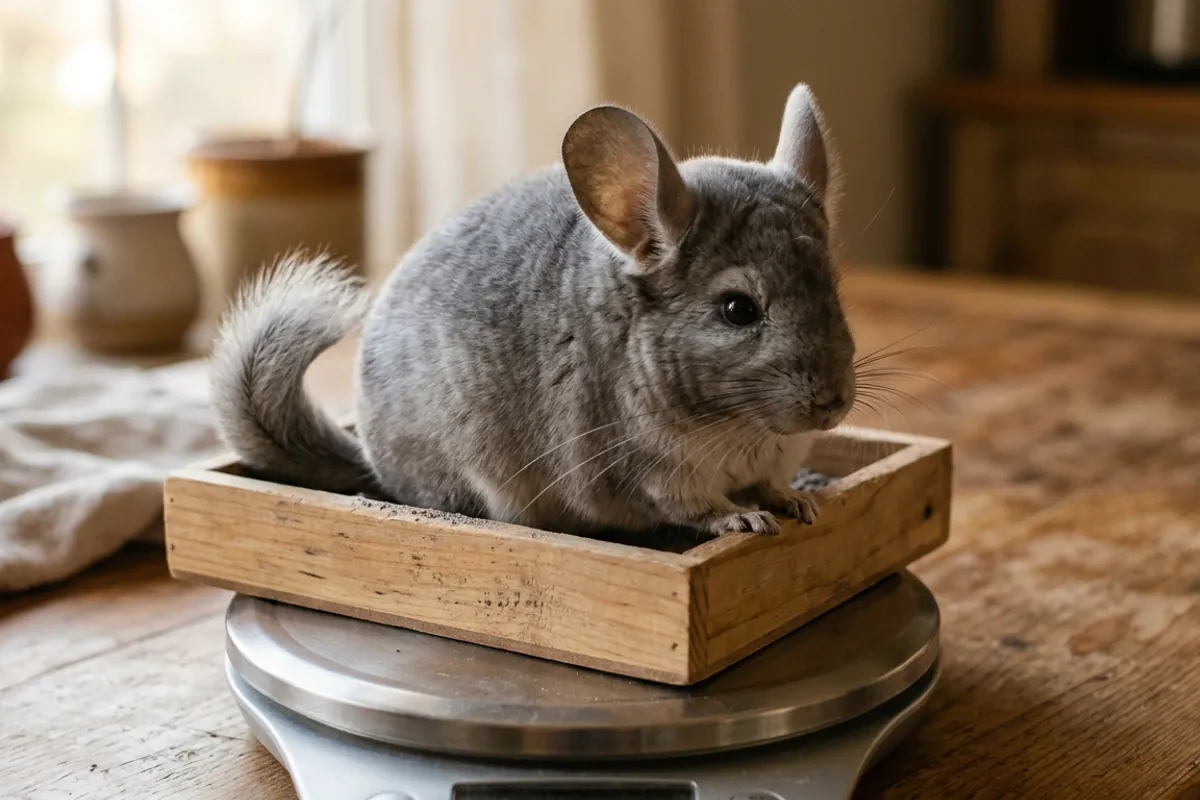
You do not need anything specialized. A flat digital kitchen scale that reads to 1 gram, of the sort that costs less than a bag of pellets, is exactly right. Set a shallow container on it, tare to zero, put the chinchilla in, read the number, and you are done. A small open box or a familiar carrier base both work. Mine treat it as a two second event during out of cage time, which is the whole trick: it should be so routine that neither of us cares.
A few things that make the numbers trustworthy:
- Weigh at the same point in the day, ideally the same point in the routine. Before the evening feed is easy to remember.
- Use the same scale every time. Two scales can disagree by several grams, and then you are chasing a difference that only exists in your equipment.
- Weigh before a dust bath, not after. Dust in the coat is not much, but there is no reason to add noise.
- Write it down immediately. Date and grams, in a notebook by the cage or a note on your phone. A number you remember approximately is not data.
Weekly is right for a healthy adult. I weigh more often for anything that is not steady state: growing kits, seniors, a chinchilla recovering from illness, or one with an ongoing condition. Juniper came to me as a neglected rescue with dental disease I manage day to day, and she gets weighed more often than that, because for her the scale is the early warning system for a mouth I cannot see into.
If you keep more than one, weigh each separately and log them separately. A shared cage total tells you nothing about which animal is losing.
Reading the trend instead of the number
Single readings bounce. Gut contents, a recent drink, a full bladder, and how much hay went in overnight can move an adult chinchilla by 5 to 15 grams between weighings with nothing wrong at all. If you panic at every wobble, you will stop weighing within a month.
What matters is direction across several readings. Three weeks pointing steadily downhill is a signal even if each individual drop looks trivial. A flat line with noise around it is a healthy animal.
The rule of thumb keepers pass around is that a loss of about 10 percent of body weight means call the vet. For a 550 gram chinchilla, that is 55 grams. I will say plainly what that number is and is not: it is a practical threshold that keepers use, not a validated clinical cutoff with a hard line on either side. In practice I act well before it. A persistent slide of 20 to 30 grams over two or three weighings, with no obvious explanation, already gets my attention, and if anything else looks off it gets a phone call.
Gains deserve the same reading. A slow creep upward over months is usually diet. A fast gain in a female housed with a male is pregnancy until proven otherwise, since chinchilla gestation runs about 111 days and mis-sexed pairs are common. A sudden gain in a chinchilla that also seems uncomfortable or bloated is not a diet problem and needs a vet.
What makes a chinchilla lose weight
Weight loss is a symptom with a long list of causes, and the list is worth knowing because a few of them are urgent.
Teeth, first and most often
Chinchilla teeth grow continuously for life, and when the molars do not wear evenly they form spurs that cut into the cheek or tongue. The animal keeps trying to eat, drops food, chews on one side, and quietly takes in less. Weight falls before you see anything else. Watch for a damp chin, food dropped around the bowl, sudden fussiness about hay while still taking pellets, and smaller or fewer droppings. That combination is a vet appointment, not a wait and see. More detail lives in chinchilla teeth problems and the teeth and health section.
The prevention side is unglamorous and it works: unlimited grass hay, all day, every day, because the long chewing stroke is what wears molars down. I buy timothy in bulk for exactly this reason, since a small bag empties faster than new owners expect and running short is not an option. Oxbow Western Timothy Hay, 9 lb box As an Amazon Associate I earn from qualifying purchases. Alongside it, a real variety of safe wood to gnaw, not one lonely block that gets ignored. emours apple wood chew sticks, 40 count As an Amazon Associate I earn from qualifying purchases.
Heat, which shows up as appetite first
A hot chinchilla stops eating before it collapses. The comfortable range is 60 to 70°F (15 to 21°C). Anything past 75°F (24°C) is dangerous, and 80°F (27°C) or above is an emergency that humid air pushes along faster. Pebble came out of an overheated attic and had a heatwave near-miss in her first summer with me that ended at the emergency vet, and I have never softened on this since. If your summer weight log dips every August, the room is too warm. Put a thermometer and hygrometer on the cage and believe the reading, not your own comfort. digital thermometer and humidity gauge with remote probes As an Amazon Associate I earn from qualifying purchases. The full picture is in chinchilla heat safety.
Two more causes to know. Reduced or absent droppings alongside weight loss suggests the gut has slowed, and that is measured in hours, not days. And in a pair, a subordinate animal can be quietly kept away from the hay rack, which is why separate weights and a second feeding station matter.
The overweight chinchilla, and how it usually happens
An overweight chinchilla is not common on a correct diet, because unlimited grass hay is close to impossible to get fat on. It is very common on the diet pet shops encourage: a bowl of pellets kept permanently full, a commercial mix with seeds and dried fruit in it, and treats handed out several times a day.
Sugar is the main culprit. Raisins, dried fruit, yogurt drops, nuts and seeds are all far richer than anything a chinchilla evolved to eat, and they push weight up while displacing the hay that keeps teeth worn. My treat list is short and dull: a piece of plain dried rose hip or a safe dried herb, a few times a week, nothing more.
Fixing an overweight chinchilla is a diet correction, in this order:
- Hay stays unlimited. Always. Cutting hay is never the lever, no matter what the scale says.
- Measure the pellets instead of free feeding. Roughly one to two tablespoons a day is where most keepers and pellet makers land, though it varies with the brand and the animal. Your vet can tell you what is right for yours.
- Cut treats to near zero while the weight comes down.
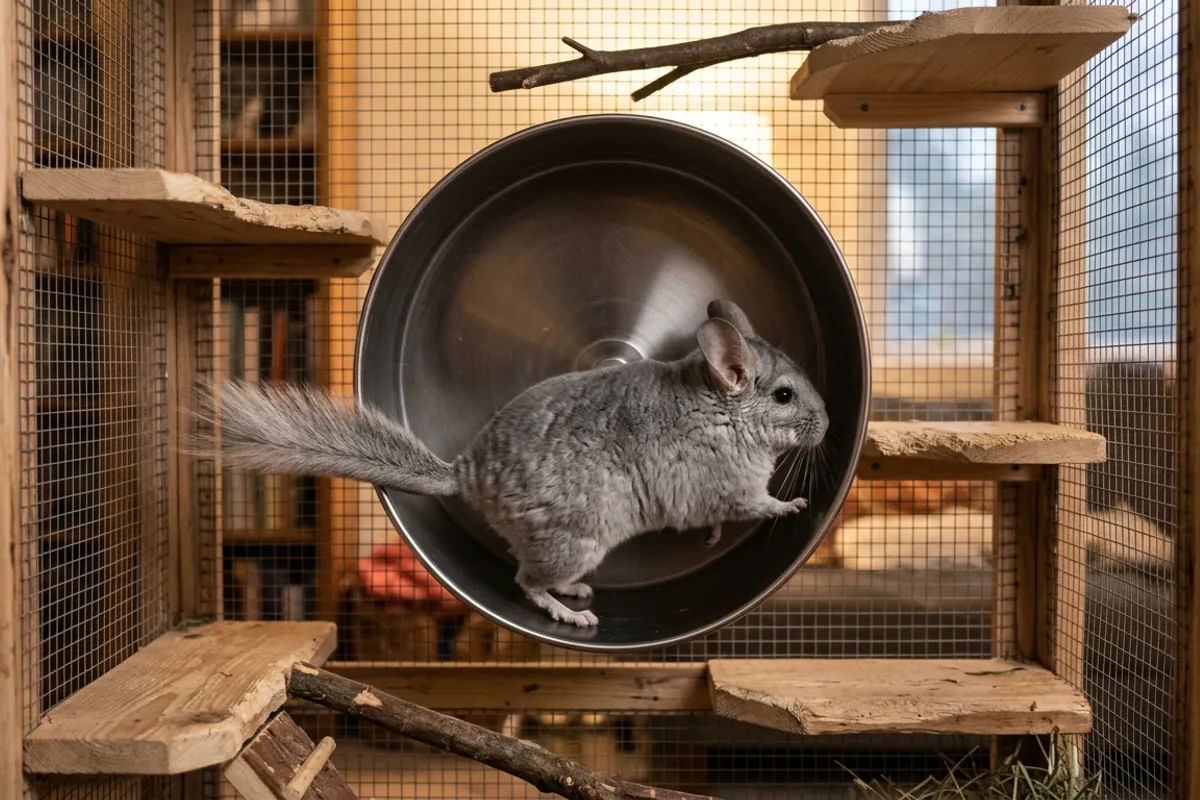
- Give the animal somewhere to move. A tall cage with wooden ledges at different heights gets a chinchilla jumping, which is how they naturally burn energy, and a proper wheel with a solid running surface adds real distance. 15 inch Chin Spin solid surface chinchilla wheel As an Amazon Associate I earn from qualifying purchases.
On wheels I am blunt: wire rung wheels break legs and catch toes, and they have no place in a chinchilla cage. Solid surface, 15 inches or larger, or nothing. Same principle as the cage itself, where height beats floor space for an animal built to leap.
Expect weight to come off slowly, over months. A chinchilla so heavy it struggles to jump or groom is a vet conversation, not a home project.
Where weight fits in a weekly chinchilla health check
Weighing is the anchor of a proper chinchilla health check, because it is the only part that produces a number. Everything else is observation, and observation drifts. Once the chinchilla is on the scale, spend another minute on the rest:
- Eyes clear and equally open, with no discharge or crusting.
- Chin and chest dry. A wet chin points at the mouth.
- Incisors yellow to orange, even, and meeting properly. Pale or white incisors are worth mentioning to a vet.
- Fur even, with no bald patches, matted sections, or ring of fur missing around the neck.
- Feet checked underneath for redness, cracking, or sore looking pads, which is how bumblefoot starts.
- Droppings plentiful, dark, firm and evenly shaped. What the poop looks like is the fastest daily read you have.
- Behavior normal for that animal: alert in the evening, moving between levels, interested in food.
Log the weight and note anything odd next to it. Patterns you would never hold in your head become obvious on paper, like a chinchilla that dips every time the weather turns, or one that has lost 10 grams a month for four months while looking fine every single week.
When the scale means it is time to call a vet
I am an experienced keeper, not a vet, so here is where I draw the line rather than what I would prescribe.
Book an appointment for a loss of about 10 percent of body weight, for a downward trend that continues across two or three weighings without explanation, or for any weight loss paired with a wet chin, dropped food, drooling, or fussiness about hay. That combination is dental until a vet says otherwise, and dental problems do not resolve on their own.
Treat it as urgent, same day, if weight loss comes with reduced or absent droppings, refusal to eat, lethargy, or a hunched, still posture. Heat exposure with any of those signs is an emergency in its own right and needs immediate cooling and a call.
Two things make that call go better. Find an exotics vet before you need one, because the day you need one is the wrong day to start searching. And bring the log. A list of dates and weights showing exactly when a decline started is useful clinical information, and it is the single most valuable thing an owner can hand over. That is the real argument for weighing weekly: not the number itself, but having the history when it counts.