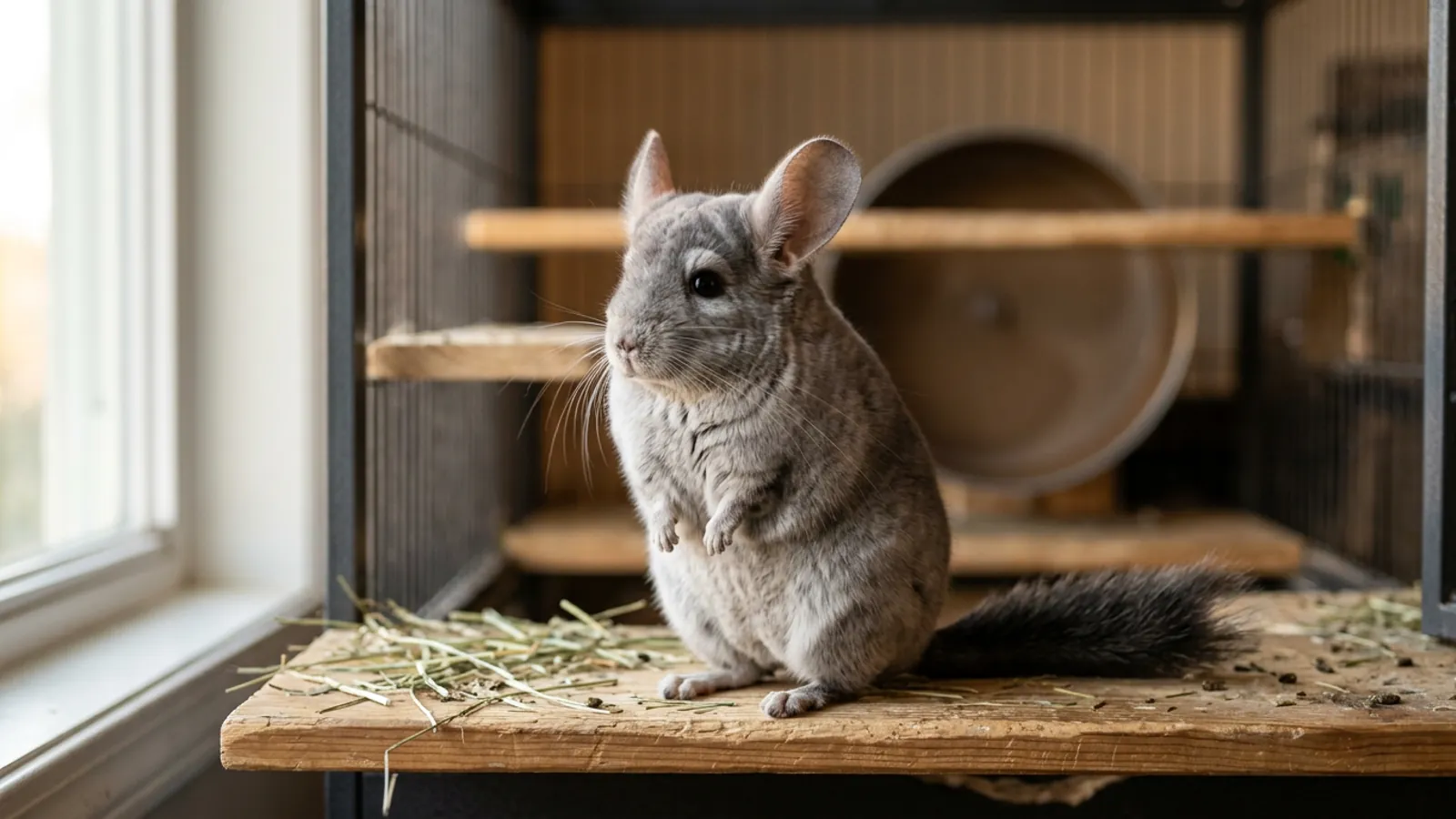
The chinchilla tail is the part of the animal people misread most. It looks like decoration, a fluffy afterthought stuck on the back of a very round rodent, and it is nothing of the kind. It is a bony, muscled, fur covered steering rod that a rock climbing animal uses to stay alive in mid air, and it is also one of the easiest parts of a chinchilla to injure badly. I have kept chinchillas for about ten years, and in that time the tail has come up in exactly two ways: as the thing new owners find charming, and as the thing new owners hurt by accident. Here is what it is, what it does, and what it is telling you.
What a chinchilla tail is
Under all that fur there is a real tail: a chain of small vertebrae running from the base out toward the tip, thick with muscle and tendon where it meets the body and thinning as it goes. I have seen several different vertebra counts quoted around the internet and I am not going to repeat a number I cannot stand behind. What matters for keeping one is simpler than the count. Bone runs most of the length, so a chinchilla tail can be broken, kinked or dislocated exactly like any other bone, and none of it grows back.
The skin over that bone is thin and only loosely anchored to what is underneath. That is the single most important physical fact on this page, and there is a whole section below about what happens when you forget it.
The fur on the tail is not the same as the fur on the body. Body fur is the densest coat of any land mammal, with 50 or more hairs growing out of a single follicle by the usual figures, which is why a chinchilla looks upholstered rather than merely furry. The tail carries longer, coarser guard hairs that sweep backwards, so a healthy tail reads as a bottle brush: wide at the base, tapering, often with a slight upward curl at the end. It is not naked and ratlike, and people meeting a chinchilla for the first time are frequently surprised by that.
On size, the tail of a pet chinchilla usually runs about 3 to 6 inches, roughly 8 to 15 cm, against a body of about 9 to 14 inches. Call it a third of the animal, give or take the individual. It is not prehensile. A chinchilla cannot grip with it, hang from it, or deliberately wrap it around a branch. Kits are born fully furred with their eyes open, and the tail is already brushy on day one.
Chinchilla long tail, chinchilla short tail, and the animal you own
Two searches land on this subject, chinchilla long tail and chinchilla short tail, and they are usually asking about two different species rather than two looks.
The long tailed chinchilla, Chinchilla lanigera, is the pet, and the animal behind essentially every chinchilla sold as a companion anywhere in the world. The short tailed chinchilla, Chinchilla chinchilla, is a wild animal and not a pet. If a seller offers you a short tailed chinchilla, treat that as a claim to check very hard rather than as a selling point, and read how to buy a chinchilla without regretting it later before any money moves.
Ranch lines were selected for coat quality, not for tail measurements, and old fur trade type names still float around breeder conversations. I would not try to read species ancestry off one animal's tail on a shelf in front of me, and I would be wary of anyone who says they can. What you can say with confidence is that a companion chinchilla with a short, thin or ragged tail is far more likely to be carrying an injury, a fur chewing habit, or the aftermath of a fight with a cage mate than any exotic pedigree.
So your chinchilla has a long tail because your chinchilla is a long tailed chinchilla. If the tail looks short today and did not look short a month ago, that is a health question and not a genetics question. The last section covers it.
What the tail does
Chinchillas come from dry, rocky Andean slopes, and their whole body plan is built for moving vertically across broken stone. They do not amble. They launch, land on a ledge the width of your palm, and launch again. What a chinchilla in the wild is really like goes deeper into that, but the tail is the part of the machine that makes the landings work.
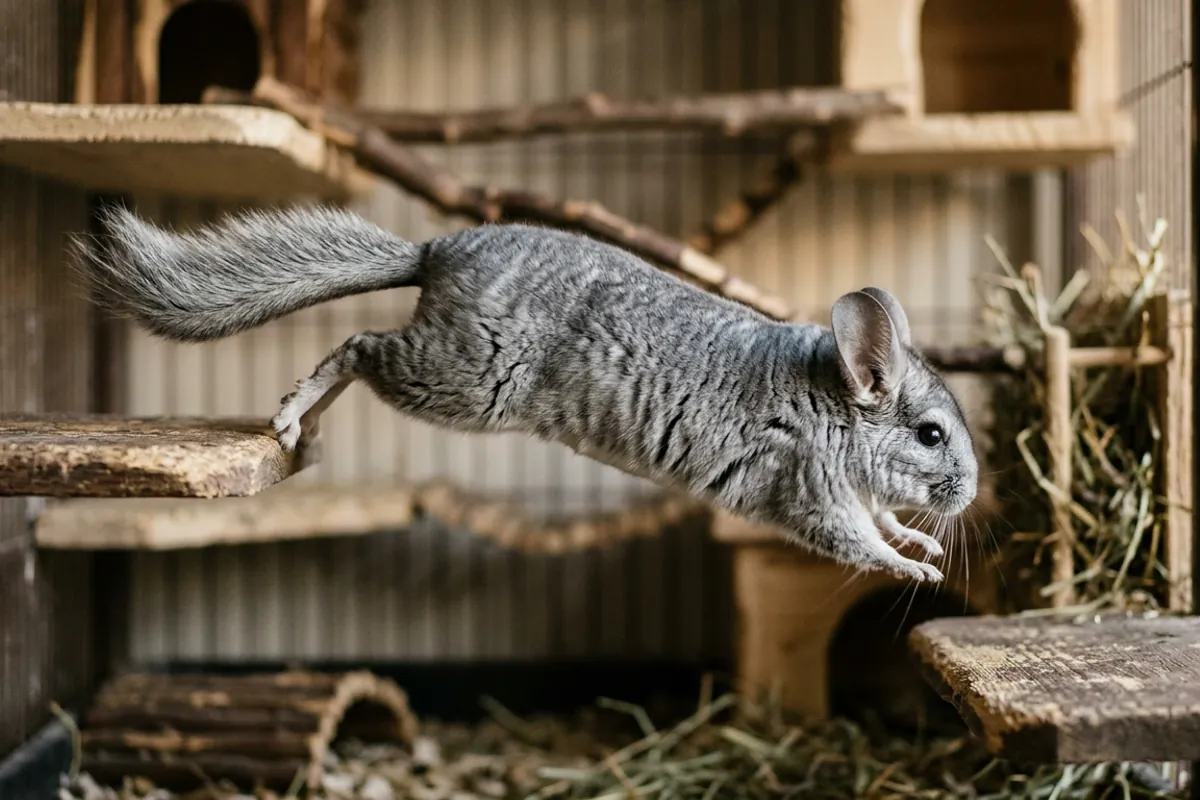
In a leap, the tail extends and flicks. It is a counterweight and a rudder at the same time: swing it one way and the body rotates the other, which lets an animal already in the air adjust where its feet will come down. Watch a chinchilla jump from a low ledge to a high one and film it on your phone if you want to see it properly. At normal speed it is a blur. Slowed down, the tail is working the entire time, and it is still working after the feet land, damping the wobble so the animal does not overshoot a narrow perch.
The tail does the same job standing still. When a chinchilla rears up on her hind legs to reach a chew or look at something, the tail drops back and acts as a third leg's worth of stability. Popcorning, the vertical joy jump, is a whole body spring with the tail arched over the back.
This is the part with a care consequence. A tail is only useful if there is somewhere to use it. A chinchilla in a short, wide cage never gets to do the thing the tail is for, and the animal that gets height, staggered wooden ledges, and jumps that are within range is a fitter, calmer animal. Why height beats floor space is the argument in full, and daily out of cage time in a safe room is the other half of it.
The tail does not cool your chinchilla
This one matters enough that I am giving it a section. People know that a rat's naked tail dumps heat, and they assume every rodent tail is a radiator. A chinchilla tail is not. It is covered in the same insulating coat as the rest of the animal, and it is closer to a jumper sleeve than a heat sink.
The ears are the radiator. That thin, sparsely furred skin is where a chinchilla sheds heat, and hot, flushed, pink ears are one of the earliest visible signs that an animal is struggling. A relaxed looking tail tells you nothing about temperature. Do not read it as reassurance.
The numbers do not move. Comfortable is 60 to 70°F, 15 to 21°C. Above 75°F, 24°C, you are into risky territory. At 80°F, 27°C, you have an emergency on your hands, and humid air makes all of that arrive faster because a chinchilla in a dense coat cannot lose heat to air that is already full of moisture. Pebble came to me out of an overheated attic, and her first summer included a heatwave near miss and a night at the emergency vet. That night is why I do not soften these numbers for anyone.
Buy a thermometer with a humidity readout, put it at cage height where the animal lives rather than on a far wall, and check it.
digital thermometer and humidity gauge with remote probes As an Amazon Associate I earn from qualifying purchases.
A cooling stone is a comfort item, not a cooling system.
Kaytee Chinchilla Chiller granite stone As an Amazon Associate I earn from qualifying purchases.
It gives an animal somewhere cooler to lie down; it does not lower the temperature of the room, and it will not save a chinchilla in an 80°F space. Air conditioning does that job. Run the heat danger calculator with your own numbers, and learn the warning signs of heat stroke before the day you need them.
A tail is not a handle
Remember the thin, loosely attached skin. If you grab a chinchilla by the tail and the animal pulls away, that skin can strip clean off the bone, from the point where you were holding it all the way to the tip. Vets call it degloving. It leaves exposed tissue and bone, it is agonizing, and the usual outcome is a surgical amputation of the stripped section. It is not a rare freak accident. It is the predictable result of using a tail as a handle, and it is the reason I will never let a visitor pick up one of mine unsupervised.
Lift a chinchilla with your whole hand under her chest and your other hand supporting the hindquarters, so the animal's weight sits on your palms and nothing is being pulled. That is the safe version, every time.
You will still need to lift the tail sometimes, to check the sex of a new arrival or to look at the vent area. Do it briefly, on a flat surface, with the body supported and the animal calm, and stop if she is struggling.
If a chinchilla escapes during play time, do not grab for the tail as she runs past. You will lose either the animal or the skin. Herd her toward a carrier or a small box on its side and let her go in on her own. Panic grabbing is also how you trigger fur slip, the release of a patch of body fur, which is the same evolutionary bargain in a milder form: give up the coat, keep the animal.
The cage hazards that take tails
Wire wheels are the worst thing in this category and I will name them plainly. A tail, a foot, or a leg goes through the rungs while the wheel is turning and the result is a break or a degloving. There is no safe wire wheel. A running surface must be solid and the wheel must be big enough that the spine is not curved while running, which in practice means at least 14 to 15 inches across, and bigger is better.
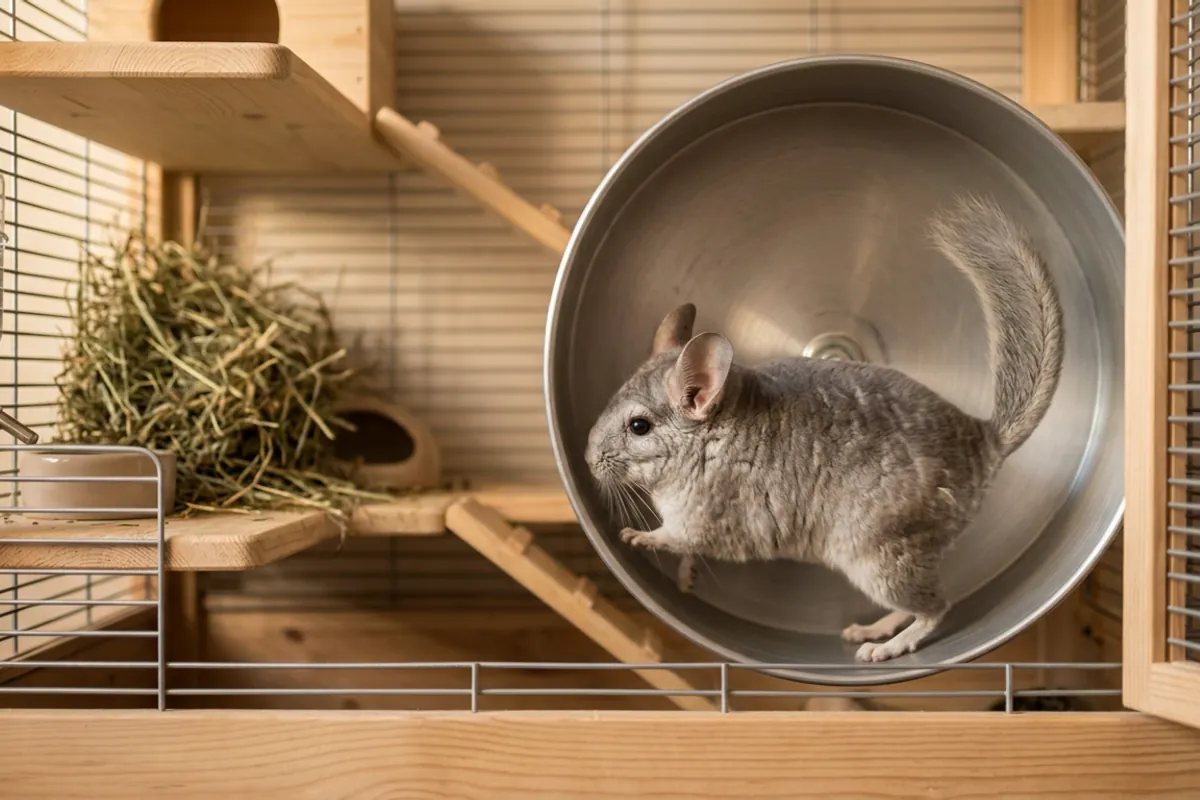
15 inch Chin Spin solid surface chinchilla wheel As an Amazon Associate I earn from qualifying purchases.
The same logic rules out wire shelves and wire ladders, which catch tails and cause bumblefoot on the feet.
Bar spacing matters for the same reason it matters for heads: one inch or less, and closer to half an inch if there are kits in the cage. Check the gaps behind shelves and between the base and the pan, because a tail sliding into a narrow slot while the animal jumps away is a classic injury. Cages should be metal and wood, with wooden ledges you can replace as they get chewed, and no plastic anywhere.
Critter Nation double unit small animal cage As an Amazon Associate I earn from qualifying purchases.
Why the cage has to be metal covers the rest of the build.
Two more, both mundane. Cage doors close on tails, so look before you swing one shut. And cage mates bite tails during a genuine fight, which is a different thing from bickering; a bleeding tail after a squabble means separating the pair and getting the wound seen.
What tail movement is telling you
The tail is part of how chinchillas talk, and it pairs with the sounds covered in what your chinchilla noises are telling you.
A male wagging or thrashing his tail while shuffling toward a female is courtship, usually with a soft repeated call along with it. It is completely normal, and it is also a decent early warning that you are about to have kits if the pair is not separated.
An annoyed chinchilla, more often a female, may stand up tall on her hind legs with her tail raised and lash it, and if you keep pushing she will spray urine at whatever is bothering her. That is a clear statement. Back off, and work out what she is objecting to.
A tail arched high over the back during a popcorn jump is happiness, plain and simple. A tail held low and flat while the animal creeps along the cage floor with her body pressed down is a nervous animal, and the answer is usually less noise, less looming, and more patience. How to tame a chinchilla without breaking her trust is the long version.
I want to be clear about the limits here. Tail language in chinchillas is read from experience, not from a controlled study, and I interpret it alongside posture, ears, and sound rather than on its own. Anyone giving you a precise dictionary of tail positions is overselling.
Tail trouble, and when it becomes a vet call
I check tails once a week, and the dust bath is the easiest moment to do it because the animal is busy and rolling and I get a clear view of every side of her.
Lixit Blue Beauty chinchilla dust, 3 lb As an Amazon Associate I earn from qualifying purchases.
Chinchillas never bathe in water, only in fine volcanic dust, so this is also the only time the tail fur separates enough to see the skin.
Call an exotics vet the same day for any of these: bleeding that does not stop within a minute or two, exposed pink tissue or visible bone, a fresh kink or a section hanging at a wrong angle, a tail the animal is dragging or refusing to lift, swelling, or a wound that has been open more than a few hours. Degloving and fractures are surgical problems, and the treatment is often removal of the damaged section. Chinchillas generally manage well afterwards, though I would expect a little less precision in a big jump. If you do not already know where your nearest exotics vet is, find one now, not on the night you need one.
While you are waiting for the appointment, keep the animal contained and the cage clean, and pause the dust bath, because dust does not belong in an open wound. Do not put human antiseptic creams or ointments on a chinchilla, and do not attempt to wash the wound with water.
A bald or thin tail with no blood is a different problem. That is usually fur chewing, from the animal herself or from a cage mate, and boredom, stress, cramped housing and a thin diet all feed it. The fix is the same as the fix for most things here: unlimited grass hay in front of them at all times,
Oxbow Western Timothy Hay, 40 oz bag As an Amazon Associate I earn from qualifying purchases.
plus a real rotation of safe wooden chews rather than the same block for months.
emours apple wood chew sticks, 40 count As an Amazon Associate I earn from qualifying purchases.
Juniper came to me as a neglected rescue with dental disease I still manage day to day, and she is the reason I am uncompromising about both. If the chewing continues once the cage and diet are right, get it looked at, because pain is a common reason an animal starts working on herself.
Last one, and it is easy to miss. A tail that is constantly damp or urine stained means either a cage that is not being cleaned often enough or an animal who cannot get out of her own mess, and the second reason covers urinary trouble and mobility problems. Either way, look at what a wet chinchilla means, fix the cage, and if the tail is still soaked with a clean cage under her, that is a vet visit.