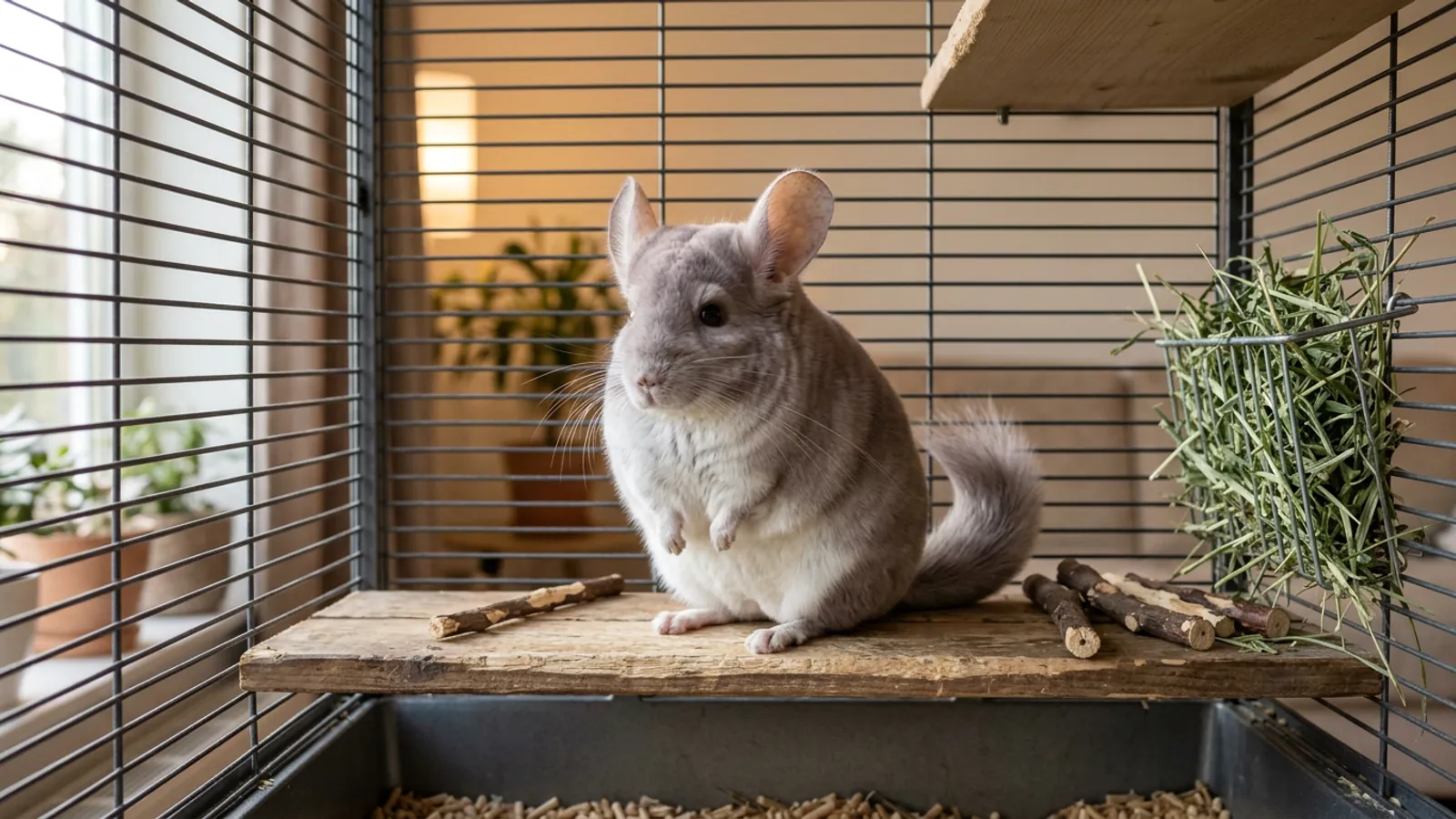
Every few weeks someone emails me asking where to find a purple chinchilla, usually after seeing a photo that looked lilac on their phone screen. The short answer is that a chinchilla purple enough to look purple does not exist. What does exist is the violet mutation, a real, established color that reads as a soft grayish lavender in good light, and that is almost certainly what the photo showed. The longer answer is worth having, because color is the single most common reason people overpay for a chinchilla, and it is also the one thing about a chinchilla that changes nothing at all about how you have to keep it.
I have kept chinchillas for about ten years. My two are Pebble, a rehome I pulled out of an overheated attic, and Juniper, a rescue whose dental disease I manage every single day. Neither is violet. Both taught me that what matters is the room temperature and the hay bin, not the coat. But I will still spend the next two thousand words on color, because if you are going to spend the money, you should at least know exactly what you are buying.
What people mean by a purple chinchilla
There is no purple pigment in a chinchilla. Chinchilla fur gets its color from melanin, the same family of pigments that colors every other mammal, and melanin comes in shades of black through brown through yellow. There is no biological route to violet, blue, or green fur in a rodent. Anything purple on an animal is either dye, a stain, or a trick of the light and the camera.
What the fancy calls violet is a mutation that removes and softens the dark pigment in the coat until the gray takes on a distinctly cool, dusty, faintly lilac cast. The technical way to say it is that violet dilutes the eumelanin, the dark pigment, leaving a paler and warmer-toned base. The practical way to say it is that a violet chinchilla standing next to a standard gray looks like someone turned the contrast down and nudged the hue toward mauve. In daylight, especially near a window, the lavender impression is real and quite pretty. Under warm indoor bulbs, or in a phone photo with heavy processing, it can look like ordinary pale gray, or it can look far more purple than it is.
So when a breeder advertises a purple chinchilla, they usually mean violet, and they are using a loose word because it sells. When a pet shop advertises one, be more careful. I have seen listings that were plainly just a light standard gray with a good photographer, and at least one that was neither.
Where the violet gene came from
Violet is one of a handful of mutations that appeared in ranch herds during the decades when chinchillas were farmed at scale for fur, and were then kept and bred deliberately because they were unusual. Standard gray is the wild-type color, the one the animals evolved with in the Andes. Everything else, white, beige, ebony, sapphire, velvet, and violet, is a mutation that turned up in captivity and was propagated by people.
The story keepers pass around is that violet was found in a herd in Rhodesia in the 1960s and later came into the wider fancy through a breeder named Sullivan, which is why you still hear the phrase Sullivan violet. I repeat that with a caveat: mutation origin stories in this hobby are largely oral history from the fur trade, not published records, and I have never seen a source I would call authoritative. The gene is real and its inheritance is well understood by breeders. The dates and names attached to its discovery are folklore that may well be accurate, and I am not going to pretend I can verify them.
What matters for you is the consequence: violet has been in the gene pool for decades, it is stable, and it is not a novelty invented last year to justify a price tag. If you buy one from a serious breeder, you are buying a long established line.
What a violet chinchilla looks like
A good violet is uniform. The body color is a pale, cool gray with a lavender undertone, the belly is white, and the transition between them is clean. There is none of the sharp black tipping you see on the guard hairs of a standard gray. The overall impression is soft rather than crisp.
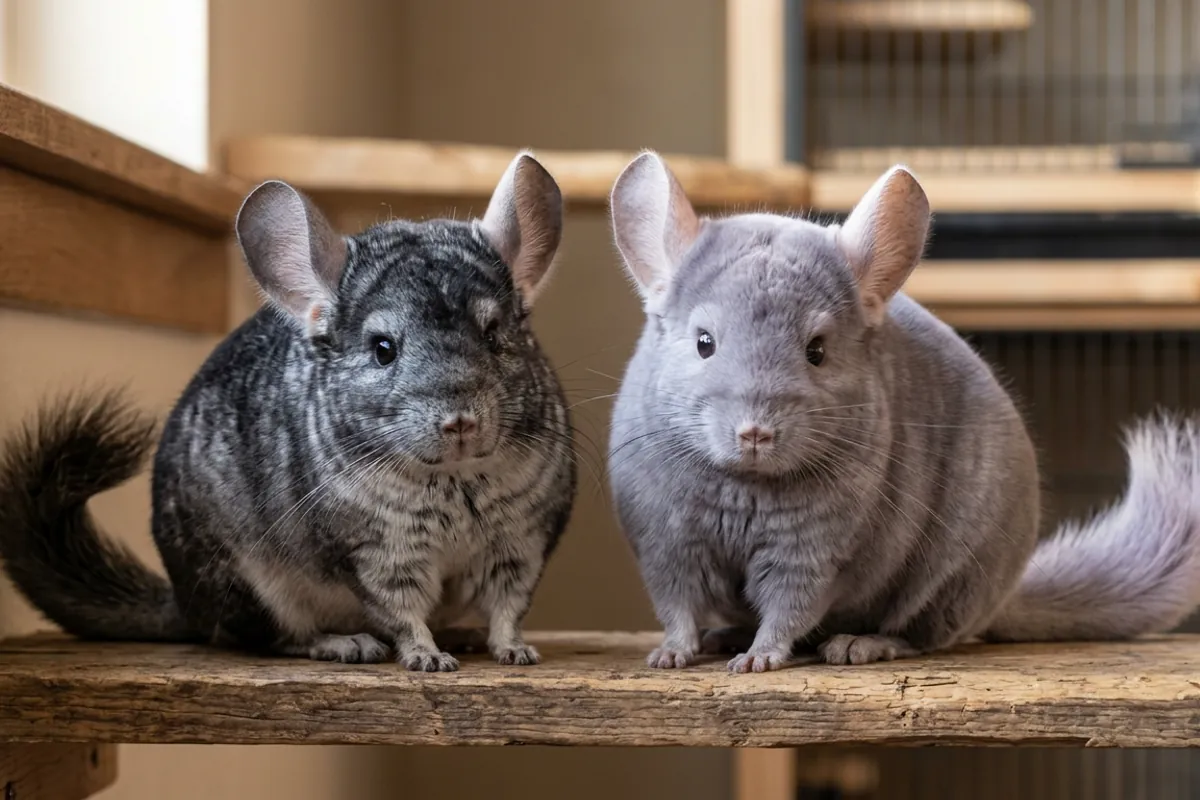
There is variation within violets, and it is worth knowing the vocabulary because breeders use it:
- Violet, on its own, is the base version described above.
- Violet velvet, sometimes written as TOV violet, combines violet with the velvet mutation, which adds a darker veil across the back and head over the lavender base. The contrast is striking and this is often the most expensive version.
- Violet white and similar crosses put violet together with a white mutation, producing a very pale animal with faint lavender shading, often through the ears and tail.
- Violet ebony combinations push the color darker and can lose the lavender read entirely.
Naming is not standardized. Two breeders in different countries will use different words for the same animal, and some invent names outright. If a listing uses a color name you have never heard, ask what mutations are in the pairing rather than trusting the label.
One warning about photos. Fur photographs badly, and chinchilla fur photographs worse than most because it is dense and it scatters light. Auto white balance on a phone will happily invent a purple cast that is not there, and equally will wash a genuine violet down to gray. Ask for video in natural daylight, and ask for a shot of the animal next to a standard gray for reference. If a seller will not do that, you have learned something either way.
How violet is inherited, and what that means when buying
Violet is a simple recessive. A chinchilla needs two copies of the gene, one from each parent, to be violet. One copy makes an animal a carrier: it looks like a completely ordinary standard gray and can pass violet on to its offspring.
That has a few consequences that catch new buyers out.
Two violet parents produce all violet kits, so a breeder working an established violet line can predict what they will get. A violet crossed with a carrier gives roughly half violets. Two carriers, both of them plain gray to look at, give roughly one violet in four, which is why violet occasionally turns up in litters where nobody expected it. And a violet crossed with a non-carrier gray produces no violets at all, only carriers. If someone is selling you a young gray as a guaranteed future violet, that is not how any of this works, because color is fixed from birth. What can change is your perception of it as the kit's coat matures, which is a real effect and takes a few months to settle.
The part I would think hardest about is this. Any color that requires two copies of a specific gene is produced by breeding within a narrower pool of related animals, and the more a breeder chases a specific look, the narrower that pool gets. Keepers have long worried that heavily line bred color animals carry more health problems, particularly malocclusion, than well outcrossed standard grays. I want to be careful here, because I do not know of solid data proving it, and plenty of violets live long healthy lives. What I will say plainly is that a breeder who can tell you about the health, teeth, and longevity of the grandparents is worth more than one who can only tell you about the color. Ask about the line, not the shade. If you want the fuller picture on where to buy safely, I wrote about that in how to buy a chinchilla for sale without getting hurt or ripped off and how to find a chinchilla near me without bringing home trouble.
What violet costs, and what the money does not buy
Colored mutations carry a premium, and violet sits toward the upper end of that premium, with violet velvet usually higher again. The exact figures move with your country, the breeder, and how fashionable a color is in a given year, so I am not going to publish a number that will be wrong for half the people reading this. I broke down the real cost structure of owning one, purchase price against everything after it, in what a chinchilla really costs and chinchilla price.
The thing I want you to take from those pages is the ratio. The purchase price of any chinchilla, violet or gray, is a small fraction of what it costs to keep one for its life. These animals commonly live into their teens, and fifteen to twenty years is not unusual with good care, which I covered in how long chinchillas really live. Over that span, the cage, the hay, the dust, the electricity for cooling, and above all the exotics vet fund dwarf whatever you paid at the start. Paying extra for a lavender coat and then economizing on the cage or the air conditioning is the worst possible order of priorities.
I say this as someone whose first vet bill for Pebble, from a single hot night, cost more than most chinchillas do.
Color changes nothing about care
A violet chinchilla is a chinchilla. Every rule is identical, and the rules are not negotiable.
Temperature comes first. The comfortable range is 60 to 70°F (15 to 21°C). Above 75°F (24°C) you are in risky territory, and 80°F (27°C) and up is an emergency, arriving faster in humid air because a chinchilla sheds heat by panting and through its ears, and humidity blunts that. That dense coat, the same coat you are paying a premium for, is exactly what makes them so bad at losing heat. Violet fur is no thinner than gray fur. If you cannot hold a room in that range through your worst summer week, you are not ready for any chinchilla regardless of color. Keep a digital thermometer with a humidity readout in the room, at cage height, not across the hall.
digital thermometer and humidity gauge with remote probes As an Amazon Associate I earn from qualifying purchases.
Check your own situation against the chinchilla heat danger calculator, and learn the signs of trouble before you need them in chinchilla heat stroke: warning signs every owner should know. Pebble's first summer is why this is not negotiable paragraph for anybody.
Hay first, always. Unlimited grass hay, available every hour of every day, is the foundation of the diet. Timothy or another grass hay, fresh and green smelling, replaced when it is soiled rather than topped up on top of old hay. Plain pellets are a measured supplement on the side, not the main event, and they should be plain: no colored bits, no seeds, no dried fruit.
Oxbow Western Timothy Hay, 40 oz bag As an Amazon Associate I earn from qualifying purchases.
Juniper is the reason I am rigid about this. Her teeth grow continuously, as all chinchillas' do, and the long grinding motion of chewing coarse hay is what keeps them worn to the right length. When that goes wrong you get malocclusion, and it is miserable and expensive and often permanent. Wooden chews in real variety help too, and they need to be safe woods, plain and untreated.
emours apple wood chew sticks, 40 count As an Amazon Associate I earn from qualifying purchases.
If you want the detail, chinchilla teeth problems: spotting malocclusion before it turns serious and the diet and hay guide cover it properly.
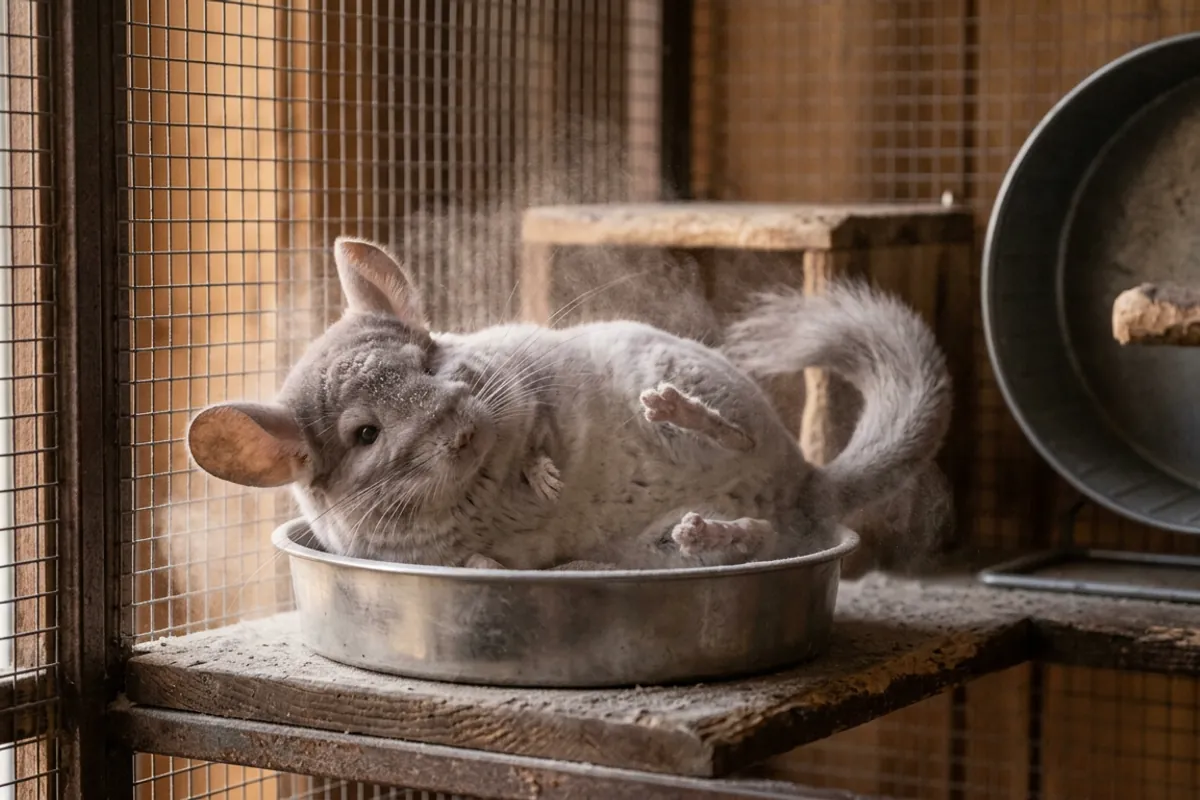
Dust, never water. Chinchillas bathe in fine volcanic pumice dust, two or three times a week for ten to fifteen minutes, and then the bath house comes out so they do not sit in it. Never bathe a chinchilla in water. That coat holds water against the skin for a very long time and invites fungal infection and dangerous chilling.
Lixit Blue Beauty chinchilla dust, 3 lb As an Amazon Associate I earn from qualifying purchases.
A small note specific to color: fine dust helps light coats look their best, because it lifts oils that would otherwise dull the fur. If your violet looks flat, the answer is usually more consistent dust baths rather than anything exotic.
Housing. Tall, metal, with solid wooden ledges, and no plastic anywhere a chinchilla can reach it, because they will eat it. Any wheel must have a solid running surface. Wire wheels break legs, and I have no patience for anyone still selling them. How to choose a chinchilla cage without buying the wrong one twice walks through it.
If any of that is new to you, start at what a chinchilla really is, and why its biology sets every care rule before you shop for a color.
When purple is a symptom, not a color
There is one context where purple on a chinchilla is urgent, and I would rather over explain it than have someone miss it.
If the gums, the tongue, the inner lips, or the skin inside the ears look bluish, gray, or purple, that is a sign the blood is not carrying enough oxygen. In any mammal that is an emergency, and in an animal as small and fragile as a chinchilla it is an emergency with a short clock. Go to an exotics vet immediately. Do not wait to see if it improves, do not search for home remedies, and do not call a general small animal clinic that has never treated a chinchilla if there is an exotics practice you can reach instead. I am an experienced keeper, not a vet, and this is squarely past the line where keepers should be making decisions.
Two related things worth knowing. Bruising shows up as purple patches on the skin, usually only visible if you part the fur, and it means something injured the animal, so work out what. And overheating typically does the opposite of purple: the ears flush bright red and hot as the animal dumps heat through them, with flat sprawled posture, panting, and drooling. Red ears and purple gums are both emergencies. They just tell you different things.
Finally: never dye a chinchilla. It seems obvious written down, and yet the search term exists. The chemicals are absorbed through skin and swallowed during grooming, the process involves getting the coat wet, and the whole thing is cruel. If you want a lavender chinchilla, buy a violet from a good breeder.
Choosing by color without getting it backwards
I am not against buying a violet. They are lovely animals and I understand the appeal completely. What I would push back on is letting color sit at the top of the list.
The order I would use is health first, then temperament, then the seller's honesty, then color. A healthy, well socialized standard gray from a breeder who knows every animal in their barn will give you fifteen or more good years. A violet from someone who breeds for color and cannot answer a question about teeth may give you a heartbreak and a vet bill. And you cannot tell these apart from a photo, which is exactly why the photo is the worst basis for the decision.
One more practical point. Chinchillas are social and generally do better in pairs, so if you are set on violet, think about whether you will be able to find a compatible second animal, and be willing to pair a violet with a gray. Nobody has ever told me their chinchillas cared what color the other one was.
If you take one thing from all of this: the purple in a purple chinchilla is a real and well established mutation called violet, it is inherited as a simple recessive, and it changes the price and absolutely nothing else. The temperature in the room, the hay in the bin, and the dust in the bath house are still the whole job.