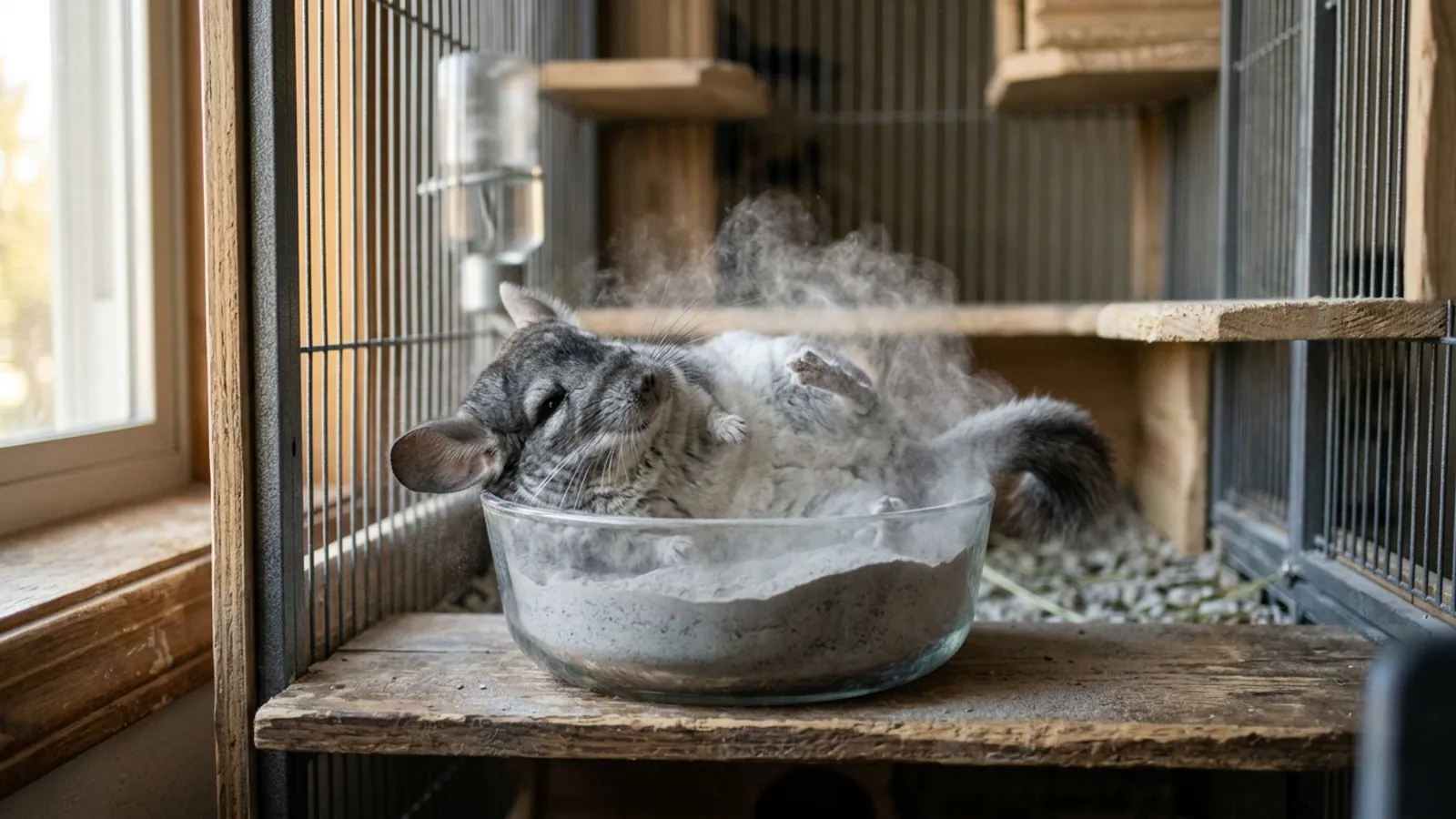
Water and dust never mix in a chinchilla's world, and the first time I set a bowl of fine gray powder in front of Pebble and watched her flip onto her back and roll like she was having the best day of her life, I understood what a lot of new owners get backwards: a chinchilla bath has nothing to do with water. It is dust, start to finish. In the wild these animals come from a high, dry part of South America where it barely rains, and their fur evolved to stay clean by rolling in fine volcanic grit, not by getting wet. That single fact drives almost everything I am going to tell you here, and getting it wrong is not a small stylistic error. A wet chinchilla is a chinchilla in real trouble.
I have kept chinchillas for about ten years now, two of them at the moment, and the dust bath is the one bit of care that new owners find charming and also, weirdly, the one they most often mishandle. So let me walk through what the bath is, why it works, how I do it, and where people go wrong.
Why the bath is dust and never water
A chinchilla's coat is the densest fur of almost any land mammal. Where you or I grow one hair from a follicle, a chinchilla grows fifty or more. That density is why the fur feels like a cloud, and it is also exactly why water is a hazard. When that coat gets soaked, the water does not run off the way it does on a dog. It wicks deep down to the skin and stays there, because the fur is packed too tightly for air to reach in and dry it. A damp undercoat against warm skin is a perfect place for fungus to grow, and a chilled, wet chinchilla can go downhill fast.
So the animal cleans itself the way its body was built to. Rolling in fine dust drives the particles down through the fur where they absorb the small amount of oil and moisture the skin produces, and then the chinchilla shakes it all out, carrying the grime with it. It is elegant. The coat comes out dry, fluffed, and clean. If you have ever tried to towel-dry a chinchilla you will never do it twice, and you should never do it once. If your chinchilla somehow gets wet, you keep it warm, keep it out of drafts, and gently help the coat dry, and you never make water part of the routine.
I have a fuller explanation of the biology behind this in my piece on what a chinchilla really is, if you want the deeper version. For today, hold onto the rule: the bath is dust.
What is in the dust
The stuff you want is a very fine, powdery dust based on volcanic pumice or a similar soft mineral. Good chinchilla dust is so fine it almost floats, and it feels like flour between your fingers, not grit. Lixit Blue Beauty chinchilla dust, 3 lb As an Amazon Associate I earn from qualifying purchases. That fineness matters more than people think. The particles have to be small and rounded enough to slip between those tightly packed hairs without abrading them. Coarse material sits on top and does nothing useful, or worse, it scratches.
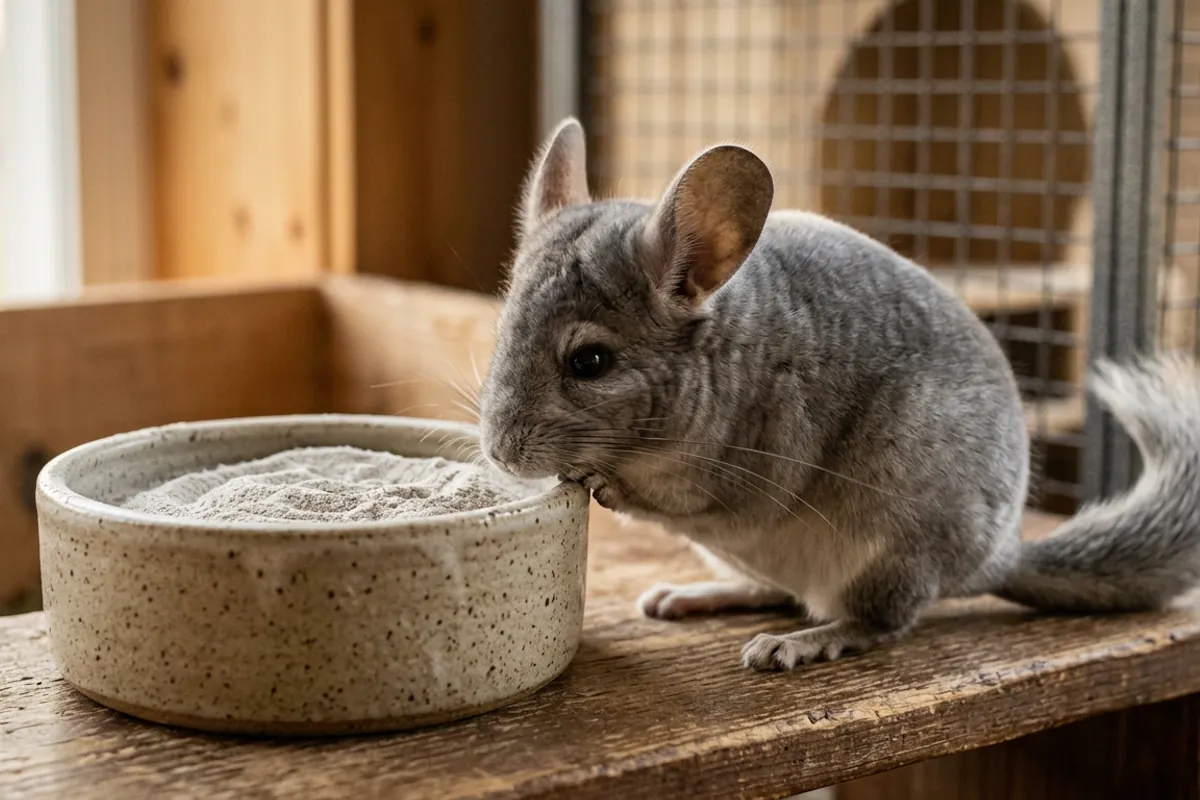
This is the single biggest place I see people go wrong, so I want to be blunt about it: do not use sand. A bag of "chinchilla sand" from a shelf is not the same product as chinchilla dust, and sand is too coarse for this coat. It can be rough on the skin and it does not absorb oils the way real dust does. Play sand, craft sand, aquarium sand, none of it belongs anywhere near your animal. The commercial dusts sold specifically for chinchillas are the right texture, and there is no clever substitute worth improvising here.
I go into the sourcing and the different products in more detail in what bathing dust for chinchillas really is. The gist: buy actual chinchilla dust, keep it dry, and throw it out when it gets clumpy or dirty.
The bath routine that works
Here is exactly what I do, and it is not complicated. I use a container big enough for the animal to flip over completely without banging into the sides. A lot of people use a heavy glass or ceramic bowl, an old fishbowl on its side, or a purpose-made bath house. I avoid tall narrow containers because the whole point is the roll, and I avoid anything flimsy that will tip. Metal or glass or ceramic, something with weight to it.
I pour in enough dust to cover the bottom by an inch or two, which is roughly two tablespoons or so for a normal bath, and I set it in the cage. Then I let the chinchilla do the work. There is nothing for you to do here. No rubbing dust into the fur, no holding the animal, none of that. A healthy chinchilla knows exactly what to do and will dive in and roll, sometimes so vigorously that dust flies everywhere. That mess is normal. I keep the bath somewhere I do not mind cleaning.
The key discipline is that the bath comes out again. I leave it in for around ten to fifteen minutes, let my chinchilla have a few good rolls, and then I remove it. I do not leave the dust bath in the cage all day, and I will explain why in a moment. Evening tends to work best, because these animals are most active at dawn and dusk, and a groggy midday chinchilla is not interested. Pebble treats her evening bath as the highlight of her day, and Juniper, who is older and a bit more deliberate about everything, takes her time but gets there.
How often to offer it, and how to read the coat
For most chinchillas in a normal home, two to three baths a week is the range I would point you toward. That is the figure most experienced keepers land on, and it is a range on purpose, because it depends on your animal and your climate rather than on a single magic number.
More is not better. Over-bathing strips too much oil from the skin and leaves it dry, flaky, and itchy, and a chinchilla with irritated skin will scratch and can damage that beautiful coat. This is exactly why I take the bath out after each session instead of leaving it in. A chinchilla left with unlimited dust will bathe constantly, use the container as a toilet, and end up with dry skin and irritated eyes from the airborne dust. In and out, a few times a week, is the whole trick.
Let the coat tell you. A clean, well-bathed chinchilla feels dry, springs back when you part the fur, and looks fluffed and glossy. If the fur starts to look a little greasy, stringy, or clumped, or feels slightly damp at the skin, that is a sign to bathe a touch more often. If you notice flaking skin or your chinchilla scratching a lot, ease off. In a humid stretch of summer the coat picks up moisture from the air and I bathe on the more frequent end. In dry winter air I sometimes go the other way. You are reading the animal, not obeying a calendar.
Heat, humidity, and when to skip the bath
This is the part I refuse to soften, because it is the part that once nearly cost me Pebble. She came to me as a rehome out of an overheated attic, and her first summer with me brought a heatwave and a night at the emergency vet. Everything I believe about heat safety came out of that scare.
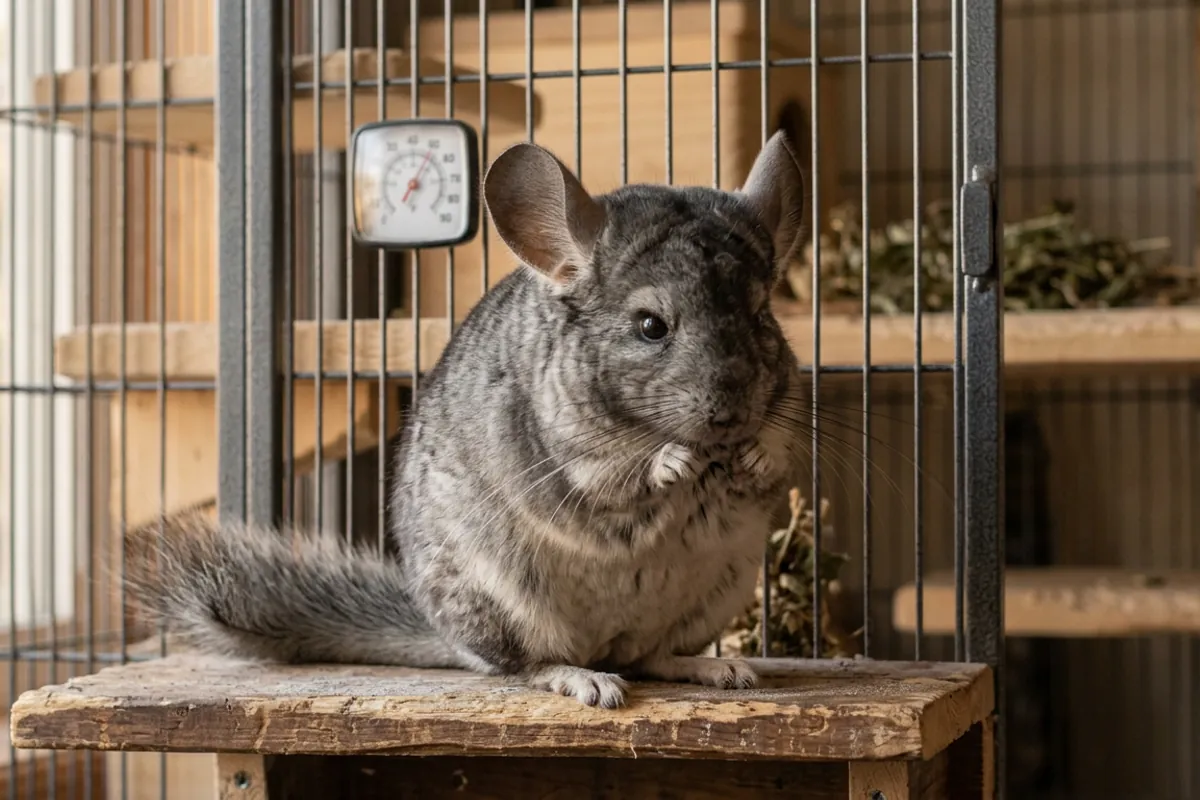
Chinchillas do not handle heat. That dense coat that keeps them warm in the Andes cannot shed heat well, and they cannot pant or sweat their way out of trouble the way other animals do. The comfortable range is 60 to 70°F, which is 15 to 21°C. Above about 75°F, which is 24°C, you are into risky territory, and at 80°F, which is 27°C, and above, you are in an emergency, and it comes on faster in humid air. If you take one number away from this whole article, take that one. I keep a thermometer and humidity gauge right on the cage so I am never guessing. digital thermometer and humidity gauge with remote probes As an Amazon Associate I earn from qualifying purchases.
Where this meets the bath: a dust bath is exercise, and an overheating chinchilla does not need a session of vigorous rolling on a hot evening. On a hot day I skip the bath entirely and put every bit of my attention into cooling the room. Humidity matters too, and there is a real tension here. Humid air is more dangerous for heat, but it is also when the coat most needs the drying help of a bath. The way I resolve it is simple: fix the temperature first. Get the room into the safe range with air conditioning or by moving the cage to the coolest part of the house, and only then think about the bath. A cool, dry chinchilla is the goal, and a chilled granite or ceramic cooling stone in the cage gives mine somewhere to stretch out on when it is warm. Kaytee Chinchilla Chiller granite stone As an Amazon Associate I earn from qualifying purchases.
If you want the full picture on heat, I have written a dedicated heat safety guide and a piece on the warning signs of heat stroke that every owner should read before their first summer. There is also a heat danger calculator I put together to take the guesswork out of a borderline day.
The gear, and what to avoid
You do not need much for a proper bath, and most of the money people spend goes to things they should not buy. Here is my list.
You need real chinchilla dust, the fine volcanic kind, and you need a sturdy container that will not tip. That is it for the bath itself. A dedicated closed bath house keeps the mess contained, or an open heavy bowl works fine if you do not mind cleaning up. Either is acceptable. What matters is the weight and the size, not the shape.
What to avoid is a longer list. Skip sand, as I said. Skip any "chinchilla bath spray" or wet-wipe product that promises a waterless clean in a bottle, because the only waterless clean a chinchilla needs is dust. Be wary of leaving the bath in as a permanent cage fixture. And while we are on the subject of equipment, since bathing sits inside the bigger question of how you set up the whole enclosure, let me say the thing I always say: the cage itself should be tall, made of metal and wood with wooden ledges, and free of plastic, because a bored or badly housed chinchilla is a chinchilla with more problems than a dirty coat. Critter Nation double unit small animal cage As an Amazon Associate I earn from qualifying purchases. If your wheel is a wire one, replace it with a solid running surface before it catches a foot. 15 inch Chin Spin solid surface chinchilla wheel As an Amazon Associate I earn from qualifying purchases. I lay all of this out in how to choose a chinchilla cage and in the enclosure setup guide, if the housing side is new to you.
None of the bath gear replaces the basics that keep a coat healthy from the inside. Unlimited grass hay, plain measured pellets, and constant chewing keep the whole animal in good order, and a well-fed chinchilla simply carries a better coat. Oxbow Western Timothy Hay, 40 oz bag As an Amazon Associate I earn from qualifying purchases.
When a bathing problem is really a health problem
Most of the time, the dust bath is a happy, low-drama part of the week. But it is also a window into your chinchilla's health, and I want you to use it as one. When I set the bath down, I am watching.
A chinchilla that suddenly stops bathing, or bathes and still looks scruffy, is telling you something. A coat that stays greasy or matted despite regular dust can point to an animal that is not grooming properly, and that is often a sign it does not feel well. Fur that comes out in patches, bald spots, or red, flaky, irritated skin can mean a fungal infection, which thrives exactly when a coat has been damp, and that is a vet matter, not a bathe-more matter. Bare patches can also come from fur chewing, which is usually a stress or boredom signal worth taking seriously.
I am an experienced keeper, not a vet, and I hold that line hard. So here is where the line sits. If you see hair loss, persistent flaking, sores, a coat that will not come clean, or a chinchilla that has simply lost interest in a bath it used to love, that is a call to an exotics vet, not a change to your dust schedule. The same goes for weepy eyes, which can come from dust that is too coarse or too plentiful but can also signal a dental problem. Juniper's dental disease is a daily reminder to me that eye and face symptoms are worth a professional look. When you cross from grooming into medicine, an exotics vet is the right answer every single time.
Get the bath right, though, and it is one of the real pleasures of living with these animals. A clean chinchilla, fluffed and dry after a good roll, sitting up to wash its face with tiny paws, is about as content as a small animal gets. Give it the right dust, take it away before it becomes too much, keep the room cool, and watch the coat for what it is telling you. Do that and the bath will be the easy part of chinchilla care, exactly as it should be.