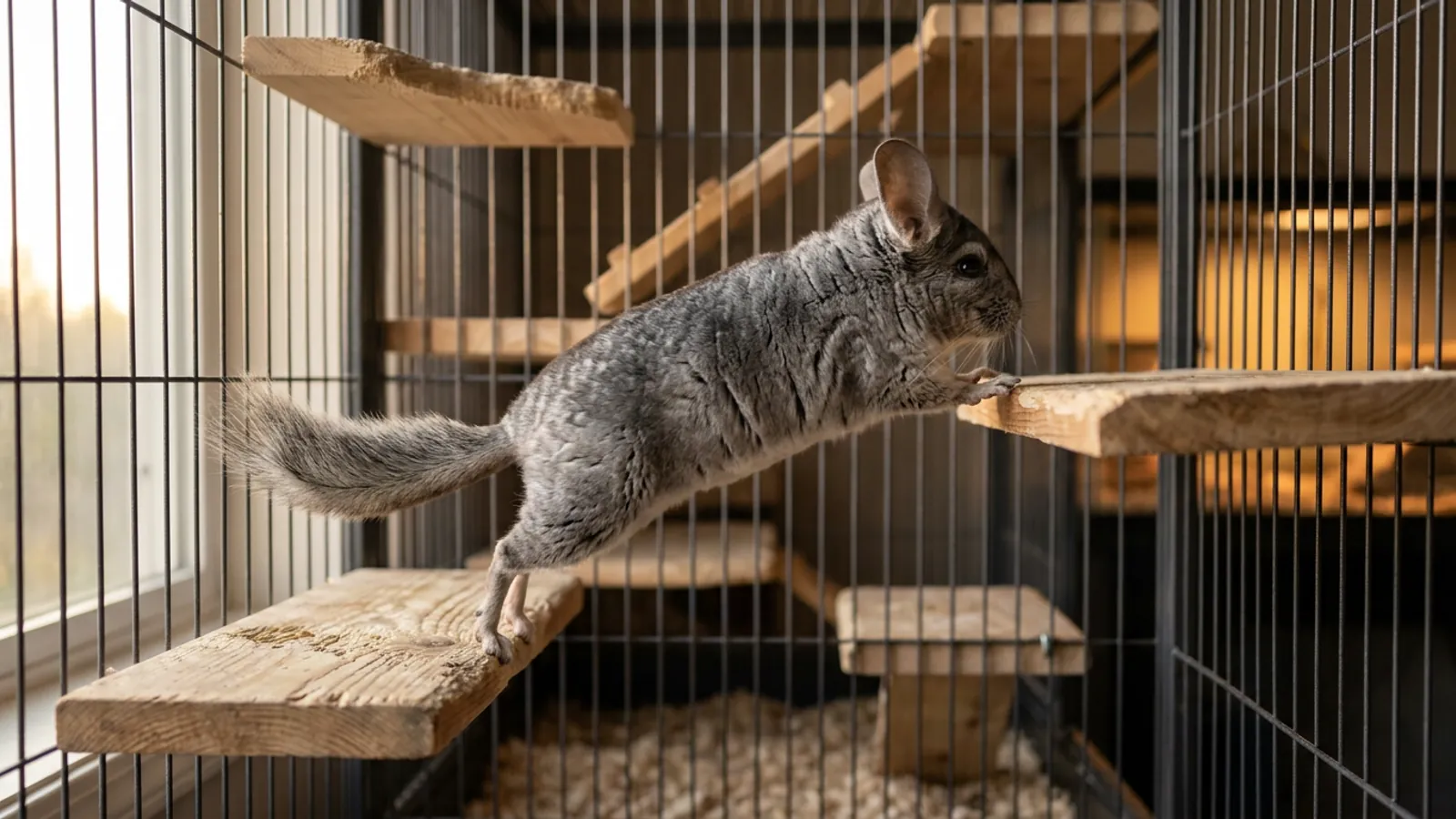
The first time I watched Pebble cross her cage without touching anything in the middle, I leaned in to check I had not simply missed a step. Chinchilla jumping is not a trick, and it is not a stage they grow out of. It is how the animal is built to move. A chinchilla strolling politely along a shelf is a chinchilla that has run out of reasons to hurry, and give it a reason and it goes up, not across. After about ten years of watching two of them do this, I have sorted the jumping into three piles: the great majority that is completely normal, a slice that is a cage problem wearing a behavior costume, and a small, serious slice where the animal is telling you something is wrong. This is how I tell them apart.
Why a chinchilla is built to go up
Everything odd about how a chinchilla moves makes sense the moment you picture where the species comes from. The wild animal lives on dry, rocky mountain slopes, in a landscape of boulders, ledges and crevices. Horizontal running gets you eaten out there. Vertical escape into a gap a predator cannot follow you into is what keeps you alive. That is the body you have in your living room, and it did not change when it moved indoors. I wrote more about that in what a chinchilla in the wild is really like, because almost every care rule traces back to it.
Look at the proportions. The hind legs are long and heavily muscled, far out of scale with the small front paws, which are used more like hands for holding food and gripping edges. The body underneath all that fur is light: most adults sit somewhere around 400 to 600 grams, with females usually the heavier ones. Long levers plus low mass is a jumping machine. The bushy tail acts as a counterweight and a rudder in mid air, which is why a chinchilla can change its mind halfway through a leap and still land where it meant to.
How high? The RSPCA says over six feet, roughly 1.8 meters, though it gives no measurement behind it. I have never put a tape measure to a leap in my own home, so I have not verified it. What I can tell you honestly is that both of mine clear the top of a kitchen counter without visible effort, and that I plan my rooms and my cage on the assumption that anything under head height is reachable. Assume more, not less. You will be wrong less often, and being wrong in that direction costs you nothing.
Hopping, popcorning, and the difference between joy and panic
Not all of it is the same behavior, and the labels people use get mixed up constantly. It helps to separate them.
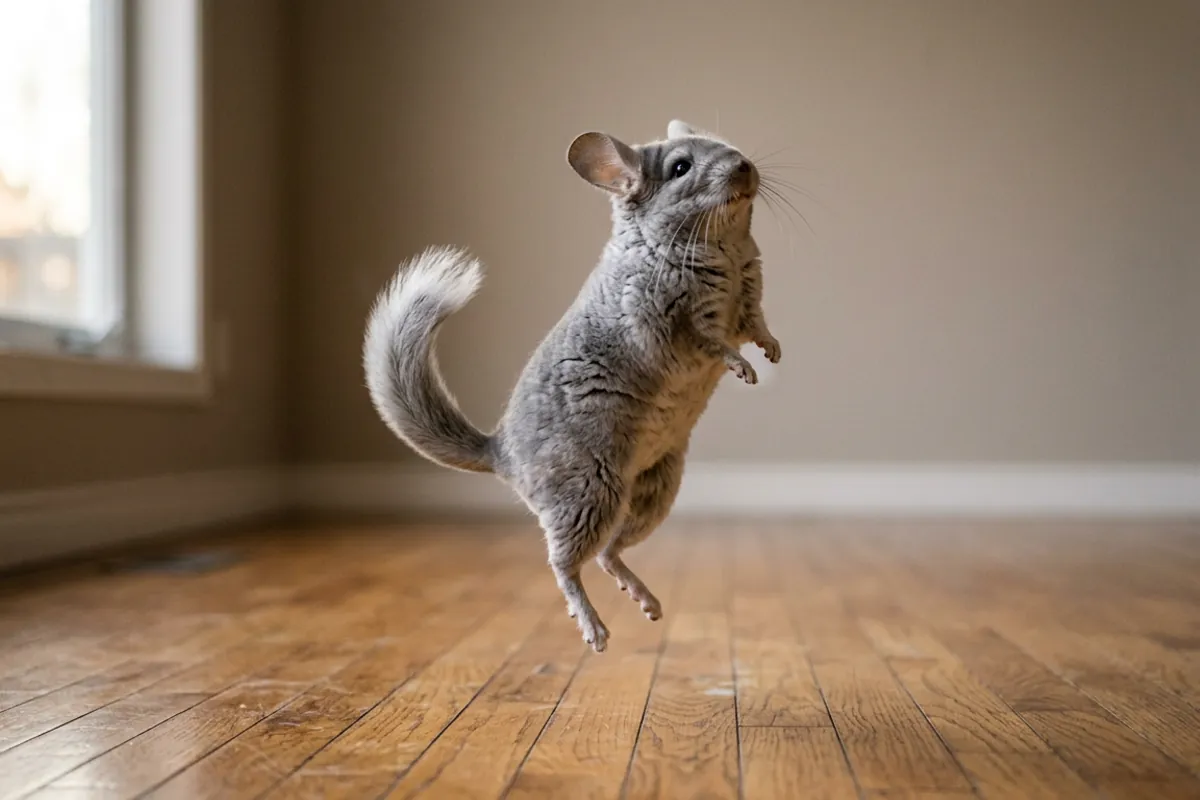
Chinchilla hopping is the everyday version: short, bouncy, low travel, usually with the back feet landing together. This is just walking, chinchilla style. It is what you see when one is crossing the floor during out time, unhurried but not interested in walking properly.
Popcorning is the one people fall in love with. The chinchilla launches straight up from a standstill, sometimes twisting in the air, sometimes bouncing off a wall and back, often several times in a row. It usually comes with the loose, chirpy little sounds I go through in what your chinchilla noises are telling you. This is a happy animal with surplus energy, and the plain interpretation is that simple. Juniper does it most reliably about twenty minutes after a dust bath, which tells you something about how much a good bath improves her mood.
Panic looks different, and once you have seen it you will not confuse the two. Panic jumping is repetitive rather than varied, aimed at a specific escape point rather than anywhere fun, and the body language changes with it: ears flat back, eyes wide, no vocalizing or a sharp alarm bark repeated on a beat. A popcorning chinchilla bounces off a wall because the wall is there. A frightened one hits the same corner over and over because it wants out of this room, now. If you see the second version, find the cause. Usually it is a dog on the other side of a door, a new noise, or a smell. More on the wider vocabulary in what chinchilla behavior is really telling you.
Chinchilla jumping around cage at night is not a problem
This is the single most common worry I get asked about, and the answer is nearly always that nothing is wrong. Chinchillas are busiest around dusk and dawn and stay active on and off right through the night. Whether the right label is nocturnal or crepuscular is genuinely argued over, and I go through that in the sleep article below rather than pretending it is settled. They sleep in short blocks through the day, which is why yours looks like a fur cushion at two in the afternoon and an acrobat at two in the morning. I broke the whole daily cycle down in what chinchilla sleep really looks like.
So a chinchilla jumping around cage shelves at midnight, thumping onto a wooden ledge, taking a run at the wheel and going again is a healthy animal doing exactly what its clock tells it to. You cannot retrain this, and you should not try. Waking a chinchilla repeatedly to fit your schedule does real harm to an animal that already sleeps in fragments.
What you can do is site the cage sensibly. Mine is not in a bedroom and never will be. A chinchilla landing on a metal ledge from a height carries surprisingly well through a wall at three in the morning. Solid wooden ledges are quieter than metal ones, and a solid running surface on the wheel is quieter than a wire one. A stable, heavy cage rattles less than a light one on a wobbly stand.
The one night pattern I would look at twice is a chinchilla that is suddenly loud when it has been quiet, or suddenly quiet when it has been loud. Change in the pattern is information. The pattern itself, however noisy, is just a chinchilla.
When jumping is telling you the cage is wrong
Here is the version that is not fine. Repetitive, unvarying jumping at one fixed point, most often the door or a front corner, done for long stretches, is not play. It is the same category of behavior as a pacing zoo animal: a body with a strong drive and nowhere legitimate to put it.
The usual cause is a cage that is too small, or more precisely too short. Chinchillas do not use floor space the way a guinea pig does. Bigger is not automatically better, though: in a 2024 preference study, chinchillas chose the smaller and lower cage most of the time, especially while resting. I made the case for height in why height beats floor space and in why a multi level cage is built for how they move, and I stand by it: height first, then width.
The second cause is a cage with nothing in the vertical space. A tall cage with one shelf is a tall empty box. The animal needs landing points at varied heights so that going up has a payoff at every stage.
The third is materials. Plastic shelves and plastic bases get chewed and swallowed, and a chinchilla landing hard on slick plastic slides. Metal frames with solid wooden ledges are the setup I trust, and it is what I would buy again.
Critter Nation double unit small animal cage As an Amazon Associate I earn from qualifying purchases.
If your chinchilla bounces at the bars for twenty minutes every evening, the fix is almost never behavioral. It is a bigger cage, more ledges, and reliable out time. Why a big chinchilla cage is the baseline covers what I consider the floor rather than the aspiration.
The jumping changes that send me to a vet
Now the part that matters most, and it is counterintuitive: with chinchillas, the frightening sign is usually less jumping, not more.
Heat is the reason I am so blunt about this. Pebble came to me from a rehome out of an overheated attic, and her first summer here brought a heatwave and a night at the emergency vet that I have never really stopped thinking about. A chinchilla in heat trouble does not bounce. It goes flat, stretched out on its side, ears hot and pink with visible blood vessels, breathing fast and shallow, unwilling to move at all. If your normally bouncy animal has gone still and lain out flat on a warm day, treat that as an emergency and get to an exotics vet.
The numbers are not negotiable. Comfortable is 60 to 70°F (15 to 21°C). Above 75°F (24°C) is risky. At 80°F (27°C) and above you are in emergency territory, and humid air makes all of it happen faster, because that coat cannot shed heat through moisture. Keep a thermometer with a humidity readout on the cage itself, not on a wall across the room, and read it daily.
digital thermometer and humidity gauge with remote probes As an Amazon Associate I earn from qualifying purchases.
A chilled granite or marble slab in the cage gives them somewhere to dump heat into, and mine both use one unprompted in summer.
Kaytee Chinchilla Chiller granite stone As an Amazon Associate I earn from qualifying purchases.
It is a comfort measure, not a cooling system: it does not fix a hot room. Chinchilla temperature, the warning signs of heat stroke and the heat danger calculator are the three things I would want any new owner to read before their first summer.
Outside heat, the jumping signs I take seriously are these. A chinchilla that hesitates before a jump it used to make casually, or starts taking the long way round. Missed landings and scrabbling where it used to be clean. Landing and then holding a back foot up. Any of those means a vet appointment, because they point at a leg, a foot or a spine, and I cannot assess those and neither can you. The same goes for a broad drop in activity: when Juniper's dental disease flares, the first thing I see is a quiet chinchilla, days before anything shows in her mouth. Pain in a prey animal looks like stillness. Find an exotics vet before you need one, using how to find a chinchilla vet.
Building a cage the jumping can use
Give the drive somewhere to go and most of the problem behavior disappears on its own.
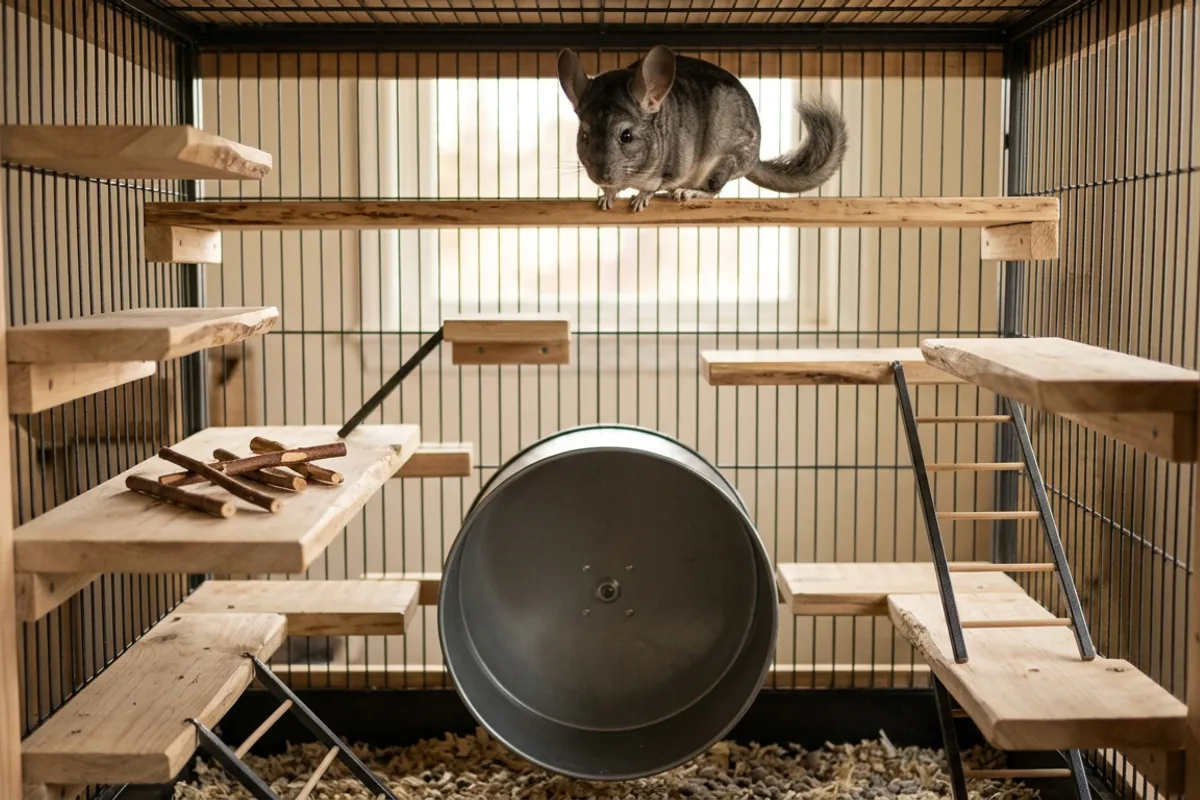
I space ledges so the drop from one to the next is modest, somewhere in the region of 12 to 18 inches (30 to 45 cm), staggered left and right rather than stacked in a straight column. That is my practice rather than a measured standard, and I will say so plainly. There is one figure I did not invent, though, and it is worth building around: the RSPCA and the PDSA both publish the same ceiling, a 60 cm (about 24 inch) uninterrupted drop. Height is not the hazard. An unbroken fall is. The reasoning is that a staggered ladder gives a young animal an interesting route and an old one a safe one, and older chinchillas do stiffen up. How age changes your care goes into that.
Ledges should be solid and wide enough for the whole animal to turn around on. Kiln dried pine is the workhorse; apple, willow and other safe hardwoods add variety, and variety matters because ledges get chewed, which is a feature and not a fault. Chinchilla safe wood has the list I go by, and rotating fresh chews through keeps the ledges lasting longer and the teeth worn down.
emours apple wood chew sticks, 40 count As an Amazon Associate I earn from qualifying purchases.
A wheel is the other outlet, and here I am inflexible: solid running surface only. Wire and mesh wheels catch toes and break legs. Diameter matters too, because a small wheel forces the spine into a permanent arch. I would not go under about 15 inches (38 cm), and bigger is better.
15 inch Chin Spin solid surface chinchilla wheel As an Amazon Associate I earn from qualifying purchases.
The chinchilla exercise wheel that is safe, and the ones that are not explains what to check before you buy. Lava ledges are worth a place as landing points that also wear nails, though they are not a substitute for wood.
Jumping outside the cage, and how people get hurt doing it
Out time is where the real athleticism shows, and where owners get caught out. Most commercial playpens are simply too short for a chinchilla, and a determined one will be over the top of an open pen. If you use one, treat it as a boundary marker for a supervised session, not a container you can walk away from. I covered making one work in how to set up a chinchilla playpen.
The room itself has to be chinchilla proofed to the height you think they cannot reach, and then a bit past it. Cables, houseplants, gaps behind furniture and any route to a window all need dealing with before the door of the cage opens.
One habit I will push hard: never grab at a chinchilla in mid air or mid run. They can release a patch of fur when something holds them, a defense called fur slip, described in why they let go of their own fur. The patch grows back, but it takes months, and the panic teaches the animal that hands are hazards. I sit on the floor, keep still, and let them come to me. It takes longer for a week and pays back for years.
What I do when the jumping changes
Behavior only reads as a signal against a baseline, so build the baseline first. Watch your chinchilla at the same points of the evening for a couple of weeks until you know what normal looks like for that particular animal. Chinchillas differ a lot: Pebble is a bouncer, Juniper never was.
When something shifts, I run the same short check before I speculate. Read the thermometer on the cage. Look at the droppings, because size and quantity change fast and change early, which is why chinchilla poop is the first thing I check. Check whether the hay pile is going down at the normal rate: unlimited grass hay is the whole meal, not a side dish, and a drop in hay intake is one of the earliest signals you get.
Then look at the animal moving. Symmetrical? Landing cleanly? Willing to go up?
If the temperature is fine, the droppings are normal, the hay is disappearing and the animal is moving evenly, a quiet week is usually just a quiet week. If any one of those is off, or if a normally active chinchilla is flat and still on a warm day, that is not a wait and see situation. Book the exotics vet. I am a keeper with ten years of practice, not a veterinarian, and the line between reading behavior and diagnosing disease is one I do not cross. Everything up to that line, though, you can learn by watching, and the jumping is one of the most honest things a chinchilla will ever tell you.