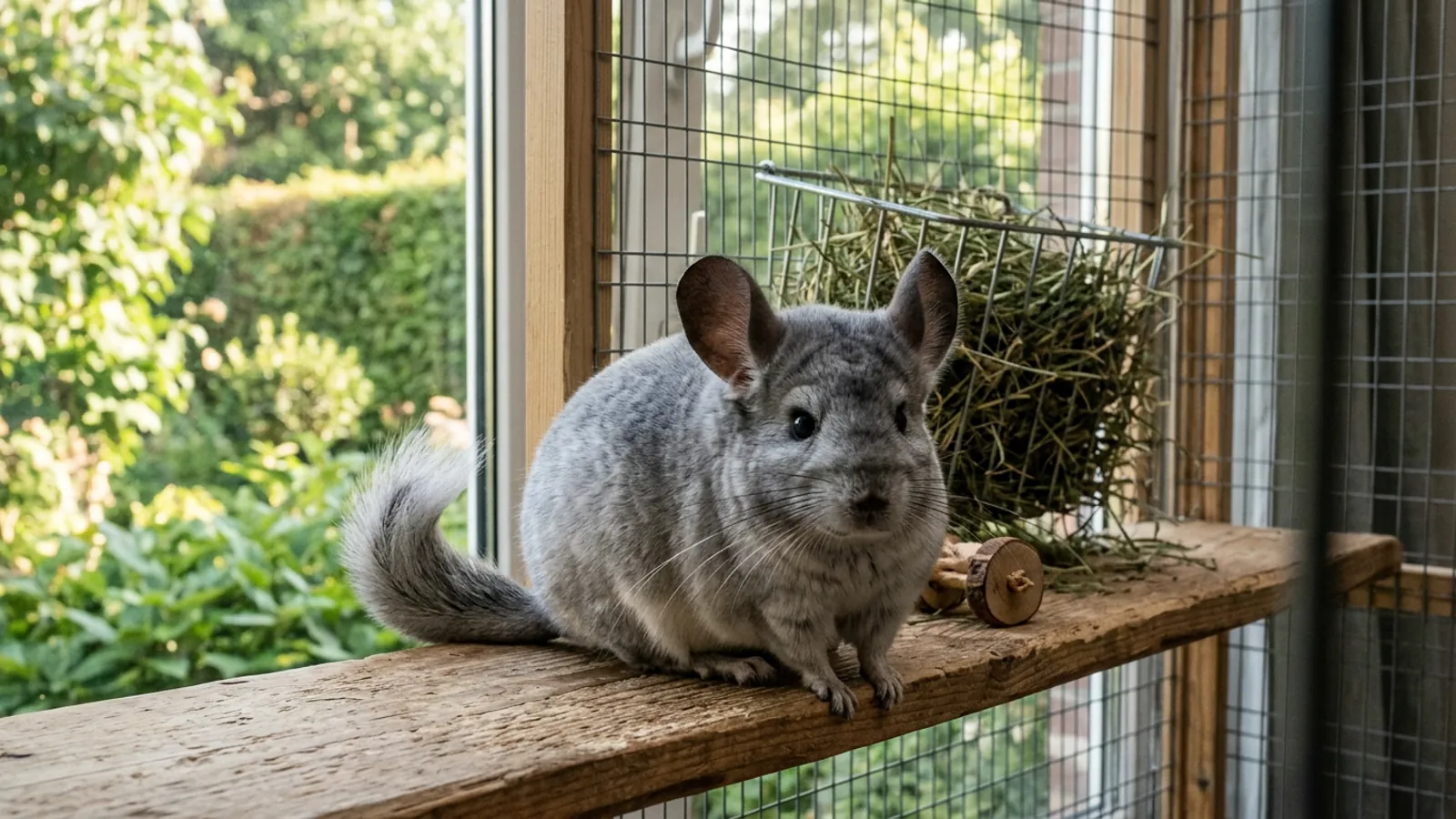
Every spring someone sends me a photo of a chinchilla sitting in the grass with sun on her fur, and asks whether it is okay. I understand the impulse completely, and I am going to be blunt anyway, because this is one of the few care questions where being polite gets animals hurt. The answer to "can chinchillas go outside" is almost always no. Not because chinchillas are fussy, but because you are dealing with an animal built for cold, dry, thin air at altitude, wrapped in the densest fur of any land mammal, with almost no way to shed heat. The outdoors is not a treat for that body. It is a hazard with good lighting.
The short answer, and what it hangs on
The rule I keep is simple: my chinchillas go outside for two reasons only, to get to the vet and to move house. Not for fresh air. Not for photos. Not for ten minutes of sunshine on the balcony because the weather is nice. Everything else about outdoors is a risk you take on the animal's behalf, and she gets nothing back that you could not give her better indoors.
That sounds absolute, so let me show the reasoning. Chinchillas come from the high Andes, where the air is cold, dry and thin, and where they spend the bright part of the day wedged into rock crevices out of the sun. If you read what a chinchilla in the wild is really like, the pattern jumps out: these are crevice animals, active at dusk and dawn, hiding from daylight. The "outside" they are adapted to is a shaded, dusty rockslide at altitude in cold air. It is not a lawn in June.
The outdoors people picture is a garden at a pleasant human temperature. Pleasant for us starts around the point where a chinchilla is already at the top of her range, and it climbs from there. That single mismatch is most of the answer, and the rest of this article is the detail behind it.
Why heat turns the outdoors into a different animal
Here are the numbers I keep on a card in my head. Comfortable is 60 to 70°F (15 to 21°C). Above 75°F (24°C) is genuinely risky. At 80°F (27°C) and up you are in an emergency, and humid air makes all of that arrive faster. Those are not my personal preferences; they are the accepted range across keepers, breeders and exotics vets, and I have never met a good reason to fudge them.
A chinchilla cannot sweat her way out of trouble, and she cannot pant efficiently the way a dog can. She dumps heat mostly through her big bare ears, and that is a small radiator for a coat with dozens of hairs growing from every single follicle. The coat that makes her look like a cloud is a sealed insulating layer. It works brilliantly in one direction and barely at all in the other.
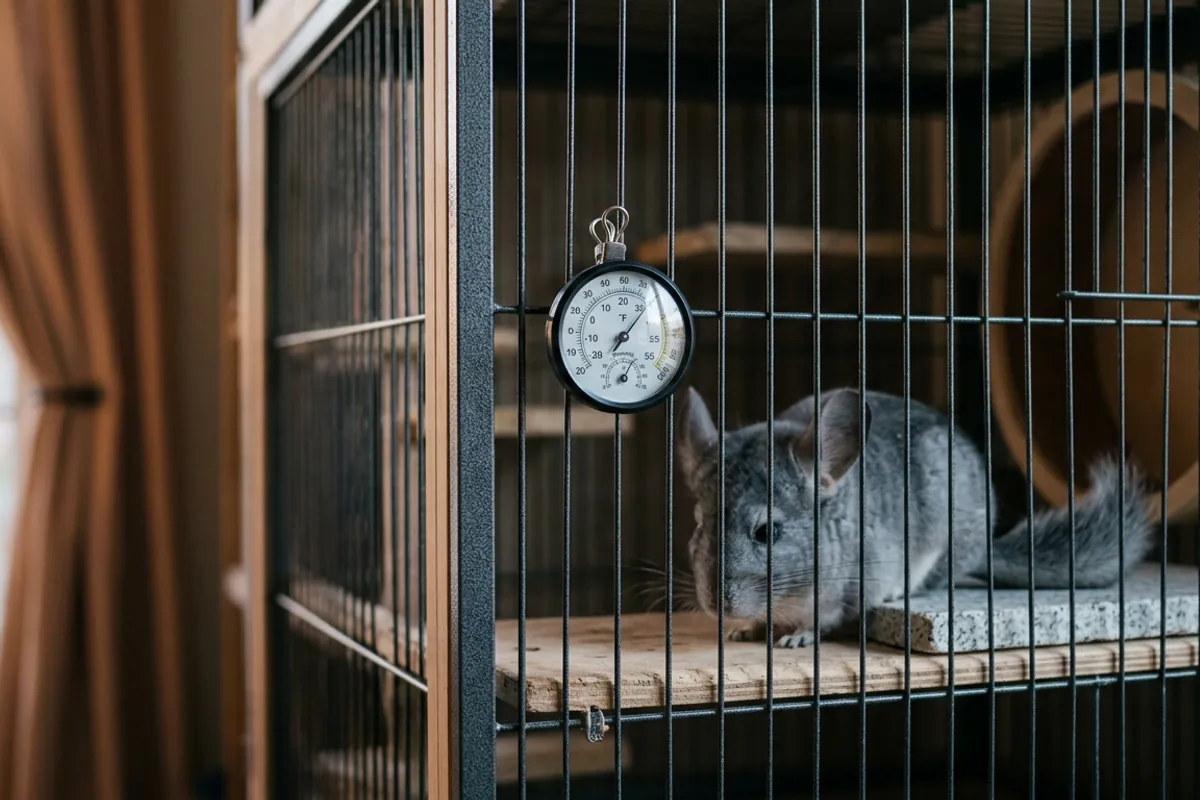
Outside, air temperature is also not the whole story. A shaded reading of 72°F on your phone means nothing if the carrier is sitting in direct sun, where radiant heat and a closed mesh box behave like a small greenhouse. I want a real reading where the animal is, which is why there is a thermometer and hygrometer on the cage itself rather than a weather app on my phone.
digital thermometer and humidity gauge with remote probes As an Amazon Associate I earn from qualifying purchases.
Many keepers use a rough rule of thumb: add the temperature in Fahrenheit to the relative humidity percentage, and stay under about 150. I use it as a nudge, not gospel, because it is a keeper convention rather than a laboratory threshold. What is not debated is that damp heat is worse than dry heat at the same number. For the fuller version, see chinchilla heat safety and the heat danger calculator, and learn the warning signs of heat stroke before you need them, not during.
This is Pebble's part of the site. She came to me from a rehome out of an overheated attic, and her first summer brought a heatwave near-miss and a night at the emergency vet. Nothing about that night was slow. She went from looking a little flat to hot red ears, stretched out flat on her side and drooling, in far less time than I would have guessed. That is why I do not soften this section to sound friendlier.
A cooling stone helps at the margins, and I keep a couple in rotation in summer.
Kaytee Chinchilla Chiller granite stone As an Amazon Associate I earn from qualifying purchases.
But be clear about what it is: a cool surface she may choose to sit on. It buys comfort, not safety. It does not make an 80°F room survivable, and it certainly does not make a garden safe. Only cooling the actual air does that, which is why air conditioning is the real answer indoors and there is no equivalent answer outdoors.
What else is out there, besides the temperature
Suppose you have a cool, overcast, dry evening at 64°F. The heat argument thins out. The rest of the list does not.
Predators come first. A hawk does not need long, and neither does a loose cat. But you do not even need contact for damage: a chinchilla is a prey animal whose whole nervous system is tuned to detect and flee from things that eat her. The neighbor's dog barking behind a fence she cannot see is a full-body panic event. Severe stress alone can cause real harm in a small prey animal, and even short of that you get fur slip, where she releases a patch of coat as an escape reflex and regrows it over months. If you live with a dog, my rules for that are in keeping a chinchilla and dog under one roof, and none of them involve the garden.
Escape is the outcome I would lose sleep over. A startled chinchilla can clear heights that surprise people, changes direction faster than you can track, and is built to vanish into a crevice. Outdoors there is no crevice, only the whole world. A chinchilla that bolts in a garden is very often simply gone, and even if you find her, a night outside is its own emergency.
Then the quiet hazards. Wild rodents leave parasites and disease behind them on ground you cannot inspect. Lawns and beds carry pesticide, herbicide and fertilizer residue that she will ingest the moment she grooms. Plenty of common garden plants are toxic, and a chinchilla samples with her teeth first. Damp grass soaks a coat that takes an extraordinarily long time to dry down to the skin, which is exactly the setup for fungal trouble; I go through why in what a soaked coat really means.
Harnesses and leashes, and why mine stay in a drawer
People ask about harnesses as the compromise. I do not use one and I would not recommend one.
Look at the shape of the animal. A chinchilla is a compressible barrel of fur over a light, fragile ribcage, and there is no landmark to hold a harness in place. Tighten it enough that she cannot reverse out of it and you are compressing a chest that was never built to be gripped. Leave it loose enough to be comfortable and she backs out of it, which is the failure mode I have seen described over and over. Either way the strapping rubs and mats the coat, and the fitting process alone is a fur slip risk.
Then there is the bolt. A tethered animal that panics does not stop when the line goes tight; she hits the end of it at full speed with her spine, neck or a limb taking the load. You have traded "she runs away" for "she injures herself and still panics."
And notice what a harness does not fix. It does not lower the temperature, deter a hawk, filter pesticide off grass, or stop the dog two gardens over from barking. It only addresses escape, which is the one hazard a closed carrier already handles better.
The trips that do happen, and how I do them
Vet visits and moves are real, so the practical question is how to move a chinchilla through outdoor air safely rather than whether to.
Use a hard sided, well ventilated carrier that is small enough that she cannot be thrown around inside it, with a familiar scent and a good handful of hay to chew on. My full reasoning is in choosing a chinchilla carrier. Never a cardboard box, and never a soft bag.
Time the trip. In summer that means early morning or late evening, never the middle of the day. Cool the car before the chinchilla goes into it, run the air conditioning for the whole drive, and keep the carrier out of direct sun and off a hot seat. A chilled tile or a frozen bottle wrapped in a towel gives her something to move toward, and the wrapping matters so she is never in direct contact with ice. Take the shortest route and do not add errands.
The rule with no exceptions: never leave a chinchilla in a parked car, not for two minutes, not with the windows cracked, not in mild weather. A parked car in sun climbs past the emergency threshold shockingly fast, and it is the single most common way this goes wrong.
Do all of this before there is a crisis, which means finding your exotics vet now. How to find a chinchilla vet before you need one exists because the worst time to start searching is the evening it matters.
Outbuildings and sheds
There is a separate question hiding inside this one, and it deserves a straight answer: can a chinchilla live in an outdoor building? Some keepers in cool climates do house chinchillas in insulated, climate controlled outbuildings, and done properly it can work.
But be clear about what that is. It is not letting a chinchilla go outside. It is building a second indoors and putting a door on it. The bar is high: real insulation, active temperature and humidity control, a plan for what happens when the power fails on a hot day, a structure that is secure against predators and theft, and a human presence often enough to notice a sick animal within hours rather than days. Miss any of those and you have a hot box or a cold box with an animal in it.
A rabbit style hutch is never acceptable, in any climate, in any season. And I will say plainly that I do not house mine this way and would not suggest it to anyone keeping their first chinchilla. Indoors, in a room you already control, is easier and safer, and you will see her.
Giving her the outdoors indoors
Here is the part I find cheering: everything the garden seems to offer, she can have inside, in a version that suits her better.
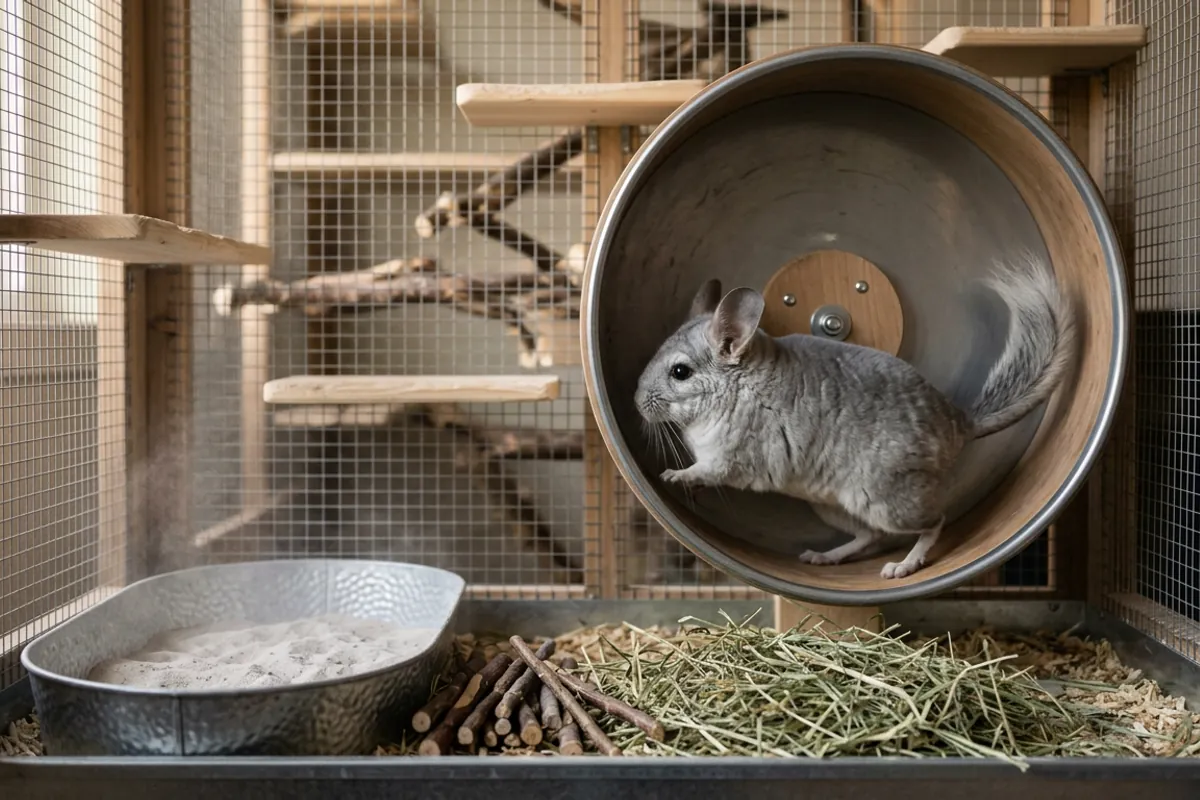
She wants to dig and roll in fine grit. She does not want soil, which is damp and full of things you cannot see. Volcanic pumice dust is the real equivalent, and it does something dirt cannot: it pulls oil out of a coat too dense for water to ever be an option. Two or three sessions a week of ten to fifteen minutes is my routine.
Lixit Blue Beauty chinchilla dust, 3 lb As an Amazon Associate I earn from qualifying purchases.
Chinchillas never bathe in water, only in dust; the dust bath guide covers the schedule and the mistakes.
She wants height and hard running, not open lawn. Vertical space in a tall metal and wood cage plus supervised floor time in a chinchilla proofed room covers it, and a wheel with a solid running surface gives her the sprint.
15 inch Chin Spin solid surface chinchilla wheel As an Amazon Associate I earn from qualifying purchases.
Wire rungs catch feet and tails, so that is one place I will name the bad product plainly. See out of cage time and chinchilla enrichment for how I structure it.
She wants to gnaw on real wood, and that is Juniper's lesson. Juniper came to me as a neglected rescue with dental disease I manage every day, and watching what happens when teeth do not get worn down made me uncompromising about two things: a real variety of safe chews,
emours apple wood chew sticks, 40 count As an Amazon Associate I earn from qualifying purchases.
and unlimited grass hay in front of her at all times.
Oxbow Western Timothy Hay, 40 oz bag As an Amazon Associate I earn from qualifying purchases.
Garden branches are not a shortcut here, because you rarely know what has been sprayed on them; safe wood species is the list I work from.
What I do, week to week
In practice this is unglamorous. I check the thermometer and hygrometer on the cage daily, and more often in a heatwave. The chinchilla room is the coolest room in the house and it stays that way from May onward, air conditioning on a timer rather than on my judgment. Windows stay shut on hot days, because open windows import heat, and open windows without secure screens are how animals get out.
Play sessions run at dusk, indoors, in a room where I have already dealt with the cables and the gaps behind furniture. Hay goes in twice a day, chews get rotated so they stay interesting, dust bath on schedule, and weights get checked so I notice trouble before it looks like trouble.
What I do not know is exactly where any individual chinchilla's tipping point sits. Age, weight, coat and health all move it, and I have no way to measure it in advance. That uncertainty is precisely why I keep a wide margin instead of a clever one. The published safe numbers are not the edge of survival; they are the range where she is comfortable, and comfort is the whole point.
So when someone asks whether chinchillas can go outside, what I really want to say is that the question is aiming at the wrong thing. She does not want the garden. She wants cool, dry air, a tall cage, hay in front of her, something hard to chew, and grit to roll in. Give her that and you have given her the version of outside that her body was designed for.