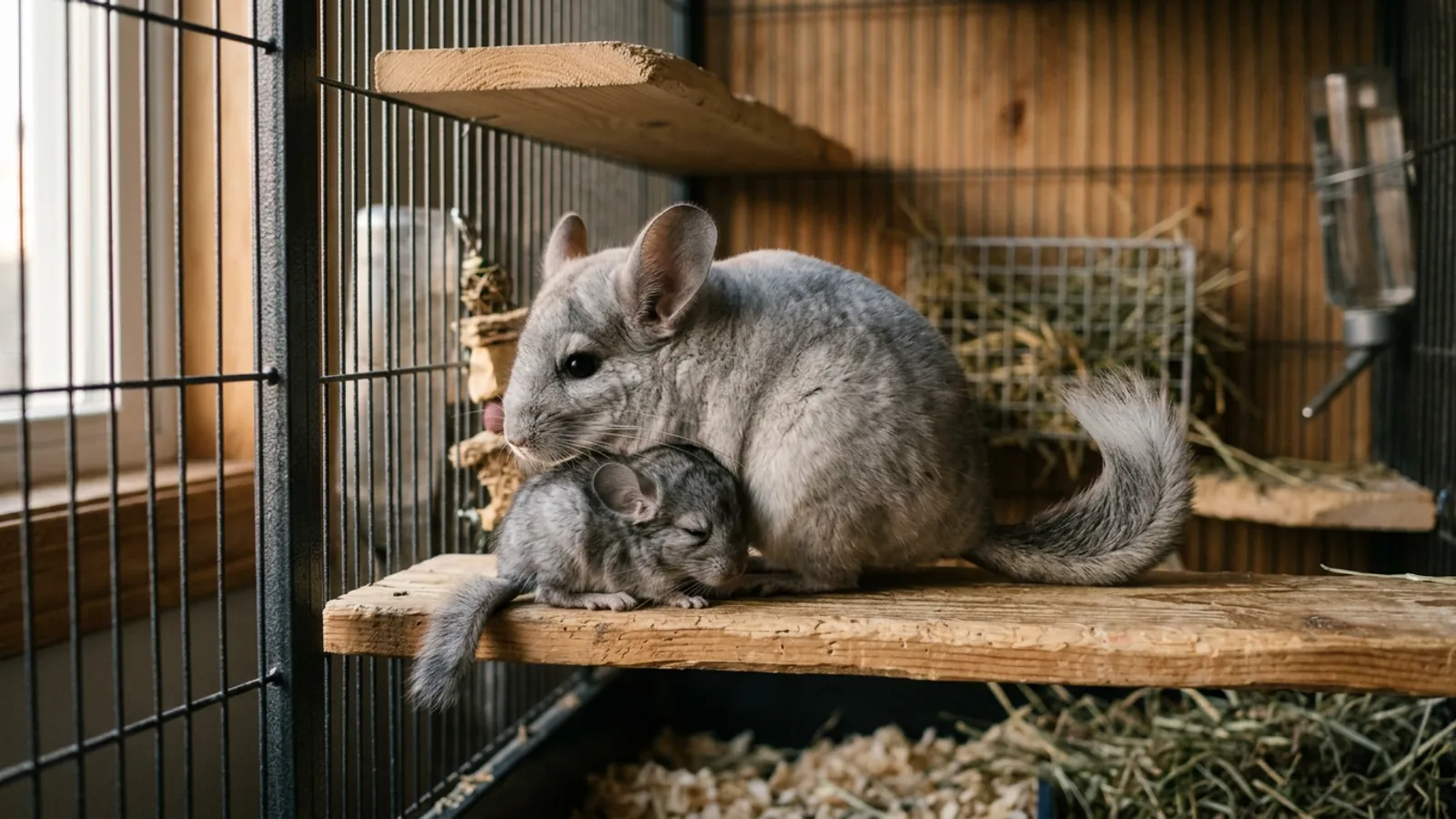
If you are looking at a chinchilla newborn for the first time, the thing that surprises almost everyone is how finished it already looks. It is not the pink, blind, jellybean-shaped creature you get with hamsters or rats. A chinchilla is born fully furred, with its eyes open, its ears up, and a working set of teeth, and it can stumble around the nest within an hour or two of birth. That head start is real, but it hides how fragile these first weeks are. I have raised kits and I have also seen what goes wrong, so this guide covers newborn chinchilla care: what the babies can do on their own, what the mother handles, and the handful of moments where standing back is the mistake.
What a chinchilla newborn is at birth
Chinchillas are what biologists call precocial. The kits arrive developed, not helpless. Expect a fully furred body, open eyes, upright rounded ears, a bushy little tail, and incisors already erupted and ready to nibble. Within a couple of hours a healthy kit is moving, and within a day it is climbing on its mother and testing solid food with those teeth.
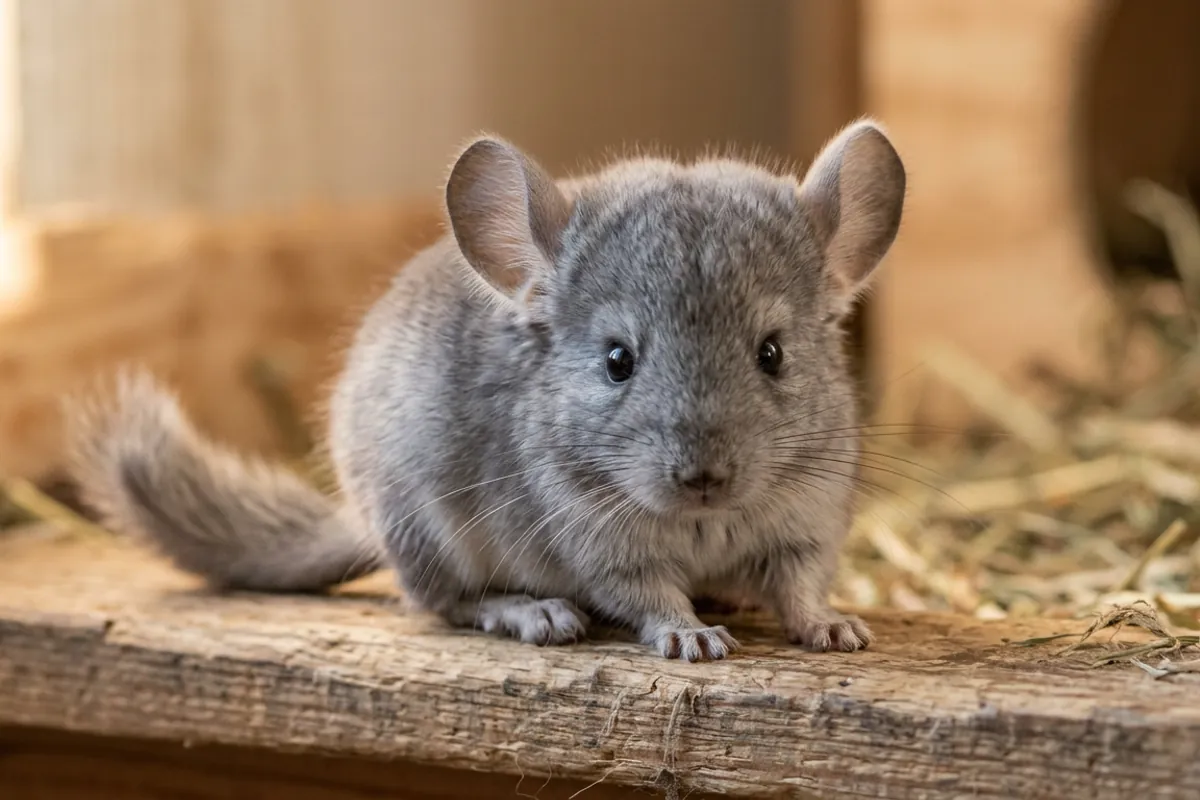
Birth weight runs roughly 30 to 60 grams, and litters are usually one to three kits, with twins being the most common outcome. A single kit is fine. A litter of four is a lot of mouths for one mother to feed, and it changes what you watch for later.
This is the opposite of a rabbit, which is born blind, bald, and completely dependent. The reason a chinchilla is born so ready is the same reason it is a jumpy, cliff-dwelling prey animal in the wild: a baby that can run within its first day has a chance, and a baby that cannot does not. Everything about a chinchilla newborn is built around that early independence.
The long pregnancy that comes first
If there is a newborn in your cage, there was a pregnancy you may not have fully clocked. Chinchilla gestation is long, about 111 days on average, which is remarkable for a rodent this size. Sources put the range somewhere around 105 to 120 days, and that stretch is exactly why an unplanned litter catches people off guard. The dense coat hides the belly, and by the time she is obviously round, she is close.
If you are here because a chinchilla you thought was a solo pet just gave birth, or because you are weighing whether to breed on purpose, read What breeding a chinchilla asks of the animal with clear eyes. It is more demanding, and more dangerous for the female, than most people expect.
One fact bears repeating loudly: a female chinchilla comes back into heat almost immediately after giving birth, often within a day or two. This postpartum estrus means that if a male is in the cage, she will very likely be pregnant again within hours of delivering. Back-to-back litters wear a mother down hard. If you were not deliberately breeding for a second litter, separate the male before or right at birth. That single decision protects her more than almost anything else you can do.
The first hours, and what to leave alone
Births usually happen quietly, often overnight or in the early morning, and they tend to go fast when they go well. The mother cleans each kit, and healthy kits find a teat and nurse within the first hour. Your job in that window is mostly to not interfere.
Do a quiet visual check. Count the kits, confirm they are all moving, and make sure none has ended up stranded and cold on the cage floor away from the warmth of the litter. That is really all the intervention a normal birth needs. Resist the urge to pick them up and pass them around. Chinchillas release a patch of fur when grabbed roughly, a defense called fur-slip, and a stressed new mother handled too much can reject a litter that smells wrong.
The moments that do call for action: a mother straining hard for a long stretch with nothing delivered, a kit visibly stuck mid-birth, heavy bleeding, or a kit that is limp and cold rather than squirming. Those are not wait-and-see situations. Those are call-the-exotics-vet situations, and I will come back to that line at the end.
Keeping newborn kits warm without breaking the mother's heat rules
This is where newborn care runs against the instinct of everything else I write about chinchillas. My convictions about heat came from Pebble's first summer and a night at the emergency vet, so I am relentless that an adult chinchilla needs cool: 60 to 70°F (15 to 21°C) is the comfortable band, above 75°F (24°C) is risky, and 80°F (27°C) and up is a true emergency, faster in humid air. None of that changes because there are babies in the cage. The mother still needs that range, and you do not get to cook the room to warm the kits.
The thing is, a newborn's danger is usually the opposite one: chilling, not overheating. A kit that has wandered off the nest and lost contact with the warmth of its mother and littermates can get cold fast, because it is tiny and its surface area is huge relative to its body. So the target is a draft-free spot inside the mother's safe temperature range, and letting her body heat and the huddle of the litter do the warming. Do not reach for a heat lamp that pushes the room past what is safe for her. You would be trading a small risk to the kit for a large risk to the mother.
To manage this at all, you have to know your temperatures, not guess them. A thermometer and humidity gauge on the cage tells you the real number where the animals live, which is often warmer than the wall thermostat across the room.
digital thermometer and humidity gauge with remote probes As an Amazon Associate I earn from qualifying purchases.
If you find a kit that is cold and stiff but still alive, gentle warmth against your body, cupped in your hands, is the emergency first move, followed by a vet call. But the everyday version of this is simpler: keep the nest in range, keep drafts off it, and check that every kit is with the group. For the full framework, Chinchilla heat safety and Chinchilla Heat Stroke: Warning Signs Every Owner Should Know cover the adult side that still governs the mother.
Feeding: milk first, then hay and the first solids
Newborn kits live on their mother's milk for the first weeks, and that is by far the most important food. A chinchilla mother has a limited number of teats, three pairs, and in a litter of three or more the kits compete for them. That competition is where a runt appears: the smallest kit that keeps getting pushed off can slowly fall behind. Watching for that is most of what feeding vigilance means in the early days.
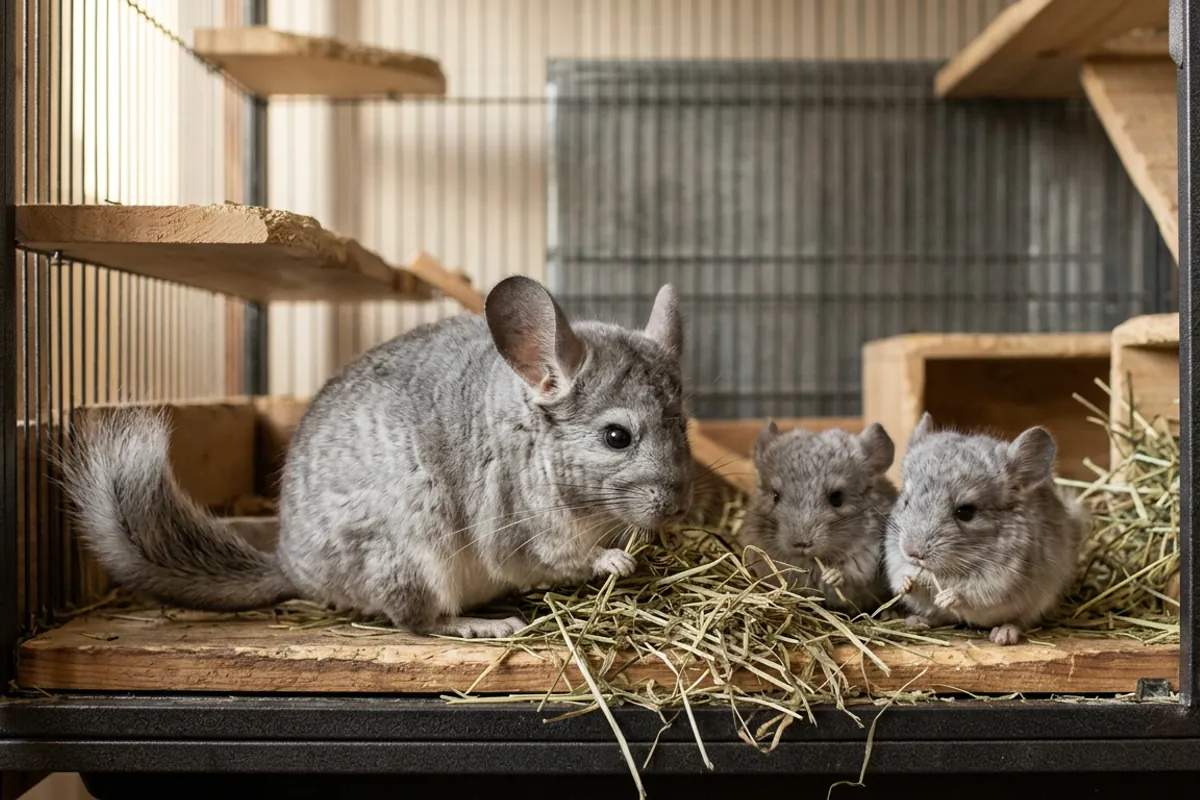
Here is where the precocial head start pays off. Because kits are born with working teeth, they start nibbling at their mother's hay and pellets within just a few days, long before weaning. That means the adult diet has to be right and within their reach from day one. Keep unlimited grass hay available, low enough in the cage that a tiny kit can get to it, because hay is the foundation of a chinchilla's whole digestive and dental life, mother and baby alike.
Oxbow Western Timothy Hay, 40 oz bag As an Amazon Associate I earn from qualifying purchases.
Alongside the hay, keep the measured plain pellets topped up and fresh water always available. The rule that never bends: chinchillas eat unlimited grass hay first, with plain pellets as a supplement, and no sugary treats, fruit, or nuts for anyone, including a nursing mother. If you want the full boundaries of what is safe, What can a chinchilla eat, and what should you never feed it and Chinchilla diet, food, and hay lay it out.
A word on the hard case. If a kit is being rejected, or the mother is not producing milk, hand-rearing with a formula is possible but it is a genuine, exhausting, round-the-clock job with a real failure rate, not something to improvise from a blog. That is a conversation to have with an exotics vet before you start, not after it goes wrong.
Cage, chews, and what to pull out while kits are tiny
An adult chinchilla cage is not automatically a safe nursery. The first problem is bar spacing. A newborn is small enough to squeeze through gaps that an adult never could, and it can escape, fall, or get its head stuck. Use a tall metal-and-wood cage with genuinely narrow spacing, or block the lower bars temporarily until the kits are bigger.
Critter Nation double unit small animal cage As an Amazon Associate I earn from qualifying purchases.
The second thing is the wheel. While kits are tiny and clumsy, take the exercise wheel out. A baby can get onto or under it and be injured while the mother spins, and there is no upside to leaving it in for a few weeks. A good solid-running-surface wheel goes back once the kits are steady on their feet.
15 inch Chin Spin solid surface chinchilla wheel As an Amazon Associate I earn from qualifying purchases.
Now the dust bath, which is the one that trips people up. Chinchillas never bathe in water, only in fine dust, and I explain why in The chinchilla dust bath, done right from dust to schedule. But right after a birth, many keepers pull the dust bath for the first week or two, or limit it hard. The reasoning is that the fine dust can irritate a newborn's eyes and airways and can work into the mother's healing genital area and cause infection. This is practice more than settled science, and keepers do disagree on exactly how long, but erring toward a short delay and then short, supervised baths is the cautious call.
Lixit Blue Beauty chinchilla dust, 3 lb As an Amazon Associate I earn from qualifying purchases.
Finally, give those fast-growing teeth something to work on. Safe untreated wood chews matter from early on, because a chinchilla's teeth grow continuously for its whole life and need constant wearing down.
emours apple wood chew sticks, 40 count As an Amazon Associate I earn from qualifying purchases.
Juniper, one of my two, is a rescue whose dental disease I manage day to day, and she is the reason I am uncompromising about hay and chew variety. You want kits building that habit from the start. Chinchilla teeth and health goes deeper on why.
Weighing, weaning, and the weeks that follow
The single most useful tool in a nursery is a small kitchen scale that reads in grams. Weigh each kit daily for the first two weeks. A healthy kit gains steadily, and weight is the earliest, most reliable warning you get. A kit that is static or losing when its siblings are gaining is the runt falling behind, and you will see it in the numbers days before you see it in the animal.
Weaning happens gradually, generally around 6 to 8 weeks, as the kits shift fully onto hay and pellets. There is one timing rule that matters enough to state plainly: separate the male kits from their mother and their sisters by around 8 weeks. Young chinchillas can reach breeding capability earlier than their small size suggests, and leaving mixed-sex youngsters together, or a young male with his mother, risks another unplanned pregnancy, this time compounded by inbreeding. Sexing is done by the distance between the anogenital openings, which is longer in males, and it is worth having someone experienced confirm it if you are unsure.
After that, the pace slows right down. Chinchillas grow toward adult size over many months and are long-lived animals, often into their teens with good care, as I cover in How long chinchillas really live, and what changes the number. The intense vigilance is really the first month. What you set up in those weeks, the diet, the temperature discipline, the dental habits, is the foundation the whole long life sits on.
When it becomes a vet's job, not a keeper's
I keep chinchillas, I do not have a medical credential, and the most important skill in a nursery is knowing where your job ends. Some things are simply beyond what an owner should handle at home, and a good exotics vet is the difference between a scare and a loss.
Call the vet, without waiting to see if it passes, for any of these: a labor that drags on with prolonged straining and nothing delivered, or a kit clearly stuck; a mother who stops eating, seems to have no milk, or is bleeding after the birth; a kit that is not gaining weight or is losing it despite nursing; a kit that goes cold, floppy, and lethargic; a mother rejecting or attacking her kits; or a kit that cries constantly and cannot settle. Any of those crosses the line from watchful keeping into medical care.
The reassuring part is that most chinchilla births go quietly and most kits, born so remarkably ready, do fine with an attentive owner who keeps the temperature honest, the hay unlimited, and the cage safe. Know the warning signs, keep the vet's number where you can find it at 3 a.m., and let the mother do the work she is built for. If you are still deciding whether raising chinchillas is for you at all, Chinchilla as pets, after ten years of keeping them is the place I would send you first.