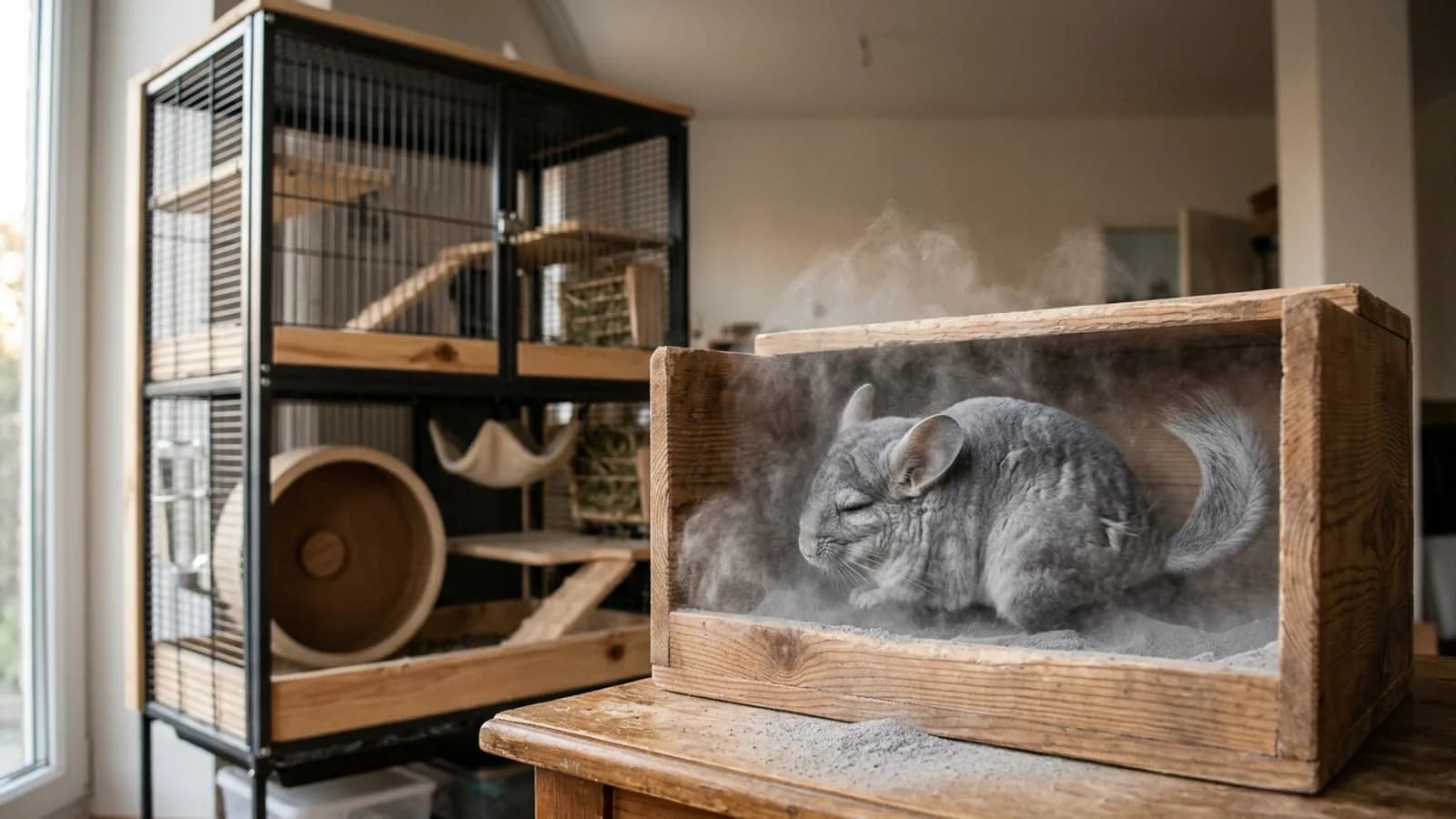
If you have priced chinchilla supplies for more than a week, you have run into blue cloud chinchilla dust. It shows up on every forum, in every starter kit, and on the shelf of most pet stores that carry chinchillas at all. The name is everywhere, which makes it easy to assume it is something special or, worse, something complicated. It is neither. It is a very fine volcanic dust, and its whole job is to do for your chinchilla what water does for most animals and must never do for this one. I have used it for years on Pebble and Juniper, and I want to walk you through what it actually is, how to run a bath with it, how often, and where the honest limits are.
What blue cloud chinchilla dust actually is
Blue Cloud is a brand, not a mineral. What is in the bag is a natural dust milled to a powder so fine it feels like flour between your fingers, not grit. That fineness is the entire point. A chinchilla's coat is denser than almost any land mammal's, with somewhere around fifty to eighty hairs growing from a single follicle. Water gets trapped down at the skin, cannot dry, and turns into a fungal problem fast, which is why a chinchilla is bathed in dust and never in water. The dust works because each tiny particle slips down between the hairs, picks up skin oil and moisture, and gets shaken back out, carrying the grease with it.
Blue Cloud dust is marketed as coming from a specific natural deposit rather than being a manufactured silicate. I cannot personally verify the geology behind the name, and I would not repeat a sourcing claim I have not checked, so I will stick to what matters for the animal: it is fine, it is light, and it has no scent additives or fragrances. That is the standard you are actually buying to. If a dust is gritty, perfumed, or clumps in the bag, it is the wrong product no matter what color the label is. For the fuller picture of what any bathing dust is and is not, I wrote a whole piece on what bathing dust for chinchillas really is.
One thing the name does not tell you: blue cloud dust does not turn anything blue, and it will not deepen or change your chinchilla's coat color. The dust looks pale gray in the bag. If you keep a sapphire or any other blue-toned chinchilla, the color is genetic and the dust is irrelevant to it. I mention this only because I have been asked, more than once, whether "blue" dust is a color treatment. It is not. The blue is branding.
Why it has to be this fine, and not sand
The single most common way people hurt a chinchilla with the best intentions is by reaching for sand. A sand bath sounds like the same thing as a dust bath, and for a gerbil it would be, but a chinchilla's coat is a different animal entirely. Sand grains are large and abrasive. They do not penetrate the coat, they scrape along the top of it, and over time they can dull and break the guard hairs and irritate the skin. What you want is the opposite of grit: a powder light enough to hang in the air like the "cloud" in the name.
This is why blue cloud dust, and any dust marketed for chinchillas specifically, is milled so fine. A dirt bath is not dirt either, and reptile calci-sand, play sand, and craft sand are all disqualified for the same reason. If you ever pour a bath and the material feels like it belongs at a beach, stop and buy the right thing. The correct dust should coat your fingers and be hard to fully brush off. That residue is the same thing that gets down to your chinchilla's skin and does the actual work.
How to run a bath with it
The mechanics are simple, and getting them right matters more than the brand on the bag. You need a container the chinchilla can get fully into and roll over in, deep enough to hold a couple of inches of dust without flinging most of it across the room. I use an enclosed bath house with a single opening, which cuts down the dust that escapes and gives the animal a sense of an enclosed burrow to throw itself around in. A purpose-made enclosed house does this far better than an open bowl.
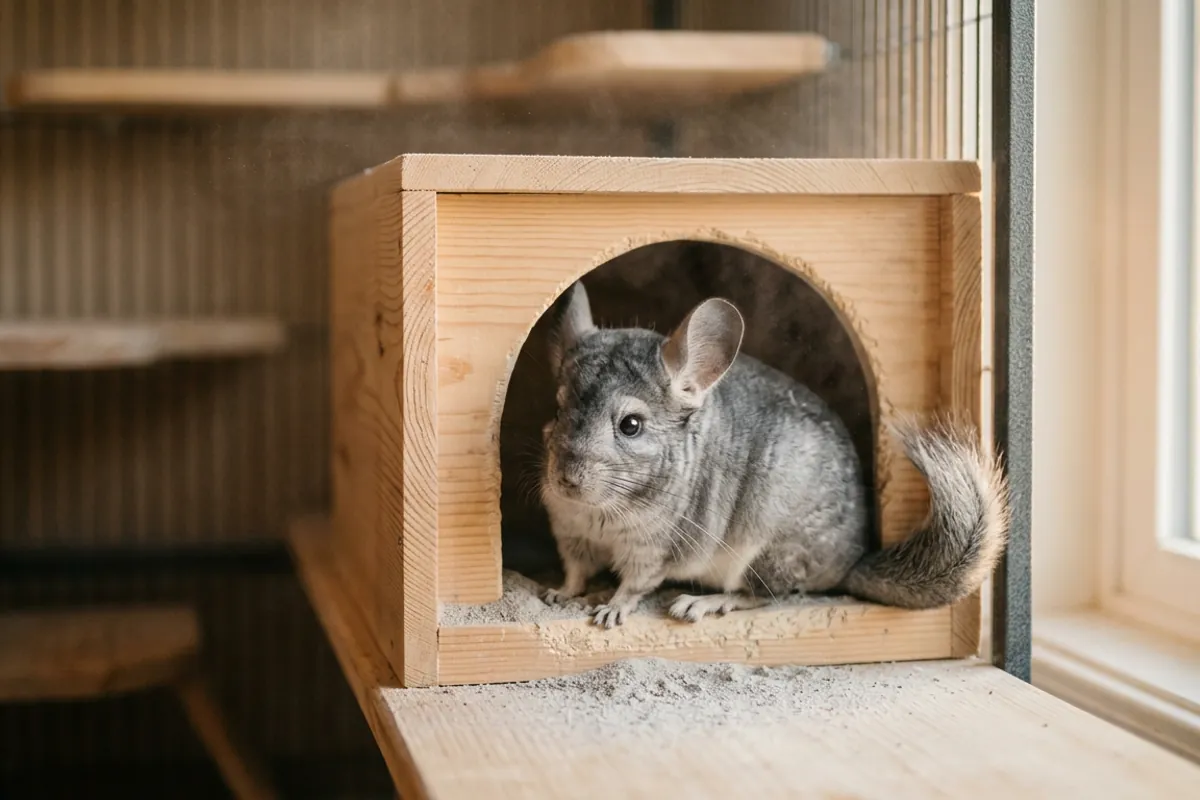
Chinchilla dust bath house Lixit Blue Beauty chinchilla dust, 3 lb As an Amazon Associate I earn from qualifying purchases.
Pour in roughly one to two inches of dust. You do not need to fill it. Put the bath in the cage, let your chinchilla in, and watch. A healthy chinchilla knows exactly what to do: it will dive in and roll, sometimes flipping over completely, kicking up that pale cloud. Two to four minutes is plenty. The point is not a long soak, it is enough rolling to work the oil out of the coat. When the rolling slows and the animal starts sitting rather than flipping, or starts nibbling the dust, the bath is done and you take it out.
Take the bath out of the cage between uses. Leaving it in is the mistake I see most often. A dust bath left sitting becomes a litter box, because chinchillas will happily use that soft, contained corner as a toilet, and then you are letting the animal roll in its own waste. Offer the bath, let them use it, remove it, and store the dust covered.
You can strain and reuse the dust for a few baths if it still looks clean, sifting out droppings and any visibly soiled clumps. Once it stops looking pale and starts looking dull and gray-brown, it is spent. It has absorbed all the oil it can, and rolling in it just moves grease around. Throw it out and start fresh.
How often, and reading the coat
Frequency is where owners get nervous, and the honest answer is a range, not a single number, because it depends on your home. Two or three baths a week suits most chinchillas in most homes. That is the band I would start any new keeper on.
From there you read the coat and the skin, not the calendar. If the fur starts looking greasy, stringy, or clumped, or you can see it separating into oily points, the chinchilla needs the bath more often. If the fur looks dry, or you notice flaky skin or the animal scratching, you are bathing too much and stripping oil the skin needs, so cut back. Humidity drives this hard. In a dry winter home you might drop to two baths a week or fewer; in a muggy stretch of summer you might go to three or four, because the coat picks up more moisture from the air.
Heat and humidity are worth watching for a reason that has nothing to do with grooming. Chinchillas do not sweat, and a damp, warm coat is exactly the condition they cannot shed. The comfortable range for the animal is 60 to 70°F (15 to 21°C). Above 75°F (24°C) is getting risky, and 80°F (27°C) and up is an emergency, faster in humid air. If your room is edging into that territory, the dust bath is the least of your worries and cooling the room comes first. A cage thermometer and hygrometer that reads both temperature and humidity earns its place here.
Cage thermometer and hygrometer digital thermometer and humidity gauge with remote probes As an Amazon Associate I earn from qualifying purchases.
One warning I will not soften: a coat that is genuinely wet is never fixed with a dust bath. If your chinchilla has gotten wet from water, you dry it with towels and gentle air, keep it warm, and watch it closely. Piling dust onto a wet coat makes a paste against the skin and traps exactly the moisture you are trying to remove.
Blue Cloud, Blue Beauty, Blue Sparkle: are they actually different
The "blue" naming has multiplied. Blue Cloud dust is the one most people mean, but you will also see blue beauty chinchilla dust and blue sparkle chinchilla dust on the same shelf, and the names alone suggest a family that may or may not exist. I will be straight with you: I cannot verify that these all come from one source or one mill, and I would rather tell you the test that matters than pretend to know their supply chains.
Here is the test. Open the bag, or read the ingredients if it is sealed. You want one thing: fine dust, no fragrance, no additives, no anti-fungal or "medicated" claims, no scent. Rub a pinch between your fingers. If it feels like flour and clings to your skin, it is the right texture. If it feels like grit or beach sand, it is wrong, whatever it is called. Any of the blue-named dusts that pass that texture test will do the same job. The differences between them, in my experience, are marketing and price per pound, not results on the coat.
Do not pay a premium for a scented or "premium" version. A chinchilla's respiratory system is delicate, and added fragrance is a lung irritant it does not need. The plainest dust is the best dust.
Buying it, and the 50 lbs question
The other thing that trips people up is the sizes. Blue cloud dust comes in small tubs and in bulk bags, and you will see a blue cloud chinchilla dust 50 lbs option that looks either like a bargain or like insanity depending on how many chinchillas you own. For one or two chinchillas, a 50 lbs sack is far more than you will get through before you tire of storing it, but the per-pound price is much lower, so it is genuinely cheaper if you can keep it well.
That "if" is the whole decision. Dust is only good while it is dry and clean. A big bag is fine value if you can decant it into a sealed, airtight container and keep it somewhere cool and dry, away from humidity that would clump it and away from anything that could contaminate it. If you are going to leave a 50 lbs sack open in a damp basement, buy the small tub instead and waste less. I keep a modest working supply in a sealed container by the cage and the rest sealed away. Bulk makes sense for multi-chinchilla homes and for anyone with dry, clean storage; it is a poor deal if the dust goes off before you use it.
Whatever size you buy, the dust is a small line on the real cost of this animal. If you are still working out what a chinchilla actually costs across food, cage, and vet care, dust is one of the cheapest recurring items on the list, which is one more reason not to overthink the brand and just get the fineness right.
When the dust is the problem, not the fix
Dust is a tool, and like any tool it has a wrong side. Because it is airborne by design, it is a respiratory irritant to you and, in excess, to your chinchilla. Keep the bath short, do not bathe in a tiny unventilated room, and if anyone in the house has asthma, be mindful of where the cloud settles. For the chinchilla, over-bathing is the real risk: too-frequent baths strip the coat and dry the skin, and I have watched a chinchilla scratch itself sore because a well-meaning owner offered the bath every single day.
Watch the eyes, too. Dust in an eye happens, and usually the chinchilla blinks and grooms it out. But a weepy or crusted eye that does not clear, a pawing at the face, redness, or discharge is past the point where dust management fixes it. That is a vet visit, and it should be an exotics vet, not a dog-and-cat clinic guessing at a rodent. The same goes for any skin that stays flaky, red, or bald in patches despite you correcting the bath schedule. I am an experienced keeper, not a vet, and the line I hold for myself is simple: grooming and schedule I handle at home, anything that looks like infection or injury goes to someone with the training and the tools.
The last thing I will say is the most reassuring. Once you have the fineness right and the schedule roughly matched to your home, the dust bath is one of the easiest and most genuinely joyful parts of keeping this animal. There is nothing quite like watching a chinchilla dive into a fresh bath and flip itself over in a pale cloud, coming out looking twice as fluffy. Get the dust right, keep it clean, take it out between baths, and blue cloud chinchilla dust will do its quiet, unglamorous job for years.