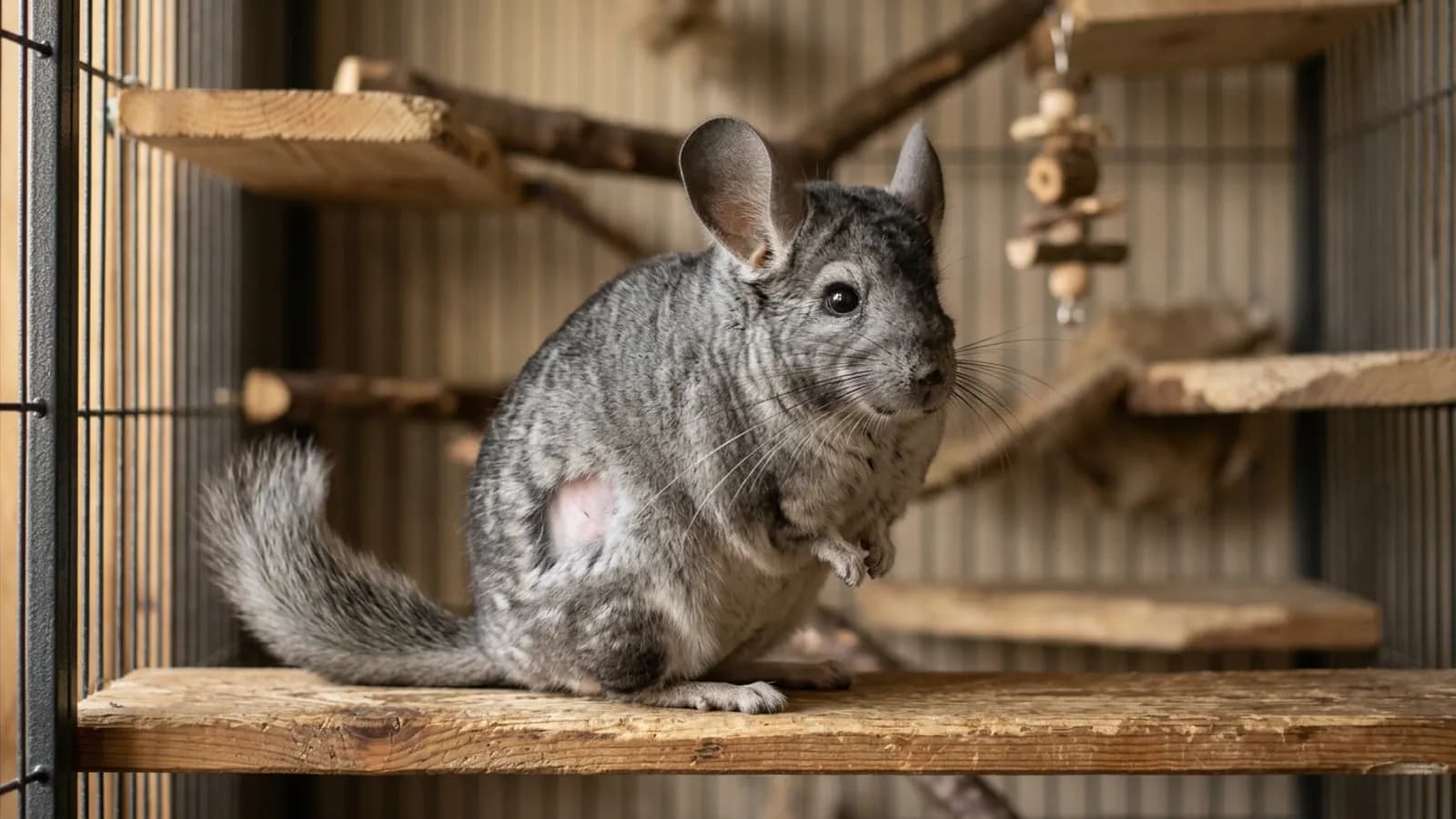
The first time you see a chinchilla fur slip, it looks like something went badly wrong. You reach in to lift your chinchilla, the animal twists, and suddenly you are holding a soft clump of silver-gray fur while a smooth patch of bare skin sits where that fur used to be. Nothing bleeds. Nothing is broken. What you just watched is a defense mechanism this species evolved over thousands of years in the wild, and knowing how it works is the difference between panicking over an injury that is not an injury and learning to handle your chinchilla the way its body actually expects. I have triggered it exactly twice in about ten years, both times early on with Pebble, and both patches grew back. Here is everything I wish I had understood the first time.
What fur slip actually is
Fur slip is the deliberate release of a patch of fur when a chinchilla is grabbed too firmly or frightened badly. The animal is not shedding, and it is not sick in that moment. It is doing on purpose exactly what its ancestors did to survive: leaving a mouthful of fur behind so a predator ends up with fluff instead of dinner.
You can tell fur slip apart from every other kind of hair loss by how clean it looks. The skin left behind is smooth and bare, an even patch with no scabbing, no redness, no broken skin, and no bleeding. The fur comes away in one soft clump rather than a scattering of loose hairs. If you have ever handled a wild rabbit or a gecko that dropped its tail, the logic is the same family of trick: sacrifice a part to save the whole.
The bald patch is harmless in itself, but it is not instant to fix. Regrowth is slow. In my experience a fur slip patch takes several weeks to start filling back in and can take a couple of months to blend fully into the surrounding coat, and the regrown fur sometimes comes in a slightly different shade at first before it evens out. That slow timeline is worth remembering, because it means fur slip is genuinely something to avoid rather than shrug off. You are not hurting the animal, but you are asking it to spend real energy rebuilding what you frightened out of it.
Why a chinchilla lets go of its own fur
To understand fur slip you have to understand the coat it comes from. Chinchilla fur is among the densest of any land mammal. Where a human hair follicle grows a single strand, a chinchilla follicle grows a whole bundle, commonly cited at fifty or more hairs from one point in the skin. That is why the coat feels like touching a cloud, and it is why fleas cannot live on a chinchilla; there is simply no room down at the skin for a parasite to move. These are chinchilla fur facts rooted in the animal's biology, not marketing about softness.
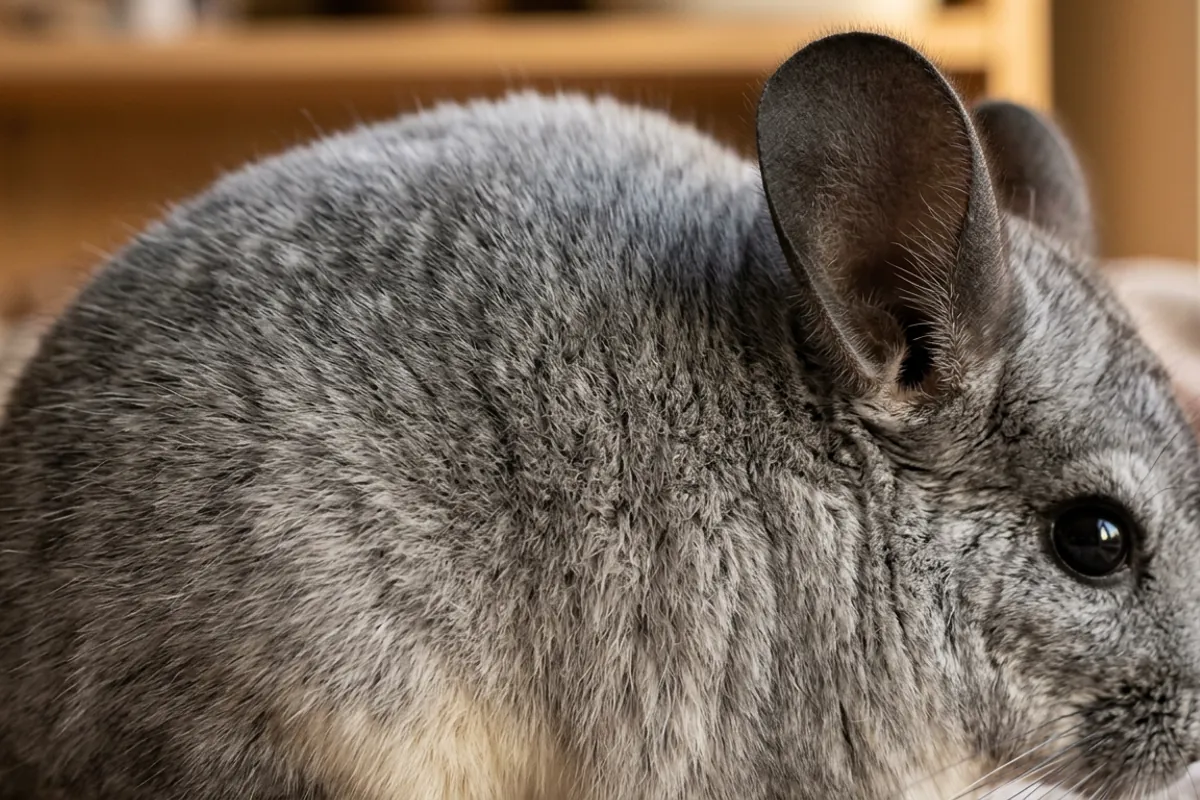
That incredible density is also what makes fur slip work as a survival tool. A predator that clamps down on a fistful of that coat gets a startling amount of fur and very little animal, because the follicles are built to release under a sharp pull rather than tear the skin. In the high, rocky Andes where chinchillas evolved, an animal that could leave a bird of prey or a fox holding a puff of fur and bolt into a crevice lived to breed. An animal that could not, did not. Fur slip is that ancestry showing up in your living room.
This is the part owners get wrong: your chinchilla is not being dramatic or difficult when it slips fur. It is running a reflex that predates any handling you could teach it. The trigger is a firm grip plus fear, and your hand closing quickly around its body reads, to that reflex, exactly like a talon. You cannot train fur slip away. You can only handle in a way that never sets it off.
Fur slip is not the same as fur biting
Here is where a lot of confusion lives, because two very different problems both leave a chinchilla with missing fur. Fur slip is a one-time, sudden release triggered by handling or a scare, and it leaves smooth bare skin. Chinchilla fur biting is something else entirely, and it matters that you can tell them apart.
Fur biting, also called barbering, is a behavior where the chinchilla chews its own coat, or occasionally a cagemate's, down to short uneven stubble. When you look at a chinchilla chewing fur, you do not see clean bald skin. You see fur cut short and ragged, often along the flanks, shoulders, the base of the tail, or wherever the animal can reach with its own mouth. The patches have texture, like a badly mown lawn, rather than the smooth skin of a fur slip. Chinchilla biting fur is a slow, repeated habit, not a single startled moment.
The causes of fur biting are still debated among keepers and vets, and I will not pretend otherwise. The usual suspects are stress, boredom, too small or too bare a cage, a diet that is off, heat, and in some lines a genetic tendency that seems to run in families. There is also a link worth taking seriously to dental pain: a chinchilla whose teeth are hurting can develop fur biting as one sign among several, which is why chinchilla fur biting belongs in the same conversation as chinchilla teeth problems. If your chinchilla starts chewing its fur, the honest first move is to look hard at its environment and its diet, and if those are already right, to get an exotics vet to check the mouth. Do not assume it is "just a habit" until a vet has ruled out pain.
How to hold a chinchilla without triggering fur slip
Because fur slip is a response to a firm, fast grip, the whole trick to preventing it is slowness and support rather than restraint. A chinchilla that feels held down panics. A chinchilla that feels supported does not.
Let the animal come to you first. I keep my hand flat and still in the cage and let Pebble choose to climb on, which turns pickup into her decision instead of my ambush. When you do lift, scoop under the body so the chinchilla is resting on your hand and forearm with its feet supported, rather than pinching a section of its side or back. The one grip that is both safe and genuinely secure is a gentle hold at the very base of the tail, close to the body, with your other hand carrying the weight underneath. That base-of-tail hold gives you control without squeezing a fistful of fur, and it means that if the animal does bolt, you are holding the one part that does not slip.
Never grab a chinchilla around the midsection and never snatch at a moving one. If your chinchilla is loose and racing around the room, do not lunge. Herd it calmly toward its cage or a familiar hidey spot and let it go in on its own. A missed grab that closes on a handful of side fur is exactly the scenario that ends with fur in your palm and bare skin on the animal. Children need this explained plainly before they ever hold one, because a child's instinct is to close a hand and hang on, which is precisely the wrong move.
Handling like this matters most in the days after you bring a chinchilla home. A new, unbonded animal is frightened by default, and fright is half the fur slip equation. Go slow for the first weeks, and read how to buy a chinchilla if you are still at that stage, because a well-started relationship is the best fur slip prevention there is.
When a bald patch is telling you something else
Not every missing patch is fur slip or fur biting, and this is where I hand the medical calls to a vet. If you find bare skin and you did not just have a handling scare, look closer before you assume.
Fur slip skin is smooth, even, and healthy looking. Skin that is red, flaky, scabbed, crusty, or ringed with a raised edge is not fur slip. Circular patches of hair loss with flaky skin can point to ringworm, which is a fungal infection, spreads to other pets and to people, and needs veterinary treatment rather than home guessing. Patches that come with scratching, restlessness, or visibly irritated skin deserve a vet visit too. Chinchillas rarely get the fur mites that plague some other small pets, thanks to that dense coat, but "rarely" is not "never," and a vet can check. Chinchilla mites works through what an itching chinchilla usually turns out to be instead.
There is also a link back to the mouth that too many owners miss. A chinchilla with dental disease may drool, and a chronically wet chin and chest can leave the fur there matted, stained, or thin. If you see a soggy chin, that is not a coat problem, it is a teeth problem wearing a coat problem's clothes, and I have written about what a wet chinchilla chin actually signals. The rule I follow: fur slip and a startled clump, I handle myself and just leave alone to regrow. Anything with inflamed skin, spreading patches, drool, weight loss, or a change in eating goes to an exotics vet, and it goes soon. I am an experienced keeper, not a vet, and skin and dental disease are exactly the lines where that distinction saves an animal.
Fur care that keeps the coat healthy
The best thing you can do for a chinchilla's fur is also the simplest, and it is the one people most often get dangerously wrong. Chinchillas never bathe in water. That cloud of a coat holds water down against the skin and takes far too long to dry, and a damp chinchilla can develop skin fungus, chills, or worse. A soaked chinchilla is a genuine problem, not a cute one.
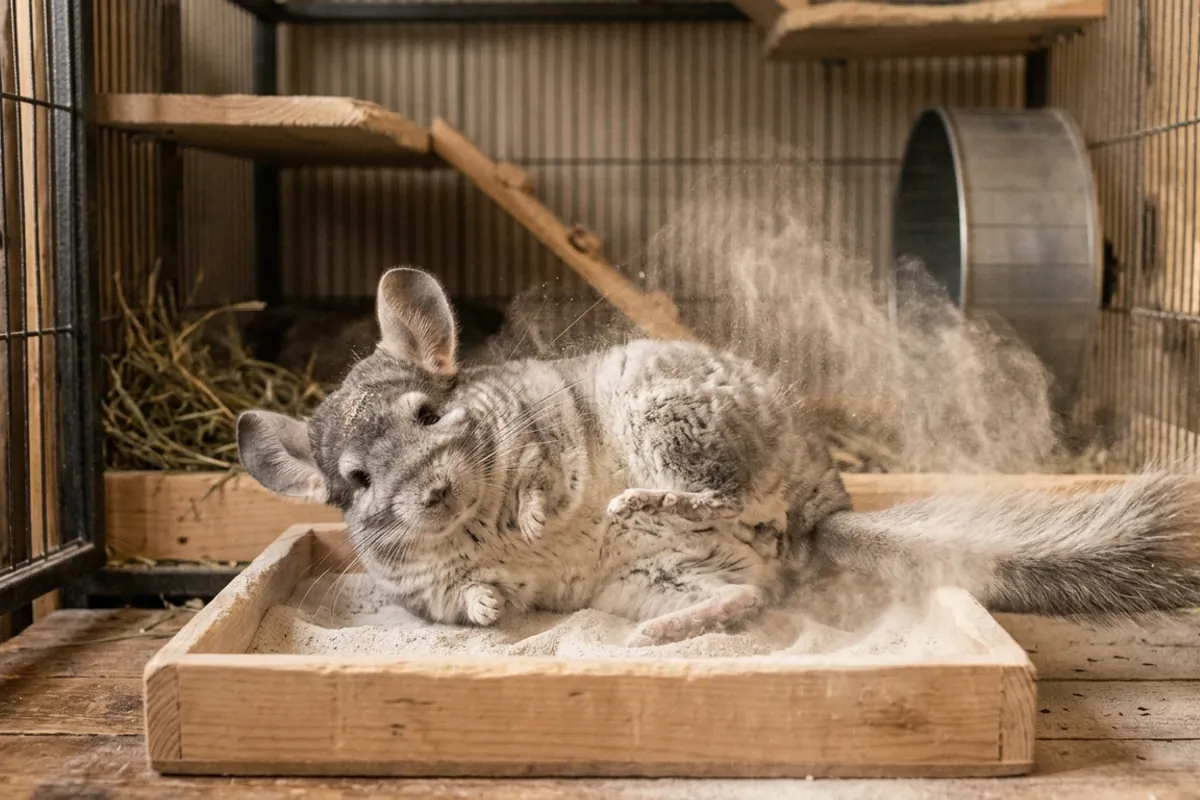
Instead, chinchillas clean themselves by rolling in fine dust that works its way down to the skin and lifts away oils and moisture. Give a dust bath a few times a week, using proper chinchilla bathing dust, which is a fine volcanic pumice, poured a couple of inches deep into a container big enough for a full roll. I leave it in for ten or fifteen minutes and then take it out, because leaving dust in around the clock can dry the skin and eyes. A dedicated bath house keeps the dust contained and the mess down. Lixit Blue Beauty chinchilla dust, 3 lb As an Amazon Associate I earn from qualifying purchases. If you want the full routine, from how deep to fill it to how often, I laid it all out in the chinchilla dust bath done right.
Coat health also comes from the inside, and this is where diet quietly does most of the work. A dull, thin, or poor coat often traces back to a diet that is wrong. Chinchillas eat unlimited grass hay first, all day, with plain measured pellets as a supplement and nothing sugary or fatty piled on top. Good timothy hay is the foundation of a good coat, and it wears the teeth down at the same time, which loops right back to the dental causes of fur biting. Oxbow Western Timothy Hay, 40 oz bag As an Amazon Associate I earn from qualifying purchases. Plenty of chewing keeps both teeth and behavior in better shape, so a rotation of safe wood chews earns its place in the cage. emours apple wood chew sticks, 40 count As an Amazon Associate I earn from qualifying purchases. And because heat stress shows up in the coat and the behavior long before it turns into an emergency, keep the room in the comfortable range of 60 to 70°F (15 to 21°C). Above 75°F (24°C) is risky, and 80°F (27°C) and up is a genuine emergency, faster in humid air. That is Pebble's story turned into a rule I will not soften.
Chinchilla fur color, and the ugly history of selling chinchilla fur
People searching for chinchilla fur color are usually asking one of two things, so let me take both. The standard wild coat is that agouti gray, dark at the tips, banded through the middle, pale at the roots and on the belly, which is what gives the coat its depth. Selective breeding has produced other shades too, from black-tipped to beige to white to violet, and I have written honestly about several of them, including what a brown chinchilla and a black and white chinchilla really are. The thing worth holding onto is that color is only color. It changes the shade of the coat and nothing else. It does not change the care, the temperament, the density, or the fur slip reflex. A violet chinchilla slips fur exactly like a gray one.
The second meaning is the darker one, and I am not going to dance around it. Chinchillas were driven nearly to extinction in the wild because their fur was hunted and then farmed on an industrial scale, and it takes a shocking number of these small animals to make a single garment. If you have typed "sell chinchilla fur" while thinking about the pet in your care, please stop and hear this plainly: this site is about chinchillas as companion animals with fifteen or twenty year lifespans and real needs, not as a product. I do not cover pelting, I do not endorse it, and I would never point an owner toward it. The fur on a living chinchilla belongs on the chinchilla.
That reframing is really the whole point of understanding fur slip in the first place. This animal evolved a coat so extraordinary that it will hand you a piece of itself to escape a threat. The respectful response is not to admire the fur as a commodity but to handle the animal so gently that it never feels the need to let any of it go. Do that, feed it right, keep it cool, and give it proper dust baths, and the coat takes care of itself.