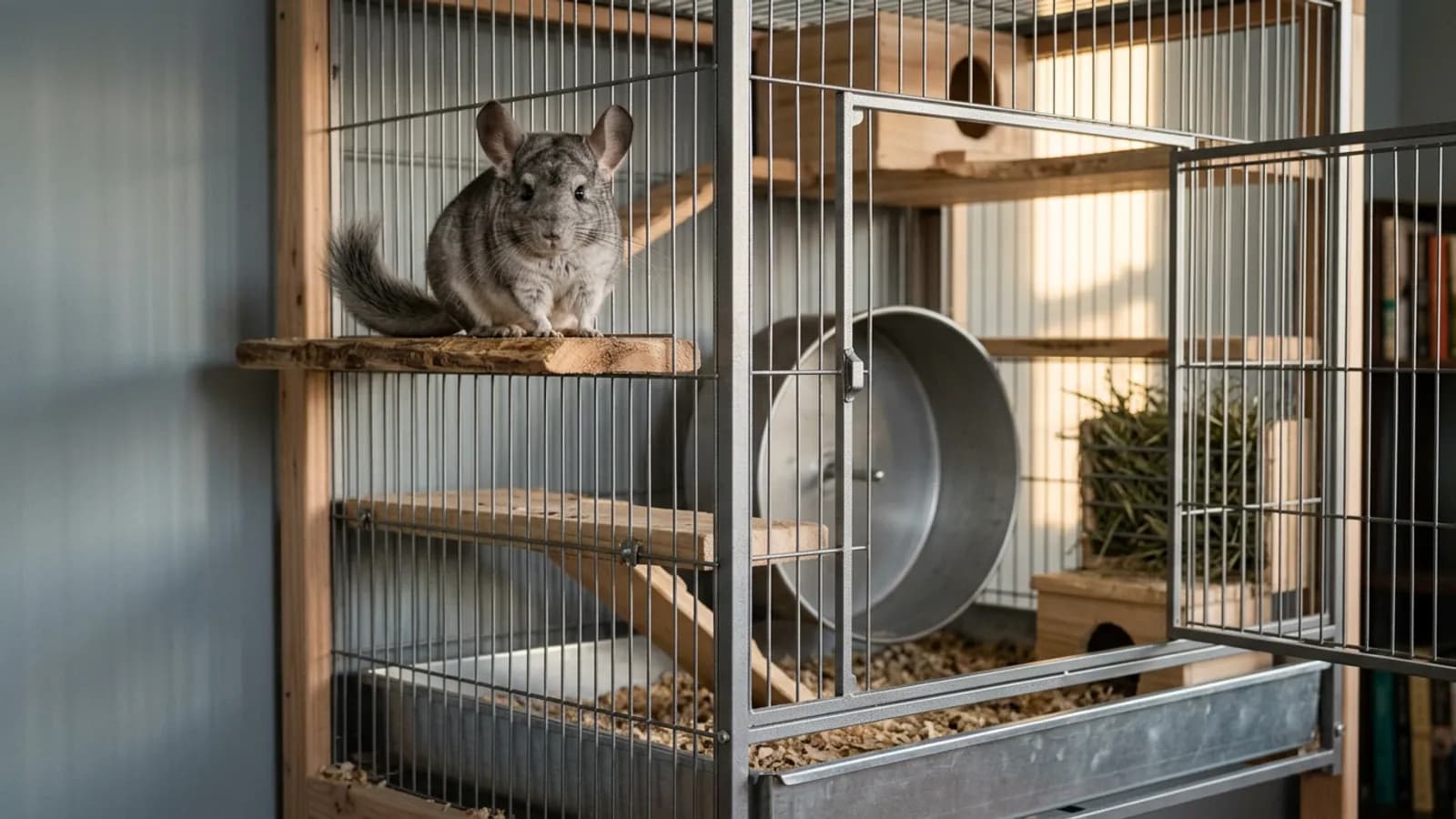
Good chinchilla cages are not the ones with the most levels in the product photo or the cutest colour on the box. They are the ones that give a fast, jumpy, heat-sensitive animal room to move vertically, in materials that will not poison it or wear its feet raw, and that you can clean without a fight. After about ten years of keeping chinchillas, I can tell you the cage is the single most important piece of gear you will buy, and it is the one people most often get wrong, then buy again. I got Pebble's first cage wrong and replaced it inside a year. This is the guide I wish I had bought from.
What actually makes a cage good
Strip away the marketing and a good cage comes down to a short list. It is tall, because a chinchilla climbs and leaps far more than it runs flat. It is made of metal bar and untreated wood, with no plastic anywhere the animal can reach. The bar spacing is narrow enough that a head cannot slip through. The ledges are solid wood or metal, not wire mesh, so feet land on something flat. There is a deep pull-out tray so waste and dust do not build up against the animal. And it is big, genuinely big, because a chinchilla that cannot move burns off none of its energy and none of its stress.
Notice what is not on that list: number of colours, a cute front door shape, a bundled water bottle, or a plastic "house" clipped inside. Those are decoration. The frame, the height, the materials, and the spacing are the whole game, and if a cage gets those right it is a good cage even if it looks plain.
I judge every cage against that list before I look at the price. A cheap cage that nails the frame beats an expensive one with a plastic shelf and wire floors every single time. If you want the longer version of how to weigh these against each other, I wrote a full walk through in how to pick the best chinchilla cage without buying the wrong one twice.
Metal and wood, and why plastic never belongs inside
Chinchillas chew everything they can reach, all day, because their teeth grow for their whole life and chewing is how they wear them down. Juniper, one of my two, has dental disease I manage day to day, and watching what happens when teeth do not get worn evenly has made me hard-line about this: whatever is in the cage will end up in the mouth. Plastic is the problem child. A chinchilla will gnaw a plastic shelf, ramp, or base into swallowable shards, and plastic in the gut can block or tear. So the cage frame has to be metal, and everything fixed inside has to be metal or safe untreated wood. There is no plastic that is safe to leave where a chinchilla can bite it.
That is why I steer people toward a proper wire-and-wood build rather than a coated all-in-one with plastic trim.
Critter Nation double unit small animal cage As an Amazon Associate I earn from qualifying purchases.
A powder-coated metal frame with solid wood ledges gives you a surface the animal can chew on without harm, and wood you can replace as it gets gnawed down, which it will. The full argument for the metal frame, including why even a painted finish matters, is in why a chinchilla cage has to be metal, and how to fit it out.
Height beats floor space
If you remember one thing from this whole piece, make it this: for a chinchilla, vertical space is worth more than floor space. In the wild these are animals of rocky Andean slopes, and they express almost everything they are through leaping between ledges. A cage that is wide and short traps that instinct. A cage that is tall, with ledges staggered at different heights, lets it out.
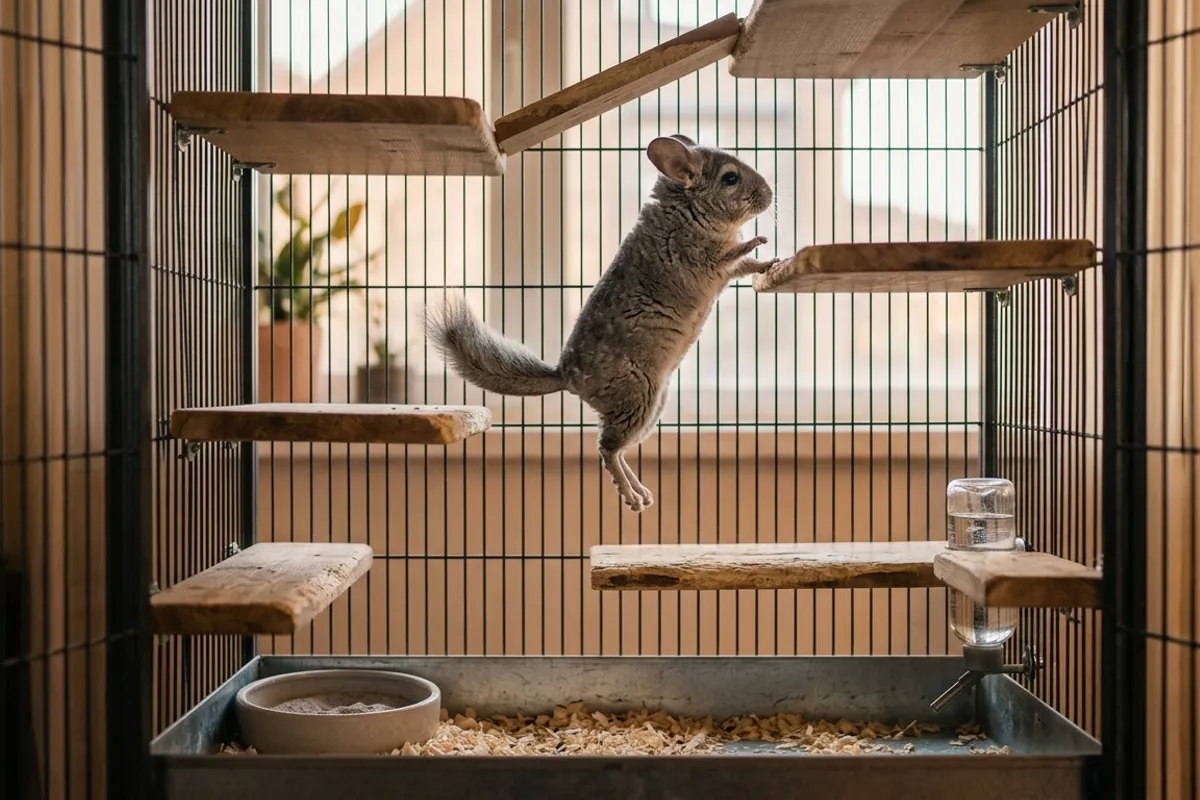
So when two cages have the same total volume, I take the taller one, and I set the ledges up so there is a real climb from the tray to the top. I would rather have a footprint of roughly two feet by two feet with three or more feet of height than a squat box with a big floor. A single chinchilla wants a lot more room than the tiny "starter" cages suggest, and a pair wants more again. I go into the numbers and the reasoning in why a big chinchilla cage is the baseline, not a luxury and, for the tall-not-wide argument specifically, the biggest chinchilla cage, and why height beats floor space.
This is also why I am blunt about small cages. A cage that is too small is not a smaller version of a good home, it is a different thing entirely, one the animal cannot behave normally in. If you are tempted by a compact one to save space, read the honest truth about a small chinchilla cage first.
Bar spacing, the tray, and the doors
Three quiet details separate a cage that is safe from one that looks fine and is not.
Bar spacing comes first, because it is a safety issue, not a comfort one. The gaps between the bars should be no wider than about one inch, roughly two and a half centimetres, so an adult cannot push its head through and get stuck. If you have a kit or a very small young chinchilla, you want it tighter still, or a temporary liner over the lower bars, because a baby can squeeze through a gap an adult cannot. Measure it. Do not trust the listing.
The tray matters next. You want a deep, solid pull-out pan you can slide out to clean without opening the whole cage and chasing an animal around the room. A shallow lip means litter and droppings spill and pile against the bars. A deep metal pan keeps the mess where it belongs and makes the weekly clean a two minute job instead of a chore you put off. I wrote up the whole routine in how to keep a clean chinchilla cage without it becoming a chore.
Doors are the detail people notice last and regret first. You want at least one door big enough to get your hands, a hide, and the animal itself in and out easily, and ideally a wide front opening for the deep cleans. Small doors turn every interaction into a wrestling match, which is bad for a nervous animal and worse for your patience.
Fitting it out without wrecking a good cage
A good cage frame is the start, not the finish. What you hang inside decides whether the height you paid for gets used.
Ledges do the heavy lifting. Solid wood ledges, staggered so the animal has to jump between them, turn a tall box into a climbing frame. Space them so the leaps are real but not so far that an older or arthritic chinchilla cannot manage. Chewable ledges double as dental work, and they wear down, so buy a build where you can swap them out.
For chewing itself, give real variety, not one lonely block. Different woods and shapes keep the animal working its teeth from different angles, which is exactly what uneven-wearing teeth need.
emours apple wood chew sticks, 40 count As an Amazon Associate I earn from qualifying purchases.
I keep a mix of safe woods in rotation and pull anything that is chewed to a nub. There is more on which chews actually earn their place, and which are just decoration, in chinchilla chew toys, and why they are dental care, not decoration.
If you add a wheel, and most chinchillas love one, it has to have a solid running surface. Never a wire rung wheel and never a mesh one, both of which can catch a foot or a tail and break it.
15 inch Chin Spin solid surface chinchilla wheel As an Amazon Associate I earn from qualifying purchases.
Get the diameter big enough that the back is not arched while running, because a wheel that is too small forces a curved spine. I go into sizing and the injury risks in what a chinchilla on a wheel really needs to run safely.
Then there is hay, which is not really an accessory but the whole meal. A chinchilla eats unlimited grass hay first, with plain pellets as a small measured supplement on the side. A rack or hay box that keeps timothy clean and off the tray floor means the animal eats more of it and wastes less.
Oxbow Western Timothy Hay, 40 oz bag As an Amazon Associate I earn from qualifying purchases.
Keep the rack full, always. The hay-first, chews-always approach is the whole of why Juniper still eats comfortably despite her teeth, and I lay it out in chinchilla hay, the honest version of why it is the whole meal. For the wider setup, from ledge placement to where the bottle goes, see how to build a chinchilla cage setup that keeps the animal healthy.
The cages I would buy, and the ones I would skip
I will name names in categories, because vague advice helps nobody.
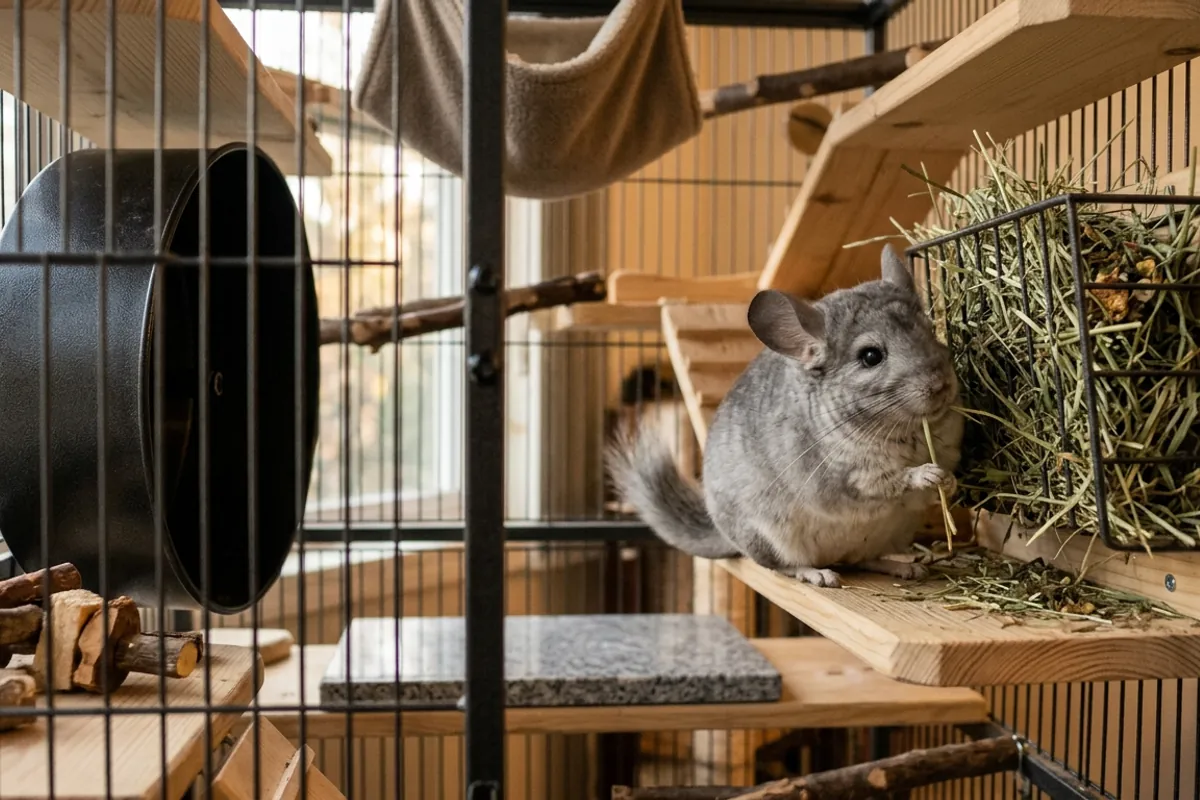
What I buy: a tall metal frame with a deep pull-out pan and solid wood ledges, the kind of double-height unit that keepers have used for years because it simply works. Many people land on a double-unit modular metal cage sold for ferrets, and it suits chinchillas well once you swap any wire shelves for solid ledges. I went through whether that specific popular cage is right in is the Critter Nation cage right for a chinchilla.
What I skip, and I mean actively avoid: the small square "chinchilla" cages sold in most chain pet stores, which are too short, too cramped, and often come with plastic shelves and ramps you will need to bin on day one. Anything with a wire mesh floor, which pushes into the feet and can cause sores over time. Anything marketed as a "starter" cage, because starter is a polite word for a cage the animal outgrows in behaviour immediately even if it fits physically. And glass tanks or aquariums, which trap heat and air and are dangerous for an animal this heat-sensitive. If you have been eyeing a chain-store cage specifically, read the honest truth about a PetSmart chinchilla cage before you commit, and for the general how-to, how to buy a chinchilla cage you won't have to replace.
One more warning on secondhand. A used metal cage can be a bargain and I have bought them, but scrub off any old wire shelves, replace chewed wood, and check the bar spacing yourself against the one-inch rule rather than trusting the seller's word.
Where you put the cage matters as much as the cage
You can buy the best cage on the market and still lose the animal if you put it in the wrong spot, because a chinchilla's real enemy is heat. Pebble came to me from an overheated attic, and her first summer brought a heatwave near-miss and a night at the emergency vet. That scare is why I will not soften this: a chinchilla is comfortable at 60 to 70°F, which is about 15 to 21°C. Above 75°F, roughly 24°C, you are in risky territory, and at 80°F, about 27°C, you are in an emergency, faster if the air is humid.
So the cage goes on an inside wall, out of direct sun, away from radiators and away from any window that bakes in the afternoon. Never in a conservatory, a loft, or a sunroom. Put a thermometer that also reads humidity right on the cage and actually watch it through summer.
digital thermometer and humidity gauge with remote probes As an Amazon Associate I earn from qualifying purchases.
On hot days a chunk of chilled granite or marble in the cage gives the animal a cool surface to stretch out on and shed heat.
Kaytee Chinchilla Chiller granite stone As an Amazon Associate I earn from qualifying purchases.
A cooling stone is a comfort measure and a stopgap, not a substitute for keeping the room itself cool, so do not let it lull you. If you want to know exactly how much danger a given temperature and humidity add up to, I keep a chinchilla heat danger calculator, and the full heat rules live in chinchilla temperature is the number that keeps yours alive.
The last thing your good cage needs is a place for a dust bath, because chinchillas clean themselves in fine dust, never in water, and a wet coat is a genuine health problem. I give a dish of proper bathing dust a few times a week rather than leaving it in full time.
Lixit Blue Beauty chinchilla dust, 3 lb As an Amazon Associate I earn from qualifying purchases.
Do that, keep the cage tall and metal and cool, and you have not just a good cage but a home the animal can actually thrive in. Get the frame right once and you will not be shopping for another.