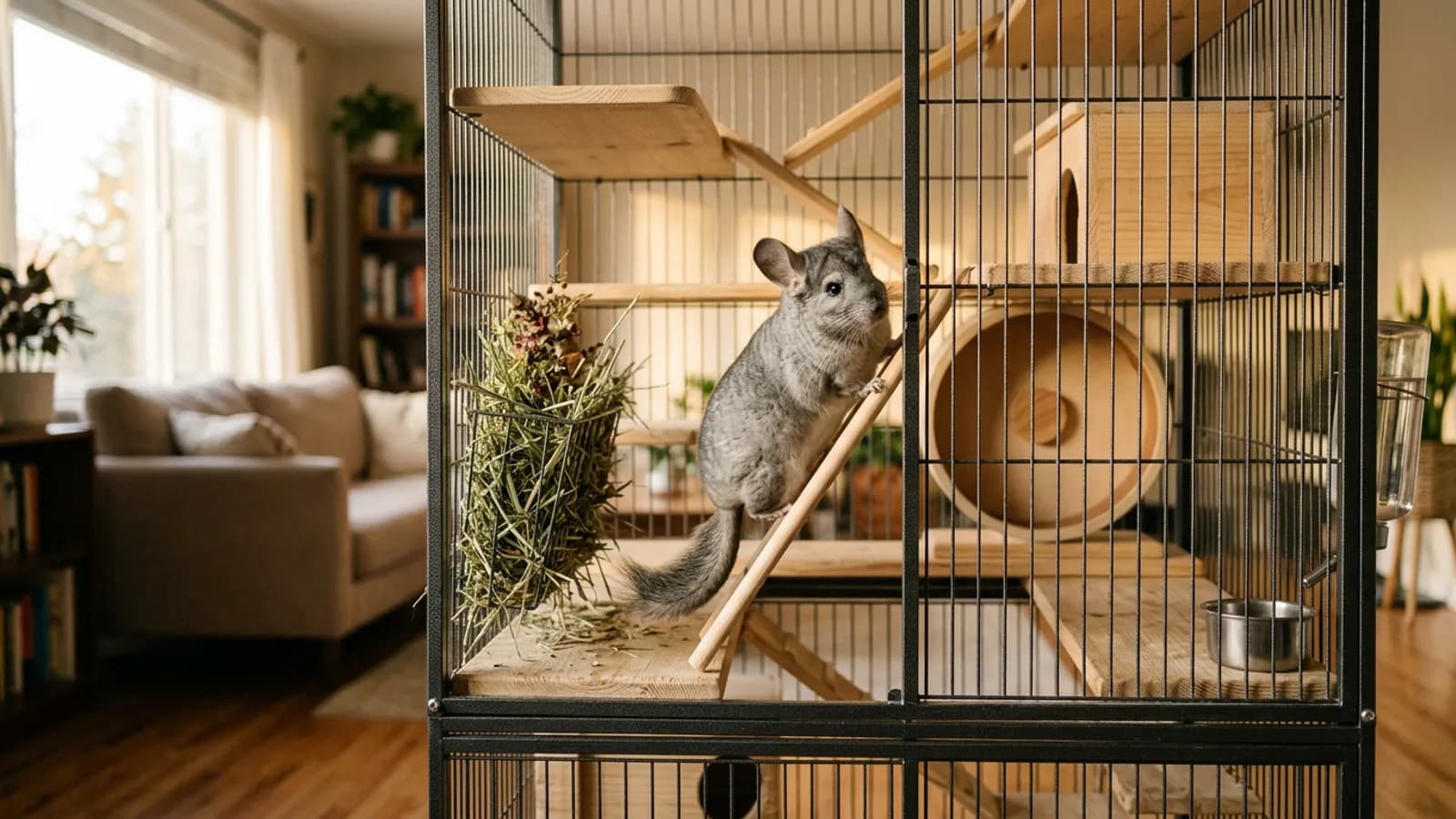
Ten years in, the one thing I would undo about my very first setup is the cage. It was too small, and I did not know it, because a pet shop sold it to me with a chinchilla on the box and I trusted the label. A big chinchilla cage is not a splurge or a way to spoil an animal that would be fine in something smaller. It is the enclosure a chinchilla genuinely needs, because these are athletic, vertical, nocturnal animals that spend their nights climbing and leaping. I am not a vet, I am someone who has kept these animals for about ten years and learned the cage lesson the expensive way. Pebble came to me out of an overheated attic in a cage barely longer than she was. The first thing she did in a taller one was jump, over and over, like she had been waiting years for the ceiling to lift. That is the whole argument for size, in one picture.
Why bigger is genuinely better, not just nicer
Chinchillas are built to move. In the wild they cover rocky ground in fast, bouncing bursts and use every vertical inch of it. A cage that only lets an animal turn around and sit is not a scaled-down version of that life, it is the removal of it. When the space is too small, the animal does not simply adapt and stay content. It gets bored, and bored chinchillas develop habits you do not want to watch: bar chewing, pacing the same short line, chewing on their own coat. Those are not quirks, they are the signs of an animal with nowhere to put its energy.
There is a physical cost too. A chinchilla that cannot run properly puts on weight, and weight it carries badly, because their bodies are made for sprinting and jumping, not for sitting. Movement keeps the gut moving, keeps muscle on the legs, and keeps the animal interested in its own day. A larger space also gives the mind something to do, which matters more than people expect in an animal this alert. I have watched the difference in my own home. When Pebble finally had height and distance to work with, she was leaner, calmer, and far less fixated on the bars. Space is not decoration. It is preventive care you only have to buy once. If you want the full argument on picking the right box, I have laid it out in how to choose a chinchilla cage without buying the wrong one twice.
What a big cage actually measures
Here is where I have to be honest about numbers, because this is where a lot of advice invents precision it does not have. There is no single official minimum that every keeper agrees on. What owners broadly settle on is a floor area of at least about 24 by 24 inches (60 by 60 cm) for one chinchilla, taller than it is wide, with more room always better than less. A good working target many keepers use is something in the region of 3 feet wide, 2 feet deep, and at least 3 to 4 feet tall (roughly 90 by 60 by 100 to 120 cm), and honestly, once you go past that you are simply making a happier animal.
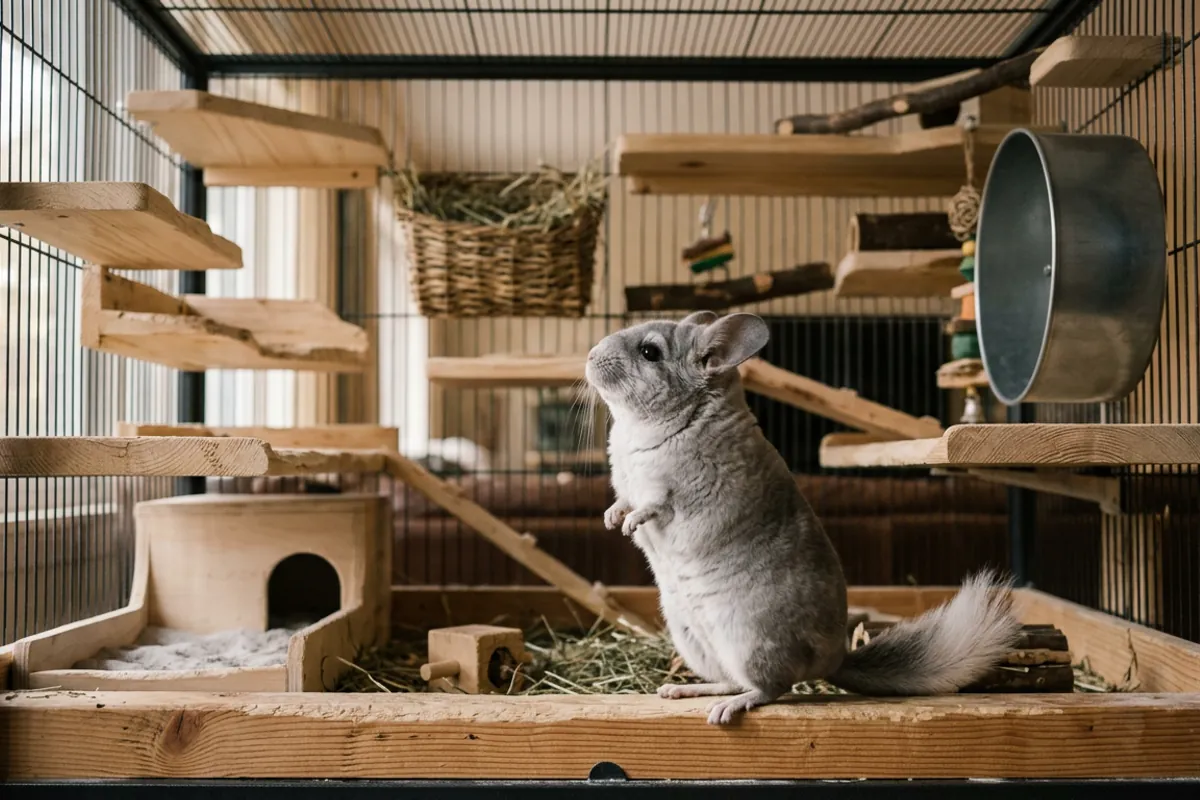
The thing to hold onto is that floor footprint and height do different jobs, and a big cage needs both. Two chinchillas need more than one, not because the math is exact but because they each need room to get away from the other. When people ask me how to make a chinchilla cage big enough, my answer is that you almost never regret going one size up, and you frequently regret going one size down. Buy for the animal you have for the next fifteen years, not the small ball of fur in the shop today. For the sizing side in more detail, I go deeper in how to choose a large chinchilla cage that actually fits the animal.
Height is the part people skip
People shop for a big cage and picture a wide one. They picture floor. But a chinchilla reads a cage vertically first. In the wild these animals live on rock faces and scramble up and along them, and a tall enclosure with ledges at staggered heights gives them back that instinct. A cage that is all floor and no climb wastes half of what makes a chinchilla a chinchilla.
So when I judge whether a cage is genuinely big, I look up, not just across. I want room for at least a few solid wooden ledges set at different levels, spaced so the animal can hop from one to the next without a straight drop the full height of the cage. That last part matters as they age. A young chinchilla will bounce off anything, but an older one with stiffer joints can hurt itself on a bad landing, so I stagger the ledges so no fall is ever the whole height at once. Kiln-dried pine or apple wood ledges are what I use, screwed in from outside, never plastic shelves and never bare wire mesh underfoot. A tall, well-laddered cage turns vertical space into exercise instead of a hazard.
Bar spacing, metal, and the details that keep big safe
A cage being big does you no good if the animal can get hurt on it, and the first place that goes wrong is bar spacing. For a chinchilla you want horizontal or vertical bars no more than about 1 inch (2.5 cm) apart, and closer to half an inch if you have a kit or a small youngster, because a head that fits between bars is a head that can get stuck. Wide bars on a large cage are a common trap, since some big enclosures are actually sold for ferrets or birds.
The whole cage should be metal, ideally powder-coated wire on a metal or removable tray base, not plastic. Chinchillas chew, constantly and by design, and plastic is not a material you want passing through a chinchilla. It can splinter, it can be swallowed, and it does nothing good in a gut built for hay. I have written the full reasoning in why a chinchilla cage has to be metal, and how to fit it out, but the short version is that metal and wood are the only two materials that belong in there. If your big cage comes with a plastic pan or plastic ramps, swap them. A metal wire and wood chinchilla cage built the right way will outlast several plastic ones anyway. Critter Nation double unit small animal cage As an Amazon Associate I earn from qualifying purchases. Solid metal ramps or wooden ledges beat wire shelving, which can catch and injure a foot.
Fitting out a big cage so the space gets used
A big empty cage is just a big empty cage. The point of the space is to fill it with things that earn their place, then leave room to move between them. Start with the wheel, because a chinchilla needs to run and the floor alone will not give enough of it. It has to be a solid running surface, never wire or mesh rungs, which catch toes and break legs. A large solid-surface wheel is one of the few pieces I would call non-negotiable in a big cage. 15 inch Chin Spin solid surface chinchilla wheel As an Amazon Associate I earn from qualifying purchases. I go into sizing and why the surface matters in what a chinchilla on a wheel really needs to run safely.
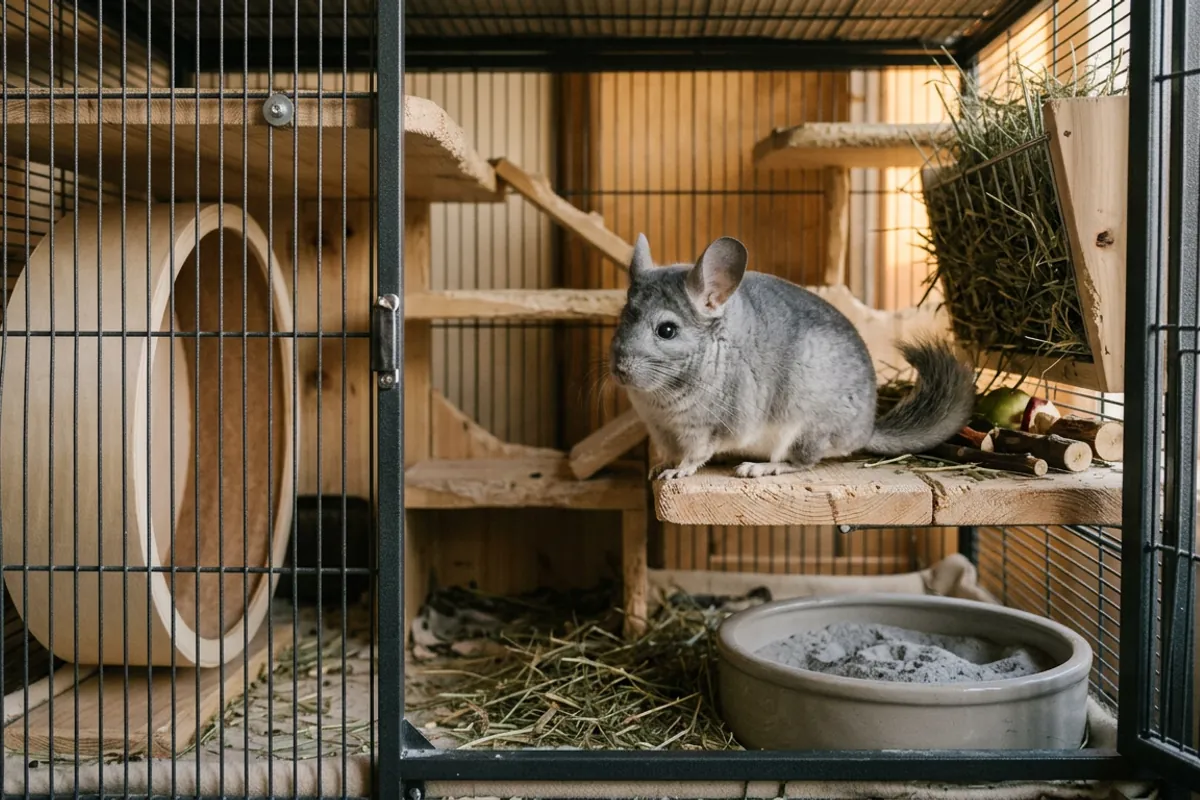
Then hay, always, and lots of it. Unlimited grass hay is the whole base of a chinchilla's diet, not a side dish, and a big cage should have a generous hay source the animal can reach from more than one perch. I keep timothy on hand constantly. Oxbow Western Timothy Hay, 40 oz bag As an Amazon Associate I earn from qualifying purchases. Juniper, my rescue with dental disease, is the reason I never let hay run low, because the chewing is what keeps teeth worn down, and teeth are where chinchilla health quietly goes wrong. Alongside hay I keep a rotating set of safe wooden chews so there is always something better than the bars to gnaw. emours apple wood chew sticks, 40 count As an Amazon Associate I earn from qualifying purchases. A dust bath goes in a few times a week, in fine volcanic dust and never water, and a big cage has the room to offer it in a heavy container the animal cannot tip. Lixit Blue Beauty chinchilla dust, 3 lb As an Amazon Associate I earn from qualifying purchases. Add a wooden hide or two, and you have a cage that is full without being cramped.
Heat does not care how big the cage is
This is the part I refuse to soften, because it is the part that nearly cost me Pebble. A big cage does not cool itself. Space gives an animal room to move away from a warm spot, but it does nothing about the temperature of the room, and heat is the fastest way to lose a chinchilla. Their dense fur, the very thing that makes them beautiful, traps heat, and they cannot pant or sweat their way out of trouble the way we can.
The comfortable range is 60 to 70°F (15 to 21°C). Above about 75°F (24°C) you are into risky territory, and 80°F (27°C) and up is an emergency, faster still in humid air. Put a combined thermometer and hygrometer on or near the cage and actually read it, because guessing the temperature of a room is how people miss the danger. digital thermometer and humidity gauge with remote probes As an Amazon Associate I earn from qualifying purchases. A chewable cooling stone gives the animal a cold surface to lie against on a warm day, though it is a comfort measure, not a fix for a hot room. Kaytee Chinchilla Chiller granite stone As an Amazon Associate I earn from qualifying purchases. The real answer to heat is cooling the room itself. I keep the whole picture, including the warning signs, in chinchilla heat safety, and there is a chinchilla heat danger calculator if you want to check your own numbers.
Keeping a big cage clean without it becoming a chore
The honest downside of a big cage is that there is more of it to clean, and a filthy cage undoes every good thing the size bought you. The trick is a routine that does not depend on willpower. I line the solid ledges and the tray so the mess sits on something I can lift out, spot clean the obvious places every day or two, and do one proper strip-down and wipe about once a week. Ammonia from stale urine is bad for those sensitive lungs, so the deep clean is not optional, big cage or not.
A removable metal tray is worth its weight here, because it slides out and lets you clear the whole floor at once instead of reaching through bars. Use a chinchilla-safe bedding like kiln-dried pine shavings or paper-based bedding, never cedar, which gives off oils that are rough on the airway. The bigger the cage, the more this pays off, because a good layout means you are wiping ledges and swapping a tray, not disassembling furniture every week. I walk through the whole rhythm in how to keep a clean chinchilla cage without it becoming a chore.
Buying a big cage, new, used, or the double-unit route
When people ask me what to actually buy, I point them at the double-unit style cages first, because they solve the height and floor problem in one purchase and are built from metal on a rolling frame. The popular one keepers reach for is the double Critter Nation, and I have written honestly about where it fits and where it falls short in is the Critter Nation cage right for a chinchilla. Out of the box these cages have wide-spaced shelf grates and a plastic-edged pan, so plan on adding wooden ledges and covering or replacing the shelving before the animal moves in.
Used is genuinely worth considering for a big cage, because the metal lasts and a second-hand frame at half price frees up money for the fit-out. Check for rust, chewed plastic parts, and bent bars, and scrub the whole thing before use. What I would not do is buy a too-small cage now and promise yourself the chinchilla cage big enough for it will come later, because later has a way of not arriving, and the animal lives in the meantime. Buy the space once, fit it out properly, and you have solved housing for the life of the animal. If you want the shopping side laid out in full, start with how to pick the best chinchilla cage without buying the wrong one twice.